


5,00 €
Mehr erfahren.
- Herausgeber: Stefano Orlando Puracchio
- Kategorie: Lebensstil
- Sprache: Englisch
A handbook for Progressive Rock (Version 1.2.1). “My new book could be the perfect guide for girlfriends, wives, or friends of any progressive rock enthusiast... it's not mainly for the prog rock expert, but rather people whose curiosity is piqued by this “genre” and who have never examined it further, thinking that it was “complicated stuff”. With my guide I try to give the reader a possible way of interpreting this genre. Hence the subtitle “A handbook” instead of “THE handbook”. Of course, the book is also for the normal “audience” of prog rock, those hardcore aficionados”. Stefano Orlando Puracchio presents his book Progressive Rock. A handbook with clarity and irony. It's a kind of introduction to this phenomenon which provides a clear point of view, and open mind to new interpretations, given by some of the “genre's” main players, especially Italian and English musicians.
Das E-Book können Sie in Legimi-Apps oder einer beliebigen App lesen, die das folgende Format unterstützen:
Veröffentlichungsjahr: 2014
Ähnliche

















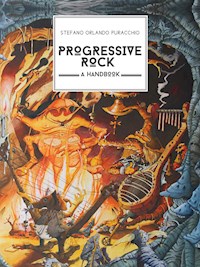
STEFANO ORLANDO PURACCHIO
PROGRESSIVE ROCK - A HANDBOOK
Cover image copyright: Peet Ellison
Progressive rock
Stefano Orlando Puracchio
Edizione digitale: marzo 2014
ISBN: 9788890927119
Edizione digitale realizzata da Simplicissimus Book Farm srl
Index
PART ONE
1. Preface
2. Introduction (and premise)
3. What is Progressive Rock?
a) The genre definition and a possible definition of meta-genre
b) The “limits” of Progressive Rock
c) The term “Progressive”
d) Brief (and approximate) genesis and history of prog
d.I) Frank Zappa
d.II) Vanilla Fudge’s experience
d.III) Procol Harum, Moody Blues and Nice
d.IV) From the Court of the Crimson King…
d.V) …to the animal farm
d.VI) What’s after
PART TWO
4. Listening guide
a) Musicology basics
b) Two different types of listening
b.I) Sensory Listening
b.II) Analytical Listening
5. The Albums
- Soft Machine: Third
- King Crimson: Islands
- Caravan: In the Land of Grey and Pink
- Osanna: L’uomo
- Gentle Giant: Acquiring the Taste
- Gentle Giant: Three Friends
- New Trolls: Concerto Grosso per i New Trolls
- Emerson, Lake & Palmer: Tarkus
- Pink Floyd: Meddle
- Pink Floyd: Dark Side of the Moon
- Van Der Graaf Generator: Pawn Hearts
- Focus: Moving Waves
- Raccomandata Ricevuta Ritorno: Per… un Mondo di Cristallo
- Banco del Mutuo Soccorso: Banco del Mutuo Soccorso
- Jethro Tull: Thick as a Brick
- Ian Anderson: Thick as a Brick #2
- Quella Vecchia Locanda: Quella Vecchia Locanda
- Balletto di Bronzo: YS
- YES: Close to the Edge
- Alan Sorrenti: Aria
- The Trip: Atlantide
- Rovescio della Medaglia: Contaminazione
- Genesis: Selling England by the Pound
- Premiata Forneria Marconi: Photos of Ghosts
- Camel: Camel
- Metamorfosi: Inferno
- Le Orme: Felona e Sorona
- Hatfield and the North: Hatfield and the North
- Hatfield and the North: Rotter’s Club
6. Appendix: a look at Hungarian Prog Rock
- Omega: 200 Years After the Last War
- Solaris: Marsbéli Krònikàk
7. Essential Bibliography
8. Acknowledgements
9. Afterword
PART ONE
1. Preface
When they ask me what “Prog” is, for some reason my mind is flooded with all those sensations and images that I felt and lived at the end of the 60’s in a popular and noisy Rome made of Trastevere alleys or extreme and dangerous suburbs. No one called it Progressive Rock then, even if all these “youngsters” were different from their older brothers and fathers in their new way of looking at life, as if curious about all that was going on, musically speaking, on the other side of the Channel and the Ocean.
As for me, I was able to barely escape the tether of a Pier-Paolo-Pasolini-like suburb by enrolling at the Artistic Liceo of Rome, which allowed me to start looking at the world from a different angle, far different from that of a person who associates with neighbourhood bullies, small time criminals and that of a submissive world, full of humanity.
Back then new rock music was born and was played in the suburbs. It was rare to have musicians that were part of the upper middle class, almost never from the aristocracy.
About a year or two before the “progressive avalanche” arrived, young Roman musicians were hard at work in the 15th century cantinas in the centre of Rome, which probably never thought they would be home to 100 watt Marshall amplifiers or see all those young people with long hair and shifting velvet clothes. There was a strange bond between the nights spent by those colourful kids occupying the staircases, the monuments and fountains of Rome, and Rome herself, who looked upon them as if in wonder, with benevolence, always wanting to be a part of the scene but resigned to being the backdrop of their new found love.
We would look a everything that came from the lands of Albion, musically and fashion-wise, and we began to cover the new music.
Rome, at night, silent and solitary, welcomed the notes of King Crimson, Van der Graaf Generator, the dark atmospheres of Arthur Brown and once again the Universal City was busy looking for new languages and secretly absorbing and conveying them.
All of a sudden “Italian Pop” exploded. All those very young musicians that had grown up on English music, found a completely personal way of expressing themselves, and, as if someone had paved the way, it was very easy to record albums, perform concerts, festivals and tour.
Basically, we were twenty and life was just beginning… and how beautiful it was!
Luciano Regoli
(Raccomandata con Ricevuta di Ritorno Band)
Elba Island, July 2013
2. Introduction (and premise)
Rock progresses […]. Rock grows, becomes amplified. It understands that it can “go where no man has gone before”, as Star Trek’s Kirk says. It stretches to territories where it didn’t even imagine it could reach. I’m speaking about culture, “high” music, educated music, classical music, jazz. Where, for better or worse, the beat, the Rolling Stones or others haven’t yet dared to go […]
– Ernesto Assante, journalist and music critic
This electronic (or electric) book is intended to be a sort of handbook for progressive rock. What drove me to write this book (with the supervision of my good friend Simone Minelli)? A series of reasons that I’ll try to illustrate. More often than not, as I speak with friends and acquaintances about progressive rock, I’ve been told: “I don’t dislike prog but it’s too complicated”; or: “I enjoy something but the sheer mass of material and information is intimidating”.
Yep… the sheer mass of information. Every time I hear that particular phrase I have to keep from laughing, almost bitterly. I started listening (seriously) to music 20 years ago. My first store-bought album (which I obtained by selling a part of my comic book collection) was “Freak Out” by Frank Zappa. At the time, Internet hadn’t shed its sci-fi cloak to slowly enter into everyone’s home. Finding information about “non commercial” artists was still a difficult endeavour. Actually, let’s face it: it was outright audacious! There was no Wikipedia, no Google, and most of all, no You Tube. The only sure way to get information was to buy the albums and start an attentive “vivisection” reading of the booklets. The liner notes were a gripping read, almost like reading Salgari or a Mark Twain book. The covers of the Albums (the cover illustrations or photos) were an evocative passport to new fantastic worlds. They were second, as they should be, only to the music contained in those LP’s or CD’s. This deductive method was widely used, especially in analysing the differences between various albums.
Another method was to purchase specialized books. Basically, 20 years ago if you wanted to find something you had to go to whatever little you could find on the market. For a price, of course. By listening, meeting someone more learned than you or reading, you have your confirmation or you could correct your ideas.
Today we’re in a very different situation. The internet is a real cornucopia where you can find everything. For those whose interest in music began like mine did, the Net offers all that there is to find. We have basically gone from having very little, to almost too much.
If it is true on one hand that internet has allowed more people to become interested in almost extinct or niche musical genres and has allowed the creation of somewhat virtual relationships between listeners, it hasn’t – in fact – guaranteed true feats. In brief: many people, although interested, do not possess the right tools to access all that is available. Perhaps (this is more probable) they tend to lose themselves in the huge sea of information. I could use at this point a very strange term: information overload. I could even say that we are virtually experts of everything and nothing at the same time, Though this would be more misleading than necessary at this time.
Suffice it to say that this handbook on progressive rock aims to try to offer a possible series of reading tools to all those people that want to get into this beautiful and image-evoking (meta)genre. A book for those people who always gave up, believing that the “progressive” task was too hard. The Italian writer Luciano De Crescenzo says that his educational books on the history of Philosophy are like the stepping ladders, in a library, help you to reach the books that are higher up, the more difficult ones. My objective, with this guide, is basically the same.
The book is divided in two parts. In the first part I will dwell on what progressive rock is in general. I’ll explain what is and isn’t prog, I’ll refer you to the necessary historical notes and I’ll show you what some of the more important musicians associated with this musical (meta)genre think of progressive rock.
The second part is a critical analysis of some thirty albums that I believe to be crucial. Obtaining these albums is very simple, except in a few cases that will be noted. Also, an important detail, the re-printing of the CD’s, as well as the electronic versions of the albums are very cheap in most cases. It highly suggested that you listen to the albums and songs mentioned as you read this book.
As I said before, this book is a handbook. It does not aim to describe Progressive Rock in every detail. For a deeper analysis I suggest you refer to the volumes I made precious use of, which will be listed in the book and/or the bibliography. Consequently, the picture I will paint you will be made up of very decisive strokes. You won’t find colours like “Raw Sienna”, or “Burnt Sienna”: there will only be “Brown”. No “Baby Blue” or “Sky Blue”: just “Blue”. I won’t act like the painter I’m not: I’m a brick layer, who also dabbles in painting. Also, since I am a bricklayer, you’ll notice that my writing style will be, except in few cases, mostly informal and colloquial.
The book is dedicated to the memory of a great Prog Rock expert, called Lajos (Lewis). It was he who spoke to me abundantly about Progressive Rock for the first time. I still symbolically remember something he told me: “head for Pink Floyd”. In this book I didn’t head only to the Pink Floyd sound. However, if I can get someone who wanted to know a bit more about Prog Rock cry out for joy, I certainly will have achieved my goal. A last note for the supporters of “first hour” prog rock: if you don’t find the name of your favourite group in this book, please don’t be disappointed. I take prime responsibility for this. Also, some approximations might make your skin crawl. However, please think: the more people get interested in Prog Rock, the more it’ll be possible to see new material on the market.
There’s always time to fine tune: the important part is to begin.
S.O.P.
A word about the translation:
All the material of the various artists or people interviewed written in this book has been taken from its original English or Italian source. The only exception to this are the words of Keith Emerson and Glenn Gould, which were taken from the Italian editions of their respective publications and translated back into English. The sense remains unchanged. The reason for this is that their books were either unavailable or prohibitively expensive.
3. What is Progressive Rock?
a) The genre definition and a possible definition of meta-genre
Progressive Rock is a rock that frees itself of its chains. I mean, that escapes the traditional schemes that are derived from Blues: certain types of chords, a certain sound. Suddenly, the opening towards classical music, is the act of freeing itself from those chains.
-Vittorio de Scalzi (New Trolls)
Let’s start right away by saying that, with Prog, we are faced with a kind of chimera. A nice chimera mind you. Nice and aesthetically pleasing. For those who have not studied any classical mythology, a chimera is a fantastical beast, made up of many different animal parts.
While a chimera is an ugly beast indeed, evil and dirty (and luckily it doesn’t exist), the prog chimera is a real, well done mix and innovative at the same time. Normally it wouldn’t be correct to talk about chimeras, manticores or similar beasts but more aptly about a concept with a difficult name: the meta-genre. Progressive rock can be considered a musical meta-genre.
What does meta-genre mean? Genres are logical groupings that help us to select and catalogue information. In practical terms, to help us understand what we are talking about. The are used to make understanding things easier and to organize things in a simple way (and sometimes, unfortunately, in a simplistic way).
If for example I say “an apple is a fruit”, your mind, in this moment, will catalogue the received information by putting apples in with pears, bananas and oranges. The apple and the orange, even though different, are part of the fruit “family”. They are a genre (or type) of fruit.
In the music field (our fruit, if you will), we have different musical genres (Blues, Jazz, Rock, Folk, etc.). Every genre denotes a particular sound, certain instruments used, precise tempos and, therefore, more specialized players in determined actions as compared to others.
Is it possible to explain the differences between different settings? I asked Simone Minelli, professor of Musical Education, guitar player and Progressive fan. “If we were to play in a Blues group”, says Minelli, “we would deal with musicians that use acoustic instruments (at most a valve amplifier for the guitar) whereas if we were in a hardcore metal band we would find hard distorted guitar solos accompanied by extreme drum performances with double pumped up bass drums and heavy bass”. In any event, as with our apples and oranges, even though the two forms of music are different, we’re still talking about music.
Sometimes, a composer can decide to mix two genres. That’s what we then call a hybridization of genres. Some of the traits of the two genres are combined to create something new. this is the case of Jazz-Rock, or, going back to our fruit, the Clementine orange (mandarin + orange).
I asked Antonio Perri, Professor of General Linguistics at the University of Suor Orsola Benincasa of Naples, for his opinion on the matter. “I completely agree”, says Perri, “on the possible definition of categories like jazz-rock as hybrid. I remember, also, that in the 80’s we spoke also of fusion – for cases like jazz-pop, like Spyro Gyra for example”.
For there to be an acceptable fusion, of course, the elements taken from the two genres have to co-exist well with each other and not clash. This is the reason why Clementine oranges are delicious while a hybrid between an orange and a carob could not be that appreciated.
Progressive Rock, as opposed to the simple hybrid, pushes itself ahead in musical research. This is not only two genres that are fused with their more adaptable parts. In prog, on top of a rock base (and classical in most cases) the most varied elements are grafted, all taken from different musical genres. In prog there are no real limits as far as choice and the quantity of the grafts.
Perri: “Prog is a genre that obeys its own concept (and it’s no coincidence that many records of prog groups in the 70’s are concept albums)”. “Now”, Perri continues, “without doubt in a prog record from time to time you can identify the different genres or grafted currents (think of western music in the opening of “Atom heart mother” by Pink Floyd) but the fusion process is much more complex and aimed to obtain a completely different effect of sense. I believe therefore that we can correctly say that it is a genre that ‘speaks’ with its own idiom, about other genres (therefore ameta-genre)”.
Is it then correct to speak of a musical meta-genre? Yes and no. Yes because, once we absorb the concept, the examination of any product of progressive rock can be much simpler. However, we need to note that not everyone agrees with this vision. Professor Daniel Müllensiefen – Music Psychologist at Goldsmiths University in London, for example, is more prone to seeing prog as a sort of multi-hybrid instead of a meta-genre. “I agree, the hybridization of several styles is probably one important defining feature of prog rock”, says Müllensiefen. But the Professor adds, “I would be cautious to introduce the category ‘meta-genre’”. “Yes, prog rock bands created a novel musical style and sounds back then”, he continues. “But of course they had to reuse older and existing material. It is extremely hard to create something completely novel without borrowing from earlier material. Music that is completely new usually doesn’t appeal to a great audience”.
Whether you see it as a meta-genre or a multi-hybrid, we are facing something new as far as composing goes. The ability and the novelty brought by the progressive composer is in making seemingly incompatible traditions and sounds co-exist together. He creates a product that, in the end is artistically and aesthetically valid.
That was exactly what we wanted to do… I mean having languages meet and merge to produce one that was then pleasing and new. The research was exactly in that.
Enrico Olivieri (Metamorfosi)
A mission that, as we’ll see later, especially in the second part of the book, worked perfectly. As we mentioned, classical music, but not only that, as Franz Di Cioccio (PFM) told us:
There were other influences that contributed to ensure that this music grew and became one of the preferred languages of musicians. Classical music made a big contribution because the keyboard, the piano gave a big incentive as far as research goes. Instruments came out that allowed the piano to be taken on stage, at live concerts. From there the moog was born, which is a monophonic instrument that synthesized sounds and allowed a certain use of classical languages, with instruments like the woods, the bassoons and the flutes. The mellotron, which even gave a taste of orchestra and orchestration. Not to mention the Hammond organ, which had a wide distribution and the acoustic piano through the Fender piano, very famous. The Yamaha piano… and so the keyboard gave an impulse to the evolution of classical music because classical music could be used by the rock groups at the time.
Let’s not forget though that every group had a more of an inspired baggage, rather than derived. In progressive musics improvisation was done by reading the same key that jazz players used. PFM, at least, does it like that. PFM has an entrance and exit. In between it improvises, giving itself themes and developing improvisational themes. This is the language. On the other hand there’s a language, typical of its original place, in which every group has a particular artistic ability. We have taken from popular music innervating rock with the classic themes of the pizzica, tarantella or the madrigals of medieval music. Other groups did this as well in England, they used often Scottish ballads, Irish ballads… we read that Jethro Tull, for example used many styles of popular music. So it became a kind of melting pot where there were many influences and everything became a diversified and creative language.
b) The “limits” of Progressive Rock
Someone may ask: “But are there any rules? Tracks to follow? There must be some limits”. Whether we see prog as a meta-genre or a maxi-hybrid, the two images are as intriguing as they are uncertain. And, even if we never abandon the idea of the “Melting Pot”, it will be repositioned inside something more “digestible”. Let’s rationalize. To do that, we will entrust ourselves to the words of Cesare Rizzi, Rock encyclopedist. In his big book “Progressive & Underground”, he sums up in a complete manner what the characteristics of progressive rock are.
“The fundamental elements of prog”, says Rizzi, “are basically three: the suite (which is to say the extended song, made of many linked movements), keyboard use, to the detriment of the guitar (which, let’s not forget, was the main instrument of rock & roll), committed lyrics, cultured, better if inspired by literature, not necessarily comprehensible”.
Thanks to the words of Franz Di Cioccio we have already seen the importance of the keyboard in prog. The passage from guitar to keyboard as the dominant instrument opens new interesting possibilities for the composer. Regarding the lyrics, we’ll open and close a parenthesis. Except for in specific cases, the lyrics of prog songs prefer to wander from our reality to go and position themselves in words far away (or better yet, different) from our own. Prog lyrics make use of images taken from fiction in general and in particular from mythology or from fantasy, from fairy tales, from nursery rhymes and from science-fiction. Often they use these highly evocative images (image-evoking) as a vehicle to better talk about the condition of man: of the great problems that men have to face, of their expectations, their fears. An analysis that is often timeless and without location because, in the end, big problems and big questions have always been the same thing, regardless of century, method, or in our case, “world” (fictitious, real or mediated) in which one lives. The lyrics, even though important, are not the focus of this book. The true innovation of prog is not so much in the poetry or lyrical poetry, but in the music and in particular, in the different structure in the “construction” of a song.
We need to give, therefore, more importance to the suite. Not only because – in substance – it’s the first element, the most important of prog, but mostly because it’s in prog that the concept of meta-genre flows so it’s strongly linked to that of the suite. We read that Rizzi defines the suite as: “an extended song in many linked movements”. What does it mean? To answer that we need to consider two factors: duration and song assembly technique.
Duration, in our case, means that the piece is longer than three minutes. A prog song is something that doesn’t coincide with the songs that are defined as “song form” or, if you will, “standard” or “radio song”. Generally the songs on the radio last around three minutes. There is an historic reason behind the “three minutes per bit”. In the past, the old 78 records lasted at most three minutes. Consequently, a composer had to stop after three minutes. This technical limitation was then raised to four minutes with the advent of the 45. However, even today, a r [...]




