


4,00 €
Mehr erfahren.
- Herausgeber: Stefano Orlando Puracchio
- Kategorie: Lebensstil
- Sprache: Englisch
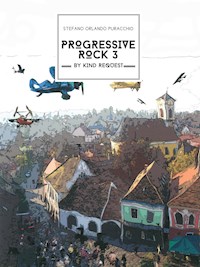
By kind request. It is a year since the well-received book Progressive Rock 2. Boundary Lines. Journalist Stefano Orlando Puracchio is back with his new book Progressive Rock 3 By Kind Request. The title alones indicates a great response and an awaited comeback. Thanks to the excellent feedback from readers and specialised journalists, but also thanks to the increasingly firm certainty of the reasons of Self-Publishing, as well as the need to draw conclusions after two volumes of interviews and reflections, Puracchio has decided to tackle the phenomenon of progressive once again, with his diverse and stimulating approach. More than an analytical essay or a scientific treatise, Puracchio envisages his work yet again as a sort of “jumble” of interviews, thematic essays and reflections on the past, present and future of prog-rock. (Version 1.5)
Das E-Book können Sie in Legimi-Apps oder einer beliebigen App lesen, die das folgende Format unterstützen:
Veröffentlichungsjahr: 2016
Ähnliche

















Stefano Orlando Puracchio
Progressive Rock 3
Cover image by Bihon Győző.
For more information on the book series and other activities:
www.progressiverock.info
Index
Preface
Introduction: Trying not to end up like the Miller
Telegrams
The Mother of all Boundary Lines
Is Prog exempt from the value (or non-value) of the trademark?
The man who went beyond the imagination
Rediscovering the Jungle
Bombook
4.6 Athos and the Future
Pendragon
Il Cerchio d’Oro
Magma
Contemporaneity
VIII Strada
Palepolitana
Marchesi Scamorza
Hungary
Histoire d’un producteur (de disques)
After Crying
Varga János – EAST and afterwards
Poseidon talks with Cynthia in a Lighthouse (by Donato Zoppo)
Progressive Metal (by Valentina Tomassetti)
The Art that illustrates the Genre (by Sadhbh de Barra)
Germany
German Progressive Rock in the 1970s (by Miklós Attila)
Interview with Christian Burchard
Epilogue: MAV Heroes Temporis
Bibliography and Acknowledgements
Bibliography
Acknowledgements
Appendix: A Chat with Unreal City
“[...] ma sopra tutto nel buon vino ho fede
e credo che sia salvo chi gli crede.”
[... but above all I have faith in good wine
and deem that he who believes in it is saved.]
(Luigi Pulci – Morgante)
“S láttam én csárdákban tisztább szíveket már,
Mint kit naponként lát térdelni az oltár.”
[And purer hearts within a tavern I’ve known,
than some who daily kneel before God’s throne.]
(Petőfi Sándor – A Csárda Romjai)
“Beati i critici e gli esegeti di questa mia canzone.”
[Blessed are the critics and commentators of this my song.]
(Rino Gaetano – Le Beatitudini)
Anne Marie Jacquet: “I don’t understand though. It isn’t clear”.
Sasha Grossman: “Clear? Nothing ever clear”. [...] “You ask me words. But words betray. Words dirty. Only music still beautiful”.
(Dialogue from the film: “The Concert” by Radu Mihăileanu)
Preface
I am always surprised when young people – those who have not yet lived or perhaps who were born when progressive rock was in its heyday – speak like great experts about the history of this wonderful music and secrets of the profession. SOP is one of these young people.
I met him a few years ago and his dedication towards my beloved progressive rock is exemplary. In cases like this, I see that my work has not been in vain, because even today there are true followers of prog rock.
This is the third volume about prog rock and I enjoyed reading every line. We Central- and Eastern European prog rock musicians are next in line. We are the true prog rock crusaders. We have always been stepchildren of rock music, but we have always persisted in what we loved doing and the music was good. So this is why I highly regard SOP’s brilliant publication, which he has written and edited with the same passion.
I would like to thank him on behalf of my contemporaries and for my part, I hereby dub thee a respected crusader of prog rock!
Török Ádám
Introduction: Trying not to end up like the Miller
To what extent is it wise for a person to follow the advice of others over the course of their life? In order to answer this question, let’s start with a story, which tradition attributes to Jean de la Fontaine. I have adjusted it a bit but the sense stays the same.
“The miller and his donkey”, this is the title of the story, which features a miller who decides to sell his donkey at the market in order to make some money. So he leaves his modest house with his son and the donkey to be sold. Along the road, they meet a group of girls almost immediately. One of them says to the miller: “Why don’t you ride the donkey? Isn’t that why he’s there?” The miller thinks it over and decides that this might not be a bad idea. He mounts the donkey and they continue on their way.
After a short while, they pass by a group of washerwomen. One of them sees the miller on top of the donkey and esclaims: “Shame on this father! He is riding the donkey like a sultan and the poor son has to walk.” The miller, who loves his son, gets down from the donkey and gets him to mount instead. They continue to walk calmly. But not for long.
Passing in front of a tavern, two old men who were intent on drinking and playing cards notice them. One says to the other: “I never thought that I would live long enough to see a brazen son mount the donkey while the poor old father walks on foot. Ah! The youth of today!” The miller, still undecided, decides to mount the donkey as well.
Do you think it finishes here? No. Because while, they continue trotting on their way, a peasant leaning against a wall calls out to them: “Where are you going?”
“We’re going to the market to sell the donkey”, says the miller.
“Is that so?” replies the peasant. “There is still a long way to go before arriving at the market. If you go on with both of you on the donkey, that beast will arrive half-dead from exhaustion.” The miller agrees that this is good advice. So he says to his son: “Let’s get down at once. We have to let the donkey rest. That way we will be able to sell him for a good price.”
The peasant chuckles to himself as he watches the miller and his son get a trunk and ropes, which they use to ties the donkey’s hooves. Then with one of them at either end of the pole, they start laboriously transporting the beast. The best route to the market is by crossing a bridge over a river. The bridge is full of people hastily making their way to the market. Upon seeing the miller and his son staggering under the weight of the donkey, everyone stops and laughs. “They’re carrying the donkey instead of making him carry them! Have you ever seen anyone more stupid than they?”
The donkey, who has been calm up to this point, takes fright when he hears these shouts. The ropes binding him become loose and the donkey, now free, takes a leap from the bridge into the water, where he swims towards the sea, braying all the way, never to be found again.
The disconsolate miller sits down on the ground. “All day I tried doing what other people were telling me. Now people are laughing at me and I no longer have any donkey to sell. If I had done things in my own way from the beginning, things would have ended differently.”
This book is subtitled: “By Kind Request”. It completes the trilogy that began with “Progressive Rock – A Handbook”. When reading, you will find almost every suggestion, request and recommendation that readers and critics have communicated over the years.
Following advice is normally a good thing. Whoever listens to the advice of others asks themselves: “Am I perhaps making a mistake? Perhaps there is another way to deal with this particular issue.” It is always good to come to terms with your own pride (in the sense of arrogance) and try to adopt a humble approach as much as possible.
The important thing, however, is to follow advice using reason. In the simplest terms: “Listen to the heart but accertain the facts”. In other words, you have to know how to discern between constructive criticism that would benefit your actions and criticism that consists only of disorientating noise. Suggestions can also conflict with each other.
On that note, the most wonderful thing for me was when I received a double conflicting criticism in these past few months. One person maintained that my first book was a sort of masterpiece while the second person thought it was a disastrous step backwards. Another person said the opposite: the first book was a sterile exercise while the second book was better. In this case, is it right to follow their advice? If you don’t want to end up like the miller – in other words, the fool – I would say not.
Both of the criticisms, although different, stem from the same error. “Progressive Rock – A Handbook” is the main book, the one on which I worked the hardest and that has the merit of combining my personal thoughts with the comments of musicians who have created the history of this “meta” genre. “Progessive Rock 2 – Boundary Lines” and “Progessive Rock 3 – By Kind Request” are outlines of the first book that can also be appreciated individually. It is therefore impossible to compare Book 1 with Book 2 and Book 3. The second and the third books have their own raison d’être because of the first book. Therefore, in a joking tone I might add, I would go as far as to say that: “the first book is a masterpiece while the second book, which complements the masterpiece, is slightly better. I cannot yet form an opinion about the third book”.
In any case, all irony aside, I was very happy to have been able to satisfy most of the needs of my readers. I have even dedicated some chapters to colleagues and friends whom I thought more capable of discussing certain subjects than myself. But it was not a simple "external contract”. I think it is right in a situation like this to take a step forward, going in a different dimension.
For the sake of making a comparison, Book 1, Book 2 and Book 3 are like three fathers. The first one says to his son: “mind you don’t fall”. The second: “walk but be careful”. The third: “run... go... go”. At this point in time, we find ourselves between the second and third fathers. When you get as far as the essays by Donato, Sadhbh and Attila, I will transform into the third father. Just to clarify: the themes that they discuss (Donato, Sadhbh and Attila, not the three fathers!) are ones that I have “left aside”, so to say, in order to facilitate the flow of the plot. On the other hand, they were topics that merited some attention, also because this would conclude this easy-to-read trilogy. Regarding the chapter on Progressive Metal, “entrusted” to Valentina Tomassetti, one thing has to be made clear. One person asked me why I had not touched on the topic of “Metal”. Now, if I give my book series the title of “Progressive Rock”, it could be that I want to talk about Progressive “Rock” and not Progressive “Metal”. But since this “small” nuance seems not to have sunk in, there’s no problem. We have also added Metal. “Your wish is my command”, as the genies in books and cartoons say.
Two more things. The first is that the style remains the same as in the previous books: using simplified language but with some energy. With more or less obvious references to the style of Luciano De Crescenzo and Gonzo Journalism. If it does not appeal to anyone, let them justify themselves. As Caravan say in their recent song: “This is What We Are”.
I firmly believe that the only way to spread progressive, or more simply, good music, is to use simplified language. This is done by finding the right balance between simple speech and not making the themes trivial. Sometimes we manage and other times we don’t. The cultural situation nowadays is not the best. However, before pointing fingers at mass communication and a society of consumerists, we would have to perform a thorough cleaning of cultural élites. Because if Prog became fashionable again at some point, the consumerist society would offer Prog and not (I will be very gentle) singing frogs with proposterous hairstyles. Therefore, society is not at fault in a strict sense, but rather the closed and sectarian élites, which prevent a healthy spread of culture. We can beat around the bush for as long as we like, but this is how it is. Spreading culture means many things, including the circulation of ideas, money and, especially, happiness. Let’s all get down from our high horses and face the people. In fact, let us burn our pride, so that we can use the embers to grill some nice meat (or vegetables, if you’re vegetarian). In the 1970s, many people listened to high music. This means that it is possible to go back to this pomp and splendour. It isn’t utopia, it’s enough to want it. I repeat and emphasise: it’s enough to want it. If certain levels were reached, it means that these peaks may still be reached.
The second and final thing, which I do not even think is needed. I am forced to write you a quick guide to reading the book. If the paragraph is in “quotation marks” or in italics, it is most likely that I am quoting someone. In any other case, I am the one speaking. Furthermore, unless I specify otherwise, I am the one who conducted all of the interviews. I apologise if these clarifications appear trivial to some people. However, quoting Sherlock Holmes (and therefore Sir Arthur Conan Doyle): “There is nothing more deceptive than an obvious fact”. There may be someone who has not adapted to this style. And to think that I even had the scruple of putting the interviews in italics so that no one could say that they could not distinguish the opinions of others from my own... Miller! Miller! Wait, I will help you carry the donkey!
Thank you and enjoy the book.
SOP
Telegrams
These “telegrams” are a series of small segments that for several reasons have not been made into chapters. It could be because, in a shortened version, they were more balanced and served the purpose. It could be because they are “only” fancy additions to complement topics discussed in previous publications. Steady as she goes.
The Mother of all Boundary Lines
I was speaking with some companions immediately after the publication of my second book, “Boundary Lines”, when an interesting topic came up. That is: “is there a mother of all boundary lines?” The Supreme boundary line? A band or situation that effectively marks the divide between Prog and the rest of the musical world?
It is certainly a tricky question which, as you will have seen, is not easy to unravel. The evening with these companions continued between drinks and conversation. Many band names and albums were mentioned but not ONE of these bands could fit into this definition. Even Weather Report were mentioned – an excellent band that has had some exceptional musicians, such as Jaco Pastorius – but this did not convince everyone. Some, including myself, said that they were “too Jazzy” and yet that could have been a valid name.
In any case, we understood that the most frequent names came from Jazz-Rock or at least Fusion. Well, if there are any vague terms (perhaps even more so than Progressive Rock, which says it all) these are Fusion and Jazz-Rock. These terms are so vague that we could define Jazz-Rock as those groups who play typical Rock instruments to make Jazz… so, without any analysis, even the simplest one, such as a hint on the percentage of planning and improvisation, at least.
Following that lively evening, I spent some time mulling over the problem. I must clarify that this discussion has been around for some time now. It is one of those “evergreen” questions that was discussed the other day, yesterday and will most likely be discussed tomorrow and the day after tomorrow. But what is at the heart of the issue? What is the element that makes this topic so interesting for enthusiasts? This is it, in a nutshell. Luca Majer (in his book with Al Aprile):
[…] In the formula jazz + rock, you can already notice some small differences. There is a group, which will receive the best public response, economically speaking. This is trivially limited to mixing two musical styles. There are others who try to keep jazz and rock separate, despite the obvious difficulty. They rely on jazz when they’re experimenting and try to cross their own limits, dipping into rock (even if – obviously – influenced by jazz) whenever necessary. The third category of jazz musicians is represented largely by the most intelligent exponents: some things are accepted in rock (facilitation in the recording studio, the search for a good timbre, the drive), and they are seen as amorphous ingredients that can be applied to material that is distinctly jazz. Rock isn’t music, but rather a tempo, a style. Are they mistaken?
It was when I was reading other questions by Giancarlo Nanni that a small lightbulb – similar to those used on Christmas trees – lit up in my brain. “MAHAVISHNU!” I exclaimed with joy. But what had I read that prompted such a reaction? What was that mysterious word that originated from oriental mythology (or Salgarian exclamation as some may think)? This is what Nanni writes:
“Jazz Rock” is one of the most ambiguous but at the same time one of the most fascinating terms in all of “progressive” […]. It predicts unsettling sound structures […] [and] implies forced sound arrangements […]. That being said, not everything is confusion or discounted “fusion”: leaving aside exemplary jazz musicians, who were only marginally involved in the rock scene, […], the best examples are Soft Machine […], Ian Carr’s Nucleus and John McLaughlin’s Mahavishnu Orchestra.
“Mahavishnu”, or Mahavishnu Orchestra, was one of the most technically-skilled bands of the 1970s. They were acrobats of music, perfectly balanced between our area of interest (Prog) and the rest of the world. The best of years of the band, from 1970 to 1973, saw John McLaughlin on guitar, the co-founder Billy Cobham on percussion, Jan Hammer on keyboards, Jerry Goodman on violin and Rick Laird on bass. Ah yes… this is the mother of all boundary lines.
Critics generally recommend “The Inner Mounting Flame” and “Birds of Fire”. However, they do not agree on which of the two albums is better. Let us first read how Zanichelli’s Pop-Rock dictionary describes The Inner Mounting Flame:
The debut was released a year after [Miles] Davis’ Bitches Brew and borrows heavily from the legacy left by Jimi Hendrix. It offers something new and unheard: the first founding stone of a new genre between Jazz and Rock which would inspire countless imitators.
I personally recommend both. And there is more. Given that I recently saw a boxset with five albums of the Orchestra for sale on Amazon (including the first two) at a huge bargain price, I would recommend buying the boxset instead of a single album. If you prefer iTunes, you can opt for “The Complete Columbia Album Collection”. What is the difference? In the first case, the line-up changes. In the second case, all of the material was produced by the line-up mentioned earlier. In any case, if I absolutely had to choose only one album, I would go by what Mimmo Franzinelli said in his book on Birds of Fire:
Birds of Fire scales international charts and consolidates the reputation of the band […]. [The title track] is perhaps the happiest track in the album; McLaughlin’s guitar races for almost six minutes against Cobham’s percussional beat. It slows down in the middle to observe the mystical spirit of the music. Thousand Island Park is an acoustic track, which highlights the skill of the guitarist. The sound lines of Hope are played on Goodman’s violin, gradually accompanied by the other musicians. Cobham’s drums dominate One Word, in a a tangle of exciting rhythms.
What merit should we acknowledge in the Orchestra? This would be instrumental output. Ah, by the way, most of the albums and situations mentioned here will be instrumental ones. You will have strayed several kilometres into “progressive”. The absence of a singer who sings a “traditional” song should not worry you any longer.
Furthermore, something is evident in the video of the Orchestra, which is on the internet. This is the lack of “theatricality” during the performances. Let me explain: we realise immediately that we have here a group that is different from Genesis. We find musicians who are playing on a stage. They feel less of a need to do anything other than play the music.
I got in touch with Billy Cobham to ask him a couple of things. He very kindly responded.
SOP: You are a composer, a drummer and a percussionist. Did you have the chance to follow regular studies or did your talent grow from a natural love of music?
BC: I studied to be a specialised musician in several fields. In 1959, I was accepted into the High School of Music & Art in New York. I completed my studies there in 1962. In 1965, I was accepted into the US army and studied at the Naval School of Music before being assigned to work in the military band. After that, I was inducted into the Universal School of “Hard Knocks” where the training is unforgiving and the punishment for failure is to lose any privilege you had gained up to that point. OK, I play music for the love of being able to express myself, based upon my life experiences. Not that it happens very often, but when I am successful in performance, the feeling of success is unequaled.
Let us get to “our” point:
SOP: Labels can often be quite inadequate, including those such as Progressive Rock and Jazz. As far as Mahavishnu Orchestra is concerned, is it fair to say that the band is exactly midway between these two definitions?
BC: I would tend to agree, although I do believe that the M.O. leans more in the direction of explorative Jazz than Progressive Rock.
As the famous saying goes: “it is six of one and half a dozen of the other”.
We will come back to this later.
Is Prog exempt from the value (or non-value) of the trademark?
On the one hand, Prog, a niche “genre”, is free from many difficulties and idiosyncrasies typical of other more popular genres. On the other hand, Prog has its own problems related to “trademarks”.
The history of contemporary music, especially Rock music, is full of events related to legal battles about trademarking. Strictly speaking, the trademark is the name of the band. The normal way it works is that the value of a famous or prestigious name is more recognisable and may encourage more sales. There is nothing new to learn here.
The individual names of Roger Waters, David Gilmour, Nick Mason and Rick Wright do not (nor will they ever, for various reasons) have the same appeal to the public as the univocal name Pink Floyd arouses. For this reason, the legal battle fought between Waters and the other three musicians for the name rights was bitter and even came to blows. In the end, Waters lost and the name was “won” by Gilmour, Mason and Wright. It helps to be able to stick the Pink Floyd logo onto one’s own solo works, if not the music, then at least it saves the hassle of worrying about supporting children, grandchildren and great-grandchildren. I am saying this with an open heart but not with blind eyes.
But the case of Pink Floyd is the most striking. In all honesty, it is not a topic for discussion here. My thoughts on trademarks are there for the opposite reasons, in other words, when value becomes non-value. One of the most evident cases is linked to the album “Softs” by Soft Machine.
Why can this album make us think about trademarks? The reason is that it is difficult to find a fan who appeciates the album. None of the original band members of Soft Machine are on Softs. In short: after Robert Wyatt left the band, many people followed him and not Soft Machine. In the end, after the album “Bundles” (which despite all of the line-up rearrangements, is a great album because it also features the immense Alan Holdsworth on guitar) there are no more links to the original Soft Machine formation. Many say that this is a factor that is beyond negative, which has an impact on the quality of Softs.
The fans are often and voluntarily too indulgent in justifying their own beliefs; they become incredibly fierce – even vicious – towards anything that they think “unworthy” of their myths. It’s a clearly childish attitude, unfortunately common in other areas (football comes to mind), devoid of any logical thinking. It’s a great pity that, even in such a cosmopolitan world as Prog, we have to witness such a fall in grace and style.
Ah, I’m aware that the reaction to these words of mine will be: “Yes, it’s true but this is it”.
Of course, Softs is not the first album I would recommend to someone who wants to get closer to Progressive Rock. But it isn’t even the last one, since it is a very enjoyable album. So, let’s do this album justice and examine it in a bit more detail.
Let’s start with the “scandal” which is the formation. When reading who has “done” the album, we could agree that there is nothing scandalous about it at all. Indeed, it has Karl Jenkins on keyboards, Roy Babbington on bass, John Etheridge on guitar, John Marshall on drums and Alan Wakeman (a relative of the great Rick) on wind instruments. Most of these musicians have played with the below-mentioned band, Nucleus, so they have a very respectable background. Prog40 reminds us that:
Nucleus were a training field for impressive talent […]. […] They anticipated certain aspects: before the Davis diaspora [Miles Davis A/N] led to the creation of the bands Return to Forever, Mahavishnu Orchestra and Headhunters, and before Weather Report’s debut, [Ian] Carr created an elaborate repertoire displaying a high level of workmanship.
So, we’re not talking about ill-equipped strummers on the beach but Master Musicians. Let’s move on to the tracks. The first one is excellent. Aubade and The Tale of Taliesin are the best you could imagine for immersing yourself in the world of disco. I would even say that the whole A-Side contains most of the things that a Progger would look for in an album, but without being didactic or a mere exercise in style. There is no doubt that this is because of Jenkin’s skill and know-how, which brings everything together.
When taking the B-Side into consideration, we notice quickly that we’re dealing with another boundary line between Prog and Jazz/Rock. This continuous change between instruments and atmospheres, in the search for balance as opposed to contrasts, is very interesting.
Aside from the first two tracks, perhaps another song to contemplate is Out of Season. Some may say that from Caravan to this song, I tend to suggest you “romantic stuff”. Alright, I admit it. The merit of this song lies in its “romanticism” or atmospheres that bring “romantic things” to mind. That gentle touch (but not in the contents), solemn, ethereal, fluttering… but then if you’re after something tougher, you will still be able to hear something a bit more “iron and steel”.
Alan Wakeman, looking at the band both as an insider and outsider, shared his memories with me (and also with you):
I am glad you think that Softs has a place and I will help you as much as I can, although my contribution to the album wa [...]




