


18,99 €
Mehr erfahren.
- Herausgeber: John Wiley & Sons
- Kategorie: Fachliteratur
- Sprache: Englisch
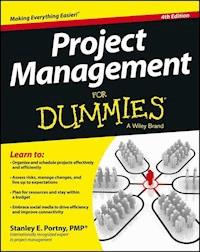
The bestselling "bible" of project management In today's time-crunched, cost-conscious global business environment, tight project deadlines and stringent expectations are the norm. Now with 25 percent new and updated content, Project Management For Dummies introduces you to the principles of successful project management and shows you how to motivate any team to gain maximum productivity. You'll learn how to organize, estimate, and schedule projects efficiently and effectively. You'll also discover how to manage deliverables, issue changes, assess risks, maintain communications, and live up to expectations by making the most of the latest technology and software--and by avoiding common problems that can trip up even the best project managers. * The latest information on measuring project management ROI and value to the organization (and customers) * Managing Continuous Process Improvement * Examples of formats used for different aspects of project management * Managing distressed projects and managing multiple team projects * Hierarchical decomposition and how it can dramatically improve the effectiveness of project planning and control * The latest trend of embracing the use of social media to drive efficiency and improve socialization * New information on managing and resolving conflicts that occur during a project * Explanations of concepts tested in the PMP® certification exam with study tips and practices to help you pass Project Management For Dummies gives professionals like you everything you need to be successful project managers. (PMI, CAPM, PMP, and Project Management Professional are registered marks of the Project Management Institute, Inc.)
Sie lesen das E-Book in den Legimi-Apps auf:
Seitenzahl: 568
Veröffentlichungsjahr: 2013
Ähnliche
















Project Management For Dummies®, 4th Edition
Published byJohn Wiley & Sons, Inc.111 River St.Hoboken, NJ 07030-5774www.wiley.com
Copyright © 2013 by John Wiley & Sons, Inc., Hoboken, New Jersey
Published simultaneously in Canada
No part of this publication may be reproduced, stored in a retrieval system or transmitted in any form or by any means, electronic, mechanical, photocopying, recording, scanning or otherwise, except as permitted under Sections 107 or 108 of the 1976 United States Copyright Act, without the prior written permission of the Publisher. Requests to the Publisher for permission should be addressed to the Permissions Department, John Wiley & Sons, Inc., 111 River Street, Hoboken, NJ 07030, (201) 748-6011, fax (201) 748-6008, or online at http://www.wiley.com/go/permissions.
Trademarks: Wiley, the Wiley logo, For Dummies, the Dummies Man logo, A Reference for the Rest of Us!, The Dummies Way, Dummies Daily, The Fun and Easy Way, Dummies.com, Making Everything Easier, and related trade dress are trademarks or registered trademarks of John Wiley & Sons, Inc., and/or its affiliates in the United States and other countries, and may not be used without written permission. All other trademarks are the property of their respective owners. John Wiley & Sons, Inc., is not associated with any product or vendor mentioned in this book.
Limit of Liability/Disclaimer of Warranty:The publisher and the author make no representations or warranties with respect to the accuracy or completeness of the contents of this work and specifically disclaim all warranties, including without limitation warranties of fitness for a particular purpose. No warranty may be created or extended by sales or promotional materials. The advice and strategies contained herein may not be suitable for every situation. This work is sold with the understanding that the publisher is not engaged in rendering legal, accounting, or other professional services. If professional assistance is required, the services of a competent professional person should be sought. Neither the publisher nor the author shall be liable for damages arising herefrom. The fact that an organization or Website is referred to in this work as a citation and/or a potential source of further information does not mean that the author or the publisher endorses the information the organization or Website may provide or recommendations it may make. Further, readers should be aware that Internet Websites listed in this work may have changed or disappeared between when this work was written and when it is read.
For general information on our other products and services, please contact our Customer Care Department within the U.S. at 877-762-2974, outside the U.S. at 317-572-3993, or fax 317-572-4002.
For technical support, please visit www.wiley.com/techsupport.
Wiley publishes in a variety of print and electronic formats and by print-on-demand. Some material included with standard print versions of this book may not be included in e-books or in print-on-demand. If this book refers to media such as a CD or DVD that is not included in the version you purchased, you may download this material at http://booksupport.wiley.com. For more information about Wiley products, visit www.wiley.com.
Library of Congress Control Number: 2013933942
ISBN 978-1-118-49723-4 (pbk); ISBN 978-1-118-49722-7 (ebk); ISBN 978-1-118-49712-8 (ebk); ISBN 978-1-118-49713-5 (ebk)
Manufactured in the United States of America
10 9 8 7 6 5 4 3 2 1
About the Author
Stan Portny, president of Stanley E. Portny and Associates, LLC, is an internationally recognized expert in project management and project leadership. During the past 35 years, he’s provided training and consultation to more than 200 public and private organizations in consumer products, insurance, pharmaceuticals, finance, information technology, telecommunications, defense, and healthcare. He has developed and conducted training programs for more than 100,000 management and staff personnel in engineering, sales and marketing, research and development, information systems, manufacturing, operations, and support areas.
Stan combines an analyst’s eye with an innate sense of order and balance and a deep respect for personal potential. He helps people understand how to control chaotic environments and produce dramatic results while still achieving personal and professional satisfaction. Widely acclaimed for his dynamic presentations and unusual ability to establish a close rapport with seminar participants, Stan specializes in tailoring his training programs to meet the unique needs of individual organizations. His clients have included ADP, ADT, American International Group, Bristol-Myers Squibb, Burlington Northern Railroad, Hewlett Packard, Johnson & Johnson, Just Born, Nabisco, Novartis Pharmaceuticals, Pitney Bowes, Raymond Corporation, UPS, Vanguard Investment Companies, as well as the United States Navy, Air Force, Central Intelligence Agency, and Office of the Comptroller of the Currency.
A Project Management Institute–certified Project Management Professional (PMP), Stan received his bachelor’s degree in electrical engineering from the Polytechnic Institute of Brooklyn. He holds a master’s degree in electrical engineering and the degree of electrical engineer from the Massachusetts Institute of Technology. Stan has also studied at the Alfred P. Sloan School of Management and the George Washington University National Law Center.
Stan provides on-site training in all aspects of project management, project team building, and project leadership. He can work with you to assess your organization’s current project-management practices, develop planning and control systems and procedures, and review the progress of ongoing projects. In addition, Stan can serve as the keynote speaker at your organization’s or professional association’s meetings.
To discuss this book or understand how Stan can work with you to enhance your organization's project-management skills and practices, please contact him at Stanley E. Portny and Associates, LLC, 20 Helene Drive, Randolph, New Jersey 07869; phone 973-366-8500; e-mail [email protected]; website www.StanPortny.com.
Dedication
To my wife, Donna; my son, Brian; my son and daughter-in-law, Jonathan and Marci; and my granddaughter, Elena. May we continue to share life’s joys together.
Author’s Acknowledgments
Writing and publishing this book was a team effort, and I would like to thank the many people who helped to make it possible. First, I want to thank Tracy Boggier, my acquisitions editor, who first contacted me to discuss the possibility of writing this fourth edition of my book. Thanks to her for making that phone call, for helping me prepare the proposal, for helping to get the project off to a smooth and timely start, for coordinating the publicity and sales, and for helping to bring all the pieces to a successful conclusion.
Thanks to Chrissy Guthrie, my project editor, and Amanda Langferman and Megan Knoll, my copy editors, for their guidance, support, and the many hours they spent polishing the text into a smooth, finished product. And thanks to Mike Fisher, my technical reviewer, for his many insightful observations and suggestions.
Finally, thanks to my family for their continued help and inspiration. Thanks to Donna, who never doubted that this book would become a reality and who shared personal and stylistic comments as she reviewed the text countless times while always making it seem like she found it enjoyable and enlightening. Thanks to Brian, Jonathan, and Marci, whose interest and excitement helped motivate me to see the fourth edition of this book through to completion.
Publisher’s Acknowledgments
We're proud of this book; please send us your comments at http://dummies.custhelp.com. For other comments, please contact our Customer Care Department within the U.S. at 877-762-2974, outside the U.S. at 317-572-3993, or fax 317-572-4002.
Some of the people who helped bring this book to market include the following:
Acquisitions, Editorial, and Vertical Websites
Senior Project Editor: Christina Guthrie
Senior Acquisitions Editor: Tracy Boggier
Copy Editors: Amanda M. Langferman, Megan Knoll
Assistant Editor: David Lutton
Editorial Program Coordinator: Joe Niesen
Technical Editor: Mike Fisher, MBA, PMP, SCM, MCTS
Editorial Manager: Christine Meloy Beck
Editorial Assistants: Rachelle Amick, Alexa Koschier
Cover Photos: © tiridifilm / iStockphoto.com
Composition Services
Project Coordinator: Patrick Redmond
Layout and Graphics: Joyce Haughey
Proofreader: Nancy Rapoport
Indexer: Palmer Publishing Services
Publishing and Editorial for Consumer Dummies
Kathleen Nebenhaus, Vice President and Executive Publisher
David Palmer, Associate Publisher
Kristin Ferguson-Wagstaffe, Product Development Director
Publishing for Technology Dummies
Andy Cummings, Vice President and Publisher
Composition Services
Debbie Stailey, Director of Composition Services
Project Management For Dummies®, 4th Edition
Visit www.dummies.com/cheatsheet/projectmanagement to view this book's cheat sheet.
Table of Contents
Introduction
About This Book
Conventions Used in This Book
What You’re Not to Read
Foolish Assumptions
How This Book Is Organized
Part I: Getting Started with Project Management
Part II: Planning Time: Determining When and How Much
Part III: Group Work: Putting Your Team Together
Part IV: Steering the Ship: Managing Your Project to Success
Part V: Taking Your Project Management to the Next Level
Part VI: The Part of Tens
Icons Used in This Book
Where to Go from Here
Part I: Getting Started with Project Management
Chapter 1: Project Management: The Key to Achieving Results
Determining What Makes a Project a Project
Understanding the three main components that define a project
Recognizing the diversity of projects
Describing the four stages of a project
Defining Project Management
Starting with the initiating processes
Outlining the planning processes
Examining the executing processes
Surveying the monitoring and controlling processes
Ending with the closing processes
Knowing the Project Manager’s Role
Looking at the project manager’s tasks
Staving off excuses for not following a structured project-management approach
Avoiding “shortcuts”
Staying aware of other potential challenges
Do You Have What It Takes to Be an Effective Project Manager?
Questions
Answer key
Relating This Chapter to the PMP Exam and PMBOK 5
Chapter 2: Knowing Your Project’s Audience: Involving the Right People
Understanding Your Project’s Audiences
Developing an Audience List
Starting your audience list
Ensuring your audience list is complete and up-to-date
Using an audience list template
Considering the Drivers, Supporters, and Observers in Your Audience
Deciding when to involve your audiences
Using different methods to involve your audiences
Making the most of your audiences’ involvement
Displaying Your Audience List
Confirming Your Audience’s Authority
Assessing Your Audience’s Power and Interest
Relating This Chapter to the PMP Exam and PMBOK 5
Chapter 3: Clarifying What You’re Trying to Accomplish — And Why
Defining Your Project with a Scope Statement
Looking at the Big Picture: Explaining the Need for Your Project
Figuring out why you’re doing the project
Drawing the line: Where your project starts and stops
Stating your project’s objectives
Marking Boundaries: Project Constraints
Working within limitations
Dealing with needs
Facing the Unknowns When Planning: Documenting Your Assumptions
Presenting Your Scope Statement in a Clear and Concise Document
Relating This Chapter to the PMP Exam and PMBOK 5
Chapter 4: Developing Your Game Plan: Getting from Here to There
Divide and Conquer: Breaking Your Project into Manageable Chunks
Thinking in detail
Identifying necessary project work with a Work Breakdown Structure
Dealing with special situations
Creating and Displaying Your Work Breakdown Structure
Considering different schemes to create your WBS hierarchy
Using one of two approaches to develop your WBS
Categorizing your project’s work
Labeling your WBS entries
Displaying your WBS in different formats
Improving the quality of your WBS
Using templates
Identifying Risks While Detailing Your Work
Documenting What You Need to Know about Your Planned Project Work
Relating This Chapter to the PMP Exam and PMBOK 5
Part II: Planning Time: Determining When and How Much
Chapter 5: You Want This Project Done When?
Picture This: Illustrating a Work Plan with a Network Diagram
Defining a network diagram’s elements
Drawing a network diagram
Analyzing a Network Diagram
Reading a network diagram
Interpreting a network diagram
Working with Your Project’s Network Diagram
Determining precedence
Using a network diagram to analyze a simple example
Developing Your Project’s Schedule
Taking the first steps
Avoiding the pitfall of backing in to your schedule
Meeting an established time constraint
Applying different strategies to arrive at your picnic in less time
Estimating Activity Duration
Determining the underlying factors
Considering resource characteristics
Finding sources of supporting information
Improving activity duration estimates
Displaying Your Project’s Schedule
Relating This Chapter to the PMP Exam and PMBOK 5
Chapter 6: Establishing Whom You Need, How Much, and When
Getting the Information You Need to Match People to Tasks
Deciding what skills and knowledge team members must have
Representing team members’ skills, knowledge, and interests in a Skills Matrix
Estimating Needed Commitment
Using a Human Resources Matrix
Identifying needed personnel in a Human Resources Matrix
Estimating required work effort
Factoring productivity, efficiency, and availability into work-effort estimates
Reflecting efficiency when you use historical data
Accounting for efficiency in personal work-effort estimates
Ensuring Your Project Team Members Can Meet Their Resource Commitments
Planning your initial allocations
Resolving potential resource overloads
Coordinating assignments across multiple projects
Relating This Chapter to the PMP Exam and PMBOK 5
Chapter 7: Planning for Other Resources and Developing the Budget
Determining Nonpersonnel Resource Needs
Making Sense of the Dollars: Project Costs and Budgets
Looking at different types of project costs
Recognizing the three stages of a project budget
Refining your budget as you move through your project’s stages
Determining project costs for a detailed budget estimate
Relating This Chapter to the PMP Exam and PMBOK 5
Chapter 8: Venturing into the Unknown: Dealing with Risk
Defining Risk and Risk Management
Focusing on Risk Factors and Risks
Recognizing risk factors
Identifying risks
Assessing Risks: Probability and Consequences
Gauging the likelihood of a risk
Estimating the extent of the consequences
Getting Everything under Control: Managing Risk
Choosing the risks you want to manage
Developing a risk-management strategy
Communicating about risks
Preparing a Risk-Management Plan
Relating This Chapter to the PMP Exam and PMBOK 5
Part III: Group Work: Putting Your Team Together
Chapter 9: Aligning the Key Players for Your Project
Defining Three Organizational Environments
The functional structure
The projectized structure
The matrix structure
Recognizing the Key Players in a Matrix Environment
The project manager
Project team members
Functional managers
Upper management
Working Successfully in a Matrix Environment
Creating and continually reinforcing a team identity
Getting team member commitment
Eliciting support from other people in the environment
Heading off common problems before they arise
Relating This Chapter to the PMP Exam and PMBOK 5
Chapter 10: Defining Team Members’ Roles and Responsibilities
Outlining the Key Roles
Distinguishing authority, responsibility, and accountability
Understanding the difference between authority and responsibility
Making Project Assignments
Delving into delegation
Sharing responsibility
Holding people accountable — even when they don’t report to you
Picture This: Depicting Roles with a Responsibility Assignment Matrix
Introducing the elements of a RAM
Reading a RAM
Developing a RAM
Ensuring your RAM is accurate
Dealing with Micromanagement
Realizing why a person micromanages
Gaining a micromanager’s trust
Working well with a micromanager
Relating This Chapter to the PMP Exam and PMBOK 5
Chapter 11: Starting Your Project Team Off on the Right Foot
Finalizing Your Project’s Participants
Are you in? Confirming your team members’ participation
Assuring that others are on board
Filling in the blanks
Developing Your Team
Reviewing the approved project plan
Developing team and individual goals
Specifying team member roles
Defining your team’s operating processes
Supporting the development of team member relationships
Resolving conflicts
All together now: Helping your team become a smooth-functioning unit
Laying the Groundwork for Controlling Your Project
Selecting and preparing your tracking systems
Establishing schedules for reports and meetings
Setting your project’s baseline
Hear Ye, Hear Ye! Announcing Your Project
Setting the Stage for Your Post-Project Evaluation
Relating This Chapter to the PMP Exam and PMBOK 5
Part IV: Steering the Ship: Managing Your Project to Success
Chapter 12: Tracking Progress and Maintaining Control
Holding On to the Reins: Project Control
Establishing Project Management Information Systems
The clock’s ticking: Monitoring schedule performance
All in a day’s work: Monitoring work effort
Follow the money: Monitoring expenditures
Putting Your Control Process into Action
Heading off problems before they occur
Formalizing your control process
Identifying possible causes of delays and variances
Identifying possible corrective actions
Getting back on track: Rebaselining
Reacting Responsibly When Changes Are Requested
Responding to change requests
Creeping away from scope creep
Relating This Chapter to the PMP Exam and PMBOK 5
Chapter 13: Keeping Everyone Informed
I Said What I Meant and I Meant What I Said: Successful Communication Basics
Breaking down the communication process
Distinguishing one-way and two-way communication
Can you hear me? Listening actively
Choosing the Appropriate Medium for Project Communication
Just the facts: Written reports
Move it along: Meetings that work
Preparing a Written Project-Progress Report
Making a list (of names) and checking it twice
Knowing what’s hot (and what’s not) in your report
Earning a Pulitzer, or at least writing an interesting report
Holding Key Project Meetings
Regularly scheduled team meetings
Ad hoc team meetings
Upper-management progress reviews
Preparing a Project Communications Management Plan
Relating This Chapter to the PMP Exam and PMBOK 5
Chapter 14: Encouraging Peak Performance by Providing Effective Leadership
Exploring the Difference between Leadership and Management
Recognizing the Traits People Look For in a Leader
Developing Personal Power and Influence
Understanding why people do what you ask
Establishing the bases of your power
You Can Do It! Creating and Sustaining Team Member Motivation
Increasing commitment by clarifying your project’s benefits
Encouraging persistence by demonstrating project feasibility
Letting people know how they’re doing
Providing rewards for work well done
Relating This Chapter to the PMP Exam and PMBOK 5
Chapter 15: Bringing Your Project to Closure
Staying the Course to Completion
Planning ahead for your project’s closure
Updating your initial closure plans when you’re ready to wind down the project
Charging up your team for the sprint to the finish line
Handling Administrative Issues
Providing a Smooth Transition for Team Members
Surveying the Results: The Post-Project Evaluation
Preparing for the evaluation throughout the project
Setting the stage for the evaluation meeting
Conducting the evaluation meeting
Following up on the evaluation
Relating This Chapter to the PMP Exam and PMBOK 5
Part V: Taking Your Project Management to the Next Level
Chapter 16: Using Technology to Enhance Project Planning and Management
Using Computer Software Effectively
Looking at your software options
Helping your software perform at its best
Introducing project-management software into your operations
Using Social Media to Enhance Project Management
Defining social media
Exploring how social media can support your project planning and performance
Using social media to support your project communications
Relating This Chapter to the PMP Exam and PMBOK 5
Chapter 17: Monitoring Project Performance with Earned Value Management
Defining Earned Value Management
Getting to know EVM terms and formulas
Looking at a simple example
Determining the reasons for observed variances
The How-To: Applying Earned Value Management to Your Project
Determining a Task’s Earned Value
Relating This Chapter to the PMP Exam and PMBOK 5
Part VI: The Part of Tens
Chapter 18: Ten Questions to Ask Yourself as You Plan Your Project
What’s the Purpose of Your Project?
Whom Do You Need to Involve?
What Results Will You Produce?
What Constraints Must You Satisfy?
What Assumptions Are You Making?
What Work Has to Be Done?
When Does Each Activity Start and End?
Who Will Perform the Project Work?
What Other Resources Do You Need?
What Can Go Wrong?
Chapter 19: Ten Tips for Being a Better Project Manager
Be a “Why” Person
Be a “Can Do” Person
Think about the Big Picture
Think in Detail
Assume Cautiously
View People as Allies, Not Adversaries
Say What You Mean and Mean What You Say
Respect Other People
Acknowledge Good Performance
Be a Manager and a Leader
Appendix: Combining the Techniques into Smooth-Flowing Processes
Introduction
Projects have been around since ancient times. Noah building the ark, Leonardo da Vinci painting the Mona Lisa, Edward Gibbon writing The Decline and Fall of the Roman Empire, Jonas Salk developing the polio vaccine — all projects. And as you know, these were all masterful successes. (Well, the products were a spectacular success, even if schedules and resource budgets were drastically overrun!)
Why, then, is the topic of project management of such great interest today? The answer is simple: The audience has changed and the stakes are higher.
Historically, projects were large, complex undertakings. The first project to use modern project-management techniques — the Polaris weapons system in the early 1950s — was a technical and administrative nightmare. Teams of specialists planned and tracked the myriad of research, development, and production activities. They produced mountains of paper to document the intricate work. As a result, people started to view project management as a highly technical discipline with confusing charts and graphs; they saw it as inordinately time-consuming, specialist-driven, and definitely off-limits for the common man or woman!
Because of the ever-growing array of huge, complex, and technically challenging projects in today’s world, people who want to devote their careers to planning and managing those projects are still vital to their successes. Over the past 25 to 30 years, however, the number of projects in the regular workplace has skyrocketed. Projects of all types and sizes are now the way that organizations accomplish their work.
At the same time, a new breed of project manager has emerged. This new breed may not have set career goals to become project managers — many among them don’t even consider themselves to be project managers. But they do know they must successfully manage projects to move ahead in their careers. Clearly, project management has become a critical skill, not a career choice.
Even though these people realize they need special tools, techniques, and knowledge to handle their new types of assignments, they may not be able or willing to devote large amounts of time to acquiring them, which is where this book comes into play. I devote this book to that silent majority of project managers.
About This Book
This book helps you recognize that the basic tenets of successful project management are simple. The most complex analytical technique takes less than ten minutes to master! In this book, I introduce information that’s necessary to plan and manage projects, and I provide important guidelines for developing and using this information. Here, you discover that the real challenge to a successful project is dealing with the multitude of people whom a project may affect or need for support. I present plenty of tips, hints, and guidelines for identifying key players and then involving them.
But knowledge alone won’t make you a successful project manager — you need to apply it. This book’s theme is that project-management skills and techniques aren’t burdensome tasks you perform because some process requires it. Rather, they’re a way of thinking, communicating, and behaving. They’re an integral part of how we approach all aspects of our work every day.
So I’ve written the book to be direct and (relatively) easy to understand. But don’t be misled — the simple text still navigates all the critical tools and techniques you’ll need to support your project planning, scheduling, budgeting, organizing, and controlling. So buckle up!
I present this information in a logical and modular progression. Examples and illustrations are plentiful — so are the tips and hints. And I inject humor from time to time to keep it all doable. My goal is that you finish this book feeling that good project management is a necessity and that you’re determined to practice it!
Conventions Used in This Book
I use the following conventions to help you find your way through this book:
I use italics to point out new words and to alert you to their definitions, which are always close by. On occasion, I also use italics for added emphasis.
I use bold text to indicate keywords in bulleted lists or to highlight action parts in numbered lists.
I put all websites in monofont.
When this book was printed, some web addresses may have needed to break across two lines of text. If that happened, rest assured that I haven’t put in any extra characters (such as hyphens) to indicate the break. So when using one of these web addresses, just type in exactly what you see in this book, pretending as though the line break doesn’t exist.
What You’re Not to Read
Of course, I want you to read every single word, but I understand your life is busy and you may have time to read only what’s relevant to your experience. In that case, feel free to skip the sidebars. Although the sidebars offer interesting, real-life stories of my own experiences, they’re not vital to grasping the concepts.
Foolish Assumptions
When writing this book, I assumed that a widely diverse group of people would read it, including the following:
Senior managers and junior assistants (tomorrow’s senior managers)
Experienced project managers and people who’ve never been on a project team
People who’ve had significant project-management training and people who’ve had none
People who’ve had years of real-world business and government experience and people who’ve just entered the workforce
I assume that you have a desire to take control of your environment. After reading this book, I hope you wonder (and rightfully so) why all projects aren’t well managed — because you’ll think these techniques are so logical, straightforward, and easy to use. But I also assume you recognize there’s a big difference between knowing what to do and doing it. And I assume you realize you’ll have to work hard to overcome the forces that conspire to prevent you from using these tools and techniques.
Finally, I assume you’ll realize that you can read this book repeatedly and learn something new and different each time. Think of this book as a comfortable resource that has more to share as you experience new situations.
How This Book Is Organized
Each chapter is self-contained, so you can read the chapters that interest you the most first — without feeling lost because you haven’t read the book from front to back. The book is divided into the following six parts.
Part I: Getting Started with Project Management
In this part, I discuss the unique characteristics of projects and what project management is all about. I also show you how to identify the people who will play a role in your project, how to clearly define your project’s proposed results, and how to determine your project’s work.
Part II: Planning Time: Determining When and How Much
In this part, I cover how to develop the project schedule and estimate the resources (both personnel and nonpersonnel) you need. I also show you how to identify and manage project risks.
Part III: Group Work: Putting Your Team Together
In this part, I show you how to identify, organize, and deal with people who play a part in your project’s success. I explain how to define team members’ roles and get your project off to a strong start.
Part IV: Steering the Ship: Managing Your Project to Success
In this part, I explain how to monitor, track, analyze, and report on your project’s activities. I also show you how to establish and maintain effective communications between you and all your project audiences and how to demonstrate leadership that energizes your project team. Then I discuss how to bring your project to a successful closure.
Part V: Taking Your Project Management to the Next Level
Here, I discuss how to use available technology to help you plan, organize, and control your project. I also discuss a technique for evaluating activity performance and resource expenditures on larger projects.
Part VI: The Part of Tens
Every For Dummies book has this fun part that gives you tidbits of information in an easy-to-chew format. In this part, I share tips on how to plan your project and and how to be a better project manager.
I also include one additional nugget of information: The appendix illustrates systematic processes for planning your project and for using the essential controls that I discuss throughout this book.
Icons Used in This Book
I include small icons in the left margins of the book to alert you to special information in the text. Here’s what they mean:
This icon leads into actual situations illustrating techniques and issues.
I use this icon to point out important information you need to keep in mind as you apply the techniques and approaches.
This icon highlights techniques or approaches you can use to improve your project-management practices.
This icon highlights potential pitfalls and danger spots.
Where to Go from Here
You can read this book in many ways, depending on your own project-management knowledge and experience and your current needs. However, I suggest you first take a minute to scan the table of contents and thumb through the sections of the book to get a feeling for the topics I address.
If you’re new to project management and are just beginning to form a plan for a project, first read Parts I and II, which explain how to plan outcomes, activities, schedules, and resources. If you want to find out how to identify and organize your project’s team and other key people, start with Part III. If you’re ready to begin work or you’re already in the midst of your project, you may want to start with Part IV. Or feel free to jump back and forth, hitting the chapters with topics that interest you the most.
The most widely recognized reference of project-management best practices is A Guide to the Project Management Body of Knowledge (PMBOK), published by the Project Management Institute (PMI). The fifth and most recent edition of PMBOK (PMBOK 5) was published in 2013. The Project Management Professional (PMP) certification — the most recognized project-management credential throughout the world — includes an examination (administered by PMI) with questions based on PMBOK 5.
Because I base my book on best practices for project-management activities, the tools and techniques I offer are in accordance with PMBOK 5. However, if you’re preparing to take the PMP examination, use my book as a companion to PMBOK 5, not as a substitute for it.
As you read this book, keep the following points in mind:
PMBOK 5 identifies what best practices are but doesn’t address in detail how to perform them or deal with difficulties you may encounter as you try to perform them. In contrast, my book focuses heavily on how to perform the project-management techniques and processes.
I’ve revised and updated my book so that all the tools and techniques discussed and all the terminology used to describe those tools and techniques are in agreement with those used in PMBOK 5.
Where appropriate, I include a section at the end of each chapter that specifies where the topics in the chapter are addressed in PMBOK 5.
PMBOK 5 often contains highly technical language and detailed processes, which people mistakenly dismiss as being relevant only for larger projects. My book, however, deliberately frames terms and discussions to be user-friendly. As a result, people who work on projects of all sizes can understand how to apply the tools and techniques presented.
No matter how you make your way through this book, plan on reading all the chapters more than once — the more you read a chapter, the more sense its approaches and techniques will make. And who knows? A change in your job responsibilities may create a need for certain techniques you’ve never used before. Have fun and good luck!
Part I
Getting Started with Project Management
For Dummies can help you get started with lots of subjects. Visit www.dummies.com to learn more and do more with For Dummies.
In this part . . .
Discover what project management is all about and whether you have what it takes to be a successful project manager.
Find out how to identify people who may need to be involved in your project and decide whether, when, and how to involve them. After you know who should be involved, determine who has the authority, power, and interest to make critical decisions along the way.
Think about the big picture of what your project is trying to accomplish (and why). Then get the scoop on writing a Scope Statement to confirm the results your project will produce and the constraints and assumptions under which everyone will work.
Outline the work you have to do to meet the expectations for your project and find out how to break that work down into manageable chunks.
Chapter 1
Project Management: The Key to Achieving Results
In This Chapter
Defining a project and its four stages
Breaking down project management
Identifying the project manager’s role
Determining whether you have what you need to be a successful project manager
Successful organizations create projects that produce desired results in established time frames with assigned resources. As a result, businesses are increasingly driven to find individuals who can excel in this project-oriented environment.
Because you’re reading this book, chances are good that you’ve been asked to manage a project. So, hang on tight — you’re going to need a new set of skills and techniques to steer that project to successful completion. But not to worry! This chapter gets you off to a smooth start by showing you what projects and project management really are and by helping you separate projects from nonproject assignments. This chapter also offers the rationale for why projects succeed or fail and gets you into the project-management mindset.
Lesen Sie weiter in der vollständigen Ausgabe!
Lesen Sie weiter in der vollständigen Ausgabe!
Lesen Sie weiter in der vollständigen Ausgabe!
Lesen Sie weiter in der vollständigen Ausgabe!
Lesen Sie weiter in der vollständigen Ausgabe!
Lesen Sie weiter in der vollständigen Ausgabe!
Lesen Sie weiter in der vollständigen Ausgabe!
Lesen Sie weiter in der vollständigen Ausgabe!
Lesen Sie weiter in der vollständigen Ausgabe!
Lesen Sie weiter in der vollständigen Ausgabe!
Lesen Sie weiter in der vollständigen Ausgabe!
Lesen Sie weiter in der vollständigen Ausgabe!
Lesen Sie weiter in der vollständigen Ausgabe!
Lesen Sie weiter in der vollständigen Ausgabe!
Lesen Sie weiter in der vollständigen Ausgabe!
Lesen Sie weiter in der vollständigen Ausgabe!
Lesen Sie weiter in der vollständigen Ausgabe!
Lesen Sie weiter in der vollständigen Ausgabe!
Lesen Sie weiter in der vollständigen Ausgabe!
Lesen Sie weiter in der vollständigen Ausgabe!
Lesen Sie weiter in der vollständigen Ausgabe!
Lesen Sie weiter in der vollständigen Ausgabe!
Lesen Sie weiter in der vollständigen Ausgabe!
Lesen Sie weiter in der vollständigen Ausgabe!
Lesen Sie weiter in der vollständigen Ausgabe!




