


15,99 €
Mehr erfahren.
- Herausgeber: John Wiley & Sons
- Kategorie: Geisteswissenschaft
- Serie: War and Conflict in the Modern World
- Sprache: Englisch
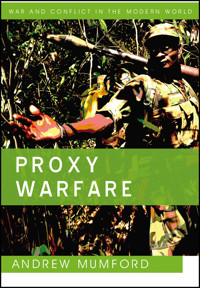
Proxy wars represent a perennial strand in the history of conflict. The appeal of ‘warfare on the cheap’ has proved an irresistible strategic allure for nations through the centuries. However, proxy wars remain a missing link in contemporary war and security studies. In this timely book Andrew Mumford sheds new light on the dynamics and lineage of proxy warfare from the Cold War to the War on Terror, whilst developing a cogent conceptual framework to explain their appeal.
Tracing the political and strategic development of proxy wars throughout the last century, they emerge as a dominant characteristic of contemporary conflict. The book ably shows how proxy interventions often prolong existing conflicts given the perpetuity of arms, money and sometimes proxy fighters sponsored by third party donors. Furthermore, it emphasizes why, given the direction of the War on Terror, the rise of China as a global power, and the prominence now achieved by non-state actors in the ‘Arab Spring’, the phenomenon of proxy warfare is increasingly relevant to understandings of contemporary security.
Proxy Warfare is an indispensable guide for students and scholars interested in the evolution and potential future direction of war and conflict in the modern world.
Sie lesen das E-Book in den Legimi-Apps auf:
Seitenzahl: 209
Veröffentlichungsjahr: 2013
Ähnliche




















Proxy Warfare
Proxy Warfare
Andrew Mumford
polity
Copyright © Andrew Mumford 2013
The right of Andrew Mumford to be identified as Author of this Work has been asserted in accordance with the UK Copyright, Designs and Patents Act 1988.
First published in 2013 by Polity Press
Polity Press 65Bridge StreetCambridge CB2 1UR, UK
Polity Press 350Main StreetMalden, MA 02148, USA
All rights reserved. Except for the quotation of short passages for the purpose of criticism and review, no part of this publication may be reproduced, stored in a retrieval system, or transmitted, in any form or by any means, electronic, mechanical, photocopying, recording or otherwise, without the prior permission of the publisher.
ISBN 9780745670928
A catalogue record for this book is available from the British Library.
The publisher has used its best endeavours to ensure that the URLs for external websites referred to in this book are correct and active at the time of going to press. However, the publisher has no responsibility for the websites and can make no guarantee that a site will remain live or that the content is or will remain appropriate.
Every effort has been made to trace all copyright holders, but if any have been inadvertently overlooked the publisher will be pleased to include any necessary credits in any subsequent reprint or edition.
For further information on Polity, visit our website: www.politybooks.com
For Hannah
Contents
Acknowledgements
Introduction: The Rise of Proxy Wars
1. What is Proxy War?
2. Why Does Proxy War Appeal?
3. Who Engages in Proxy War?
4. How are Proxy Wars Fought?
5. The Future of Proxy War
Conclusion: The Continuing Appeal of Proxy Warfare
Notes
Bibliography
Index
Acknowledgements
My first debt of gratitude must go to Louise Knight at Polity for showing faith in a sketchy idea and guiding the book skilfully along with wonderful patience and enthusiasm. David Winters has also been of valuable assistance during the whole process.
I am thankful to my colleagues within the School of Politics and International Relations at the University of Nottingham, especially those within the Centre for Conflict, Security and Terrorism, who have debated the facets of proxy war with me. The arguments in the book are sharper for their insights.
The Plymouth International Studies Centre was kind enough to give me the opportunity to deliver some of the key ideas in the book at an invitational lecture. The probing questions I faced afterwards helped hone my thinking on many issues.
A special thank you must be extended to the students in my Contemporary Warfare class of 2011/12 at Nottingham, who saw straight through my inclusion of proxy wars as a topic on the syllabus and rigorously engaged with the issues covered in this book. Their intellectual curiosity and insights challenged me to think harder about the dynamics of proxy wars in the modern world.
I am especially grateful to three students of mine for providing valuable research assistance. Will Jackson, Chris Anquist and Vladimir Rauta remained vigilant for useful articles, tracked down obscure references for me, and proved valuable sounding boards for my ideas.
Indebted as I am to all of the above people for their contributions and help, I of course remain solely responsible for any opinions or errors contained in the book.
My final thanks go to my wife, Hannah, to whom this book is dedicated. Her love and support enabled me to face the tyranny of the blank Word document as writing commenced. Her incisive comments helped me mould arguments as the project developed. Her warm encouragement pushed the book towards completion. For this, and so much more, I am forever grateful.
Introduction
The Rise of Proxy Wars
Proxy conflict represents a perennial strand in the history of warfare. The appeal of ‘warfare on the cheap’ has proved an irresistible strategic allure for nations through the centuries. However, proxy wars remain a missing link in contemporary war and security studies. They are historically ubiquitous yet chronically under-analysed. This book attempts to rectify this situation by assessing the dynamics and lineage of proxy warfare from the Cold War to the War on Terror, and analysing them within a conceptual framework to help us explain their appeal. The following chapters will set the international political and strategic background of proxy warfare in the modern world, tracing its development throughout the last century, and posit it as a highly pertinent factor in the character of contemporary conflict. Also addressed are questions of what defines a proxy war; why they appeal; and who fights in them. Furthermore, the book will emphasize why, given the direction of the War on Terror and the prominence now achieved by non-state actors in the Arab Spring, this is an important time to be studying the phenomenon of proxy warfare.
Proxy wars are defined here as the indirect engagement in a conflict by third parties wishing to influence its strategic outcome. As we will see, this prevents confusion with direct intervention or covert action. Theoretically, it will be argued that recourse to proxy war has been a perpetual element of modern warfare, and will continue to be so, because the attainment of a preferred strategic outcome in a certain conflict is outweighed by consequences of direct engagement based on an assessment of interest, ideology and risk. This tendency has been particularly prevalent since 1945, as the shadow of nuclear war ensured more acute selectivity in conflict engagement given the consequences of a potential nuclear exchange. Where state or group survival is not at stake but the augmentation of interest can still be achieved, states and sub-state groups have historically proven to be conspicuous users of proxy methods as a means of securing particular conflict outcomes.
Lesen Sie weiter in der vollständigen Ausgabe!
Lesen Sie weiter in der vollständigen Ausgabe!
Lesen Sie weiter in der vollständigen Ausgabe!
Lesen Sie weiter in der vollständigen Ausgabe!
Lesen Sie weiter in der vollständigen Ausgabe!
Lesen Sie weiter in der vollständigen Ausgabe!
Lesen Sie weiter in der vollständigen Ausgabe!
Lesen Sie weiter in der vollständigen Ausgabe!
Lesen Sie weiter in der vollständigen Ausgabe!




