


Erhalten Sie Zugang zu diesem und mehr als 300000 Büchern ab EUR 5,99 monatlich.
- Herausgeber: The Lilliput Press
- Kategorie: Geisteswissenschaft
- Sprache: Englisch
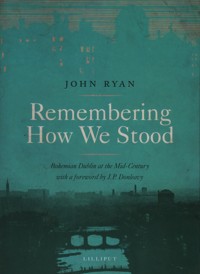
Edna O'Brien chose John Ryan's memoirs as her Observer Book of the Year in 1975, describing it as 'a fine and loving account of literary Dublin in the golden fifties, which purrs with life and anecdote'. This classic evocation of the period 1945-55 celebrates a city and its personalities – Brendan Behan, Patrick Kavanagh, Myles na gCopaleen (Flann O'Brien), as well as Pope' O'Mahony, Gainor Crist the original Ginger Man, and others – a remarkable group who revitalized post-war literature in Ireland. As friend, publisher, publican and fellow artist, Ryan paints a vivid picture of this ebullient, fertile milieu: 'No more singular body of characters will ever rub shoulders again at any given time, or a city more uniquely bizarre than literary Dublin will ever be seen.'
Sie lesen das E-Book in den Legimi-Apps auf:
Seitenzahl: 294
Veröffentlichungsjahr: 2008
Das E-Book (TTS) können Sie hören im Abo „Legimi Premium” in Legimi-Apps auf:
Ähnliche




















Remembering How We Stood
Bohemian Dublin at the Mid-Century
John Ryan
with a foreword by J. P. Donleavy
For Dee
Acknowledgments
The author wishes to thank the following for permission to use certain extracts used in this work: Oliver D. Gogarty S.C. for a quotation from a poem of his father’s; Mrs Evelyn O’Nolan for a quotation from Brian O’Nolan’s TheThirdPoliceman; Mrs Patrick Kavanagh for two excerpts from a poem by Patrick Kavanagh and The Bodley Head for an excerpt from James Joyce’s Ulysses.
Contents
Title Page
Dedication
Acknowledgment
FOREWORD
INTRODUCTION
PART ONE: THE TIME AND THE PLACE
1 The Fair City
2 O What a Lovely Emergency!
3 Behind the Emerald Curtain
4 Distilled Damnation
5 Overtures and Beginners
6 Liffeysiders
7 In the Joyce Country
PART TWO: THE PERSONALITIES
8 The Home and Colonial Boy
9 The Lost Umbilical Chord
10 Paddy Kavanagh
11 The Incomparable Myles
12 The Man from Ohio
13 Remembering How We Stood
14 The Swan in the Evening
Index
Plates
About the Author
Copyright
But it won’t be always summer—not for us; there are bad times coming
When you and I will look with envy on old photographs, Remembering how we stood ….
Valentin Iremonger: ‘Clear View in Summer’
from Reservations
Foreword
John Ryan was my first publisher, who presented my earliest writing, a short story, ‘A Party on Saturday Afternoon’, in the pages of his magazine Envoy. However, I knew him long before that. As an invariably polite, quiet, and somewhat shy individual, who when at the bar of a pub, would patiently listen to anyone’s stories and if prompted sufficiently could tell splendid tales of his own. He was also a rare man in Irish life who could harbour many a secret from which, I suspect, comes much of the wisdom lurking in his words.
In Dublin, following the Second World War, there was a celebratory air and the pubs of the capital city were jammed. And in the years following, of which John Ryan writes, there was a carelessness about life with the hopeless present being made tolerable by adorning the days ahead with rosy dreams. These, for target practice, always being promptly shot down in flames by your listeners, who in a public house, need have no mind for having to please a host or hostess. Intellectual social life, rather than being conducted in the salons of Dublin and country houses as it seemed to have been in the decades previously, was nearly entirely exercised where drink was for sale or available in one or two of the more impromptu places such as that now legendary basement redoubt, the Catacombs. Unselfconsciousness and face breaking being rampant at the time, no one knew or much cared that a so called literary period was then in the making. Comeuppance and instant amusement were all the rage and you were as good as your last fist thrown or sentence uttered. While delving into the problem of obtaining a lifetime private income, food, not for thought but to devour, was on every mind. And if little hope of that was to be had, then a drink held in your fist was the preferred substitute. The exception to all this deprivation and behaviour was John Ryan.
Courtesy a mother who was as intrepid as she was charming and who ran her considerable business of the Monument Creameries, Ryan was one of the few who personally had available to him both food and drink in plentisome quantity. With money to spare, and able to elect to a degree as to what he did with his time, he could have done as nearly all did, spend his days racing and dining evenings at Jammets and the Red Bank with jodhpured cronies. However, Ryan had a distinct consciousness of the value and worth of the writers, painters and poets of the period. And he chose to be interested in his native city and the relics left by so many of its literary sons who had fled or been driven out. It was nearly as if to redress such wrong that Ryan had collected their books, music and pictures, and let it be known that such banned and ridiculed things were still to be seen and heard back in the creator’s native land and that there remained at least one man there who kept their names alive and held them in high esteem. For as this book reveals, Ryan was himself, as well as a publican and publisher, also a creator of painting, writing and music. And he in turn self-effacingly cherished and nourished those in the same pursuit, who embattled, still remained in this land so hostile to their survival.
But Ryan was even more than a helping hand. Over the years of which he writes, he grew into a central figure to become a touchstone who was always sought out by those returning to Dublin. And when found, he would be a ready repository for news or able to report that which was soon to become news which was usually gossip turned into a fine art. He listened to all mouths and spoke into all ears. And without snobbery he would never ignore, as many did, the awestruck gas meter readers who edged near to be in the intellectual vicinity of the greatness of poets. Nor would a deaf ear ever be turned to the ‘chancers’ who swarmed about him exerting their charm looking for loans or trying to launch their money-making schemes. Thus, with Ryan invariably remaining imperturbably benign to and indulgent of all, did he become himself a dependable focus in a land where begrudgers abounded during a period of censorship and religious repression and when the philistine and pompous pedant held full sway, albeit with all kinds of shockingly prurient behaviour omnipresent.
As a diplomat in a Dublin where undiplomatic behaviour was invented, Ryan has no peer. The fact that he was able to keep as life-long friends many of those who detested even hearing another’s name mentioned, is proof. But he was not to be, in the literal sense, pushed too far. He could and did, when required, mete out plenty of unpoetic justice, especially when it required to aid a friend in battle. And unlike the slight self-congratulatory slaps one might be expected to give oneself in a distant reminiscence, it is amusing to read Ryan’s accounts of his being constantly saved from extinction in various brawls by other hands such as those of the fair-minded Gainor Stephen Crist, the patron saint of Dublin tourists and stickler for justice. It is true Crist was possessed of incredible strength and would administer punishment to the unworthy by levering them on their backs and bouncing their heads on the floor. But from my own recollection of watching Ryan’s fists fly and innumerable adversaries in the briefest of seconds be poleaxed to the deck, there was never any question in my mind that here was, in spite of his well-behaved diplomatic retiring nature, one of the world’s all-time-best light heavyweights. And even now these considerable years later I can still feel the wind over my shoulder as the whoosh of his straight right fist rent the air like a thundering freight train to put manners upon some nearby vulgarian.
Perhaps because of this, Ryan himself has become one of the strangest characters Dublin has ever found in its bosom. As host and friend to an astonishing array and cross-section of men, including princes, criminals, revolutionaries, and movie stars. For Ryan was forever in Dublin’s midst. As an occasional surveying visitor to one of his mother’s many shops. Or as proprietor of The Bailey restaurant and pub. Or as friend and comforter to both sides in libel actions, these so often erupting from the endlessly circulating letters and slanderous reporting of the greatest series of soap operas ever to run concurrently in the history of mankind. And as a dedicated Irish nationalist and patriot, Ryan sailed the most treacherous of these bohemian seas with the same skill he used as a mariner when navigating his yacht around the unpredictable and hostile waters of this island. Ryan survived it all. And without, as few of his contemporaries avoided doing, ever, even semi-permanently, leaving these shores.
But alas, I suppose, with stories retold and in their telling added to and embellished, it’s not surprising I might find, on a minor point or two, that my memory does not quite jibe with his. And I must say that I have never known Gainor Stephen Crist ever to despoil an alcoholic beverage, or to enter, sit down or drink a cup of coffee in a Dublin coffee house. Yet here it is in black and white, in RememberingHowWeStood, and perhaps it’s true, the unbelievable. Also that Crist set elaborate traps for comely females. And I reel back in surprise. And maybe that’s true too. But what I do remember is that, Crist, whose compassion for and loyalty to women was a saintly obsession, was always pursued by them and himself stepped into many an elaborate ensnarement. Ah but what matter. There’s plenty of time later for disputing facts if a little bit of fiction has you enthralled with the truth of entertainment said for the time being for your listening pleasure. And that is how John Ryan has always told his tales.
Now as one reads his words, dressed in their wonderful finery of irony, the world he speaks of reblossoms to be back again awhile. To see, feel and smell that Dublin of that day. Drawn from his encyclopaedic knowledge of the streets he loved and daily lived in. His erudition always used to entertain but never to impress. His savouring of language, rolled about on the tongue, tasted for its vintage and measuredly poured out into waiting ears. His words sounding with the same deft intimate solemnity which he himself uses when with a gently perceptible signal he orders a drink at a bar. Among the begrudgers, he is the least begrudging of men. And even oft accused of lacking malice in a city so noted for such. Indeed it was unknown for him to take a friend’s name in vain in a Dublin where no man’s name was sacred. But there could always be his nod of the head and his dry chuckle. Which would tell you as much as any oath of condemnation shouted from the rooftops.
In a masterpiece of reminiscence, he gives a touching tolerant account of Brendan Behan, under whose laughing vaudevillian behaviour lurked much hidden haunted suffering and whose nightmarish soul blazed its brief blasphemy in Dublin. And always between the lines of John Ryan’s words, the ghosts abound, sorrow and sadness pervades. His words ‘It was a bleak February in a bad year’ might be, with their timeless profundity, another sub title for this book. But bleak Februaries or bad years, Ryan was always there alertly listening. To the nonsense spouting and the great bards thundering their daily complaint while all present were existentially hoping there would be no delay in the buying of another round.
We can now, before our own time comes, pick over dead-men’s bones with our own silver-plated utensils. Sentimentally to live again in this city as it does in this book. Where the graves of the departed dead are never visited because they still live alive on our lips. If nothing else John Ryan must be said to be your true Dubliner, a man of humanity and kindness. Who will be attentive to your sorrows long after they are spoken. And if this city were ever thought to have had a king, he is and was John Ryan. Who was always one of its princes. And in the years ahead, he, who has for so many others provided memorials, is one of the very few who deserves one himself. And with the epitaph I once heard said of him.
Ah you’d always
Feel kind of safe
In his presence
J. P. Donleavy
Mullingar, April1987
Introduction
These reminiscences, or memoirs (for what follows is neither biography nor autobiography) are concerned with the people whom I knew in Dublin at about the middle of the century, when I was a young and (I suspect) callow fellow.
The period 1945–1955, for the arts in Ireland, was a particularly rich one—considering the golden age that had preceded, and remembering the death of both Yeats and Joyce, and the moratorium in letters that would, most thought, predictably follow. But many factors conspired to make the new decade the prolific one that it turned out to be, and not the least of these was a universal reaction following the insularity of the five wartime years of neutrality. The windows had been flung open and, intellectually speaking, people were breathing again.
Many writers who later became internationally known, such as Edna O’Brien, J.P. Donleavy and Brendan Behan, were then being seduced into taking their first tremulous steps in literature in the half-hostile obscurity of Dublin. Others, like Patrick Kavanagh and Myles na gCopaleen, still young men, who were denied the wider acclaim which would have been theirs but for World War II, were making a delayed debut—late starters, like many others. Much happened in that short span, but there was little cohesion or plan, so that it would be too much to claim that anything like a literary movement was born—except in the sense that AE defined literary movements: ‘five or six people who live in the same town and hate each other cordially.’ Yet it is possible that history may disagree; she may find so many unlabelled loose ends lying around but belonging to the same period, excessive and untidy, and call it the post-Yeatsian or the Literary Skinhead Age, whereupon all the disparate elements that gave the time its special flavour will be made to fall in beneath one unifying academic banner.
Those I knew and liked the most, and whom it is my present ambition to recall, were linked together by bonds of time, location and circumstance—but not invariably by those of artistic purpose, mutual admiration or even friendship. And yet, in a peculiar Dublin way there did exist a rough-and-ready camaraderie that was only from time to time maimed by exceptionally gross infidelities and which was the outcome of a mutual history of chronic impecuniosity, the abuse of nonentities, the usual grey savageries inflicted by the establishment on the artist, but mostly the common experience of neglect—financial and critical.
But all these things could be, and were, occasionally ameliorated by a good laugh, a charitable act, a kind thought or, better again, a ball of malt. What is clear to me as I look back is that no more singular a body of characters will ever rub shoulders again at any given time, or a city so uniquely bizarre as ‘literary’ Dublin then was, will evermore be seen. Because of this and because I happened to be so strategically placed (inmediares—as it were), I finally yielded to a persistent temptation to set down on paper these recollections while they were still comparatively green; before they yellowed, became arid and were ultimately, like lost memories, borne away on the wind of time but, above all in the words of an old friend and colleague of those days, the poet Valentin Iremonger, ‘lest the wrong story fan out into history.’
John Ryan Dublin, 1974
PART ONE
The Time and the Place
Theshadowofaflyingbirdspeedsawaywiththebird,buttheshadowofafriendabideslongafterthefriendhasgoneoutofourlives …
George Moore: HailandFarewell
Irelandwasn’tgoldenalways,butitwasgoldensometimesandin1950itwas,allinall,agoldenageformeandforothers.
Harold Pinter: Mac (1968)
1
The Fair City
To take an active part in the artistic life of any small city is as cuddlesome a thing as to immerse oneself in a hip-bath of piranha fish. But before we now take that vicarious plunge let us first take a look at the bath.
A visiting Englishman, John Head, writing in the year 1600, had this to say about Dublin:
Many of its inhabitants call this city Divlin, quasi Divel’s Inn, and very properly it is by them so termed; for there is hardly in the world a city that entertains such devil’s imps as that doth. If any knavishly break, murder, rob or are desirous of polygamy, they straightforward repair thither.
Sir Jonah Barrington in his Recollections (1835) saw it more for itself than its denizens:
Dublin, the second city in the British Empire, though it yields in extent, yields not in architectural beauty to the metropolis of England.
It has been called many things since then, including dear, old and dirty; but to most of those who feel deeply about the place, it is ‘the fair city’.
It is a writers’ city—or at least a city more written about than any other of its size that I can think of. It was and is a city of many authors—from Swift to Beckett. Around Saint Patrick’s Cathedral there are vestiges of the Dean’s Dublin still to be seen, and there is much of the Dublin of George Bernard Shaw’s boyhood extant today. Particular districts bring others to mind: elegant Merrion Square reminds us of Oscar Wilde’s elegant upbringing, while the hauteur of Ely Place proclaims that both George Moore and Oliver St John Gogarty lived in it; even though the residence of the first—as fine a Georgian city house as there is, confronted the rather charming Victorian confection on the opposite side of the street belonging to the second—put one in mind of Eliza Doolittle being presented to Mrs FitzHerbert.
Rathgar, clad in its reddish-brown brick, like an old russet apple or a lingering autumnal evening, is William Carleton and AE and the first years of James Joyce. There is still much of O’Casey’s world to be seen, heard and felt in the north city and if many old tenements have made way for corporation flats, it is very much a case of plusçachange, plusc’estlamêmechose. There is Yeats’s Sandymount and Rathfarnham; Brendan Behan’s Royal Canal (along which was heard the ‘Ould Triangle’) and Patrick Kavanagh’s Grand Canal (‘leafy with love banks’)—so near yet so many light years apart … Myles na gCopaleen’s, James Stephens’s, L.A.G. Strong’s, J.P. Donleavy’s—so many Dublins overlapping and interlacing, replacing and embracing.
But the place itself is older than its own memories or historians’ guesses. Ptolemy gives it prominence in his atlas of the world in 140 A.D., calling it Eblana—a name that is commemorated in one of the city’s theatres. We now use the Irish word Dubhlinn (the dark pool) a name that belonged more to the Danish occupation of the city (from the eighth to the eleventh century) rather than the earlier form, Baile Atha Cliath (the town of the ford of the hurdles) although we (rather perversely) use this form when we are speaking Irish.
The ancient name of her river Liffey is Anna Livia and once, a long time ago, a man must have tarried by her banks. He had a plan. Instead of crossing the rickety structure of wattles which formed a rough viaduct over the shallows at this spot, he decided to guard the ford and to extract tribute from those who needed to use it. It had strategic importance as it straddled one of the roads to the royal capital at Tara. Oliver St John Gogarty in later days, from a bridge on the river, evoked the primordial scene when, with a
… longing for the taintless air,
I called that desolation back again,
Which reigned when Liffey’s widening banks were bare;
Before Ben Edair gazed upon the Dane,
Before the hurdle ford, and long before
Finn drowned the young men by its meadowy shore.
In a short time other dwellings grew on, or clustered about, his original structure, and I’ll wager the first was an inn, the second a blacksmith, the third a wheelwright, and the fourth a brothel. No offence intended, but in 1917 (admittedly the city had a British garrison) there were in Dublin 132 known brothels and 1,700 street girls. A lady unless she was accompanied by a man would not dare to venture down the General Post Office side of O’Connell Street.
In the fulness of time (and there was plenty of it, God having created an abundance thereof) this unlawful assembly, this squattage, this random grouping, became a village which, in turn, expanded to the importance of a town or borough; only when this became the seat of a bishop did it attain to the eminence of being a city. Dublin, because of her two cathedrals—St Patrick’s and Christ Church—each possessing the coveted throne or ‘cathedra’—has owned this status for nearly eight centuries, although her population in a census of 1659 was under nine thousand, much of it living outside the walls. Strangely, Dublin never was, despite all this, the ecclesiastical capital—an honour given to, and retained by, Armagh.
With a population of just over a half million, Dublin by my time was the same in size as Samuel Pepys’ London. It, too, was a capital city, the seat of government, administration, law and learning. Already, like London, it had spawned a considerable civil service, with all the bureaucratic appurtenances thereof, as well as housing the diplomatic representatives of many nations within its gates. It was also the busiest seaport and the focal point of industry and commerce. It was a city by any estimate, but was yet within the limits of the human scale—though only just.
It was a city still happily tailored to the requirements of man. The ambulatory Dubliner found it well within his stamina to walk most of the important central streets during the course of his long day. He was on speaking terms with almost everybody in his own sphere of activities and on nodding terms with the rest. In the placid, traffic-free boulevards he could dally and browse; for time was still on his side; but mostly he could exchange news and views, relay gossip and disseminate scandal. Like Pepys’ London, bolder, more pushing citizens could (and did) poke their noses into the very administration, and their fingers into every pie—City Hall and Dublin Castle being much the same thing to them as Whitehall and ’Change were to the ambitious Pepys.
The war had ‘frozen’ all building and public works. Time, in that sense, had stopped in the summer of 1939. It might have been 1839 but for the fact that there had been some development in the preceding decade, though this was mainly outward and suburban. A huge red-tiled dormitory city (not to be confused with the lost ‘nighttown’ of Joyce), Crumlin, had been built, partly to house the expanding population and partly to re-house the denizens of those faded glories, the Georgian town houses of the rich, long since turned into teeming, squalid tenements. Brendan Behan, himself one of a family of such refugees, resettled in this hinterland, remembered how his father had got a ‘bad turn’ on looking out a window on the first morning in his new corporation house and seeing an open field complete with a cow!
Dublin central, the O’Connell Street area in particular had been devastated in the 1916 rising, and later during the civil war of the ’twenties. It was about as much as her dazed citizens could do, pulling themselves up from the rubble (by their own shoe-laces) physically to replace what had been lost, without bothering excessively about architectural niceties, in the following two frenetic decades that included fratricidal strife, the Wall Street crash and the ‘economic’ war. It is a poor thing, this O’Connell Street, with an occasional exception like the Gresham Hotel (which has at least period grace like a Cunard liner of the mid-thirties), but it is our own. For the rest, the thoroughfare is ‘soda-fountain’ modern—out of Barbara Hutton by Walter Gropius.
Architecturally, Dublin was a Georgian city with all the aesthetic coherence that this implies; even the Victorian speculators came to terms, in their own way, with this concept so that it was only in the most recent times that developments wholly alien to the eighteenth-century ideal were pile-driven and implanted on the original Georgian matrix.
It was in many respects the city that Joyce had left behind. True, there had been a growth in population in these forty-odd years since his departure—a gradual, barely perceptible growth, yet one which had managed to erode stealthily the open commons, small green fields, groves, culverts and many a leafy lovers’ lane that stood between the old city and her attendant villages of Howth, Clontarf, Cabra, Drumcondra, Kilmainham, Clondalkin, Rathfarnham, Dundrum, Sandymount, Blackrock, Kingstown and Dalkey. But the concrete had not yet seeped through every nook and cranny of what was metropolitan Dublin and her four companion boroughs.
Since his day, the most significant change has been a psychological rather than a physical one; the Dublin of a half-century earlier was already a faded eighteenth-century beauty in greatly reduced circumstances (though, even in poverty, gracious)—her hour as second city of the Empire had long passed. The Act of Union and the subsequent departure from her purlieus of the sham-squires, the bankrupt baronets, the rakes of Mallow and the rest of the motley assembly of settlers and adventurers that made up the ‘gintry’, their few grubby shillings of Castlereagh’s blood-money in their breeches pocket, had left her empty and penniless. These vanished carpet-baggers were Dublin’s tragi-comic version of the Flight of the Earls.
This bathos was regularly commemorated by W. H. Conn, the black-and-white artist, in his numerous pen sketches in the now defunct DublinOpinion (a humorous monthly), showing their crinolined and peruked ghosts descending from ethereal sedan-chairs outside real Georgian doorways, while time solid, bare-footed, twentieth-century urchins and street-arabs disported themselves on swings improvized between neo-classical pillars or played on the gracious, winding stairs, beneath richly stuccoed ceilings and Angelica Kaufmann medallions.
This then was substantially the same city that continued to stand or, with occasional lapses, fall around us; in other words, Joyce’s physical city but with motor cars (few and far between) and neon-lighting (switched off for the ‘emergency’).
It was, in 1943 (the first year of my adult association with it), an enormous town on the brink of becoming a city. As a setting it was big enough (which is to say, sufficiently unprovincial) for the larger-than-life egos of those whom we are about to meet, but not so much so as to drown them.
Those of us who live that long are likely to see, by the end of this century, a city that will stretch from Drogheda in the north to the town of Wicklow in the south and as far west as Naas. God knows how many it will be trying to contain, but it should be as densely packed and contain as much charm as Glasgow. Already Dublin is breaking itself up into self-sufficient zones and groupings while the centre atrophies and dies—and thus a city dies.
How much will the sense of belonging to one large, even if disputatious, family also have died by then?
2
O What a Lovely Emergency! (1939–1945)
Yeshallhearofwarsandrumoursofwars.
St Matthew (24 : 6)
C’estmagnifique,maiscen’estpaslaguerre.
Maréchal Bosquet (In reference to the Charge of the Light Brigade)
The ‘Emergency’ (God bless us), was a piece of word frightfulness of our own invention. Young as we were as a nation and new as the forms of government were to us then, we lagged behind none in the opaqueness of our officialese. The ‘Emergency’ as a description of this sanguine holocaust calls for a new noun to replace ‘euphemism’. But there you are; we were obliged to refer to the war thus mildly.
Semantics aside, the country itself, however, was on a real war footing. The volunteer army was, if anything, overmanned, posing a problem almost beyond the physical or technical resources of the army headquarters staff to feed and house it. In addition, there was a considerable ‘home guard’ which was, in effect, a first line reserve. These hosts might only be referred to in print as the ‘Defence Forces’. Paddy Kavanagh did not endear himself to many by suggesting that these would be hard put to defend a field of potatoes against an invasion of crows.
He was wrong. The allies seriously considered invading the state in 1943 but were dissuaded only by the realization that, however inevitable the outcome, there would be a frightful welter of blood before this goal was achieved. The morale of the Irish army was unquestionable; it is no exaggeration that they were determined to fight it out to the finish, and that many volunteers had chosen the Irish army rather than the British one because they genuinely believed that it was here on the home ground that the real battle would take place. They freely accepted, from the very commencement of the ‘Emergency’, that any situation developing from an invasion across the border must, inevitably, be a ‘doomsday one’. To that end they were fully resigned to involving as many of their opponents as possible in the ensuing doom.
Great numbers of young men and women had also joined Britain’s army, navy and airforce. It is well known that there were more Southern Irish volunteers, per capita, in the British army than there were from the ‘loyal’ province of Ulster, or the six annexed counties thereof. These volunteers were predominantly Catholic—some even were I.R.A. Montgomery, or some such big ‘brass’, when reviewing troops after the D-day landing, stopped in front of a man who was wearing with his other ribbons one of unusual hues, namely, green, white and orange. ‘What’s that one then, private?’ he enquired. ‘That’s me 1916 ribbon’, was the reply. Or so the story goes.
Again, many Irish were working for the good war-time wages in the factories of Britain—glad to get the work too because Ireland, isolated from the outside world and having no resources either of minerals or fuels (other than peat), was unable to keep her own industries fully going. Thanks to de Valera’s economic policy of self-sufficiency, there was just enough industry to provide for the nation’s basic consumers’ needs. All energies were concentrated on agriculture so that it was in this sphere that the country really excelled. Vast quantities of cattle, sheep, poultry, cheese and other high-protein food poured into the British larder, which would have been very bare indeed but for the Irish contribution. All round, Britain was getting the best of the bargain. The price of Ireland’s total involvement in this götterdämmerung would have been Britain’s relinquishing of her formal claim to suzerainty over Ireland’s northern counties.
On the home front there were the civilians; of these, I myself could now be accounted one, having only just been released from school. Illness had brought this about a year earlier than had been intended. I was really no longer sick, but not recovered either. As a semi-invalid or convalescent I signed on at the National College of Art in Dublin and spent the next few years there.
What was the ‘Emergency’ like from the level of the domestic consumer—and that indeed was what we were—consumers of invaluable scarcities and a damned nuisance undoubtedly? Ireland, as noted, produces neither coal, oil nor natural gas. The tiny amount of petroleum and coal that Britain allowed us to import, on a strict barter arrangement, was just about enough to keep a skeleton bus service, doctors’ cars, taxis, and the army going, on a drastically curtailed basis. A doctor could lose his permit to have a car if he were caught taking his children to the seaside. A taxi driver would lose his if he took his fares to even the proximity of a race-course if races were being run. Some cars were propelled by gas which was stored in great dirigibles tethered to the roofs. These and cars or trucks with anthracite gas-burners were permitted to operate as they were not consuming petrol. One may wonder at how their engines ever stood up to this obnoxious gaseous diet. Many vehicles so equipped were suspected of having hidden petrol tanks.
Ninety per cent of urbanites used the humble bike—others a variety of horse-drawn vehicles. To this end a staggering array of wheeled carriages was brought to light. Some were Georgian coaches that had not hit the roads for a century and a half. There were broughams, hansom cabs, landaus, brakes, drays, dog-carts, vans, three-horse omnibuses, hooded phaetons, goat chaises, four-in-hand drags and, of course, the ubiquitous Irish side-car. I remember the side-cars in Eyre Square in Galway during those years and the drivers shouting, ‘Two bob a skull to Salthill. A shilling a leg.’
Living as I did near Stillorgan, I depended for my commuting during that time on the old Bray-Harcourt Street railway, now unhappily removed. It possessed a unique mode of transport, the ‘Drumm’ train. This was an electric train powered by batteries. These batteries were recharged at the terminals every so often. The inventor was an Irishman, Dr Drumm, and as far as I knew, the experiment never went further than the trains built for the Dublin suburban lines. Despite this, these locomotives ran without a hitch for the whole period of the war and many years afterwards. They and some of the lines are gone, but were once our salvation.
Dublin was fortunate too in having a very good electric tram service which had stood the city in good stead during those lean years. It was a somewhat reduced replica of the system Joyce commemorated in Ulysses:
Before Nelson’s pillar trams slowed, shunted, changed trolley, started for Blackrock, Kingstown and Dalkey, Clonskea, Rathgar and Terenure, Palmerston park and Upper Rathmines, Sandymount Green, Rathmines, Ringsend and Sandymount Tower, Harold’s Cross …
—Come on, Sandymount Green! …
—Start, Palmerston park!
The trams ran, thanks to the limited self-sufficiency that we had in electricity—this in turn was due to the founding fathers having built an enormous hydro-electric dam on the Shannon in the late ’twenties which vastly exceeded, in its capacity to produce electricity, the state’s need at the time. Lengthy train journeys in winter were microcosms of the trans-Siberian railway during the revolution. Stories were told of miniature ‘Zhivago’ type epics being enacted when passengers had to get out in the snow and fell trees.
Dublin relied almost exclusively on gas for cooking purposes. It was severely rationed. Full pressure was only allowed at certain key hours of the day when important meals were being prepared. On the other hand, gas cannot be switched off from the main source like electricity. Millions of cubic feet remained in the pipes. This gave a ‘glimmer’ in burners but it was




