


18,49 €
Mehr erfahren.
- Herausgeber: Robert Hale Non Fiction
- Kategorie: Geisteswissenschaft
- Sprache: Englisch
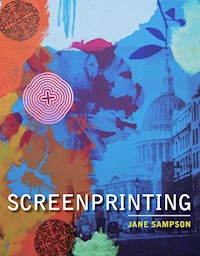
Screenprinting is loved by artists and designers for its accessibility and for the seemingly endless possibilities that come naturally to a process that can combine vibrant colour and layering with pattern and image making. This book is not only aimed at the beginner, but also at more experienced printers who would like to brush up on their technique or bring themselves up to date. It is divided into chapters that cover a wealth of different screenprinting methods, from simple ones that can be achieved on a table top at home with minimum equipment, to those that require a professional studio or workshop set-up. Topics covered include using paper stencils and filler stencils; monoprinting through the screen; making positives for photo exposure by hand or by using the computer; making high-contrast positives and posterizations and there are special sections on using bitmaps, half tones and making colour separations. Aimed at screenprinters, both beginners and more advanced practitioners and lavishly illustrated with 200 clear, step-by-step colour photographs that lead you through each procedure.
Das E-Book können Sie in Legimi-Apps oder einer beliebigen App lesen, die das folgende Format unterstützen:
Veröffentlichungsjahr: 2017
Ähnliche




















SCREENPRINTING
JANE SAMPSON
ROBERT HALE
First published in 2017 by Robert Hale, an imprint of The Crowood Press Ltd,
Ramsbury, Marlborough, Wiltshire SN8 2HR
www.crowood.com
www.halebooks.com
This e-book first published in 2017
© Jane Sampson 2017
All rights reserved. No part of this publication may be reproduced or transmitted in any form or by any means, electronic or mechanical, including photocopy, recording or any information storage and retrieval system, without permission in writing from the publishers.
British Library Cataloguing-in-Publication Data
A catalogue record for this book is available from the British Library.
ISBN 978 0 71982 214 8
The right of Jane Sampson to be identified as author of this work has been asserted by her in accordance with the Copyright, Designs and Patents Act 1988.
CONTENTS
Preface
1 Introduction
2 Equipment and Materials
3 Using Paper Stencils
4 Reduction Printing
5 Drawing Fluid and Filler Stencils
6 Monoprinting Through the Screen
7 Photographic Stencil Making – the Basics
8 Making Positives for Photostencils
9 High-Contrast Digital Positives and Posterizations
10 Dealing with Halftones and Bitmaps
11 Four-Colour Separations
12 Colour Theory
Glossary
List of Suppliers
Index
PREFACE
This is a practical ‘how to do it’ book written with artists, designers and enthusiastic amateurs in mind. It is based on many years of experience as a professional artist/printmaker with a long track record of exhibiting and also working as a teacher and lecturer in colleges, universities and in my own open-access studio, Inkspot Press.
The book uses an accessible step-by-step approach, with separate chapters illustrating everything from basic paper stencil techniques and simple handmade approaches that do not require sophisticated equipment, to the use of more complex photographic stencils. It also covers making colour separations by hand and on the computer. It aims to enlighten and inspire, giving people the confidence to have a go at this most versatile of print media and to develop their own style.
I would like to thank all of the artists who kindly allowed me to photograph them at work, or contributed their time and imagery to the book. These are: John Parkinson (Parky), Anthony Downey, Frances Quail, Annie Mendelow, Jack Nash, Jodie Tableporter, Rachel Brookes-Read and Anita Bernacka, plus Fox Fisher (who took many of the photographs), all of whom are regulars at Inkspot Press. And last but not least, I would like to thank my partner, the print wizard, Andy from Handprint, who helped with the last two chapters.
Jane Sampson
Jane Sampson is an award-winning artist/printmaker with a specialist knowledge of screenprinting. She has been printing for over thirty years and has experience in both commercial and artistic environments. She is well known as an enthusiastic and inspiring teacher. She works from her open-access studio, Inkspot Press, in Brighton, as a part-time lecturer at Brighton University and as a short-course tutor at Westdean College (the Edward James Foundation). As a practising artist she exhibits widely, both in the UK and abroad, and her work is held in many private and public collections.
CHAPTER 1
INTRODUCTION
What is screenprinting?
In essence, screenprinting is a sophisticated form of stencilling, in which the stencil is carried on a fabric mesh that is tightly stretched across a frame. The advantage of mounting a stencil on a screen is that the stencil can have its floating parts (like the middle of an ‘o’) held in place by the mesh, whereas a traditional stencil would need to have ‘ties’ or bridges to hold some of its elements in place.
It is also known as silkscreenprinting, because in its infancy as a commercial process at the beginning of the nineteenth century early pioneers used silk ‘bolting’ cloth as the stretched fabric. Likewise in Europe it is called sérigraphie, serigrafica or siebdruck (French, Spanish and German) from the Greek/Latin root seri for silk. Fine Art prints are sometimes known as serigraphs, particularly in America, rather than screenprints, as a way to distinguish these prints from their commercial counterparts.
Nowadays the mesh is not made of silk. It is usually made of specially woven monofilament polyester, although in some applications nylon or stainless-steel meshes are used. Modern meshes are not prone to rotting and stretching with wear like silk and can be reclaimed after use.
The screen frames can either be made of wood or metal (usually steel or aluminium) to which the mesh is firmly glued. The frames have to be strong enough to resist the tension of the tightly stretched fabric without bowing and also must be water-resistant so that they do not warp with constant cleaning and reclaiming. The days are gone when it was sufficient to stretch a screen by hand and staple the fabric to the frame. In the wider world, screenprinting is a high-tech industry with equally high-tech industries creating machinery and supplies to service it.
The stencil image is printed, using a squeegee, by forcing ink or dye through the open areas of the mesh on to the paper or fabric underneath. In the early days, metal blades were used, but as these would eventually tear the silk, they were replaced by rubber blades, which, in turn, would wear down and harden with age. Today, squeegees usually consist of a flexible, very durable, polyurethane blade clamped into a wooden or aluminium handle.
When printing, the empty stencil is first loaded with ink using the squeegee (the flood bar on an automated printing table). This is called the flood stroke. The ink in the screen is then printed down on to the print with another stroke of the squeegee (the pull). Preparation – the artwork, stencil making, ink mixing and colour matching – forms a huge part of the process and can be time-consuming. The actual printing is a relatively fast procedure.
The stencil itself can be made in many different ways, both low- and high-tech. Its main function is to block the mesh in the non-printing areas and prevent the printing ink from penetrating through on to the substrate below. It has to resist the action of the squeegee blade and the printing ink without breaking down.
At the low-tech end, simple temporary stencils can be made from thin cut paper, or can be painted directly on to the mesh with fluid, which, when dry, will be ink-resistant (screen filler or screen block). Some stencils are cut on a backing such as Profilm and adhered to the mesh with solvent or water. Others make use of a resist technique rather like batik.
All of the above hands-on, direct methods are still in use, particularly amongst artists, designers and hobbyists who want to make their own prints. It is possible to work using these methods without having access to complicated or expensive equipment or even a workshop. They are still popular because they can produce a particular aesthetic, or look, that is hard to create in any other way, even on a computer. There is a physicality about screenprints that is hard to fake with an inkjet printer.
These direct methods also mean that the artist incorporates his or her hand in the making process and can stay true to the immediacy of drawing, cutting or painting without any intervening mechanics. As such, screenprints are as satisfying to do, as they are absorbing and creative. While running my open-access print workshop and when teaching, I am constantly being told, particularly by graphic designers and Illustrators, just how much they enjoy ‘getting their hands dirty’ after long hours sitting at a computer screen. Also, the satisfaction of creating a product from start to finish simply cannot be matched.
However, by far the most reliable, accurate and widely used method of stencil making is photographic. Photo stencils are exposed on to the screen from a positive, using ultraviolet light. This allows an extraordinary array of textures, marks and imagery, whether hand-drawn or photographic, photocopied or computer-generated, to be used. This opens up a whole world of possibilities when it comes to image-making. Artists and designers have exploited this to great effect since the 1950s, although the technology to make photo stencils has actually been around since the turn of the nineteenth century.
A screen-printed image (graphic or Fine Art) is built up in layers of colour, one colour at a time. So, for example, if you were printing twenty two-colour prints on to paper using blue and black, you would first print all twenty sheets using the blue stencil. Then, when they were dry, you would print all twenty again using the black stencil. The black would have to print in the right place, registering with the blue, on every print, for the print run to work out successfully. To achieve this, a system of registration has to be used in multilayered, multicoloured designs.
Screenprinting is incredibly flexible when it comes to ink. The inks used can be mixed to different opacities (using transparent bases) and can be printed, either to cover a colour underneath or to let it show through, therefore creating a third colour (overprinting). The thickness of the layer of ink deposited can be controlled by using fine or coarse meshes. This makes it possible to print images on to an extraordinarily wide variety of surfaces and great vibrancy of colour can be achieved. Specialist inks, both solvent- and water-based, can be sourced to print on to paper or textiles, wood or vinyl, and also on to glass, ceramics, metal, plastic, rubber and polythene. There are ink mixtures that are scented, metallic, phosphorescent, fluorescent, heat-sensitive, electrically conductive or adhesive, or that carry glitter, mica, interference powders, or tiny reflective glass beads.
Since screenprinting is not, like etching or lithography, a pressure process, where an image is offset from a plate, it is possible to print on almost anything, even three-dimensional objects such as mugs or bottles or objects in situ, given the right equipment. It is simply one of the most versatile methods of printing in existence. Powered by commerce, over the years the process has been exploited and diversified by ingenious printers, technicians and entrepreneurs until there is hardly a consumer product that is not touched by it at some part of its manufacture.
If asked, most people would know that their T-shirts, caps, football shirts and other sports gear (basically anything that needs branding), their jackets, shirts and dresses, the fabric for their curtains, cushions and upholstery, tea towels, umbrellas, wallpaper, ceramic tiles, plates and mugs and so on are, more often then not, decorated using screenprinting. They might also realize that posters, banners and flags, stickers, billboards, display signage, estate-agent signs, road signs, car licence plates, skateboards, surf boards, beer mats, transfers, CDs and DVDs, bottles and containers of all kinds, are also screen-printed. As are the control panels and instrument panels on, for example, their washing machine or car dashboard.
But unless they were in the components trade, how many people would know that PCBs (printed circuit boards), semiconductors, biomedical sensors, fuel cells and membrane switches all use screenprinting as part of their manufacture and that its technical uses are constantly evolving?
Screenprinting is visible everywhere you look. Wherever there is a need for a cheap and controllable way of layering one substance on to another with extraordinary precision and endless repeatability, screenprinting will probably prove to be one of the simplest, most cost-effective ways of achieving it.
Given this extraordinary diversity and commercial success, the development of screenprinting as a medium for artistic expression is a drop in the ocean. But it is that significant drop that is the subject of this book. In the chapters that follow I will show you some of the inner secrets of screenprinting and explain just how you can explore and improve your techniques to produce fantastic prints.
CHAPTER 2
EQUIPMENT AND MATERIALS
Since this book is primarily aimed at artists, designers and those who would like to print their own work, my explanations cover flatbed printing and only mention commercial cylinder presses or rotary printing in passing.
Lesen Sie weiter in der vollständigen Ausgabe!
Lesen Sie weiter in der vollständigen Ausgabe!
Lesen Sie weiter in der vollständigen Ausgabe!
Lesen Sie weiter in der vollständigen Ausgabe!
Lesen Sie weiter in der vollständigen Ausgabe!
Lesen Sie weiter in der vollständigen Ausgabe!
Lesen Sie weiter in der vollständigen Ausgabe!
Lesen Sie weiter in der vollständigen Ausgabe!
Lesen Sie weiter in der vollständigen Ausgabe!
Lesen Sie weiter in der vollständigen Ausgabe!
Lesen Sie weiter in der vollständigen Ausgabe!
Lesen Sie weiter in der vollständigen Ausgabe!
Lesen Sie weiter in der vollständigen Ausgabe!
Lesen Sie weiter in der vollständigen Ausgabe!




