


0,00 €
Mehr erfahren.
- Herausgeber: transcript Verlag
- Kategorie: Geisteswissenschaft
- Serie: Postcolonial Studies
- Sprache: Englisch
With the right to petition the United Nations, the Ewe and Togoland unification movement enjoyed a privilege unmatched by other dependent peoples. Using language conveying insecurity, the movement seized the international spotlight, ensuring that the topic of unification dominated the UN Trusteeship System for over a decade. Yet, its vociferous securitisations fell silent due to colonial distortion, leaving unification unfulfilled, thus allowing the seeds of secessionist conflict to grow. At the intersection of postcolonial theory and security studies, Julius Heise presents a theory-driven history of Togoland's path to independence, offering a crucial lesson for international statebuilding efforts.
Das E-Book können Sie in Legimi-Apps oder einer beliebigen App lesen, die das folgende Format unterstützen:
Seitenzahl: 940
Veröffentlichungsjahr: 2024
Ähnliche




















Editorial
Postcolonial research has brought critical perspectives on colonialism in history and its heritage nowadays into public and scholarly focus. Similarly, postcolonial theorists have shown how deeply European scholarship and education are intertwined with the history and present of colonialism. For quite some time now, this postcolonial critique has triggered important public debates on the colonial past and how it should be remembered. The series Postcolonial Studies offers an editorial platform to continue these important discussions in an interdisciplinary framework.
Julius Heise, born in 1989, completed his doctorate at the Center for Conflict Studies (CCS) at Philipps-Universität Marburg and the Collaborative Research Center “Dynamics of Security”. His research encompasses post- and decolonial approaches to decolonisation and statebuilding, emphasizing Critical Security Studies within Conflict Studies.
Julius Heise
Securitising Decolonisation
The Silencing of Ewe and Togoland Unification under United Nations Trusteeship, 1945-1960
This publication constitutes a shortened version of the doctoral dissertation “‘Give Unification or We Perish’: The (failed) Securitisation of Ewe and Togoland Unification under United Nations Trusteeship” submitted to the Department of Social Sciences and Philosophy at the University of Marburg.
The research was funded by the Deutsche Forschungsgemeinschaft (DFG, German Research Foundation) – project number 227068724. Open access funding provided by the Open Access Publishing Fund of Philipps-Universität Marburg with support of the Deutsche Forschungsgemeinschaft (DFG, German Research Foundation).
Bibliographic information published by the Deutsche Nationalbibliothek
The Deutsche Nationalbibliothek lists this publication in the Deutsche Nationalbibliografie; detailed bibliographic data are available in the Internet at https://dnb.dnb.de/
This work is licensed under the Creative Commons Attribution 4.0 (BY) license, which means that the text may be remixed, transformed and built upon and be copied and redistributed in any medium or format even commercially, provided credit is given to the author. https://creativecommons.org/licenses/by/4.0/
Creative Commons license terms for re-use do not apply to any content (such as graphs, figures, photos, excerpts, etc.) not original to the Open Access publication and further permission may be required from the rights holder. The obligation to research and clear permission lies solely with the party re-using the material.
First published in 2024 by transcript Verlag, Bielefeld
© Julius Heise
Cover layout: Maria Arndt, Bielefeld
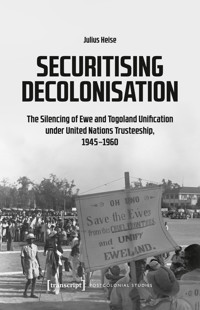
Cover illustration: UN Photo / Lomé, French Togoland, natives manifest for Unification of Eweland during visit of the Mission to West Africa
Printed by: Majuskel Medienproduktion GmbH, Wetzlar
https://doi.org/10.14361/9783839473061
Print-ISBN: 978-3-8376-7306-7
PDF-ISBN: 978-3-8394-7306-1
EPUB-ISBN: 978-3-7328-7306-7
ISSN of series: 2703-1233
eISSN of series: 2703-1241
Contents
List of Photographs, Figures, and Maps
List of Tables
List of Abbreviations
Acknowledgements
1.Introduction
1.1Secessionist Conflict in “Western Togoland”
1.2Research Puzzle & Goal
1.3Argument & Approach
1.4Relevance & Contribution
1.5Outline
2.State of the Art
2.1Neo-Trusteeship & (In)Security
2.1.1Antecedents: From Transitional to Structural Problems (1960–1970s)
2.1.2 The 1st Generation: Of ‘Quasi’ & ‘Failed States’
2.1.3 The 2nd Generation: From Peace-Keeping to State-Building
2.1.4 The 3rd Generation: Colonial Reminiscence
2.1.5 The 4th Generation: The Local Turn
2.1.6 The 5th Generation? Decolonising State-Building
2.1.7 Postcolonial Security Studies
2.2Trusteeship & (De)Colonisation
2.2.1 Origins of Trusteeship
2.2.2 The United Nations Trusteeship System & Security
2.3Togoland
2.3.1 State- & Nationhood
2.3.2 Security
2.4Situating the Research Agenda
3.Theoretical Framework
3.1Copenhagen School
3.1.1 Internalist vs. Externalist Understanding
3.1.2 The Audience’s Agency
3.1.3 Securitisation Theory? Or: How to Predict the Present
3.1.4 Historicisation of Security & Securitisation of History
3.1.5 Securitisation in a Postcolonial Reading
3.2Paris School
3.3Research Perspective
4.Methods
4.1Research Design
4.1.1 A Constructivist Study
4.1.2 A Qualitative & Comparative Study
4.2Archival Research
4.2.1 Archives Visited
4.2.2 Challenge of Access & Supplementary Sources
4.2.3 Research Procedure & Evaluation
5.Historical Background: From Slave Coast to Mandate Territory
5.1Precolonial Era & Introduction of European Rule
5.1.1 From ‘Gold Coast’ to ‘Slave Coast’
5.1.2 Ewe Heterogeneity
5.1.3 The Emergence of ‘Eweness’
5.2The ‘Schutzgebiet Togoland’
5.2.1 Drawing Borders & Conquest of the Hinterland
5.2.2 Exploitation & Modernization
5.2.3 Petitions as Anticolonial Resistance
5.3Togoland under Mandate
5.3.1 Creation of the Mandates System
5.3.2 French & British Togoland under Mandate
6.The Securitisation of Ewe & Togoland Unification before the United Nations
6.1Bringing Togoland under United Nations Trusteeship
6.1.1 Establishment of the United Nations Trusteeship System
6.1.2 The Instruments of International Supervision
6.2The All-Ewe-Conference & First Petitions under Trusteeship
6.2.1 Formation of the ‘Ewe Parties’
6.2.2 Establishment of the Petition Procedure
6.3Security Matters: Trouble in Accra & Abidjan (1948–1951)
6.3.1 The Accra Riots & the Special Branch
6.3.2 The Abidjan Troubles & the Service de Sûreté
6.4Securitising Petitions I: Trusteeship Council (1949–1951)
6.4.1 New Restrictions for Petitions & Visiting Missions (1949)
6.4.2 The Anglo-French “Master Stroke” (1950)
6.4.3 From Ewe to Togoland Unification (1951)
6.5Securitising Petitions II: The General Assembly (1951–1955)
6.5.1 After Vogan: Double Standard for Examining Petitions (1951)
6.5.2 Political Development under Security Surveillance (1952)
6.5.3 Securitising the French “Reign of Terror” (1952)
6.5.4 A Spectre haunts Africa – the Spectre of the “Red Menace” (1953)
6.6Turning the Tides I: British Togoland (1954–1957)
6.6.1 “A New Type of Threat” (1954)
6.6.2 Action Plan & Internal Security Updates (1955)
6.6.3 The 3rd Visiting Mission (1955)
6.6.4 Anglo-French Arrangements for the Togoland Referenda (1955)
6.6.5 The British Togoland Referendum (1956)
6.7Turning the Tides II: French Togoland (1956–1960)
6.7.1 Loi-Cadre & the Autonomous Republic of Togoland (1956)
6.7.2 The French Togoland Referendum (1956)
6.8The Independence of British & French Togoland
6.8.1 Securitising the Independence of French Togoland (1957)
6.8.2 The Parliamentary Election in French Togoland (1958)
6.8.3 Termination of Trusteeship & Independence
6.9Post-Independence Conflict
6.9.1 Repressive Tit-For-Tat (1960–1962)
6.9.2 Assassination of Olympio (1963)
6.9.3 Aftermath: Rise & Demise of The Togoland Liberation Movement
7.Conclusion
7.1General Summary
7.2Key Findings and Conclusion
7.2.1 Sub-Question 1: (In)Securitisation by the Administering Authorities
7.2.2 Sub-Question 2: Securitisation by the Petitioners
7.2.3 Sub-Question 3: The United Nations as an Audience of Securitisation
7.2.4 General Conclusion
7.3Potentials, Limits, Outlook
Bibliography
List of Photographs, Figures, and Maps
Map 1:“Western Togoland”
Map 2:Ewe Settlements & Togoland under UN Trusteeship (1946–1957)
Map 3:Reorganization of the Volta Region
Map 4:Ewe Settlements
Photo 1:Schutztruppe in German Togoland
Map 5:German Togoland (1885–1915)
Map 6:Simon-Milner Boundary Accords (1920)
Map 7:Border Demarcation across Eweland (1920–1956)
Figure 1:Distribution of the Ewe-speaking population (1947)
Photo 2:Meeting of the Togobund, Accra (26 July 1931)
Figure 2:Structure of the Trusteeship System
Photo 3:Sylvanus Olympio & Ralph Bunche, Lake Success (8 December 1947)
Photo 4:Olympio addressing a crowd at Hotel Tonyeviadji, Lomé (4 January 1948)
Photo 5:CUT Meeting after Olympio’s return, Lomé (4 January 1948)
Photo 6a & 6b:AEC Meeting after Olympio’s return, Ho (11 January 1948)
Figure 3:Police Force in British Togoland (1947–1955)
Photo 7:Ewe Unificationist awaiting the Visiting Mission, Lomé (December 1949)
Photo 8:Amu, Simpson & Olympio at Palais de Nations, Geneva (20 March 1950)
Photo 9:Asare, Antor & Olympio before Hearing, Lake Success (11 July 1950)
Photo 10:Ayeva & Olympio before Council Hearing, Lake Success (11 July 1950)
Figure 4:Written Petitions from Togoland handled by the Council (1947–1959)
Photo 11:Enlarged Consultative Commission (7 November 1950)
Figure 5:Written Petitions on the Trusteeship Council’s Agenda (1954–1957)
Figure 6:Trusteeship Council Resolutions on Petitions (1952–1956)
Photo 12:Chairman of the 1952 UN Visiting Mission (2 September 1952)
Photo 13:Olympio & Antor conversing with Ralph Bunche (1 December 1952)
Photo 14:Robert Ajavon addressing the 4th Committee (12 December 1952)
Photo 15:Odame, Olympio & Kpodar before 4th Committee (15 December 1952)
Photo 16:Petitioners of Togoland Congress (17 November 1953)
Photo 17:Oral Hearing of Integrationists (1 March 1954)
Photo 18:15 Togoland Petitioners before the 4th Committee (1 December 1954)
Figure 7:Number of Petitioners before the 4th Committee (1951–1957)
Map 8:Voting Districts as Recommended by Visiting Mission (1955)
Photo 19:Togoland Unificationists before 4th Committee (1 December 1955)
Photo 20:Voting Campaign in Southern Togoland (April 1956)
Photo 21:March organised by Togoland Congress, Ho (6 May 1956)
Photo 22:Alex Odame addressing a gathering, Jasikan (April 1956)
Photo 23:Referendum Day, Logba Adzakoe (9 May 1956)
Map 9:British Togoland Referendum (1956)
Photo 24:Togoland Congress and CPP before 4th Committee (ca. November 1956)
Photo 25:Pro-French Counter-Petitioners before 4th Committee (3 January 1957)
Photo 26:Akakpo, Santos & Olympio before 4th Committee (03 January 1957)
Photo 27:The “King-Commission” (3 May 1957)
Photo 28:Sylvanus Olympio before Trusteeship Council (17 April 1957)
Photo 29:Apedo-Amah & Koscziusko-Morizet (12 September 1957)
Photo 30:Akakpo & Ohin before 4th Committee (8 November 1957)
Photo 31:Santos & Olympio before 4th Committee (8 November 1957)
Photo 32:Bureau of UN Observation Mission (25 March 1958)
Photo 33:Emergency registration, Hall of Justice, Lomé (7 April 1958)
Photo 34:Line-up during election day, Agabadelogan (27 April 1958)
Photo 35:CUT and Juvento supporters celebrating, Lomé (1 May 1958)
Map 10:French Togoland Parliamentary Elections (1958)
Photo 36:Juventists singing party song on election eve (26 April 1958)
Photo 37:Olympio (with nameplate of France), 4th Committee (3 November 1958)
Photo 38:Prime Ministers Olympio & Nkrumah, Lomé (11 June 1960)
Photo 39:March for the re-unification of Togoland, Lomé (23 September 1961)
Photo 40:”The Togo that we want,” Lomé (23 September 196)
List of Tables
Table 1:Silence Dilemma & Three Wise Monkeys
Table 2:Securitisation’s Silence Dilemma resulting from
Table 3:Results Togolese Assembly, Elections (1946–1952)
Table 4:1954 General Elections’ results in British Togoland (South)
Table 5:Togolese Security Personnel after Independence
List of Abbreviations
AFP
Agence France-Presse
ANOM
Archives Nationales d’Outre-Mer (Aix-en-Provence)
ANF
Archives Nationales de France (Pierrefitte-sur-Seine)
ANT
Archives Nationales du Togo (Lomé)
AOF
Afrique Occidentale Français
BNI
Bureau of National Investigation (Ghana)
CenSeC
Central Security Committee (Gold Coast)
CFA
Franc des Colonies Françaises d’Afrique
CPP
Convention People’s Party
CSS
Critical Security Studies
CUT
Comité de l’Unité Togolaise
DisSeC
District Security Council
GAOR
General Assembly Official Records
HMG
Her/His Majesty’s Government
HSGF
Homeland Study Group Foundation
ILRM
International League for the Rights of Man
Juvento
Mouvement de la Jeunesse Togolaise
LIC
Local Intelligence Committee (Gold Coast)
MAE
Archives Diplomatiques du Ministère des Affaires Étrangères (La Courneuve)
MI5
Military Intelligence 5
MPT
Mouvement Populaire Togolais
NIB
National Intelligence Bureau (Ghana)
NSC
National Security Council (Ghana)
NSGTs
Non-Self-Governing Territories
PTP
Parti Togolais du Progrès
R2P
Responsibility to Protect
RDA
Rassemblement Démocratique Africain
RegSeC
Regional Security Council
PMC
Permanent Mandates Commission
PRAAD
Public Records and Archives Administration Department (Accra & Ho)
PUT
Parti de l’Unité Togolaise
SB
Special Branch
SCRBC
Schomburg Center for Research in Black Culture (New York)
SDECE
Service de Documentation et de Contre-Espionage
SLO
Security Liaison Officer
TCOR
Trusteeship Council Official Records
TNA
The National Archive (London)
TOLIMO
Togoland Liberation Movement
UCPN
Union des Chefs et des Population du Nord
UDPT
Union Démocratique des Peuples Togolais
UN
United Nations
UN
ARMS United Nations Archives and Records Management
UNPO
Unrepresented Nations and Peoples Organization
USA
United States of America
USSR
Union of Soviet Socialist Republics
Acknowledgements
A project of this size and scope is a product of rewarding friendships and rich collegial exchanges that accumulated many intellectual, personal, and financial debts.
Thorsten Bonacker, under whose supervision this dissertation was written, first drafted the cornerstones of this project. Above all, I thank him for “entrusting” me with the investigation of this case as a research fellow. Special gratitude goes to the circle of colleagues in the research project: Werner Distler and Maria Ketzmerick have contributed to this study with their own research on the UN Trusteeship System and showed me the way around the vagaries of the German university system and academia in general. Our research project could not have been what it was without the work of our student assistants: Karoline Möller, Lea Stromowski, Luisa Seutter, Laura Kotzur, Theresa Bachmann, and Leonie Disselkamp. Special gratitude must go the latter for supporting my work with her incredible dedication and with in-depth office conversations that kept me on the toes. I am grateful to have enjoyed the collegial companionship of the staff at the Center for Conflict Studies (CCS): Susanne Buckley-Zistel, Stéphane Voell, Philipp Lottholz, Alina Giesen, Miriam Tekath, Tareq Sydiq, Joana Amaral, Stephen Foose, Alexandra Engelsdorfer, and Astrid Juckenack.
I would also like to thank my colleagues from the SFB/TRR 138 “Dynamics of Security,” especially Marina Kraft and Angela Marciniak for their supportive work, but also the other doctoral students, through the unifying awareness that we were all in the same boat. I also benefited immensely from the collegial exchange with the members of the project group Intersectionality and Difference. Gratitude goes to Sigrid Ruby for willingly steering the group over the four years and to Huub van Baar for the many helpful comments.
In my research, I benefited from the expertise and guidance of the staff of several archival institutions to whom I am grateful for allowing me to consult documents and other works in their possession. Among those I would like to mention the reading room staff the Archives Nationales du Togo (ANT) and the Bibliothèque Nationale du Togo in Lomé; the Public Records and Archives Administration Department (PRAAD) in Accra and the regional branch in Ho (special gratitude goes to Augustine Julius Gede, who with tremendous kindness helped me immensely in finding delicate source material); Kathryn of the United Nations Records Management Section (UN ARMS) in New York, the staff at the Archives Nationalesde France (ANF) in Pierfitte-sûr-Seine, Paris; the staff of The National Archive (TNA) in London; the Archives Nationales d’Outre Mer (ANOM) in Aix-en-Provence; and the Archives Diplomatiques du Ministère des Affaires Étrangères (MAE) in La Courneuve, Paris.
I am grateful for the research tips of the following scholars who pointed me to source material and initiated further contacts: Joël Glassman, Kokou Azamade, Emmanuel K. Noglo, Adovi Michel Goeh-Akue, and Alexander Keese.
I am also grateful to all the anonymous reviewers of the research papers, who cannot be named here. Although not always easy to deal with the anonymised criticism, the comments have nonetheless improved the argumentation of this dissertation.
In Togo and Ghana, I was fortunate to have many friends and an incredibly supportive host-family. Special thanks to the Ahli family who hosted me so long ago, who endeavoured to stay connected and who hosted me again without further ado. Especially I would like to thank my host mother, Lucie Ahli and my fofoga Albert Yao Ahli. You were the most patient and loyal company I had during my stays in Togo. I would like to thank my long friend Alfred Kokou Gbidi, who provided me access to Emmanuel Go-Konu at the Université de Lomé.
The best should be saved for last. Above all, I would like to thank my family: my lovely daughter, without whom this project would certainly have been completed a year earlier, and my wife, Alina. This project has benefited in so many ways from her help, whether academically, linguistically, organisationally, emotionally, or financially. You always had my back. Thank you. To all of you.
1.Introduction
“We live in an illusion of security in this country without recourse to the lessons of the past.”1
1.1 Secessionist Conflict in “Western Togoland”
On 6 March 2017, during Ghana’s 60-year independence celebrations, Ghanaian security forces arrested the leadership of the Homeland Study Group Foundation (HSGF),2 including its then 84-year-old founder, Charles Kwame Kudzordzi. Shortly after Ghana returned to democratic rule in 1992, the former educationist and self-proclaimed Ewe-historian founded the HSGF in 1994 to openly advocate for the secession of parts of Ghana’s Northern, Upper East, and Volta Region to form the state of “Western Togoland” (see Map 1).3
When members of the HSGF were spotted wearing T-shirts reading “9 May 2017 is OUR DAY Western Togoland” Ghanaian security agencies suspected the group to make a declaration of independence and thus arrested its leadership.4 Apart from the suspiciously deliberate decision of the Ghanaian security forces to arrest the group on 6 March, thereby producing a nationalist statement during Ghana’s 60th independence celebration, the HSGF’s allusion to “9 May” was a reference to another symbolic date – in Ghana’s national history and the history of decolonisation at large.
Map 1: “Western Togoland”
Source: Own creation.
The Division of Togoland
After World War I, the former colony of German Togoland was divided among France and Britain as spoils of war: “Eastern” Togoland became a League of Nations mandate territory under French administration and “Western” Togoland became a mandate territory under British administration. However, the new colonial border demarcation cut through the settlement area of the Ewe people(s),5 the majority of which found itself split among three territories: French mandated Togoland, British mandated Togoland, and the “Volta Triangle” of the British Gold Coast Colony (see Map 2).
Map 2: Ewe Settlements & Togoland under UN Trusteeship (1946–1957)
Source: Own creation.
After World War II, the League of Nations Mandates System was transformed into the United Nations Trusteeship System and oversight of Togoland’s path to self-determination developed a dynamic of its own: the division of the territory led to the formation of a unification movement, which at first campaigned for the unification of ‘Eweland’ and later for the reunification of French and British Togoland within its former ‘German’ borders. The unification movement petitioned the United Nations – a right which hardly any other dependent people had dreamed of having recourse to. By using the right to petition the unification movement soon turned into something like a “star turn”6 of the United Nations, where it regularly pointed out violations of the Trusteeship Agreements and human rights, discrediting the rule and prestige of France and Britain.
For these two colonial powers, the unificationists’ campaign represented a concrete threat to the unity and integrity of their post-colonial associations of states: France wanted to keep French (“Eastern”) Togoland in the French Union and Britain wanted to integrate British (“Western”) Togoland into the Gold Coast, thereby keeping it within the British Commonwealth of Nations. Even though human rights gained international recognition and France and Britain were de jure the United Nations’ “Administering Authorities” and not colonial powers, both powers ostracized the Ewe and Togoland unification movement, presenting unification as a minority demand that was unfeasible, unpractical, and overall, a serious threat that could set a potential precedent for the ‘balkanisation’ of the African continent at large.
In the end, after years of negotiations before the venues of the United Nations as well as political campaigns and colonial repression in the trusteeship territories themselves, the movement’s Dream of Unity7 failed to materialise: On 9 May 1956, the United Nations supervised for the first time in its history an independence referendum, which eventually sealed the incorporation of the trusteeship territory of British (“Western”) Togoland into the neighbouring colony of the British Gold Coast. Consequently, the referendum sealed the definitive separation of the trusteeship territory of British (“Western”) Togoland from the trusteeship territory of French (“Eastern”) Togoland and thereby put an end to the decade-long debate at the United Nations on the demand for the unification of the Ewe people and the two Togolands.
Under the leadership of Kwame Nkrumah, British Togoland and the Gold Coast merged to form a new state, Ghana, which became the first African colony to gain independence on 6 March 1957. Ghana’s independence, thus, encompassed not only the independence of the first colony in sub-Saharan Africa but at the same time the independence of the first United Nations trusteeship territory. Ghana’s independence on 6 March 1957 is widely deemed a milestone in the history of decolonisation.8 For many inhabitants of British Togoland, particularly in its northern regions, it represented an anticolonial victory. However, for the Ewe and Togoland unification movement, the referendum on 9 May 1956 was tantamount to an anticolonial defeat. Especially many Ewes criticised the integration because it degraded them to an ethnic minority within the Akan-dominated state of Ghana and further removed them from the Ewes in neighbouring French Togoland. Thus, until today, 9 May 1956 and 6 March 1957 respectively, symbolize the tension between two contesting nationalist visions for the region.
A Reawakened Western Togoland Nationalism
Although the HSGF is calling for neither the unification of the Ewe people nor of the two former Togolands anymore, its followers still embrace a territorial ‘Western Togoland’ identity,9 similar to the unification movement of the trusteeship era. In fact, the formation of the HSGF represented a direct revival of a territory-based Togoland-nationalism under Ewe leadership that since the partition of German Togoland has been propagated by the (‘Western’) Togoland Liberation Movement (TOLIMO) in the 1970s, itself a successor to the Togoland Congress of the 1950s, the Togoland Union of the 1940s and the Bund der deutschen Togoländer (Togobund) of the 1920/30s.10 At the same time, many HSGF followers embrace an ethnic Ewe identity,11 for in the HSGF-produced maps of ‘Western Togoland,’ which are printed on T-Shirts and banners or distributed digitally on social media, the HSGF also lays claim to the Ewe-populated areas such, as Tongu or Anlo, that fall in the area of the former “Volta Triangle” of the British Cold Coast Colony, which historically never belonged to Togoland (see Map 2).
Since the HSGF’s founding in 1994, Charles Kwame Kudzordzi and his followers claimed that the 1956 UN-supervised referendum was rigged and ‘Western Togoland’ was therefore illegally integrated into Ghana.12 Besides the alleged invalidity of the referendum, according to the HSGF, UN Secretary-General Dag Hammarskjöld and Queen Elisabeth II allegedly tied the referendum’s result to a moratorium, which required an approval of the ‘union’ between the Gold Coast and British (“Western”) Togoland within 50 years; otherwise, the union would be void.13 As long as the ‘union’ was not approved, the people of ‘Western Togoland’ were merely “plebiscite citizens in Ghana.”14 Ghanaian historians were alarmed by the HSGF’s “bogus and unsubstantiated claims about the scope and import of the plebiscite,”15 stressing “the legality of the integration of British Togoland into Ghana.”16 When in 2007 the alleged ‘union document’ could not be produced, the HSGF contrived a narrative that Kwame Nkrumah, the figurehead of Ghanaian independence, probably made said document disappear. Losing much of its credibility, public interest in the HSGF dwindled – at least until the arrest of its leadership during the 60-year independence celebrations on 6 March 2017.
Kudzordzi and two of his comrades-in-arms were charged with treason. However, the Attorney-General dropped the charges due to their advanced age. Kudzordzi was cautioned and dismissed after signing a pledge of good behaviour along with a document acknowledging that the continuation of the HSGF’s secessionist activities is likely to pose a “threat to national security.”17
The Division of the Volta Region
To understand why the Ghanaian Attorney-General attorney found compelled to threaten the three elderly HSGF leaders with imprisonment unless they give up their activities, it is important to note that the HSGF’s demand for secession not only posed a threat to Ghana’s one-nation-agenda but at the same time exacerbated a dilemma for the newly elected Ghanaian government.
A couple of months earlier, during the 2016 parliamentary elections,18 the presidential candidate of the conservative New Patriotic Party (NPP), Nana Akufo-Addo, won against the National Democratic Congress (NDC) of incumbent President John Mahama. Akufo-Addo’s victory was in part due to the campaign promise to representatives of various ethnic groups that Ghana’s intrastate boundaries would be redrawn to create new regions. In January 2017, barely a month after the elections, Akufo-Addo ordered the creation of the Ministry of Regional Reorganisation and Development. In the northern part of the Volta Region, the Joint Consultative Committee (JCC), composed mainly of chiefs from the Guan ethnic sub-group, petitioned to President Akufo-Addo on 6 June 2017 calling for the creation of a separate region from the existing Volta Region: the Oti Region (see Map 3).19
A government-appointed commission of enquiry subsequently determined that there was a need and necessity in Ghana for a New Regions Referendum to decide on the division of four regions to create six new regions. While the report of the government-appointed commission argued that the regional reorganization was “for enhanced socio-economic development and not based on ethnic, cultural and religious issues,”20 the proposed new regional lines and support for them fell on an almost perfect parallel to where the new Oti Region would separate the Guans in the north from the Ewes in the south (compare Map 2 and Map 3).
The ruling NPP-government was in a predicament: Since it had to support the one-nation-agenda vis-à-vis the secessionist HSGF, at the same time it could not afford the impression that it was bowing to the pressure of ethnic appeasement. Soon voices were raised that the referendum on the redrawing of the internal border was an unconstitutional attempt at ethnic appeasement, representing a first step towards a possible descent into the ‘balkanisation’ of the Volta Region and a fragmenting “one-dialect-one-region” system.21 Particularly in the Ewe-dominated southern part of the Volta Region, complaints were raised that voting was only allowed in the areas of the proposed Oti Region – a provision, which would prejudge the outcome of the referendum.22
Map 3: Reorganization of the Volta Region
Source: Own creation.
In 2018, this prompted the US-based Association of Volta Youth to petition UN Secretary-General, Antonio Guterres, to intervene. The petition likened the New Regions Referendum to the British Togoland referendum of 1956, condemning it as “yet another fraudulent plebiscite.”23 Desiring to secede the entire region from Ghana, Kudzordzi opposed the fragmentation of the region, which before Ghana’s independence, as Kudzordzi pointed out, was called Trans-Volta-Togoland: “A trusteeship territory – it’s an aggression to divide it!”24 Kudzordzi regarded the New Regions Referendum as yet another weaponization of a popular consultation by the government in Accra against the traditional inhabitants of the Volta Region, particularly the Ewes, who over the last 150 years have seen the borders around them constantly change due to foreign interests.25 For Kudzordzi, the division of the Volta Region was just another item on the growing list of Ewe indignities in an Akan-dominated Ghana. Instances, such as the 2007 forcible eviction of hundreds of residents from Dudzorme Island in Lake Volta’s Digya National Park, during which more than 100 of the forcibly evicted died when a ferry capsized,26 or when the NPP-MP Kennedy Agyapong’s held his “Kill all the Ewes” hate speech in 2012,27 led Kudzordzi to the conclusion: “Today we are not safe. Insecurity is in our land.”28 Accordingly, the HSGF has…
“…decided to use force and leave. Yet, we are afraid. The nations of this world who will say ‘No. Why should you go by means of force? You must go democratically.’ What is the meaning of democracy? Does it not affect us as human beings too? This is the stage we have reached. And we are deciding now strongly, firmly to go, even if the United Nations, even if Britain would assist Ghana to commit genocide to all of us in the land, they could do so. They could decide to do so…”29
Similarly, when opposing youth groups clashed violently at a hearing in the run-up to the New Regions Referendum,30 the Asogli State Council, a representation of Ewe chiefs from the capital city of the Volta Region, Ho, voiced its opposition to the referendum as it represented apparently “a threat to the cherished peace we have enjoyed over the years in the Volta Region.”31 These statements were taken seriously: In the run-up to the ballot, 1,000 extra security personnel were deployed to the then still northern part of the Volta Region.32 Journalists were banned.33 In the end, in December 2018, according to official figures, an astonishing 99% voted in favour of becoming part of the new Oti Region.34
Six months after the New Regions Referendum, on 5 May 2019, that is, again just before the symbolic 9 May anniversary of the 1956 British Togoland referendum, the HSGF protested with T-shirts reading “Independence for Western Togoland – No Division of Volta.”35 Again, eight members, including Kudzordzi, were arrested by the Ghanaian security forces. Once more, the scale of the swoop was a national statement by the Ghanaian state that provided some bizarre imagery: described as a “Rambo-style” operation,36 26 armed police officers, 20 armed military personnel and some Bureau of National Investigation operatives whisked the eight arrested HSGF members to the 66 Artillery Regiment in Ho, where a waiting helicopter airlifted them to Accra. Video footage of the arrest shows the armed military personnel surrounding the by-then frail Kudzordzi, who approached the helicopter on a cane only with difficulty.37 However, when the court hearings began two months later, as before, on the government’s instructions, the AttorneyGeneral withdrew the charges due to Kudzordzi’s advanced age and general health conditions. The defendants were cautioned and released by July 2019.
Securitising “Western Togoland” Secessionism
Despite the previous arrests and judicial caveats, Kudzordzi could not be deterred in his determination: On 16 November 2019, he gathered his supporters at a rally, which was disguised as a funeral procession to elude the Ghanaian intelligence services, and publicly declared the secession and independence of ‘Western Togoland’.38 Broadcasted via social media platforms, the livestream showed a crowd raging with joy and Kudzordzi being driven from the scene.39 Soon after the declaration, pictures circulated on social media platforms, showing the supposed new country’s armed forces at the Western Togoland Gorilla Army training camp.40
From this moment on, various Ghanaian security analysts were alarmed and publicly called out the apparent lapsus by Ghanaian intelligence agencies,41 raising concerns that the aspirations of the Western Togoland secessionists could take on violent dimensions such as that of the Anglophone crisis in Cameroon.42 Numerous newspaper commentators and established security experts made appeals for a harsh and rapid crackdown:43 “Now that the issue is becoming an existential threat to the Volta Region and Ghana, stakeholders including chiefs, politicians and duty bearers from the region must be seen and heard doing something to contain the threat.”44 Some analysts considered “the stability of the entire country and, perhaps, even the entire West African sub-region” at risk.45 Others cautioned that the secession campaign by the HSGF might cause “tribal war.”46 Public calls were made to increase police presence in the Volta Region.47
Endorsed by such calls, the Ghanaian security agencies launched a crackdown and fugitive hunt for Kudzordzi as well as members and suspected sympathisers of the HSGF. In the following two weeks some thirty people were arrested.48 In a video message from his hiding place, Kudzordzi expounded that the Ghanaian authorities had forced the HSGF into exile and that those arrested had been put in prisons without trial and many people had disappeared. Kudzordzi called upon his supporters to remain peaceful in the face of antagonism from the Ghanaian security agencies. Yet, he reiterated his stance on secession by calling on international support: “I do appeal to the international world, those in the corridors of peace […] to come here, to put the situation under control, [and] to avoid any possible mayhem.”49 From his hide-out, Kudzordzi liaised with the Belgium-based Unrepresented Nations and Peoples Organization (UNPO), which in January 2022 brought the matter officially to the attention to of the UN, when it filed a complaint to the UN’s Working Group on Arbitrary Detention, alleging that the government of Ghana was systematically misusing the criminal justice system to target the HSGF.50 In June 2022, the UNPO followed up with a submission of a Universal Periodic Review to the UN Human Rights Council on the subject of Ghana’s crackdown on members of the HSGF.51
In the meantime, Ghanaian media outlets hotly debated the influence and legacy of these very ‘international corridors of peace’ invoked by Kudzordzi. Journalists dug up 60-year-old UN documents, strongly arguing for and against the historical (il)legality of the integration of British Togoland into the Gold Coast.52 In the course of the debate some notions of the United Nations’ colonial complicity were expressed: “Ghana’s rule over Western Togoland is […] an injustice, a trespass, a tyranny, worse than colonialism. […] that annexation of Western Togoland by Ghana for the purposes of expansionism or preponderance have been allowed, questioned the sacredness of the UN trust.”53 After a radio anchor in Sogakofe, South Tongu, criticised the Volta Regional Minister, Archibald Yao Letsa, for the heavy-handed crackdown, the later responded that “some media houses have become mouthpieces for the group whose activities threaten the peace and security of the country. But [...] they will be held liable if national security takes action against the group.”54 The Ghanaian Bureau of National Investigation arrested the radio’s director and shut the radio station down on grounds of national security concerns,55 which caused a massive backlash by press and NGOs.56
Eventually, the training camp of the Western Togoland Gorilla Army was located at Wli Todzi, near Hohoe, at the Togo-Ghana border. Two separate counter-insurgency operations by the Ho-based 66 Artillery Regiment and the Ghana Police Service led to over 70 arrests by May 2020.57 However, many of the suspected secessionists were discharged in subsequent court hearings.58
Yet, despite the military-aided crackdown, more separatist groups, such as the Peoples’Liberation Council of Western Togoland,59 the United Freedom Fighters,60 the Association of Western Togoland Youths,61 or the Concerned Citizens of Western Togoland made themselves publicly known.62 The latter claimed, given that Western Togolander’s “fundamental human rights always have been abused, they have come to the point of no return in becoming a state on its own.”63 A former MP from the Volta Region, Kosi Kedem, who has been echoing the HSGF’s thesis of the absent union document,64 argued that Ghana did not legally exist.65 While President Akufo-Addo, for his part, invoked Ghana’s national cohesion, he contended that the Western Togoland secessionists “do not understand nation-building.”66
In the meanwhile, some analysts opposed the hardliners that called for the heavy-handed crackdown, pleading that “government overreaction [...] should not escalate into full blown destructive wars.”67 Especially John Mahama, presidential candidate of the oppositional NDC, which maintains a stronghold in the Volta Region, condemned the ruling NPP for the deployment of military and security agencies in the Volta Region as a strategy to intimidate people ahead of the voter registration for the parliamentary elections in December 2020:68 “The military siege of the Volta Region and other locations during the [voters] registration exercise created an intimidatory atmosphere akin to a nation at war.”69 Unsurprisingly the NDC’s founder and Ghana’s former Ewe-born president, John Rawlings, put his political weight into the balance, condemning that the “deployment of the military and other security agencies in some parts of the Volta and Oti Regions is generating animosity especially amongst innocent citizens.”70
While Ghana’s Minister of National Security, Albert Kan-Dapaah, justified the use of military personnel by claiming that the Ghana Police Service was at times not up to the task when it comes to the level of security equipment required, several of Ghana’s prominent security analysts called for his removal saying that events in the Volta Region apparently vindicated that “the practice of ‘civilianising’ the military cannot be justified, cautioning that the military may lose its relevance and respect.”71 A media commentator’s historical analysis of Ghana’s security personnel concluded that Ghana’s security system is not fit for the separatists anyway, concluding that “at first gunshot emanating from these Western Togolanders, every one of them will run into the bush.”72 And shots were fired.
On 25 September 2020, events came thick and fast: militants of the previously unknown Western Togoland Restoration Front (WTRF) blocked several streets into the Volta Region, stormed two police stations, freed inmates, kidnapped three officers, stole two vehicles and a dozen or so machine guns from the armoury. During an exchange of gunfire, a member of the WTRF and the Chief Superintendent were shot.73 The WTRF subsequently issued a press release regarding their attempt to “assert their sovereignty on the Volta Region,”74 and called on the Ghanaian government to negotiate a ban on all its political activities including the withdrawal of all security forces from the Volta Region. By October 2020, another militia faction calling itself the Dragons of Western Togoland Military Army sent a note of caution to the Regional Minister, Letsa, claiming that “4,000-plus persons have been trained in another country to rescue their motherland” within 3 weeks.75 This claim has not materialised and operations by the Ghanaian security forces have had some success in containing the situation.
The ensuing media discussion was in full swing, and the spotlight was on historians and security analysts who offered different assessments of the causes of and possible responses to the secessionist threat.76 Security analysts engaged in an exchange of blows with the Minister of National Security, again calling for his removal over the failure of intelligence and security agencies.77
Indeed, the events and public debate had an effect as it eventually prompted a whole series of reforms addressing Ghana’s national security challenges.78 In the following, Ghana’s 25-year-old Security and Intelligence Act was reformed,79transforming the Bureau of National Investigation into a National Intelligence Bureau (NIB), thereby conflating core competencies of policing and criminal investigation with increased intelligence-driven activities.80 The reform furthermore updated Ghana’s pyramidal security architecture, rooted in the colonial period,81 and created additional committees for the National Security Council (NSC). Furthermore, memberships of the Regional Security Councils (RegSeCs) and District Security Councils (DisSeCs) were expanded to include community leaders with expertise in human security. To encourage public vigilantism as a direct reaction to the violence by the Western Togoland secessionists in the Volta Region, in June 2020, the Ministry of National Security and the National Commission for Civic Education (NCCE)82 launched a workshop campaign with representatives of civil society and religious communities, as well as district directors of the police and the newly created NIB.83 Finally, under the directive of President Akufo-Addo, a comprehensive National Framework for Preventing and Countering Violent Extremism and Terrorism has been introduced – the first document of this kind in Ghana’s history.84
Final Act?
These measures soon paid off: the figurehead of the secessionist movement, Kudzordzi, was tracked down by the Ghanaian intelligence services at his hideout near Ho and arrested on 28 July 2021.85 Due to health reasons, the trial against Kudzordzi had to be postponed several times and was finally scheduled to begin on 22 October 2021. In a final media interview, Kudzordzi presented himself combative: “I’ll be angry with God if my dream for Western Togoland is not realized.”86 Yet, after being released from custody to seek medical treatment, Kudzordzi passed away at St. Paul Hospital in Aksthi South, Volta Region, on 15 October 2021, at the age of 88.87
Expectedly, Kudzordzi’s passing was not the end of the story as even his funeral polarised the Ghanaian society: the MP for Volta Region’s district of North Tongu, Samuel Okudzeto Ablakwa, called on President AkufoAddo to pay Kudzordzi the honour of a state funeral, whereas security analysts, on the other hand, pointed to the still lingering threat posed by Kudzordzi’s ideas for which he should be buried in an unmarked grave so as not to create a place of pilgrimage for a martyr.88 On 29 October 2022, Kudzordzi was finally laid to rest in his hometown Xavi, in the south of the Volta Region, with tributes paid by HSGF comrades and amidst heavy presence of state security personnel.89
A month later, in November 2022, by order of the Ministry for National Security, Ghana’s National Peace Council had undertaking consultations with stakeholders in the Volta and Oti Regions regarding alleged ethnic identity-based discrimination and marginalization raised by people of Ewe origin and put together a report including recommendations, which would serve in addressing the concerns. Ironically, speaking on behalf of the Minister of National Security was the National Coordinator of the Ghana Boundary Commission, Major General Emmanuel Kotia, that is, head of the very state institution that for the HSGF was the starting point of the most recent bloodshed over ‘Western Togoland.’ This context was not sidestepped by the Volta Regional Minister, Archibald Letsa, who reminded at the event that “the alleged marginalization of the Ewe ethnic group dates back to 1956, following the plebiscite which saw the unification of the then Western Togoland and other territories to form Ghana.”90
In January 2023, the United Nations Working Group on Arbitrary Detention (WGAD) finally delivered its verdict in the case of arrested Western Togoland secessionists, concluding that the Ghanaian government had violated their rights by detaining them for sedition.91 Two months later, on 21 March 2023, the Accra High Court finally convicted the five arrested in the aftermath of the September 2020 attacks.92 Although the trial implicated the accused in the attacks, they were not charged for the attack and the policeman’s murder per se, but each received the maximum sentence of five years in prison in hard labour for violations of the Prohibited Organisations Act. Although the WTRF was unknown until the attacks, the Prohibited Organisations Act (which was passed in 1976 when Ghana was under military rule) banned the National Liberation Movement of Western Togoland (Tolimo) and thus also “any other organisation howsoever called, whose objects include advocating and promoting the succession from Ghana of the former British mandated territory of Togoland or part thereof.”93
1.2 Research Puzzle & Goal
The events and debates following the declaration of independence of ‘Western Togoland’ are exemplary of many speech-acts collected in the course of this work, demonstrating that the conflicts once considered resolved after the termination of United Nations trusteeship over Togoland are flaring up again. By reviving a language of threat and security in the conflict over ‘Western Togoland,’ the Ghanaian state and the secessionists entered a discursive exchange of blows in which one side is portrayed as an existential threat for the other – a dynamic which eventually led to bloodshed. Inspired by this empirical observation, this dissertation traces the history of Togoland’s internationally supervised decolonisation process to solve the puzzle of how (re)awakenings of a dormant Ewe and (“Western”) Togoland nationalism became a matter of security.
Over 60 years ago, ‘Western Togoland’ was hailed as the first territory to achieve independence under the international supervision of the United Nations Trusteeship System. Against the backdrop of the internationalisation of global governance, an emerging anti-colonialism as well as a right for the inhabitants of trusteeship territories to petition directly to the United Nations, Ewe and Togoland unificationists continuously petitioned against French and British rule and for sovereign statehood before United Nations venues. Their claims for unification, self-determination, statehood, and independence were similarly negotiated through a language of threat and security, influencing international opinion in a way that hardly any other independence movement in Africa had managed before. Yet, as Claude Welch put it in 1967,94 the institutions of international governance did not grant the unificationists their Dream of Unity, thus allowing the seeds of conflict to grow. The question arises why, despite all these favourable conditions, did the unificationists not have the upper hand in deciding the shaping of their future statehood? An answer to this question, which at first glance seems to be purely historical and only about Ghana, touches on broader, intersecting themes of decolonisation history, such as debates on national belonging, statehood, self-determination, but also international responses to security threats – in short, it informs current debates of international concern from a historical perspective.
To this end, the dissertation analyses a security-specific mode of communication from a historicising state-building perspective in the context of the United Nations trusteeship over Togoland under British and French administration (1947–1960). With a research agenda that looks at discursively negotiated constructions of threat and security, the research is guided by the question: “How have constructions of threat and (in)security influenced the decolonisation of Togoland, and to what extent is the recent conflict over the attempted secession of ‘Western Togoland’ rooted in these constructions?” This question will be broken down into three sub-questions, each focussing on a specific actor within the trilateral constellation of the United Nations Trusteeship System:
1.How did the French and British trustees (de)securitise their administration over French and British Togoland?
2.How did the unificationist petitioners securitise the trusteeship administration in Togoland, what agency is revealed in relation to it, and why did their attempts to securitise the (re)unification of Ewe- and Togoland not succeed?
3.What role did the United Nations, and the influence of world opinion more broadly, have in this dynamic of security constructions?
1.3 Argument & Approach
Security plays a significant role in international administrations as it is one of the core tasks named in the respective mandate agreements, thus representing a key point of reference for the legitimisation of international rule. In the introductory account of events, security emerged, on the one hand, as an object of conflict: the central purpose of state intervention is to ensure security and prevent serious threats, both internal and external, regarding previous violent conflicts or foreign domination. On the other hand, the events demonstrate that security also turned out to be a strategic mode of communication by which actors tried to make their political decisions, opposition, or resistance plausible to an audience and thus influenced a contested attempt at secession. Security communication can thus paradoxically not only ensure peace and public order, but also suppress oppositional forces.95
The research explores security constructions in and around decolonisation. Using Togoland as a case study, it delves into security dynamics under French and British administration, examining conflicts around the Ewe and Togoland unification movement. The study identifies threat constructions, analyses argumentation patterns, and explains mechanisms of action. Overarching all of this lingers the political science question of how to decide what security threats do and, what it says about the actors involved.
Drawing from Critical Security Studies (CSS),95F96 the struggle over Togoland’s decolonisation will be decoded primarily via a postcolonial reading of CSS’ securitisation framework. This framework explains how ‘security issues’ are an important vehicle for negotiating political power. Securitisation conceptualises security as a social process that classifies an issue as so significant that it is lifted out of normal everyday politics and makes extraordinary measures possible. Thus, at the centre of a securitisation process is a speech act, that is, an empirical object, which is not a threat per se but is only discursively made into one.
With approaches to securitisation, it is possible to address security speech acts and threat communication as well as macro-constellations, which link the international scene with local events in the territories themselves. This is what is special about Togoland’s internationally supervised decolonisation process, where a conflict developed over the conditions of independence. Petitioners from Togoland agitated before the United Nations Trusteeship Council and General Assembly for the reunification of once colonially divided territories. In doing so, they took on the role of anti-colonial securitising actors. In the case of Togoland, France and Britain assumed responsibility for the administration in the trusteeship territories, and in doing so, they fulfilled virtually all government functions. The trustees were monitored through the Trusteeship Council and General Assembly, with regular debates, reporting, and Visiting Missions to the trusteeship territories. This distinguished trusteeship de jure from colonial rule, yet de facto Togoland and other trusteeship territories were still under control of colonial powers. The ruling trusteeship powers, so-called Administering Authorities, demonstrated this through a continuity in colonial practice and discourse, enacting before the UN disabling frames to thwart the Ewe and Togoland unificationists’ securitising moves. Ultimately, their Dream of Unity97 failed to materialise because the structures supposed to ensure the “just treatment,”98 “well-being,”99 and “freely expressed wishes of the peoples concerned,”100 were used to limit the scope for protest. Thus, the failure of the Togolese petitioners was due to silencing effects originating from the colonial constellation of international supervision.
This study analyses these actors’ constructions of security and threat perceptions, their ruptures, and dilemmas in a historical perspective. This historical study of the debates around the trusteeship territories of British and French Togoland addresses the tripartite constellation of African, colonial, and UN actors, that is, the various levels of influence that legitimised political measures and interests during the period of decolonisation. The empirical analysis will show that constructions of (in)security were influential for the negotiation of trusteeship rule.
1.4 Relevance & Contribution
The study aims to contribute to literature in three key areas: historical Togoland research, statebuilding literature, and postcolonial perspectives in International Relations.
Regarding Togoland, the research delves into its significance as a site of historical precedents for postcolonial African states, such as being the location of the first UN-led independence referendum.101 The study emphasizes the lack of comprehensive theory-driven perspectives on Togoland’s decolonisation, highlighting its unique circumstances and the role it played in the international spotlight due to the reunification movement. In the realm of statebuilding literature, the research critiques the prevailing notion that deficits in statehood, often observed in postcolonial African states, pose direct threats to international security. It challenges the colonial continuity in contemporary statebuilding missions and emphasizes the need for a nuanced examination of securitisation moves and accountability bottlenecks in international statebuilding.
From a postcolonial perspective on International Relations and Critical Security Studies, the study explores the historical context of the UN Trusteeship System within 20th-century decolonisation. It advocates for incorporating postcolonial theory into Critical Security Studies, examining the conditions for success and failure in securitization moves and addressing the colonial legacy in the Togo-Ghana region. The study aims to bridge the gap between discourse approaches and sociological practices by analysing articulations of colonial fears and threat constructions in both public and behind-the-scenes forums. As this work is ultimately about a history of exclusion, it draws on guidance on how to promote more inclusion, both in ways that would expand the circle of who is speaking International Relations and Critical Security Studies,102 as well as the inclusion of marginalized security speech.103
1.5 Outline
The work is structured as follows: After this introduction, Chapter 2 outlines not only the current state of research on but also the course of the academic debate on state- and peacebuilding as well as Critical Security Studies. This is followed by the state of research on historical trusteeship and finally the research on security as well as nation- and statehood in Togoland. Chapter 3 engages the Copenhagen and Paris School of Critical Security Studies and presents the research approach of a post-colonially informed securitisation framework. Chapter 4 presents the methodological approach, explaining the research design and operationalisation of archival sources, including considerations that will address postcolonial sensitivities. Chapter 5 provides the historical context for the main analytical chapter. Although this is not the main chapter, the analytical framework comes into play to some extent in the presentation. Chapter 6 is the main empirical chapter, which contextually examines how Ewe and Togoland unification were securitised in the decolonisation process. An attempt was made to present the development of events and thus the context for the articulations of (in)security as chronologically as possible. On the one hand, this is deliberately done so as not to take securitisation moves out of their context and, on the other hand, because earlier works tended to separate their analyses of British Togoland and French Togoland for the sake of clarity.104 Such an approach was decidedly not applied in the present work to emphasise the interconnectedness and simultaneity of events from the anti-colonial actor’s point of view. Finally, Chapter 7 summarizes the findings and situates them in the context of the academic debate. A reflection on the potentials and limitations of the research approach aim to provide an outlook on remaining research desiderata.
1Samuel Adjei Sarfo, “The Secession of the Togolanders,” GhanaWeb, 26 September 2020.
2A. B. Kafui Kanyi, “Police Arrest Volta Secessionist Group Leaders,” Modern Ghana, 08 March 2017.
3Leticia Osei, “Police to Charge Volta ‘Separatist’ Group Members with Treason,” Ultimate FM online, 08 March 2017.
4Tim Dzamboe, “Group to Declare ‘Volta Region’ Independence on May 9, 2017,” Graphic Online, 17 August 2016.
5The plurality-s aims to indicate the commonly held understanding that the Ewe-speaking people in the region neither ethnically nor politically formed a homogeneous unit in the pre-colonial period.
6TNA (London), FO 371/138270, Foreign policy of Togoland, 1959, A.T. Oldham to H.F.T. Smith [Confidential Letter No. 5110/59], 24 April 1959.
7Claude E. Welch, Dream of Unity: Pan-Africanism and Political Unification in West Africa (Ithaca: Cornell University Press, 1967).
8Adom Getachew, Worldmaking after empire: The rise and fall of self-determination (Princeton: Princeton University Press, 2019).
9Charles Kwami Kudzordzi, A Stolen Nation and Her Deprived Nationals: (Franco-British Atrocities in Togoland). An Irredentist Nationalism (Ho: Win I.C.T. Centre, 2016).
10For his part, Kudzordzi makes no secret of his Germanophilia and glorification of the Deutsch Togobund as the national boundaries of the longed-for state of “Western Togoland” are based on the borders drawn first by German colonial officials.
11Charles Kwami Kudzordzi, A history of Eweland: A Resource Document for Ewe Socio-Political Studies (Ho: E.P. Church Publishing Ltd., n.d.).
12Charles Kwami Kudzordzi, interview by Julius Heise, 19 November 2018, Ho, Ghana.
13Charles Kwami Kudzordzi, interview by Julius Heise, 21 November 2018, Ho, Ghana.
14Dzamboe, “Group to declare ‘Volta region’ independence on May 9, 2017.”
15D. E. K. Amenumey, “The Brouhaha over Togoland Plebiscite. The Historical Fact,” GhanaWeb, 03 September 2016.
16Obed Y. Asamoah, The political history of Ghana (1950–2013): The experience of a non-conformist (Bloomington, IN, USA: AuthorHouse, 2014), p. 23.
17Tim Dzamboe, “Western Togoland “Secessionists” Discharged, Bonded,” Graphic Online, 20 July 2017; Osei, “Police to charge Volta ‘separatist’ group members with Treason”; “Member Profile: Western Togoland,” UNPO, accessed 09 July 2020, available from https://unpo.org/downloads/2363.pdf.
18Nathalie Raunet Robert-Nicoud, “Elections and Borderlands in Ghana,” African Affairs 118, no. 473 (2019), https://doi.org/10.1093/afraf/adz002.
19Government of Ghana, “Report of the Commission of Inquiry into the Creation of New Regions: Equitable Distribution of National Resources for Balanced Development” (2018), p. 91.
20Government of Ghana, “Report of the Commission of Inquiry into the Creation of New Regions: Equitable Distribution of National Resources for Balanced Development” (2018), p. 24.
21Komla Dzigbodi-Adjimah, “Oti Region,” Gbi Voice, 22 March 2017.
22Nii L. Lartey, “Ohene, Elizabeth Asks: Who Speaks for Ewes?,” Citi Newsroom, 02 November 2018.
23Association of Volta Youth, “Petition,” accessed 22 March 2021, available from https://www.modernghana.com/news/828252/volta-group-in-the-usa-petitions-un-over-split.html.
24Charles Kwami Kudzordzi, interview by Julius Heise, 19 November 2018, Ho, Ghana.
25Vincent Djokoto, Eeto and the Partitions of Eenyigba,” My Joy Online, 30 April 2020.
26Amnesty International, “Ghana: Forced Evictions in the Digya National Park Area Must Stop,” news release, 19 April 2006, accessed 10 June 2019, available from https://www.amnesty.org/download/Documents/68000/afr280012006en.pdf.
27GhanaWeb, “Kill All Ewes in the Ashanti Region - Kennedy Agyapong,” 16 April 2012.
28Charles Kwami Kudzordzi, interview by Julius Heise, 21 November 2018, Ho, Ghana.
29Charles Kwami Kudzordzi, interview by Julius Heise, 19 November 2018, Ho, Ghana.
30Samuel Akumatey, “Hohoe and Buem Youth Clash at Hearing on New Region,” Ghana News Agency, 20 January 2018.
31Asogli State Council, “Oti Region Referendum: Entire Region Must Vote,” news release, 03 October 2018, accessed 24 February 2020, available from https://starrfm.com.gh/2018/10/oti-region-referedum-entire-region-must-vote-asogli-state/.
32Abu Mubarik, “Over 1000 Security Personnel Deployed for Oti Region Referendum,” Pulse GH, 26 December 2018.
33Starr FM Online, “Journalists Barred from Covering Oti Referendum,” 27 December 2018.
34Jude Duncan, “Referendum: Oti Residents Okay New Region with 99% YES Vote,” Citi Newsroom, 26 February 2020.
35Jonas Nyabor, “Eight Arrested for Trying to Declare Volta Region an Independent State,” Citi Newsroom, 06 May 2019.
36Rockson-Nelson E. Dafeamekpor, “Rambo-Style Arrest of ‘Western Togoland’ Separatists Worrying – MP,” news release, 07 May 2019, accessed 23 November 2021, available from https://www.ghanaweb.com/GhanaHomePage/NewsArchive/Rambo-style-arrest-of-Western-Togoland-separatists-worrying-MP-744471.
37Mary Mensah, “Suspected Secessionists Charged for Conspiring to Commit Treason Felony,” Graphic Online, 08 May 2019.
38Peter Atsu Ahianyo, “Secessionist Armed Conflict Looms in Ghana as the World Is Silent,” Modern Ghana, 23 December 2019; A. R. Gomda, “Manhunt for Papavi as New Group Emerges,” Daily Guide Network, 22 November 2019; Benjamin Aklama, “Separatist Movement Declares Independence for Western Togoland,” Citi Newsroom, 17 November 2019.
39Western Togoland Independence Declaration (Ewe TV Online, 2019), YouTube, accessed 26 November 2021, available from https://www.youtube.com/watch?v=3J8Le-8hphI.
40Emmanuel Ayamga, “National Security Confirms Operations of Western Togoland Militia Group; Goes After Them,” Pulse GH, 18 December 2019; “New Photos Revealing ‘Military Operations’ of Western Togolanders Pop up,” GhanaWeb, accessed 18 December 2019, available from https://www.ghanaweb.com/GhanaHomePage/NewsArchive/New-photos-revealing-military-operations-of-Western-Togolanders-pop-up-818080.
41Jonas Nyabor, “Clamp down on Western Togoland ‘Militia Group’ – Security Analyst to Government,” Citi Newsroom, 18 December 2019; Gomda, “Manhunt for Papavi as new group emerges.”
42Atsu Ahianyo, “Secessionist Armed Conflict Looms In Ghana As The World Is Silent”; Maria Ketzmerick, Staat, Sicherheit und Gewalt in Kamerun: Postkoloniale Perspektiven auf den Dekolonisierungsprozess unter französischer UN-Treuhandverwaltung, Postcolonial studies 36 (Bielefeld: transcript, 2019).
43Kwame Acheampong, “Deal with Western Togoland Security ‘Training’ Reports – Adam Bonaa to Akufo-Addo,” Starr FM Online, 18 December 2019.
44Nicholas Mawunyah, “The Complexities of the Western Togoland Problem,” My Joy Online, 26 September 2020, authors emphasis.
45Kwame Okoampa-Ahoofe, JR., “Let Us Settle the Western Togoland Problem Once and for All,” Modern Ghana, 08 December 2019.
46Felix Anim-Appau, “Western Togoland Brouhaha Is Recipe for Tribal War – Antwi-Danso Warns,” My Joy Online, 26 November 2019; Kabu Nartey, “Our Independence Is Not Complete Without Western Togoland,” My Joy Online, 04 December 2019.
47Edward Williams, ““We Have No Support for Secessionist Activities”-Fodome Traditional Council,” Ghana News Agency, 16 January 2020.
48“Western Togoland: Members of HSGF Systematically Persecuted by Ghanaian Authorities,” UNPO, accessed 09 July 2020, available from https://unpo.org/article/21783.
49Charles Kwami Kudzordzi, Founder of Western Togoland Papavi sends “Love Note” to President Akufo-Addo (GhanaNews TV, 2019), YouTube, accessed 15 June 2021, available from https://www.youtube.com/watch?v=P5phVqGsO9A.
50“UNPO Submits Complaint to UN on Detention of Western Togoland Activists,” UNPO, accessed 02 August 2022, available from https://www.unpo.org/article/22183.
51“Western Togoland,” UNPO, accessed 02 August 2022, available from https://unpo.org/article/22222.
52Enimil Ashon, “Western Togoland: Blame UK and UN, Not Ghana,” Graphic Online, 22 November 2019; Cameron Duodu, “The ‘Western Togoland’ Issue,” Peace FM Online, 28 November 2019; Appiah Brobbey, “Opinion: History of Trans Volta Togoland,” My Joy Online, 28 November 2019; Richard Amoako Bahh, “The UN Document on the Ghana and ‘Western Togoland’ Unionization,” GhanaWeb, 06 October 2020; Mawunyah, “The complexities of the Western Togoland problem.”
53Not to be mistaken with the UN Trusteeship System; Seth Mifetu, “Why Western Togoland Restoration Struggle Is Lawful,” Modern Ghana, 27 November 2019.
54Daily Guide Network, “Letsa Warns Media Promoting Secessionists,” 10 January 2020.
55Nii L. Lartey, “NCA Shuts down Radio Tongu over National Security Concerns,” Citi Newsroom, 12 February 2020.
56Committee to Protect Journalists, “Radio Tongu Broadcaster Suspended, Director Arrested in Ghana,” 11 March 2020.
57My Joy Online, “17 Members of Separatist Group Rounded up in Dawn Swoop,” 24 December 2019; Mohammed Alabira, “18 Suspected Western Togoland Separatists Arrested in Bimbilla,” Citi Newsroom, 30 December 2019; Fred Q. Asare, “Update: Military Invades ‘Secessionist’ Training Camp, Arrests 21 Trainees,” My Joy Online, 17 February 2020; Fred Q. Asare, “Western Togoland: 14 Suspected Secessionists Arrested at Kpando Aziavi,” My Joy Online, 30 May 2020.
58Justice Agbenorsi, “Court Discharges 20 Suspected Western Togoland Secessionists,” Graphic Online, 04 April 2020.
59Seth Mifetu, “How Divine Odonkor Saved Ghana from Torrential Encumbrances,” Modern Ghana, 08 August 2020.
60Peter Atsu Ahianyo, “New Separatist Group Pops-up in Volta Region,” Modern Ghana, 19 August 2019.
61Enimil Ashon, “West Togoland: Let’s Go to UN,” My Joy Online, 05 October 2020.
62Gomda, “Manhunt for Papavi as new group emerges.”
63Rainbow Radio, “No Amount of Arrest Will Stop Us - Citizens of Western Togoland,” 18 September 2020.
64Amoako Bahh, “The UN document on the Ghana and ‘Western Togoland’ unionization”; Kate Skinner has previously discussed Kedem’s stance on the status of Western




