


Erhalten Sie Zugang zu diesem und mehr als 300000 Büchern ab EUR 5,99 monatlich.
- Herausgeber: Tracey McDonald Publishers
- Kategorie: Fachliteratur
- Sprache: Englisch
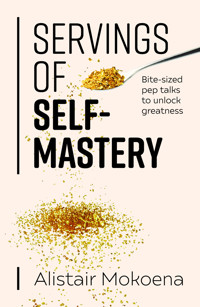
Self-mastery is the pinnacle of self-effectiveness. It is the reset button that puts you back in control of your life and helps you make healthy choices in both your personal and business life. If you've ever experienced anxiety, loss, self-doubt, confusion, procrastination, helplessness, lack of self-control and impatience, then Servings of Self-Mastery is for you. With self-mastery you are able to coach yourself out of the negative mind-states that hold you back. This book will help you recognise the thoughts, feelings and beliefs that stand in your way of physical, mental, emotional and spiritual fulfilment. It will equip you with the agency to reframe these barriers into positive energy that will catalyse and catapult you into action. With short, easy-to-digest pep talks, you may want to read this book from cover-to-cover, or choose a specific chapter to read on those days when you need a little support and inspiration. Alistair Mokoena's Servings of Self-Mastery is packed with bite-sized reminders of the greatness within us, together with the tools to unlock potential and abundance in all aspects of our lives. It is a book that is written with love and compassion to help you thrive).
Sie lesen das E-Book in den Legimi-Apps auf:
Seitenzahl: 276
Veröffentlichungsjahr: 2023
Das E-Book (TTS) können Sie hören im Abo „Legimi Premium” in Legimi-Apps auf:
Ähnliche


















First published by Tracey McDonald Publishers, 2023
Suite No. 53, Private Bag X903, Bryanston, South Africa, 2021
www.traceymcdonaldpublishers.com
Copyright © Dr Alistair Mokoena, 2023
All rights reserved.
No part of this book may be reproduced, stored in a retrieval system, or transmitted in any form or by any means, electronic, mechanical, photocopying, recording, or otherwise, without the prior written permission from the publisher.
ISBN 978-1-7764432-0-8
e-ISBN 978-1-7764432-1-5
Text design and typesetting by Patricia Crain, Empressa
Edited by Nicole McDonald
Cover design by Tomangopawpadilla
Digital conversion by Wouter Reinders
CONTENTS
FOREWORD
Over the years I’ve had the privilege to meet many corporate leaders. Most of them are pretty smart and some of them are great human beings who manage to be curious and humble, all the while radiating an infectious positive energy that inspires others. Alistair is of this rare breed. In the 15 years I’ve known him I’ve never walked away from a conversation without learning something new, and wondering how on earth he is able to achieve all he does with apparent ease and grace. This book was my chance to find out how he has built a career that spans the corporate, entrepreneurial and academic worlds with integrity and authenticity.
In true Alistair-style he’s written a book that has multiple layers of appeal. It’s an easy read, but, on deeper reflection, provides enough food for thought to fill your intellectual, emotional and spiritual pantry for a long time. Whether you choose to devour it in one sitting or, as I’ve preferred to do, take time to savour each chapter in a different sitting, you’ll find nuggets of wisdom set against a backdrop of what it means to grow as a leader in a country that never makes personal or organisational leadership an easy task.
What I loved most about reading Servings of Self-Mastery was appreciating the potential it has to guide people to be inspiring, to live a more fulfilled life, and to enhance the lives of others. It’s my fervent hope that Servings of Self-Mastery inspires a whole community of leaders to tap into their purpose and strengths to make their unique contribution to a world that is crying out for great leadership. If you seek to be a member of this community, this book deserves to be by your side for the journey ahead!
PROF NICOLA KLEYN
Dean: Executive Education and Professor of Corporate Marketing at Rotterdam School of Management, Erasmus University
INTRODUCTION
The title of this book, Servings of Self-Mastery, is a collection of bite-sized essays dedicated to the practise of self-mastery. I firmly believe that self-mastery leads to personal effectiveness, which in turn, leads to peace, happiness, contentment, and success. Being effective means winning and succeeding, which is ultimately what we all desire. What I love about the title of this book is that it reminds us that personal effectiveness is within reach for us all, and all it requires from us is dedication to the practice of self-mastery. By focusing on building these muscles, we can unlock the leadership potential that lies within us.
Leadership is an opt-in exercise. Once you decide to become a leader, you have to constantly work on self-improvement. This is where self-mastery and personal effectiveness intersect. Self-mastery helps you to identify and amplify your strengths, while personal effectiveness is about playing to your strengths. Every leader should devote their time to cultivating self-mastery to achieve personal effectiveness. An effective leader serves, inspires, builds, and guides others towards realising their potential. Leadership is a lifelong pursuit of learning, refining, and optimising – it demands enduring responsibility and commitment.
As a leader, you are constantly making thoughtful choices about how you wish to show up to your team, your organisation, your industry, your community, and society at large. These choices revolve around values such as fairness, compassion, honesty, transparency, friendship, trust, empowerment, and humility. You make choices about being vulnerable and open to feedback. You also choose to let your team shine and take the glory. Leadership is about choosing to be a lighthouse that guides others, a crutch for others to lean on, a wind that propels people’s growth, a sounding board that offers wise counsel, and a coach who sparks self-discovery in others. These choices keep leaders focused on being a force for good.
Leading others is challenging. There is an expectation that you will provide answers to tough questions, instil hope when everyone’s spirits are down, provide air cover when the team is under threat, and pull out a crystal ball when the future seems unclear. The good news is leaders need not have all the answers. Good leaders help their teams find answers. They teach others to fish – instead of providing fish, good leaders provide fishing rods. A good leader provides hope and inspiration and helps remove obstacles that prevent the team from achieving their goals.
A good leader does not step into the ring and take over the fight; instead a good leader teaches the team how to box cleverly. As Ronald Heifetz says in his book, Leadership Without Easy Answers, good leaders ‘step away from the dance floor and move to the balcony’, where they can get a good aerial view of what’s going on and provide wise counsel, instead of getting into the details. Those who we lead need us to provide an inspiring vision and sponsorship. We ought to be of service to them. The privilege of leadership comes with the responsibility of guiding others on their path to self-discovery, self-awareness, self-mastery, and ultimately, personal growth and fulfilment.
CHAPTER 1
MY LIFE STORY
My life purpose is to change people’s lives. I try to live up to this ideal by investing in self-mastery and personal effectiveness so that I can be helpful to others. That’s precisely the reason why I wrote this book. My wish is that it will remind you of the brilliant basics of personal effectiveness and leadership. I hope the ideas in this book will challenge some of your paradigms and introduce perspectives to help you on your journey towards self-mastery and personal effectiveness. May you soar as you serve and inspire others.
Whatever challenge you might be grappling with, know that you are not alone. We all face similar difficulties so it’s important that we share our experiences with each other. The exponential power of collective learning has the potential to change the world. Your mistakes and failures serve as powerful lessons for others. Your victories and triumphs provide much needed inspiration to others. Your grit and resilience spread hope in the world. May your light shine even brighter as you illuminate the path for others.
Throughout my life and career, I have come across many people who expressed a need for coaching. In fact, a week does not go by without a request for mentorship landing in my inbox. The same goes for my social media handles. Even though I want to acknowledge and respond to every request, I simply do not have the capacity to do so. I hope that this book will travel far and wide and provide sustenance where it is needed.
Some of the stories, anecdotes, insights, questions, and ‘aha moments’ in this book are based on the many conversations I have had with colleagues, direct reports, mentees, mentors, coaches, managers and even strangers. And, of course, books and articles I have read over the years. I have repackaged all of these learnings into essays focusing on specific themes that I hope will be of use to you. This is my gift to you.
My full name is Alistair Gaopaleloe Rasekgothe Ishmael Mokoena, though only the first two names appear on my birth certificate and my Identity Document. Alistair is the Scottish version of the Greek name Alexander, which means ‘defender of man, protector of people’. I was given this Scottish name by parents who were avid readers of author Alistair MacLean, and the former editor of Rand Daily Mail, Allister Sparks.
The name Gaopaleloe is a short version of the phrase Modimo ga o paleloe, which means ‘God never fails’. It also means invincible and infallible. My parents were quick to point out the reason they gave me this name was so that I would always remember that nothing is impossible with God. Thankfully, I was not expected to live up to this name, but merely to submit to God’s guidance and purpose for my life.
My brothers and I all have biblical names. My older brother is Isaac, which means ‘he will laugh’ in Hebrew. My brother is Theodore, meaning ‘divine gift’ in Greek. I am Ishmael, meaning ‘God will hear’ in Hebrew. True to form, my older brother Isaac has the best sense of humour and Theodore has the kindest heart. As for me, God always answers my prayers. This book is a case in point.
I was born in Pretoria on March 11, 1976. I am the second child of John Meshack Mokoena and Joyce Desia Mokoena (née Pooe). I was born at Holy Cross Hospital in a place called Lady Selborne, in Pretoria. Over the years, Holy Cross Hospital was converted into an old age home. Lady Selborne is a place of historical significance in South Africa’s race politics. According to the Group Areas Act of 1950 and the Land Act, black people and white people could not live in the same residential areas. More affluent, well-developed areas, usually situated near central business districts (CBDs), were reserved for whites, while blacks were forcibly removed and relocated to far-flung, less developed and underserved areas.
The precursor to the Group Areas Act of 1950 was the Native Land Act of 1913 which prohibited blacks from buying or leasing land which was considered to be ‘white’ land. Black people in Pretoria were forcibly removed from Lady Selborne and relocated to townships such as Atteridgeville, Mamelodi, Mabopane, Hebron, Erasmus, Mothotlung, Hammanskraal, Kgabalatsane and Ga-Rankuwa. Both my parents grew up in Lady Selborne until their families moved to Ga-Rankuwa, where my brothers and I grew up. In essence, Lady Selborne is Pretoria’s version of Sophiatown. Sophiatown, a Johannesburg suburb, is a place where in 1955 blacks were forcibly removed by the same apartheid government and relocated to under-developed townships, like Soweto, with barely any services.
South Africa’s spatial planning derives from the apartheid government’s policy of separation and segregation based on race. Large metropolitan cities, industrial hubs, mines, and farms around the country are surrounded by black ‘reserves’, whose sole purpose is to keep blacks out of white areas and to supply cheap labour to the surrounding white areas. These black reserves, located near urban areas, are referred to as townships, ghettos or favelas, while those in rural areas are termed villages. Townships are normally situated close enough to white suburbs and CBDs as a source of labour but far enough not to be neighbours. The apartheid government used to justify this segregation with the following Afrikaans adage, skape en bokke behoort nie saam nie,which loosely translates to ‘sheep and goats do not belong together’. Fortunately, we now live in a democratic South Africa where black and whites live side by side without impediment.
A city like Cape Town is surrounded by townships like Langa, Nyanga, Gugulethu, the Cape Flats, Mitchell’s Plain, Philippi, and so on. Instead of giving Gugulethu proper street names, the apartheid government referred to streets as Native Yards – for example, one’s address would be Native Yard 19 or NY19 for short. Durban is surrounded by townships like Cato Manor, Lamontville, Umlazi, Chatsworth, KwaMashu, Inanda, Phoenix, Ntuzuma, amongst others. Bloemfontein is surrounded by townships like Botshabelo and Thaba ‘Nchuu. Port Elizabeth is serviced by Motherwell, KwaMagxaki, New Brighton, KwaZakhele, KwaDwesi, and Zwide townships. East London is supported by Mdantsane and Duncan Village. And on it goes.
Education runs in my family. My father’s late parents were educators. My paternal grandfather, Isaac Mokoena (Senior), was an educator through and through. He has a school named after him in Mothotlung, near Brits, and a street named after him in Ga-Rankuwa. I remember witnessing his BEd Honours graduation while I was in primary school. He went from being a schoolteacher, to headmaster, to school inspector, and eventually the Secretary of Education in the old Bophuthatswana government, which was one of the five homelands that the apartheid government created to: a) keep blacks out of South Africa, and b) divide and conquer black people by placing them in these Bantustans along tribal lines, so that they wouldn’t come together and revolt against a racist and undemocratic regime.
Bophuthatswana was reserved for Setswana speaking blacks. Lebowa was reserved for Sepedi speakers. Venda was for Venda speakers. Gazankulu was for Tsonga speakers. KwaZulu was for Zulu speakers. KwaNdebele was for Ndebele speakers. Xhosas were split between Transkei and Ciskei homelands, another name for Bantustans. These homelands had their own governments, parliaments and were run by presidents. If you lived in one of these homelands you needed a passport to enter South Africa, your native country. Confusing, I know. Many things did not make sense during the apartheid era.
My paternal grandmother, Angelina, was also an educator. She went from being a schoolteacher to a school principal. She lived to 94, and came from the Manamela clan in a village called Moletjie, outside Mokopane, a town formerly known as Potgietersrus. She had seven children: my dad John and siblings Rupert, Judith, Rose, Orienda, Lloyd, and Mpho. Predictably, many of them were teachers like their parents.
My mother’s parents were Daniel Matjane Pooe and Elizabeth Mabotseng Pooe (née Morgan). They were blessed with six daughters, namely; Stabie, Evelyn, Joyce (my mother), Doris, Mosidi and Ruth. Unfortunately the first two passed on a year ago. My maternal grandfather Daniel was a lovely man and a disciplinarian. He worked for Coca-Cola (ABI) and he would wake up at 3 am to catch a Putco bus to work in Pretoria West. My maternal grandmother, Mabotseng, worked for diplomats in Pretoria before she became a housewife, serial entrepreneur, and a baby-sitter for all her grandchildren. She sold anything from atchar, vetkoek (doughnuts), soft drinks, ice lollies, sweets, you name it. She was an incredible cook and captivating storyteller. All of the grandchildren would take turns helping with her business ventures. What a big heart she had! I associate her with soul food, love, and laughter.
My parents got married when my dad was 26 and my mom was 21. They had my brother Isaac (Izzy) in 1974, me in 1976, and my brother Theodore (Teddy) in 1991. My late dad, John Meshack Mokoena, commonly known as Johnny, died of cancer at the tender age of 55. He was a great dad and a friend. He had a big heart and thousands of friends. More than 4 000 people attended his funeral. His first career was teaching, which he left for professional soccer. He played for Kaizer Chiefs in the 1970s, one of the largest soccer teams in South Africa. He was nicknamed ‘Magwegwe’ meaning the bow-legged one. He was a gifted soccer player, with many attributing his dribbling skills to his bandy legs, his pace, and his quick-thinking ‘mathematics teacher’ brain.
When his soccer career ended my dad turned to entrepreneurship. He had various businesses, from the liquor industry, to a business that hired out catering equipment. My brothers and I spent many of our formative years in the family business. The liquor business became a target for armed robbers and my parents eventually sold it. The people of Ga-Rankuwa loved my dad so much that they bestowed on him the Ga-Rankuwa Resident of Worth (GROW) Award for his contribution to the community.
My mom, Joyce Desia Mokoena (née Pooe), started her career as a nurse, and later became a nursing tutor, nursing lecturer, and eventually retired as a nursing professor at Medunsa University, now called Sefako Makgatho Health Sciences University in Pretoria. She co-authored many academic articles and textbooks during her career, inspiring my love for academia and writing. She had five sisters but sadly two have passed away and her three remaining siblings are all university graduates and professionals from whom I draw a lot of inspiration. It is a blessing to come from a family of strong, educated women.
My brother Isaac (Izzy) is a doctor, lawyer, property developer, and serial entrepreneur. He has an incredible work ethic and a nose for good ideas. What is remarkable about him is that he works very hard and still manages to get seven hours of sleep every night. My brother Theodore (Teddy) is a marketing graduate, photographer, and radio producer. He is also a fundi in nutrition and wellness.
My late father-in-law, Wilson Buqindlela Mpikashe, died when my wife was just four years old. He hailed from Umtata in the Eastern Cape province and, like my father, he too was a great footballer. He was an administrator at the Walter Sisulu University in Umtata, which was previously known as the University of the Transkei, and he was raised by the Lujabe family in Umtata. My late mother-in-law, Imelda Mpikashe (née Mathe), was an incredible person, full of love and kindness. An only child to Shillion Mathe and Placida Mathe of Nongoma in Northern Zululand, she went to Inkamana High School; a school that was started in 1923 by Benedictine Missionaries from Germany. She started her career as a nurse in Durban and Umtata. Her cousin, Queen Buhle Mathe, was married to the late king of the Zulu nation, King Zwelithini kaBhekuzulu. After her husband died, she moved to Pretoria with her two daughters to study medicine at Medunsa. As a single parent, she had to work part-time to support her two daughters while studying medicine. Incidentally, my mom and mother-in-law attended some classes together at Medunsa where it was customary for nursing and medical students to share certain classes.
My wife, Nandisile Zonkintombi Mokoena (née Mpikashe), is a lawyer by profession. She studied at the University of Pretoria and the University of South Africa (Unisa) respectively. She specialises in Competition Law. I always remind her that she was born with many gifts. She sings like an angel, is an avid cook, a great baker, a formidable lawyer and a very good writer. Her sister, Pilisiwe Mpikashe, is a doctor specialising in Nuclear Medicine, and she also studied at Medunsa. She has two sons, Thato and Tsia. My friend, Dr Zakes Motene, who is also a Medunsa graduate, often jokes that I’m an honorary Medunsa student because I practically spent all my university holidays there visiting my brother Isaac, who was studying medicine at the time, and my mom who was a professor there.
As you can see, I come from a family of educators, entrepreneurs, professionals, and academics. I pretty much had no excuse but to study and study further. I grew up with everyone around me talking up the value of education and a career. That was all the motivation I needed to put my head down and get on with it. By the time I finished high school, I had attended enough graduation parties to want a university degree like my life depended on it. I knew I had to study hard and get my qualifications, so I didn’t struggle with motivation throughout university. I knew that the stakes were high, and that quitting was not an option.
Both Isaac and I started school at the same time at Ikageng Primary School in Ga-Rankuwa, north-east of Pretoria. I was only six years old, which is a year too young for school, and Isaac was seven, but the school accepted both of us into Grade 1. It helped that my brother and I are only 15 months apart in age, and I learnt a lot of things from him. For high school, our parents sent us to Mmabatho High School, a multiracial boarding school in Mafikeng, which, at the time, was the capital city of the former Bophuthatswana homeland. I was 11 when I started Standard 5 (Grade 7) at Mmabatho High School. My boarding master and music teacher, the late Mr Simon Cushman, was like a father figure to me. My paternal grandparents lived a few kilometres from our school and would often visit us on the weekends. Home was 300 kilometres away, and we only saw our parents during school holidays. I loved my time at Mmabatho High School; it moulded me into the person I am today, and I still have many friends from my time there.
Mafikeng had a profound impact on my upbringing. The story of my youth is a tale of two cities, Ga-Rankuwa and Mafikeng. My family lived in Ga-Rankuwa, a township just outside Pretoria. We lived in a two-bedroom house with an outside toilet. A typical township characterised by abject poverty, crime, dirt roads, and limited basic services. Meanwhile, a mere 20 kilometres away, the Pretoria CBD dazzled with beautiful tall buildings, and white suburbs with tarred roads, street lights and well-appointed homes. This stark contrast between Ga-Rankuwa and the white suburbs was a harsh daily reminder of the apartheid government’s policy of racial discrimination against black people. On the other hand, Mafikeng, as the capital city of Bophuthatswana, was a beautiful, highly developed, well-resourced city where black people ran the show and people of different races and cultures mingled, schooled and lived together. It was a breath of fresh air for a boy who came from a divided society where one constantly felt ‘othered’ and ‘less than’.
Mafikeng was a place of hope, a place where dreams were validated, a place where black people soared because no ceilings were placed in their way. Every time I felt despondent in Ga-Rankuwa I would remind myself that there was a place 300 kilometres away where I saw my own people running a government, running an economy, leading business, working as professors, judges, vice-chancellors, and so on. Mafikeng was also where I first learned to use a computer. Not only did Mafikeng give me the gift of a good education but it also restored my dignity, fuelled my self-confidence and self-love, and set me up for a life of self-mastery.
My paternal grandfather was Secretary of Education in the Bophuthatswana government. I remember visiting him at his office in the Garona Building in Mafikeng and seeing black cabinet ministers milling about. The president of Bophuthatswana, President Kgosi Lucas Manyane Mangope, once gave a talk at my high school and on the odd occasion the Minister of Education would send my grandfather to my school to give a speech on his behalf. Most of the memories I have of my grandfather involve him sitting in his study at home, reading or writing. If he saw me peeping in, he would invite me into the study and ask about my school work. This all had a significantly positive impact on me. Two things stand out: a) it cemented the role of education as a ticket to a better life, and b) it left me feeling like the world was my oyster and the sky was the limit. I’m eternally grateful for this upbringing, and I’m trying to give the same to my children.
Growing up under such hard-working parents and grandparents, and having been exposed to a family business, it was no surprise that I would dabble in entrepreneurship and end up in business. My first business venture was a sneaker-cleaning business in boarding school. After a mild initiation period in which juniors were tasked with carrying senior students’ school bags and washing their dirty sneakers, my friends and I saw a gap in the market and started a sneaker-washing business where anybody could get their sneakers washed for a small fee. Talk about turning lemons into lemonade! It was a good business and we kept overheads low to maximise profit. We used the school’s water, our own detergent and scrubbing brush, and used the sun to dry the sneakers.
My second business venture was a clothing business. I started it with my boarding school buddies Gilbert Moshoette, Tshepo Stoan Seate of Bongo Maffin, Karabo Qhobosheane and author Molefe Pooe. Gilbert had a sewing machine and knew how to sew. At the time, we were all crazy about the rapper MC Hammer, and his iconic baggy pants, and so we decided to make our own MC Hammer ‘diaper pants’ and sell them to the kids in our school. They sold like hot cakes!
My third venture was an events company that I started while attending Rhodes University in Grahamstown, Eastern Cape. I started it with Tseliso Rangaka, Dunduka Mhango, Tshepo Matshaba, Topiwa Slash Chilume and Simukai Munjanganja. The student population at Rhodes University in the early 1990s was 90% white and 10% black, and most of the music played at parties and clubs was rock and heavy metal which didn’t appeal to many black students. My friends and I saw this as an opportunity to introduce an events company that would stage parties that played music that black students enjoyed like rap, house, kwaito, ragga, and dancehall. We did a roaring trade. Again, we were quite scrappy and kept the overheads down by designing our own posters and printing them in black and white at the university library. There were six of us in the business – four could deejay and two of us took care of the admin and the commercial side of the business.
The fourth business I started was a marketing consultancy called Birds Eye View, which I started during my one-year sabbatical in 2011. I wrote marketing strategies for clients and provided marketing capability training. I even started a T-shirt business and an art business stemming from my hobby as a photographer. I did all of this while studying towards an MBA and raising my son who was only a few months old. I am blessed to have such a supportive wife.
I often get asked why I studied law but ended up in business. When I was growing up, the two careers that piqued my interest were law and business. I was not keen on being a doctor because I’m squeamish and cannot stand the sight of blood. So I decided to study a BCom Law degree so that I could gain exposure to both subjects, which I followed with a Bachelor of Laws (LLB) degree.
My love for business came from working in the family business. My love for law was inspired by my parents’ love for law and their lawyer friends who often visited our home. They always sounded very intelligent and sophisticated. I got the same feeling when I watched legal dramas like L.A. Law starring Blair Underwood (I was a huge Blair Underwood fan). Richard Gere’s role as a commercial lawyer in the movie Pretty Woman, where he starred alongside Julia Roberts, also inspired me. My love for law was further cemented when I did a week’s job-shadowing at Lephoko & Ledwaba Attorneys in Pretoria during my final school year.
I enjoyed studying law and was exposed to legal practice at the Grahamstown Legal Aid Clinic where I worked with Prof Jonathan Campbell and the late Patrick Dlamini on Small Claims Court cases, most of which involved breaches of contract. We also represented chicory farmworkers and university students. Even though I’m a coffee snob now, I used to be a big chicory fan in my younger days. When I completed law school, I found myself torn between doing law articles at Moodie & Robertson Attorneys in Braamfontein, Johannesburg, or taking up the role of a marketing trainee at Unilever in Durban. I decided to take the latter, and the rest, as they say, is history. I have no regrets about my decision to study law and pursue a career in business. My legal training has stood me in good stead throughout my marketing career.
My career spans 25 years and comprises various roles in marketing, general management, academic leadership, and industry body leadership positions. My marketing roles include being a brand manager at Unilever where I worked on categories such as deodorants, face care products, and detergents. I was also a senior brand manager at Tiger Brands where I was responsible for dairy products, and grains like pasta and rice. I was a marketing manager at SABMiller where I looked after a portfolio of local beer brands and international premium brands. I was a marketing director at Cadbury (Mondelēz) where I was responsible for the gum and candy portfolios, and at Absa Bank where I headed up the Retail and Business Bank marketing.
After a decade and a half as a marketing specialist I decided to take up general management roles, running advertising agencies. There were a few reasons behind this decision:
1)I wanted to grow my general management muscles.
2)I wanted to learn about professional services.
3)I wanted to learn about marketing and sales in a Business-to-Business (B2B) environment.
4)I wanted to be exposed to multiple industries.
5)I wanted to lead creatives.
6)I wanted to learn how to achieve creative excellence.
My first foray into running an advertising agency was as the Managing Director of FCB Johannesburg. During that time I published an academic article based on my Master of Business Administration (MBA) dissertation titled ‘The Impact of Storytelling on Advertising Effectiveness.’ This research influenced my approach to creative development. I then moved to Ogilvy Johannesburg to take up the role of Managing Director. We achieved many great milestones with the team including winning ‘Agency of the Year’. Subsequently, I was promoted to Group Chief Executive Officer (CEO) of Ogilvy South Africa where we continued our successful run as ‘Group Agency of the Year’. On a personal level I received ‘The Best Advertising and Marketing Leader in South Africa Award’ at the 2019 Global Brands Awards.
In 2020 I graduated with a Doctor of Philosophy (PhD) degree in Business Administration, majoring in Marketing. I published an article titled ‘A Framework for the Sustainability of Advertising Agencies in an Emerging Economy: The Case of South Africa’ in the peer-reviewed Journal of Marketing Communications.
A large part of my role as Group CEO of Ogilvy South Africa was about grappling with the impact of digital disruption on the advertising agency business model, which is what informed my PhD research. This is when I fell in love with the idea of working for Google where technology is used to help customers grow their businesses and used to address some of society’s most pressing challenges. So, when I got a call from a headhunter saying Google South Africa was looking for a Country Director, I did not think twice. I joined Google in this role in April 2020, at the onset of South Africa’s Covid-19 lockdown.
My academic career started in earnest in 2008 when Prof Nicola Kleyn, the previous Dean of the University of Pretoria’s Business School, the Gordon Institute of Business Science (GIBS), invited me to speak about building a marketing career at GIBS’ Marketing Career Evening event. This marked the beginning of a long friendship with Nicola and an enduring partnership with GIBS which saw me present many guest lectures to their postgraduate Diploma and MBA classes. After GIBS came a series of guest lectures over the years at Wits Business School, University of Cape Town Graduate School of Business, Rhodes University Business School, North-West University Business School, Johannesburg Business School, IIE-Vega, Inscape, Richfield Graduate Institute of Technology, Africa Brand Leadership Academy (ABLA), Botho University (Botswana), University of Utah’s David Eccles School of Business (USA), Pepperdine Graziadio Business School (USA), University of Washington’s Michael G. Foster School of Business (USA), and Williams College (USA).
I also served in various capacities at various academic institutions. I served as a Senate member for Richfield Graduate Institute of Technology from 2018 to 2020. IIE-Vega appointed me as supervisor for Master’s and Doctoral students in 2021, while Botho University (Botswana) appointed me as an External Examiner for their MBA programme in 2021 and a member of the Industry Reference Forum for the faculty of Business and Accounting.




