


15,99 €
Mehr erfahren.
- Herausgeber: John Wiley & Sons
- Kategorie: Geisteswissenschaft
- Sprache: Englisch
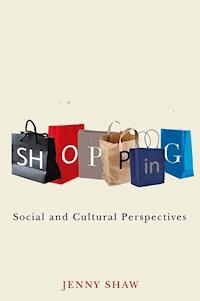
We spend more time shopping than doing anything else, after sleep and work. So why is it not taken more seriously? The answer: we take shopping for granted. Indeed, culture can only ‘work’ by being taken for granted. This paradox – that what is most familiar, like shopping, is also the hardest to ‘see’ analytically – provides the starting point for this compelling examination of the many dimensions of the shopping experience.
Shopping enables readers to realize the significance of their shopping memories and milestones, how the rhythm of the day or week revolves as much around shop opening hours as working hours or bus times, and why Mayor Giuliani was right after 9/11 to tell Americans to keep on shopping. From an exciting cultural perspective, Jenny Shaw explores how shopping is viewed, the history behind its ‘fall from grace’, its part in the common culture, its role in helping us craft new identities, hold on to old ones, adjust to change, and generally ‘hold us together’ both as individuals and communities.
Students of sociology, anthropology, social psychology, media and business studies interested in culture and the everyday world will be gripped by this engaging and accessible guide to the meaning behind what the ordinary shopper actually does and why shopping remains so popular despite social and cultural changes.
Sie lesen das E-Book in den Legimi-Apps auf:
Seitenzahl: 300
Veröffentlichungsjahr: 2013
Ähnliche




















Shopping
Shopping
Social and Cultural Perspectives
JENNY SHAW
polity
Copyright © Jenny Shaw 2010
The right of Jenny Shaw to be identified as Author of this Work has been asserted in accordance with the UK Copyright, Designs and Patents Act 1988.
First published in 2010 by Polity Press
Polity Press65 Bridge StreetCambridge CB2 1UR, UK
Polity Press350 Main StreetMalden, MA 02148, USA
All rights reserved. Except for the quotation of short passages for the purpose of criticism and review, no part of this publication may be reproduced, stored in a retrieval system, or transmitted, in any form or by any means, electronic, mechanical, photocopying, recording or otherwise, without the prior permission of the publisher.
ISBN-13: 978-0-7456-5803-2
A catalogue record for this book is available from the British Library.
Typeset in 11 on 13 pt Bembo byServis Filmsetting Limited, Stockport, Cheshire.Printed and bound by MPG Books Group, UK
The publisher has used its best endeavours to ensure that the URLs for external websites referred to in this book are correct and active at the time of going to press. However, the publisher has no responsibility for the websites and can make no guarantee that a site will remain live or that the content is or will remain appropriate.
Every effort has been made to trace all copyright holders, but if any have been inadvertently overlooked the publisher will be pleased to include any necessary credits in any subsequent reprint or edition.
For further information on Polity, visit our website: www.politybooks.com
Contents
1
Shopping in the Rain
2
From Thrift to Spendthrift: How Buying Turned into Spending
3
A la Recherche des Shops Perdus
4
Signposts and Shopping Milestones: Too Old for Topshop?
5
Shopping: A Rough Guide to Gender
6
Putting on a Posh Voice
7
Conclusion: Taking it all for Granted
References
Index
Acknowledgements
The idea of a ‘single authored’ book is always a fanciful one, and to claim such in this case would be outrageous. In addition to the patience and forbearance of all those at Polity who have worked on the book with me, especially Jonathan Skerrett, and the kindness of unknown reviewers, there is a legion of friends. Shopping is a central part of relationships with friends and family, and discussing shopping, or sharing the doing of it, with Jennie Bamford, Betty Mechen, Margaret Boushel, Carol Dyhouse, Jenny Harris, Susan Joekes, Niki Khan, Jill Lewis, Liz Mestheneos, Marcia Pointon, Carole Satyamurti and Anna Walnycki, has been critical. I thank them all, heartily. I am especially indebted to my colleague Janice Winship with whom I once embarked on a study of Marks and Spencer and its ‘cultural success’, but which, as history overtook both the store and us, came to seem ill timed, if not misleading. That study, however, continues to inform my thinking about shopping. Ann Marcus gave me wise and judicious counsel, and the space and time in New York and Maine to write a good part of the book, while Robert Cassen, George Irvin and Fiona Wilson read and commented on separate chapters. My deepest thanks go to Elaine Sharland, Andy Smith and Barbara Lloyd, three guardian angels, without whose wisdom, wit, patience, intellectual generosity and encouragement I could not have completed this book, and to George, Ann and Geraldine Wilkinson, for their love and humour, as well as technical support. All too easily we overlook what is important because we take it for granted. This is true both of shopping and family life, and setting me on the path to thinking seriously about shopping were my mother, Edna Shaw, and her sister, my aunt, Ethel Mann.
1
Shopping in the Rain
‘Why do we go shopping?’ It seems such a simple question and the most obvious answer, ‘to buy the things we need or want’, equally so. But after a moment’s thought most of us can remember times when we entered shops and did not buy, or even intend to buy. There are many reasons for shopping, or for thinking about shopping, however we choose to do it, yet, if asked to explain ourselves, we can be taken aback. Or, at least I was when, after returning from a walk and talking to a friend about how I had gone into a shop, she asked ‘Why?’, and I replied ‘Because it rained.’ Though true, it seemed an inadequate answer. We could have gone on to discuss whether some intention or motive is needed to explain shopping, or whether because, as a species, we humans are very responsive to our environments, my running for cover in a dress shop in lower Manhattan was only to be expected, but we let the matter drop. The next day, at passport control in the UK, I was asked, ‘Where have you come from today?’, and I answered, ‘New York’. The official then asked, ‘Working, or shopping?’ to which I replied ‘Both’. Then, I asked him, very politely, ‘Would you ask this of a man?’ He did not reply, so I pressed, ‘Would you?’, and then he shook his head. Perhaps I should have let that go too. Only a few hours earlier, the friendly check-in staff at JFK, amused by the number of books on shopping buried among my clothes, as I hauled them out to reduce the weight of the bag, wanted to know why I had those books. Then, after I told them, they wanted to know why was I writing another one?
In his book ‘Why’, Charles Tilly (2006) argues that there are four types of reasons which we give for what we do: ‘conventions’, which are the most culturally acceptable reasons; ‘stories’, which show a clear cause and effect; ‘codes’, which govern action, often legal; and specialist ‘technical accounts’; and that in every instance, when we give, ask for, or consider a reason, we negotiate a relationship. To my friend, I perhaps gave a technical reason; to the official at Heathrow I gave a conventional reason; and at JFK I gave a story. It started, as does this book, with time and space. With Jonathan Gershuny’s (2000) finding that in the rich nations, such as Britain and the United States, shopping is the daily activity on which, after work and sleep, we spend most time, and with Will Hutton’s (2002) revelation that in Britain retail footage had expanded to over five times the European average. A figure possibly much larger now, and one reflected in the fact that shopping regularly tops the list as Britons’ favourite leisure activity. We spend the time we do shopping not because shortages force us to queue for hours on end, or because we are compulsively acquisitive, but because, in addition to shopping being the mundane reality of buying the things we need to live and, more importantly, do not, and cannot, make for ourselves, shopping makes our lives more meaningful because it is both more and less than buying.
Lesen Sie weiter in der vollständigen Ausgabe!
Lesen Sie weiter in der vollständigen Ausgabe!
Lesen Sie weiter in der vollständigen Ausgabe!
Lesen Sie weiter in der vollständigen Ausgabe!
Lesen Sie weiter in der vollständigen Ausgabe!
Lesen Sie weiter in der vollständigen Ausgabe!
Lesen Sie weiter in der vollständigen Ausgabe!
Lesen Sie weiter in der vollständigen Ausgabe!




