


9,49 €
Mehr erfahren.
- Herausgeber: Sonicbond Publishing
- Kategorie: Geisteswissenschaft
- Serie: On Track
- Sprache: Englisch
This long-overdue book charts the career of Sparks from 1969 to 1979. Every album and every song is examined, including some which are still officially unreleased, beginning with their early recordings as Halfnelson/Sparks and when they were a band of five. After that band split, Ron and Russell Mael retained the name and spent much of the seventies working with a succession of sidemen and collaborators, although this was not always evident to some! They ended the seventies on a high note with the collaboration with Gorgio Moroder for ‘No. 1 In Heaven’.
Many who worked on their records have shared their thoughts in the book. The list includes Dean Detrick, Simon Draper, Harley Feinstein, Martin Gordon, Ian Hampton, Rupert Holmes, James Lowe, Sal Maida, James Mankey, John Mendelsohn, Adrian Munsey, Ralph Oswald, Peter Oxendale, Mike Piggott, Terry Rae, Thom Rotella, Suzi Ronson, Paul Rudolph, Richard Digby Smith, Karl Stoecker, David Swanson, Trevor White, Muff Winwood and Luke Zamperini.
But this book adds much new information for fans as well as lively opinions on the records. It’s essential reading for anyone who wants to know more about how Sparks developed in the decade which saw them create much of their best work.
Chris Sutton has been a Sparks fan since their legendary debut on Top Of The Pops in 1974. His favourite album by them is their second, A Woofer In Tweeter’s Clothing. He manages Smethwick Heritage Centre museum, for whom he has written several publications and he has also written several plays. This is his fifth book on music, following on from books on Alice Cooper, Black Sabbath and AC/DC. He also writes for Power Play magazine, and has contributed to a documentary on Alice Cooper.
Das E-Book können Sie in Legimi-Apps oder einer beliebigen App lesen, die das folgende Format unterstützen:
Seitenzahl: 332
Veröffentlichungsjahr: 2024
Ähnliche


















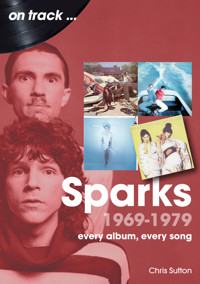
Sparks 1969 to 1979
Every Album, Every Song
On Track
Chris Sutton
Sonicbond Publishing Limited www.sonicbondpublishing.co.uk Email: [email protected]
First Published in the United Kingdom 2024
First Published in the United States 2024
British Library Cataloguing in Publication Data:
A Catalogue record for this book is available from the British Library Copyright Chris Sutton 2024
ISBN 978-1-78952-279-2
The right of Chris Sutton to be identified
as the author of this work has been asserted by him
in accordance with the Copyright, Designs and Patents Act 1988.
All rights reserved. No part of this publication may be reproduced, stored in a retrieval system or transmitted in any form or by any means, electronic, mechanical, photocopying, recording or otherwise, without prior permission in writing from Sonicbond Publishing Limited
Contents
Social Media
Introduction
Interviews
Early Years
1. 1969: The Halfnelson Demo Album (Promo Issue Only)
2. Halfnelson/Sparks (1971/1972)
3. A Woofer In Tweeter’s Clothing (1973)
4. Off to Europe
5. The End Of The Line And ‘I Like Girls’
6. The Road To Kimono My House
7. Kimono My House (1974)
8. Promoting Kimono My House
9. Propaganda (1974)
10. Promoting Propaganda
11. Indiscreet (1975)
12. Promoting Indiscreet
13. 1976: Back Home For Three New Songs
14. Big Beat (1976)
15. Promoting Big Beat
16. Introducing Sparks (1977)
17. The ‘Arista’ Demos
18. No. 1 In Heaven (1979)
19. Other 1979 Recordings
20. Promoting No. 1 In Heaven
Postscript
Social Media
Follow us on social media:
Twitter: https://twitter.com/SonicbondP
Instagram: www.instagram.com/sonicbondpublishing_/
Facebook: www.facebook.com/SonicbondPublishing/
Introduction
Top Of The Pops (TOTP) was a weekly institution on British television. One of the most explosive jaw-dropping appearances on it was the debut by Sparks in 1974 with ‘This Town Ain’t Big Enough For Both Of Us’. Nobody who saw it, whether you liked the song or not, will ever forget it. There was the giddy rush of the song itself, a pulsating drama wrapped up in just over three breathless minutes. Apologies to band members Martin Gordon, Dinky Diamond and Adrian Fisher, but it was the Mael brothers who were the talking points of the performance – Russell’s teen-friendly looks and that voice, and Ron’s austere garb, with his death-stare glances and that moustache!
That appearance was the start of a lifelong love for all things Sparks for many UK fans, with similar results across Europe. Prior to ‘This Town’ there had been a fully American Sparks that was a delicious package of delights all on its own. The roots of that line-up go back to 1968 and that’s where the story really starts with the Maels hooking up with recording wiz-kid Earle Mankey.
Looking ahead from ‘This Town’, there was to be a twisting narrative throughout the 1970s of distinctive albums. The only constant factors, then and now, are Ron and Russell Mael and while this is predominately their story through the decade, it also takes into account the contributions and thoughts of their many collaborators.
Interviews
Ron and Russell Mael’s management declined an invitation for their contributions. In their absence, I have used contemporary quotes as well as some later key observations, such as their notes on the Profile and 2 Originals Of Sparks sets, among others.
My sincere thanks to all of the following for their time and thoughts. Some spoke at considerable length, while one or two chose to be more concise:
Dean Detrick, Simon Draper, Harley Feinstein, Martin Gordon, Ian Hampton, Rupert Holmes, James Lowe, Sal Maida, James Mankey, John Mendelsohn, Adrian Munsey, Ralph Oswald, Peter Oxendale, Mike Piggott, Terry Rae, Thom Rotella, Suzi Ronson, Paul Rudolph, Richard Digby Smith, Karl Stoecker, David Swanson, Trevor White, Muff Winwood, Luke Zamperini
In the text, the Maels are referred to as Ron and Russell and the Mankeys as Earle and James. Harley Feinstein, for consistency, is Harley! All further collaborators are referred to initially by full name and then successively by surname alone unless a full name is better for clarity.
Early Years
Ronald David Mael (born 12 August 1945 in Culver City) and Russell Craig Mael (born 5 October 1948 in Los Angeles) grew up in Pacific Palisades, Los Angeles. Their father, Meyer Mael, was an artist and graphic designer whose work has become increasingly collectable. Their mother, Miriam (nee Moskowitz), was a librarian. The death of their father (aged just 40) on 5 February 1957 from a previously undiagnosed heart condition must have been a dreadful shock. With their mother now as their sole parent, times were obviously difficult. When she remarried (31 August 1961 in Los Angeles) to Oscar Roganson, this provided increased stability. The brothers’ closeness to each other is remarkable, perhaps originating in those challenging years of the late 1950s. What is clear is that their mutual love of the Arts was fostered and honed at High School/University of California. In the Profile double CD notes, Russell talks about their education: ‘Both of us graduated from UCLA. He (Ron) was one quarter away from a master’s in art and graphic design. My degree was in Theater Arts and English. I went to Palisades High. Ron went to Uni High.’ That shared interest in the Arts remains an ever-present facet of their career. Their musical influences during their teens came mainly from British bands of the mid to late sixties, as will become evident.
The Maels’ recording debut actually came in January 1967 when they laid down four songs under the name Urban Renewal Project with Ron’s friend Fred Frank on guitar and his wife Ronna Frank on piano and backing vocals. Two of the four songs were ‘Summer Days’ and ‘Computer Girl’. The latter, written by Russell alone, has been officially released since on the New Music For Amnesiacs compilation set and is a hazy, pulsing noise with Russell making a reasonable go of the vocals. It’s a curio at best, but it is intriguing to hear an embryonic ‘oddness’ that has never really left them.
Also arriving in the Maels’ orbit at this time was their college friend Larry Dupont, who, usefully, had a reel-to-reel tape recorder. He would go on to be an assistant to the band and their photographer.
1969: The Halfnelson Demo Album (Promo Issue Only)
Personnel:
Russell Mael: vocals, bass
Ron Mael: keyboards, piano
Earle Mankey: guitar, vocals
Ralph Oswald: bass on ‘Chile Farm Farney’ and one other song
John Mendelsohn: drums
Produced in July 1969 by Earle Mankey at his home studio
All songs by Ron and/or Russell Mael, except as noted.
In 1968, Ron and Russell ‘recruited’ Earle Mankey (born 8 March 1947, Washington). Russell recalled in the Profile compilation notes that ‘we met Earle [Mankey] at UCLA. He put up a sign on the bulletin board: ‘Engineering wiz wants to connect with other musicians’’. Earle, who also played guitar, had built a recording studio in his home and in July 1969, the trio set about recording an album. Michael Berns, their manager, financed the project, which saw the band named Halfnelson (after the wrestling hold). Russell recalled the studio setup to soundonsound.com (2013):
[It was] just really primitive, the recording technology and the process that we had. Earle had a tiny apartment and a couple of reel-to-reel tape recorders, so we could just record things. We would use these two tiny seven-and-a-half- inch-per-second machines, bouncing things from one machine over to the other. Obviously, you’d lose fidelity all the time, but you’d also gain some kind of quality to the recording by building up all the hiss on the tape.
The advantage of Earle’s home set-up was the lack of any real cost to record and the ability to experiment and develop songs at leisure. Russell pointed out in the Profile notes that:
None of us were from a live music background; it was all recording. We kept making recordings with him and never played live. We never did things from the standpoint of whether things would work in front of an audience. That’s why we were able to be as quirky as we wanted to be because we didn’t worry what people would think.
Ron played organ and a Wurlitzer electric piano on the songs. The latter was tricky because, as he told soundonsound.com (2013):
We didn’t have a piano, so we’d go into the piano rehearsal halls at UCLA. The three of us would take the tape recorder down and do backwards piano recordings while people were kind of wondering what we were up to.
Everybody was really traditional as far as piano went, and we kind of liked it sounding backwards more than forwards.
Russell sang lead vocals on all but one song and also played most of the bass. Earle played guitar, produced and worked on effects and arrangements. Two other musicians also contributed to the demo: John Mendelsohn, another acquaintance from UCLA, played drums, whilst his friend Ralph Oswald played bass on two tracks. Mendelsohn’s association with the Maels began at university.
I took an Italian class and there were about ten males with long hair on campus, I was one of them and Russell Mael was another. He was sort of stand-offish, but we were aware of each other because we were (both) fervent Anglophiles. They tried to put together a blues band at one point and that lasted for one rehearsal; it was called The Bel Air Blues Band, the joke being that if you lived in Bel Air, you probably wouldn’t have the blues. Ron was the lead guitar player; that was hilarious!
In the summer of 1969, when the Maels and Earle needed a drummer, they called Mendelsohn: ‘I wasn’t very good and I was extremely flattered that anyone would ask me to be in their band.’ There are stories that manager Mike Berns plays drums on some of the demo album, but Mendelsohn says definitely not. His view of the Maels’ personalities is that they were ‘very closed people’. As for Earle, Mendelsohn feels he saw early signs of differences between him and the Maels: ‘I don’t think Earle had much to offer musically, to be honest. I do think he was more rock ‘n’ roll than the Maels and I suspect some of their preciousness annoyed him.’ Mendelsohn’s tenure was very brief, only lasting for three rehearsals and a couple of recording sessions.
Mendelsohn’s friend Ralph Oswald was also familiar with the Maels and Earle, having ‘seen them around’ in earlier years. He feels that the Maels already had ‘their own private language’ whilst Earle was ‘outgoing and easy to talk to.’ Oswald recalls how he got involved on the demo album:
One day, John (Mendelsohn) says, ‘Ron’s been in touch and asked if we would like to do a couple of demos.’ I happened to own a bass at the time and John said it was bass and drum tracks. So we went to this little studio, which was almost like a living room. John played drums and I played bass. It was two tracks, short tunes with heavy bass/drum lines. I think we got ‘em in two takes, maximum. One track was called ‘Chile Farm Farney’, the other one I can’t remember. I thought we were doing a session with them but it was just me and John. I had no idea what the melody was going to be or anything like that. There was just drum and bass and that’s all I knew.
Earle was present with the Maels for the recordings, but the one Oswald most recalls, still, was Russell, ‘because he’s so damn cute’! As for Oswald himself, the ‘Surly Ralph’ nickname has become part of his folklore:
John (Mendelsohn) laid that on me. He finally realised that it wasn’t so much that I was surly, but that I was shy and uncomfortable in conversation with other people. Also, John had a knack for bringing out the worst in me.
Eventually, I changed my ways when I discovered alcohol. I quickly became ‘Laughing’ Ralph Oswald and ‘Rotting’ Ralph Oswald.
After ‘leaving’ Halfnelson, Oswald and Mendelsohn went on to form a band together called Christopher Milk whose output is well worth checking out. There are stories that this demo album was called A Woofer In Tweeter’s Clothing, with a cover, designed by Ron, of a surfer going past the Eiffel Tower. This is mostly untrue. Harley Feinstein joined the band towards the end of the sessions and says it was only known as ‘the demo album’ (no title) with no cover design, albeit extravagantly packaged. However, a feature in Sounds (10 October 1970) says that the demo was called by this title, so perhaps this was a mooted title by the Maels.
It was pressed in a very limited quantity, each packaged in an ornate box. This was hand-constructed to look like an oversized restaurant check in black and white. Inside was the album and various ad-hoc titbits, such as a pack of popcorn. In the Sparks Brothers film, Ron and Russell show a copy of the album, still with inserts intact, to Todd Rundgren.
The album was a long-held ‘Holy Grail’ for Sparks fans once its existence had been established. A copy appeared in fan circles, recorded from one of the vinyl albums, and is easy to find online. Anyone who rejoices in the first Bearsville album, in particular, will find a lot to enjoy here. The chief sonic issue is the thin sound due to the lack of bottom end on most tracks. In spite of that, the character and quirkiness of the songs shine through.
The unique plus they had going for them at this early stage predominately comes down to Ron Mael. Russell’s voice catches the ear and Earle Mankey’s prodigious abilities at recording techniques keep things interesting, but it’s Ron’s already unusual songwriting (most of them are his lyrics) and his keyboard playing that stand out.
It’s an enjoyable record, a heady brew that defies all logic. Instruments fly in and out and the rhythm is often held down by Ron. The soundscape constantly surprises you with Earle’s inventive touches. Two songs not recorded but known to exist are ‘We Will Make Great Pets’ and an instrumental called ‘Spider Run’.
If Halfnelson was to develop, they were going to need a semblance of more normality in the songs and clearly, they were a musician or two short. While recording the album, the trio saw an advert at Ace Music in Santa Monica, placed there by Harley Feinstein (born on 10 April 1951 in Los Angeles). Ron, Russell, Earle and his wife Elisa met their would-be drummer at his parents’ house. Harley was thrilled to join: ‘It was the first real band I had ever been in!’. While he didn’t add to the album, he was there at the end of the recordings, hanging out with his new bandmates.
‘Chile Farm Farney’
A trivia note to start, but shouldn’t it be chilli? It’s a bright and bouncy opening song, brief but likeable. Oswald and Mendelsohn handle the rhythm track well, though Mendelsohn is mixed way too low. Ron, by contrast, is mixed well up and his piano is a delight. Russell sings effectively, and it is one of his very best vocals on the album. Earle plays a few guitar parts – a fuzz rhythm part is his standby, but it also sounds like he has overdubbed a couple of lead parts. I particularly love the rock ‘n’ roll guitar ending and Russell’s exultant ‘wooh’ to finish.
‘Johnny’s Adventure’
It starts off with Ron’s organ, then Russell joins in for this charming, childlike nursery-style song. There’s a Pink Floyd (Barrett era) feel at times, with all sorts going on in the background. Earle adds effective guitar work, flitting between heavier licks and melodic parts. Mendelsohn’s drums are barely discernible in the background, mostly popping up with a cymbal crash.
Russell’s bass is good, but the standout section is the outro, with several overdubbed Russells as a heavenly fading choir.
‘Roger’ (Russell Mael)
When it came to choosing material for the Halfnelson album, this was one that Todd Rundgren especially liked. The original, here, is taken at a higher pitch and is slightly faster. It’s an utterly mad track with a hugely percussive backing of what sounds like them hitting anything within reach, with bottles filled or partially filled with water making up most of it!
Bass doesn’t appear to be present, leaving Ron to hold the rhythm down while Earle’s guitar crazily flits in and out. It’s all topped off with a controlled, almost menacing, vocal from Russell. You have to smile at the all-too-brief ending featuring Ron’s lounge-style piano.
‘Arts And Crafts Spectacular’
A simply fabulous song that always delights. It’s all about the competitive ladies at a home/soft furnishings competition and sales show. The triumphant opening amusingly ‘bigs up’ the event that Russell takes us through, always coming back to the ‘lovely Claudine Jones’. Sadly, Claudine is destined to go home with her quilt, probably not for the first time, which nobody wants.
The drums are prominent on this one and Mendelsohn plays them like a fanfare at a circus. There are nice switches of tempo as it ebbs and flows between Russell’s announcements and the extended outro of the ‘Claudine Jones’ refrain, with Russell adding spoken embellishments.
‘Landlady’
Some lyric transcriptions have Ralph Oswald’s Christian name in the song, but they are mishearing ‘Ralph’ for ‘round’. Mendelsohn definitely isn’t a fan of this one: ‘My own band recorded some appalling demos, but I submit that nothing we ever did was as bad as ‘Landlady Turn Up The Heat’ or whatever that song is called.’
It sounds like something from a strange musical with massed vocals on what would pass for a chorus. Earle adds some fine guitar work, albeit too low in the mix, whilst the bass is right in your face. Ron has a field day on keyboards as the song shifts through different phases. At times, it’s almost musical, as at 1:03 with the instrumental break, but it soon reverts to the creepy spectral sound that dominates the track. An oddity for sure, but also strangely compelling.
‘The Animals At Jason’s Bar And Grill’
It has an endearing, whimsical warmth and simplicity. Jason’s patrons are startled ‘when what to their wandering eyes should appear, but a moose, a dog, a mouse, an ant, dear.’ Mendelsohn contributes but is mostly nearly inaudible, so it’s left to Russell to hold the rhythm on his bass. He is also clearly enjoying singing too, his glee audible in every word. The two guitar parts (acoustic and electric) are either both by Earle or by him and Ron. You can also hear Ron on keyboards so this may have been a huge effort of overdubbing in primitive circumstances! It’s an enjoyable romp that always provokes a smile.
‘Big Rock Candy Mountain’ (Earle Mankey)
Earle sings lead on his own song. It’s one of the best on the album too, with Earle showing his West Coast roots on what is a well-crafted piece of work. There’s full instrumentation on it, but oddly, it’s his guitar that is buried in the mix. Ron’s keyboards are well-judged and suit the mood of the song. Praise also for Russell’s prominent and decent bass playing The bridge at 0:35 sounds like Russell and not Earle, in which case this is the earliest example of his falsetto. It makes for a pleasing contrast with Earle’s verses. When they come out of the bridge, you can clearly hear this was an edit piece that was dropped in. It just doesn’t sound ‘natural’ as Earle comes back in at 0:49. But that doesn’t detract from the quality of the song.
‘Millie’
Earle’s jangly guitar opens the song, but this is a hard listen. It’s harsh and brittle, with Russell’s overplayed bass doing little to alleviate that. Even his voice is too strident. There is a rhythm track indistinctly played on something, perhaps the cardboard boxes they legendarily used on occasion. Somebody adds castanets from 1:06 onwards, but this doesn’t help much. This is a quaint curiosity of a song and just about worth it for that.
‘Saccharin And The War’ (Russell Mael)
A shorter, echo-drenched and more laid-back version than the re-recording to come on their first ‘proper album’ with Rundgren. The melody is carried well on acoustic guitar. The flaws come with Russell’s bass which is comically busy, as it often is on these tracks. Then there’s Ron, who seems to be missing on keyboards, which might mean it is him on the acoustic and not Earle. The electric guitar riffs do sound like Earle, though.
While Russell will later praise this version over the one with Rundgren, it really isn’t as good at all. Rundgren created a ‘proper’ song from it, but this version does have a naïve charm to it.
‘Join The Firm’ A foggy, psychedelic sound sets the atmosphere. Russell’s seductive come-on opens it: ‘Hello, won’t you join our big show’, accompanied by fairground- style keyboards from Ron. However, it transpires that Russell is welcoming us not to a fair or circus but to our new job! His voice hits similar vocal territory to what he will develop on the next two albums; he sounds very at home with this song indeed and delivers it well.
At 1:10, we get a chorus, which comes as a surprise because, so far, the song has sounded more like a monologue set to music! It’s not a great chorus, but there is a good fuzz guitar solo from Earle at 1:27, which builds and builds with sound effects spiralling and an overdubbed second guitar.
Now, it gets truly bizarre. It fades out to nearly nothing at 2:01, but the song returns to the beginning for what is a rerun with additional vocals and effects. Not content with that, at about 3:00, it all goes really off the wall with sounds of hammering and banging as Russell extols the virtues of the firm. And so it goes off into the outro. A peculiar song that holds your attention.
‘Jane Church’
Lots to enjoy on this one. Earle’s lyrical guitar is prominent in the bright mix. Everyone gives it their best shot and even the drums are mixed up to an acceptable level. The attention-grabbing keyboard riff that Ron first plays at 0:39 is terrific. Equally, Russell’s vocals are perfect for the song. The music is amazing, all twists and turns spinning off Earle’s guitar. As Russell hammers home the lyrics, there’s one final blast of the keyboard riff at 2:13 to finish it all off. Given the effective synergy of the rhythm section here, I feel this is surely the other Oswald/Mendelsohn pairing.
This exciting song shows what they could achieve when things fell into place at this early stage of their career.
‘The Factory’
The intro, with strongly echoed percussion, says this is going to be a very different song. Then there’s Russell’s whispered vocals adding to the bizarre nature of it all. The rest of the backing instrumentation features two keyboard tracks from Ron weaving in and out of each other, plus Earle’s guitar and a curious bass part that never quite fits in. This could almost be early Pink Floyd at times. It’s hard to say whether it is good or bad – it just kind of comes on and happens!
Halfnelson/Sparks (1971/1972)
Personnel:
Russell Mael: vocals
Ron Mael: organ, piano
Earle Mankey: guitar, vocals, bass on ‘No More Mr Nice Guys’
James Mankey: bass, guitar, vocals, lead guitar on ‘No More
Mr Nice Guys’
Harley Feinstein: drums (except ‘Roger’)
With:
John Mendelsohn: drums on ‘Roger’
Elisa Mankey: voice on ‘Biology 2’
Todd Rundgren: backing vocals, vibraslap on ‘Saccharin And The War’
Produced at I.D. Sounds, Hollywood in Autumn 1970 by Todd Rundgren and Thaddeus James Lowe
Label: Bearsville
Release date: September 1971 as Halfnelson, July 1972 as Sparks
Highest chart places: UK: -, USA: - Running time: 40:23
All songs by Ron Mael, except as noted.
The new four-piece Halfnelson saw Russell playing bass, but according to Harley: ‘That didn’t last very long. Russell didn’t want to be saddled with the bass, so we had to find a bass player so Russell could sing like Mick Jagger. We went through a bunch of guys, but none of them worked.’ They eventually settled on Earle’s younger brother. James Mankey (born 23 May 1952, Washington) duly came in on bass and occasional guitar. John Mendelsohn remembers that the decision baffled him: ‘The odd thing about that configuration was that Jim Mankey was quite a good guitarist and Earle wasn’t. It seemed to me to be an example of shooting yourself in the foot.’ Earle famously explained to Sounds (10 October 1970) that ‘Jim is a better guitar player than I’d ever hope to be, but he’s playing bass because I’m bigger.’ James laughs when I mention the story to him:
I don’t think that’s true because it was Earle who brought me into the band. So he can’t have been too threatened. Earle was always helping out his kid brother; he found the first garage band that I ever played in. I guess he thought I could contribute to Halfnelson.
The dry-humoured and self-deprecating James settled into the band, gravitating towards Harley: ‘He was the heartthrob of the band; the girls loved him. We got along pretty well, maybe because we were the youngsters in the band.’
While the group worked on material, Mike Berns aimed to get the band signed to a record company. He invited reps out to see them play at their Dog Bunk Bed Factory (aka Doggy Factory) rehearsal room. James recalls:
We had a lot of common struggles between all of us, trying to get somebody to come and see the band play. One time we were waiting for a big producer to turn up, who was Jack Nitszche. He was coming to our rehearsal place, the Doggy Factory, and we were all set up and ready to play and show him what we could do. It was like midnight/1 am when he finally showed up, but we were all doing this Three Stooges bit where we traded snores. He did not find it amusing and he did not sign us. Things might have gone entirely differently if we had been a little more respectful to the guy.
Nitzsche and others failed to bite, and the continual failure to attract record company interest would have been fatal, but for Todd Rundgren. His regular engineer (and former Electric Prunes vocalist) James Lowe recalls how the link-up occurred: ‘I had been doing some records with Todd and we were finishing up something and he asked me if I wanted to get involved with this band. Miss Christine of the GTOs was the one that turned us on to them.’ Miss Christine (Christine Frka) was Rundgren’s girlfriend at the time but was also at some point romantically linked to Russell.
Rundgren was invited to a showcase set at the Doggy Factory, turning up with Miss Christine and James Lowe – the latter also bringing his wife, Pamela. The band threw everything into their show and even had waitresses on hand and a tape of audience applause. Lowe was very impressed: ‘I thought they were unlike anything that was out, at least here in LA, so that made them interesting.’ Rundgren, too, heard something unique. He was further convinced that the band had something when he heard a four-track demo he was sent comprising of ‘Fa La Fa Lee’, ‘High C’, ‘Slowboat’ and ‘Wonder Girl’. Rundgren later told Words And Music (1973) that: ‘Sparks’ songs are like little designs, both musically and lyrically. If they seem incongruous, it’s because they are musical designs extracted from a lifestyle that’s inaccessible.’ Rundgren told Bearsville supremo Albert Grossman to sign the band. The intention now was to record an album of their newest material with Rundgren producing and Lowe engineering. Meanwhile, behind the scenes, Mike Berns left as manager, with Roy Silver coming in just as things were really starting to look up.
Contract now signed with Bearsville, the band got a nice bonus, as Harley recalls: ‘We were allotted a fund to buy the instruments of our choice; I got a really nice Rogers drum set, which at the time was the best one around. Ron chose a Farfisa organ. I remember him always using that; that was his instrument.‘ Indeed, a key part of the sound on the album is the Farfisa, which Ron habitually uses throughout.
The band had disparate influences musically. Harley sees it like this:
Earle always seemed to lean towards greaser doo-wop. You can hear that coming out in ‘Biology 2’. It kind of has that ‘Oh baby’ 50s doo-wop feel. That was very different to how the rest of us felt. Ron and Russ were all excited about the British invasion and Jimmy was more into headbanging psychedelia; Blue Cheer was his favourite band. I would play whatever the other guys wanted.
When pushed for influences, Harley went for ‘Surf music – Dick Dale, The Pyramids, Chantays, you know? Similar to Keith Moon, that was one of his original interests. I used to get into trouble at school for playing ‘Wipeout’ on the desk.’
The band, Rundgren and Lowe entered I.D. Sound in the autumn of 1970. Harley says that ‘it took a couple of months to record. We worked all the songs up in our rehearsal studio without any recording devices.’ Lowe kind of concurs, saying that the recording was ‘very quick and we were able to fool around and do some different ideas on it, so it was interesting to record.’ Two songs from the demo album made it onto the album – ‘Roger’ and ‘Saccharin And The War’, both written by Russell. It’s interesting that none of Ron’s songs were chosen to be re-recorded.
Rundgren mixed the album so that Ron’s Farfisa and piano playing stands out as the melodic heart. He didn’t radically alter the band’s sound, just some smoothing here and there. ‘We were thrilled to have him around us, one of the coolest guys going’, says James. ‘I don’t think anyone was complaining about him coming along; he was perfect and he was nice to us.’
Russell was also happy with Rundgren, as he outlined to Soundonsound. com (2013):
To his credit, he didn’t wanna change what we were doing; he just wanted the fidelity to be a little better. So we were going into an expensive recording studio with Todd, but still banging on cardboard boxes and all. The way we were recording was a fair part of what we were and what made us interesting as a band to him.
James was nervous and found the sessions hard at first: ‘I was 18 or 19 and I had never been in a recording studio. I had no idea what I was doing and it was kind of stressful, ‘OK, tape’s rolling, Jim, it’s time for you to do something’’. Rundgren helped put the young musician at ease: ‘He treated me quite well, although he probably thought I was one of the lesser musicians in the group.’
While Rundgren doesn’t play guitar on the album, he does sing: ‘Todd did some harmonies on the first album’, confirms Lowe, who, for his own part, adds: ‘I didn’t do a bunch of editing or tape manipulation, they didn’t need it. They were already kind of goofy enough.’ So the album is Halfnelson with all their delightful quirks and idiosyncrasies intact.
There was allegedly one snag during the sessions. Circus magazine (1972) said that the relationship between Rundgren and the band ‘cooled’ when he ‘lost’ Miss Christine to Russell halfway through recording the album. But Rundgren’s connection to the band was still strong enough that he commissioned Ron to take and arrange the photographs on the inside sleeve of his album Runt: The Ballad Of Todd Rundgren, which was released in June 1971.
Halfnelson/Sparks is an absorbing record full of intriguing vignettes of people going about their lives. None of it sounds much like anyone else at the time and it still sounds unique today. And it’s very obvious, in spite of the Mael songwriting domination, that this is the work of a band. The album originally came out as Halfnelson, with the cover using an ad by Oldsmobile, which Ron got permission to use. It features a radiant Grace Kelly lookalike in the back seat of an Oldsmobile, on which Ron has pasted the band looking in through the windows. The band picture on the back cover shows no special favours to anyone either; all are equal.
What the album failed to do was sell, due in no small part to the inability of Bearsville to promote it. Lowe remains perplexed at the lack of reaction: ‘I couldn’t find any of my friends, or anybody, that liked it, you know? I still like it, all the reasons that I got involved with it are still there I still think that it’s viable stuff!’
With the album bombing and a consensus that a wrestling hold was a poor name, Grossman felt a new band name was a potential winner. He suggested that they should change their name to Sparks Brothers. A compromise of sorts led to the shortened Sparks and a new sleeve for the newly named album. Ron came up with the design of the band in front of a red brick wall. It was a strong image, which beefed-up the ‘Sparks is a band’ profile. The point here is that many Sparks fans came into their orbit via ‘This Town’ and Kimono and it didn’t take long to work out from sleeves and TV appearances that this was all about the Maels, plus a band. This first incarnation of Sparks was a band, full stop.
Lowe comments on the band’s ‘three leaders’, as he saw it, at the end of the sessions:
Earle was interested in the engineering part of it, though he didn’t get in my way. I didn’t have any disagreements with him other than the guitar sometimes sounded a little funky for what we were doing. Russell was just amazing, how he could sing that high and keep doing it over and over again. I don’t recall ever having to punch in that much on any of the stuff. He just had total control. Ron used a couple of different instruments on there. He’s a quiet type, so you forgot how you mic’d him and what he did.
Also, according to Lowe, the new boy in the band was the quietest, whilst the drummer was ‘perfect for them’. James picks up on Lowe’s comments about his brother:
Earle was always really interested in the production. Before Sparks, he had a tape recorder and he was figuring out ways to stack tracks and make music.
He’s technically oriented. He didn’t have the same confidence in his playing as he did in his production abilities. He’s an excellent producer; he can really get the most out of whoever comes before him.
Halfnelson/Sparks remains one of my favourite Sparks albums. The songs have stayed with me for decades like old friends. Lowe concurs heartily: ‘I still remember the lyrics to these stupid things. I don’t know how long it’s been; it’s been forever. That album wears well with me.’
‘Wonder Girl’
In the Profile notes, Russell observed that it was ‘one of the original Earle, Ron and Russell songs. The final recording that Todd Rundgren produced stayed really true to our home demo of it.’
John Mendelsohn feels Ron took titular inspiration from a favourite band: ‘Wonder Girl’ is pretty telling in view of the fact The Kinks had a single called ‘Wonder Boy’ he pithily observes.
What strikes you immediately about the song is the drums. Harley explains that:
When we began working that song up in our rehearsal studio we were discussing how it should shape up. And someone said, ‘What about like ‘Neanderthal Man’ by Hotlegs?’ So we said that sounded pretty cool, lots of echo and big sounding. We went into the studio and that’s how I started playing the drums. Then Todd got an idea: ‘You play your drum part, but I’m gonna turn on an echo machine and you’re gonna play along with your echo. That will double the part.’ That’s how that happened. It wasn’t easy playing and I had to keep in perfect time.
There’s a warm conversational quality to the song, as though Russell is recounting the tale over a coffee. Ron plays Wurlitzer piano throughout, sticking to a two-note piano riff. It’s all simple stuff, but it’s an engaging song largely marked out by those hypnotic drums and the throbbing pulse of James’s bass. For light relief, Russell adds a farting noise at 1:50, an addition that ‘got a good chuckle’ out of everyone, according to Harley.
It was picked out as the first single (backed with ‘No More Mr Nice Guys’). Harley was unimpressed: ‘I don’t remember any discussion that ‘Wonder Girl’ should be the single. I suspect it was someone at Bearsville or Warner Bros. There are so many songs that could have been singles that were better than ‘Wonder Girl’. It still boggles my mind.’ James was similarly underwhelmed:
A company will always choose the least representative song as the first single. ‘Wonder Girl’ is a thinking song, heavy on words and intelligence, but there are better songs musically on the record. On the other hand, It may have been an excellent choice because nobody forgets that song when they’ve heard it. Ron plays weird, like he’s got a nervous twitch in his elbows or something. You have to say in that respect that ‘Wonder Girl’ is pretty representative of his vision.
It’s definitely not the best song on the album, but it’s good enough to keep me coming back to it. Ron and Russell clearly loved it because it made the set list on the Kimono My House tour.
‘Fa La, Fa Lee’
Russell had to record this with a cold, so Rundgren recorded him on four tracks to try and add more to the vocals. Ron wryly observed that ‘It ended up sounding like four tracks of a person with a cold (2 Originals CD notes).’
There’s a hopefully fresh innocence present in the lyrics, which detail a guy’s thoughts about his sister, knowing that ‘as it stands now, that would be a felony.’ There’s a sly nod to a Hollies huge hit single (‘He Ain’t Heavy, He’s My Brother’) in the first verse: ‘She ain’t heavy, she’s a brother to me.’
Two things set this song apart for me. The first is Ron’s almost childlike organ part. That’s not a criticism; it just comes over with a whimsical charm that offsets the driving rhythm. The second is the killer lick that James plays on the bass at the end of each chorus. He tops that after the final chorus with an extended fill that is pure joy. Since I first heard this song in 1974, I still listen to it eagerly, waiting for that final run-through on the lick. And I am not the only one who does that. Lowe agrees, ‘That’s what I find myself doing on a lot of their songs, waiting for a certain part.’ The man who played that lick is more modest: ‘You got to play something and you play the best you can do. That was a spur-of-the-moment thing. They all start that way and then when you decide that’s it, it becomes an etched-in-stone arrangement.’ Harley loves James’s part on the track and for him, it confirms that ‘Jim was, and still is, a very talented musician. Probably the most virtuosity of any of the members.’ The song remains a hugely enjoyable Sparks deep cut.
‘Roger’ (Russell Mael)
Harley confirms that the song is largely re-used from the demo album version:




