


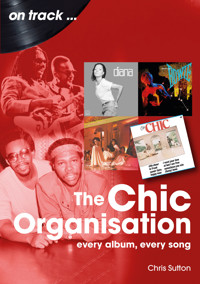
9,99 €
Mehr erfahren.
- Herausgeber: Sonicbond Publishing
- Kategorie: Geisteswissenschaft
- Serie: On Track
- Sprache: Englisch
This book charts all of the albums which feature The Chic Organisation, helmed by Nile Rodgers and Bernard Edwards. As well as records under the Chic name, the duo also wrote, produced and played on albums by Sister Sledge, Diana Ross, Debbie Harry, Johnny Mathis, Sheila B., Madonna, Odyssey, Carly Simon and David Bowie, amongst many. Appearing on these records was a regular pool of talented singers and musicians. So, sharing their thoughts are Eddie Daniels, Sammy Figueroa, Jean Fineberg, Stan Harrison, Bill Holloman, Kenny Lehman, Ellen Seeling, Roger Squitero and Jessica Wagner. Alva Chinn, who appeared on the front of the debut Chic album, also contributes, as does Tony Wright, who designed the Take It Off cover.
Every album and song is reviewed all together for the first time. There is also a section on further listening, which features records with a slightly lesser Chic presence for those who want to dig a little deeper. The book also features the more recent work of the rebranded Nile Rodgers & Chic. While many will know of the extent of Chic's influence and work, it will likely come as a surprise to even more. Whether you are a hardcore fan or are keen to delve below the surface, this book is for you. Le freak c'est Chic!
Chris Sutton has been a fan of the Chic Organisation since they first emerged in 1977. He feels their peak remains the two C'est Chic and Risque albums. He is the manager of Smethwick Heritage Centre, for whom he has written several publications. This is his sixth book for Sonicbond, following on from books on Black Sabbath, AC/DC, Sparks and two on Alice Cooper. He is also a regular contributor to PowerPlay Magazine and has contributed to a TV documentary on Alice Cooper.
Das E-Book können Sie in Legimi-Apps oder einer beliebigen App lesen, die das folgende Format unterstützen:
Seitenzahl: 333
Veröffentlichungsjahr: 2025
Ähnliche


















The Chic Organisation
Chris Sutton
Dedicated to Anne Ellis and Julia Lowndes with much love and thanks for their constant support and friendship.
Contents
Interviews and notes
1. Who Were The Chic Organisation?
2. Key Personnel From The ‘Classic’ Era Of The Chic Organisation (1977 – 1984)
3. In The Beginning – The Big Apple Band
4. Chic’s Studio Methods And Style
5. Chic (Chic) (1977)
6. Norma Jean (Norma Jean Wright) (1978)
7. C’est Chic (Chic) (1978)
8. We Are Family (Sister Sledge) (1979)
9. Risqué (Chic) (1979)
10. Love Somebody Today (Sister Sledge) (1980)
11. Diana (Diana Ross) (1980)
12. King Of The World (Sheila & B. Devotion) (1980)
13. Real People (Chic) (1980)
14. Don’t Throw My Love Away (Fonzi Thornton) (Unreleased, 1980)
15. I Love My Lady (Johnny Mathis) (1981)
16. KooKoo (Debbie Harry) (1981)
17. Take It Off (Chic) (1981)
18. Soup For One (Chic & others) (1982)
19. Tongue In Chic (Chic) (1982)
20. Adventures In The Land Of The Good Groove (Nile Rodgers) (1983)
21. Glad To Be Here (Bernard Edwards) (1983)
22. Let’s Dance (David Bowie) (1983)
23. Believer (Chic) (1983)
24. Like A Virgin (Madonna) (1984)
25. B-Movie Matinee (Nile Rodgers) (1985)
26. Chic-Ism (Chic) (1992)
27. Chic Freak And More Treats (Nile Rodgers) (1996)
28. Live At The Budokan (Chic) (1999)
29. Nile Rodgers & Chic – The New Era
30. It’s About Time (Nile Rodgers & Chic) (2018)
31. Extra Chic
32. The Legacy
Interviews and notes
My thanks to the following for their participation in this book: Alva Chinn, Eddie Daniels, Sammy Figueroa, Jean Fineberg, Stan Harrison, Bill Holloman, Kenny Lehman, Ellen Seeling, Roger Squitero, Jessica Wagner and Tony Wright.
The Chic Organisation personnel are prioritised in the album credits (apart from the principal artists in the case of their work with external clients). This is intended to aid reference and in no way downplays the contributions of the ‘non-Chic’ musicians.
The best mixes/masters of the albums were created by Steven Wilson and released to streaming services in 2023. His work has brought a new clarity to the albums without losing the original production design. So far, the first five Chic albums and Sister Sledge’s We Are Family are available. It is hoped that a physical release of these Hi-Res mixes in stereo and 5.1 surround sound will one day be made available.
Many remixes have been created as these albums have been slowly reissued. Principal among them are those by Dimitri From Paris. For an easy way to get all of his Chic Organisation remixes, readers should check out his Bandcamp page, where his album Dimitri From Paris Presents Le Chic Remix is available. His work is an essential listen as he presents the songs in intriguing new mixes, often featuring elements which didn’t make the original final mix. He has also created instrumental mixes of all the songs he worked on.
While this book focuses on the songs, there are two books which are more biographical in nature. Nile Rodgers’ autobiography Le Freak and Daryl Easlea’s Chic And The Politics Of Disco are both excellent further reading and are referenced on occasion here. There is one superb CD box set compilation – The Chic Organisation Box Set Volume 1: Savoir Faire. This is abbreviated to Savoir Faire in the comments.
Who Were The Chic Organisation?
The Chic Organisation was an umbrella term used for the collective of musicians appearing on the records discussed in this book. At the heart of it was the actual Chic Organisation partnership, which was solely between Nile Rodgers and Bernard Edwards. The other musicians and singers involved were paid wages for their services, but three were also used for promotional purposes. In Le Freak, Rodgers talked about drummer Tony Thompson being ‘formally hired’ to ‘role-play’ for press and publicity photos. As time went on, it would rankle with Thompson that he was not part of the Rodgers and Edwards partnership. Equally part of the promotional side were singers Alfa Anderson and Luci Martin. Because Thompson, Anderson and Martin were involved in the promotional aspects, it made Chic look essentially like a five- person group, understandably leading to assumptions that they were equal group members with Rodgers and Edwards.
Key Personnel From The ‘Classic’ Era Of The Chic Organisation (1977 – 1984)
Alfa Anderson
She first appears on the debut album as part of the Chic Choir. Following the first tour, she was lead and harmony vocalist from the C’est Chic album onwards, also appearing on the Organisation’s work for other clients. She was a key member for publicity photos and appearances.
The Chic Brass
Jean Fineberg (saxophone) and Ellen Seeling (trumpet) were recruited for the first Chic tour and also recorded brass parts for C’est Chic, We Are Family, Risqué and the near title track of Love Somebody Today.
The Chic Strings
There were several members, including pre-eminent members Marianne Carroll, Valerie Haywood, Cheryl Hong and Karen Milne. Others include Claire Bergman and Karen Karlsrud. The strings first appeared on C’est Chic and remained a vital part of most albums and live shows.
Michelle Cobbs
She joined for touring purposes initially, and then sang on Risqué, along with Fonzi Thornton. She then contributed to most of the albums as harmony/ backing vocalist.
Bernard Edwards
Co-founder of the Chic Organisation, he was the co-producer, writer, arranger and bass player on the classic era albums. He was also a member of the pre- Chic band New York City. Edwards’ bass playing was a significant part of the Chic sound.
Sammy Figueroa
The legendary percussionist appeared on the debut album and then recorded on the majority of the albums in this era.
Ray Jones
The piano and keyboards player joined the Organisation when he was 19 and played on many of the records from C’est Chic onwards. He also toured with Chic.
Kenny Lehman
A woodwind player, songwriter and producer, he was a key part of the setup for the debut album. He parted ways with Rodgers and Edwards after the recording of Chic and Norma Jean Wright’s album.
Luci Martin
The lead and harmony vocalist first came in for the tour supporting the debut album. She was also part of the publicity for the band as one of ‘the five faces’ of Chic.
Nile Rodgers
The guitarist/vocalist/songwriter/producer was co-owner of the Organisation. His guitar style has often been imitated and his influence has been felt across the musical spectrum. He continues to lead Nile Rodgers & Chic and often guest appears with other artists.
Rob Sabino
The keyboard and synth wizard started with Rodgers and Edwards in New York City and stayed with them working on most of the Organisation albums, as well as some touring duties.
Andy Schwartz
He was recruited on piano/keyboards for the debut album and contributed to many of the other records, as well as being touring member.
Tony Thompson
Chic’s powerhouse drummer was there from the New York City days. He appears on all of the records in the classic era and was one of the five in the publicity photos.
Fonzi Thornton
The harmony and lead vocalist joined Chic in time for Risqué and subsequent touring. He was with them on most of the Organisation’s records and still works with Nile Rodgers & Chic on occasions.
Norma Jean Wright
She was the original lead vocalist, brought in for the debut album. Her own album was also recorded with the Organisation. She did part of the first tour and was featured in publicity photos and appearances.
In The Beginning – The Big Apple Band
Nile Rodgers (born 19 September 1952 in New York City) studied guitar at the Manhattan School of Music. His early bands included the jazz/rock fusion New World Rising and a touring version of the Sesame Street TV show. Bernard Edwards (born 31 October 1952 in Greenville, North Carolina) started his musical career on saxophone and then guitar, swapping over to bass while a teenager. In 1973, Edwards became the musical director for r&b vocal band New York City, best remembered for their smash hit ‘I’m Doing Fine Now’. His key duty was to assemble a backing band for the singers, which he called the Big Apple Band. Rodgers, by now a firm friend of Edwards, came in on guitar, while Rob Sabino came in on keyboards. The original drummer was only named as ‘Clyde’ by Rodgers in Le Freak. He left and was replaced for a short time by Woody Cunningham. The Big Apple Band didn’t play on any of New York City’s records, but the run of live dates gave them the experience of playing in front of big audiences.
They also started to play dates in their own right, securing the services of Robert Cotter on vocals. They had seen him sing with his band, Best Of Both Worlds, who had been the house band in a touring production of Jesus Christ Superstar (JCS). More significantly than Cotter’s recruitment, the band acquired a new drummer, Tony Thompson. He was, in fact, their second choice; their first choice had been the too-young (at 15) Omar Hakim. He would return to the Chic orbit in 1982.
The Big Apple Band setlist featured songs written by Rodgers and Edwards, plus some by Sabino, as well as disco and r&b covers. The band were tight and good enough that it felt worthwhile to record some demos, which were produced by Leon Pendarvis (the Saturday Night Live band producer). Rodgers told Ian Meldrum on the Australian TV show Countdown in 1979: ‘Now when we hear them, they sound pretty decent for a young band. But when the tapes got out there, it was pretty different. All of the companies that we gave our tapes to kept the songs and said, ‘Wow, the group are great, now let’s see a picture of them’, and it was five black guys and one white guy!’ At best, record companies were confused by the look of the band!
For the curious, Rodgers explained in the Very Best Of Chic CD notes (2000) how the band’s sound worked: ‘I’d take these jazz standards and do disco arrangements of them, like Porgy And Bess. The record the band made never came out, but that’s how we got involved with the concept of dance music.’ That record he mentions is tantalising; presumably, he still has the unreleased tracks tucked away.
Nothing else was known about The Big Apple Band’s music until, surprisingly, Rodgers put two black-and-white promo videos of them up on YouTube. Kenny Lehman (who was Robert Cotter’s flatmate) confirms that it was he who recorded the footage of what is a lively, vibrant band running through two energetic cover versions. This performance likely dates from between October and December 1976. The lineup is Robert Cotter (vocals), Nile Rodgers (guitar, vocals), Bernard Edwards (bass, vocals), Tony Thompson (drums) and Rob Sabino (keyboards).
First up is the Bee Gees’ ‘You Should Be Dancing’. They released it in June 1976 on their Children Of The World album. By September, it had also been a number-one hit single in the US and reached number five in the UK. The Big Apple Band version is a pretty straight cover version but without the brass they might have added if it had been covered in the Chic years. Rodgers gets a short, flashy solo, but that’s the only real difference to the Bee Gees version in this solid, energetic piece of work.
‘Getaway’ follows. Earth, Wind And Fire released this in 1976 as a single and it charted at number 12 in the US. It was taken from their album Spirit, released on 28 September 1976. The jazzy tones of this excellent song suit the embryonic Chic down to the ground. Cotter is still very much the odd man out. He doesn’t sound ‘right’, but that is partly because we know there is better to come without him in the future. There is a real burn and intensity to the music, a harder energy to it than Chic would deploy until it started to appear in their music in the 1980s. It’s a compelling song that ends suddenly and leaves you wanting more.
Missing You (Robert Cotter) (1976)
Personnel:
Robert Cotter: lead vocals
Nile Rodgers: guitar, backing vocals
Bernard Edwards: bass
Tony Thompson: drums, percussion
Rob Sabino: keyboards, Fender Rhodes
Kenny Lehman: saxophone, flute (whole album)
Produced by Robert Cotter and Lee Grayson in New York, 1976
Release date: 1976, 2021 (reissue)
Label: Tiger Lily/Wewantsounds
Highest chart places: UK: did not chart, US: did not chart
Running time: 38:33
Robert Cotter got a deal with Tiger Lily Records for a solo album, which featured the nascent Chic. Recording dates are unknown, but it seems feasible that it was put together around the end of 1976, sometime around or after when those two live tracks were recorded. The credits listed above are just for the two tracks the Big Apple Band appear on. While the other tracks have their moments, it’s these two that are of major concern for Chic completists. Sadly for Cotter, his fortune was short-lived; the album initially vanished without a trace due, allegedly, to the label being a tax scam venture of owner Morris Levy. It has since seen a limited re-release on CD.
‘Love Rite’ (Cotter)
Many of the Chic components are present and correct here. Edwards and Rodgers have the groove in place and Thompson’s cymbals have a sizzle that would come to be a trademark. Sabino’s Fender Rhodes has a warm, jazzy feel, more indistinct than his later work with Chic. Rodgers gets a solo, which is good without being astonishing, but it works for the song. Cotter’s falsetto vocals are good enough, but in the final analysis, this is an average piece of work that would attract little interest but for the Chic connections. That being said, the instrumental track would have worked a treat as part of a film or TV score.
‘Saturday’ (Cotter/Rodgers/Edwards)
This sounds almost like a demo for the more sumptuous later version with Norma Jean. Rodgers’ guitar work is sketchier and less full, with Sabino carrying the melody alone on keyboards. It feels so much sparser without the strings, etc. Cotter sings alone, too, and while he is adequate on the verses, he misses the lift on the choruses with the Chic singers. Somebody (possibly Rodgers) does sing along with him, but it’s not as impressive. The best part is the middle eight (‘if you left it up to me every day would Saturday’), which has a taut, minimal force to it that is more diluted on the Norma Jean version. This one is worth hearing, but the Norma Jean version is still better.
Cotter was fired from the Big Apple Band (for reasons unknown), and for a time, the band continued as a four-piece. A name change was then forced on them when a different Big Apple Band emerged. This incarnation (led by Walter Murphy) had a hit track on the Saturday Night Fever soundtrack called ‘A Fifth Of Beethoven’. It was Edwards who initially came up with the name Chic, which they felt summed up their attitude and musical direction. Rodgers recalled in the Very Best Of Chic CD notes in 2000: ‘That’s when the whole concept of disco became so exciting to us. I thought, ‘Wow, I can use my jazz chops and my harmonic knowledge and still write a good pop melody over it.’ Those same notes reported Edwards’ assessment of the new band: ‘Chic is about good vibes, good grooves and good clothes. That’s all we talked about – the fantasy life.’ Now, all they had to do was work up some material and get a record deal!
Chic’s Studio Methods And Style
Although it didn’t happen instantaneously Chic evolved as an r&b band with influences ranging from jazz, funk, rock and, yes, even disco! Rodgers and Edwards’ songwriting partnership was driven by Rodgers, as most of the songs’ initial sketches came from him. Edwards would then add his ideas and the songs would come together. It sometimes worked the other way around, but this was not usual.
The duo were also the core of the music. Arguably, the most recognisable facet of the Chic sound is Rodgers’ rhythm guitar. His guitar of choice has long been the ‘Hitmaker’, a 1960 Fender Stratocaster with a ‘59 neck. He spoke to Amit Sharma for Guitar World in October 2020 about how he settled on it as his go-to guitar:
I was basically a jazz and classical player, to begin with. The speed I could achieve using my fingers, I couldn’t achieve with a pick. I found it easier with my hands. Bernard was a really funk-oriented guy, and he hated my sound with the big, fat, jazzy guitar (a Gibson Barney Kessel). He’d say it fed back too much, and, therefore, you couldn’t play it loud, etc. There was an opening act on our tour and I let their guitarist use my equipment. He was playing a Stratocaster and was really chugging on it. That’s when I realised what Bernard was trying to get me to do. He talked me into buying a Strat, so I did. And that was the Hitmaker, bought in 1973 from a little pawn shop in Florida.
As for effects pedals, Rodgers admitted: ‘I’m quite simple; my pedalboard only has three things on it – a chorus, a wah and maybe an overdrive, which I don’t really use.’ Rodgers’ tone was, and still is, usually clean and bright with a focus on the high and high-mid tones.
Bernard Edwards’s formidable bass playing, although not always as instantly recognisable, was almost as key to the Chic sound as Rodgers’ guitar. For the first Chic album, he used a Precision bass, swapping over to a 1977 Music Man Stingray (with round wound strings) for every album after that. Rodgers explained his partner’s unusual technique to Bass Player in November 2023:
Bernard was a guitar player before he played the bass guitar. But the last thing he wanted to be was a bass player who used a pick. So he played with his forefinger and thumb as if he were holding a pick. He’d strike the string with the bottom and top of his finger. The strength of the low-end comes from his thumb on top and the other three fingers curled up underneath, so he had the fattest pick you could ever imagine!
The third man in the expanded rhythm department was their powerhouse drummer. Tony Thompson had to adapt quickly to the wishes of Rodgers and Edwards, moreso the former. He explained to Modern Drummer in 2002:
When I first joined, Nile was like: ‘Why do you need all those cymbals and stuff?’ He would tell Bernard, ‘The brother plays way too much.’ So Bernard took me under his wing. He told me: ‘Get rid of all that shit. Just keep a bass drum, snare and hi-hat. When you master that, then maybe I’ll add another cymbal or drum.’ So, I was spoon-fed my kit. But it worked. It’s amazing how creative you get from boredom. You come up with all these different things. Nile and Bernard saw a lot of things in me that I didn’t see in myself. They helped me immensely in learning to groove.
Also contributing backing tracks were Rob Sabino (keyboards) and Sammy Figueroa (percussion).
The band moved fast when recording. It’s known, for instance, that the backing tracks on C’est Chic and We Are Family were all done within the same two weeks. Percussionist Sammy Figueroa recalls: ‘We all played together like we were playing a concert. The studio was completely open and a lot of those songs were done in one take.’ Rodgers expanded on this to Sound On Sound in April 2005: ‘The rhythm track was always played completely live, without a click track, and we’d select one particular take. No song that we ever recorded was compiled from different takes. We knew which take it was because that’s the one we kept.’ Once the ‘best’ rhythm track, which also included Rodgers’ rhythm guitar and often keyboards, was selected, they would swiftly move on to overdubs and vocals. It was common for them to record all the strings and brass in two or three days, with any other instrumental overdubs and all of the vocals taking about the same length of time.
As as writing the material and playing on it, Rodgers and Edwards also produced the records, sometimes with assistance. A key man in the studio on most of the early Chic Organisation records was the legendary Bob Clearmountain, who has worked on many massive hit albums. Crispin Cioe caught up with him for High Fidelity in September 1979. He explained how they got the sounds down:
With Chic, I go for a live sound that is recorded very cleanly. Bernard and Nile will rarely use all 24 tracks on their tunes, and we try to do as much live playing as possible. I close-mic the instruments, with 12 to 16 mics on the drums alone, so we get virtually no leakage. We also get a tight sound in the small room and they’re playing live, with each other.
The Chic Organisation also wrote, played on and produced many records for other artists. Rodgers explained their philosophy on these projects to Freeze Frame in 1981: ‘We have a certain formula for doing what we do. However, we absolutely write and produce differently for each one of those artists. We have to understand these people’s artistry and try to develop that with our interpretation of them.’ Once they had settled on the songs and recorded the backing tracks, they would bring in the artists to sing. Rodgers commented to Sound On Sound in April 2005:
We never did guide vocals, and no vocalists ever heard the song before they recorded any of our records, even if they were stars. Hearing these records for the first time, the artists were excited by them and wanted to prove they could do a good job. That made them concentrate and give a fresh, exciting performance. At the same time, the way Bernard and I worked with vocalists, we’d really coach and push them. We had a very definite idea as to what kind of vocal we needed.
Rodgers is ‘forgetting’ there that Fonzi Thornton (regular backing/harmony singer) recorded guide vocals for Diana Ross and Johnny Mathis at least. There were some stars you clearly didn’t spring a vocal on, but Sister Sledge and Norma Jean Wright were among those who did record vocals with no prior knowledge of the song.
The final track selection and sequencing had a formula, as Rodgers partly explained to Sound On Sound in April 2005:
The concept of a Chic album is that we’re the opening act for a really big star, and we’re unknown. No-one has ever heard of us; we’re brand new and we’re a live band coming out on stage to tell everybody who we are. So, there’s always a song on the album that announces we’re Chic – on the first album, it’s ‘Strike Up The Band’; on the second, it’s ‘Chic Cheer’, and so on. The concept is that we’re an r&b band playing live for an old-time r&b audience. They came to see the star, but the opening act was important, too, so the opening act had to put on a really good show.
As well as the albums, a key facet of their success was the huge hit singles – a sparkling array of gems recorded under their own name and for other artists. A facet they had in common was opening with the chorus. It set the songs up immediately, straight into the hook, and made for an interesting dynamic of shifting to the verse rather than vice versa. Another key feature, more often used in the album tracks, was the ‘breakdown’, where the song was stripped down to the basics and built back up again. These are some of the finest passages in Chic’s output.
If there was a weakness to the songs, then it was definitely the lyrics. But the feel and emotion in the vocals were usually more than enough to compensate.
The groove and feel of their songs often saw them categorised as a disco band. Initially, they had embraced it because – as Rodgers told James Truman of Melody Maker in 1979 – ‘Disco gave us the perfect opportunity to realise our concept because it wasn’t about being black, white, male or female. Furthermore, it would give us a chance to get into the mainstream.’ Edwards had been less keen, admitting to Truman: ‘I realised if we did it our way, it’d be pretty good.’
The links to disco didn’t take long, two years at most, to prove a problem. The sometimes derogatory press inferences about their quality and musical credibility rightly infuriated them. Edwards indignantly made it clear to Danny Baker in New Musical Express in January 1979 that the band had musical chops: ‘The two of us, with our drummer Tony Thompson, could walk into a studio and sweat off some stuff that could floor these so-called serious music guys.’ But the band, in essence, were all about the groove. Within that, there was still room for dazzling musical passages and solos. There was more going on in the likes of ‘Good Times’ or ‘I Want Your Love’ than much of the material in the disco genre that hit the charts.
Baker, having seen them on Top Of The Pops (TOTP), wondered how much of the style was planned out. ‘Oh, I wouldn’t say planned at all’, replied Edwards. He continued:
I always thought that presenting an all-male show, like The Commodores, is really lacking something. So the girls (Anderson and Martin) are looking great, singing great and it all helps tone down the black funky impression that a lot of bands put over. The three women who play violins are very important, too, for our balance, our look and our sound. Even though I dislike a lot of strings on a disc, I think they add a necessary sweetener to our rhythm.
Chic (Chic) (1977)
Personnel:
Nile Rodgers: guitar, backing vocals
Bernard Edwards: bass, lead vocals on ‘You Can Get By’
Tony Thompson: drums, percussion (except ‘Dance, Dance, Dance’)
Norma Jean Wright: lead vocals on ‘Everybody Dance’, ‘Est-Ce Que C’est Chic?’ and ‘Falling In Love With You’, backing vocals
Rob Sabino, Andy Schwartz: keyboards, piano
Alfa Anderson, Robin Clark, Diva Gray, David Lasley, Luther Vandross: harmony and backing vocals
David Friedman: vibraphone on ‘Everybody Dance’ and ‘You Can Get By’
Tom Coppola: keyboards, clavinet on ‘Everybody Dance’ and ‘Strike Up The Band’
Sammy Figueroa, Gerardo Velez: percussion
Eddie Martinez: guitar overdubs on ‘Everybody Dance’
Jimmy Young: drums on ‘Dance, Dance, Dance’
George Young: flute, tenor saxophone
Vito Rendace: flute, tenor saxophone on ‘Dance, Dance, Dance’
Jay Beckenstein: saxophone solo on ‘Sao Paolo’
Barry Rogers: trombone
Jon Faddis: trumpet
Gloria Agostini: harp
Kenny Lehman: woodwind arrangements
Alfred Brown: strings
Produced and arranged by Bernard Edwards, Kenny Lehman and Nile Rodgers at Electric Lady Studios and Power Station (New York), 1977
‘Everybody Dance’ original tracks produced and engineered at Sound Ideas (New York) by Robert Drake, 1977
Release date: 22 November 1977
Label: Atlantic
Highest chart places: UK: did not chart, US: 27
Running time: 38:33
All songs by Edwards and Rodgers, except as noted.
The first song to be recorded was ‘Everybody Dance’. Their friend Robert Drake was an engineer and de facto producer at the Sound Ideas studio, and he let them in to record the song out of hours during the studio’s downtime. A test pressing of the song proved a success, wowing the customers of the Night Owl Club in New York, where Drake worked as a DJ.
Things started to move when Edwards got a gig playing bass on a song called ‘I Love New York’ (a huge song by Steve Karmen), which was being produced/arranged by Kenny Lehman. Lehman had been looking for a B-side for the song and was interested in using Rodgers and Edwards for it, but he went with an instrumental take of the A-side instead when he realised just how promising a proposition the duo were, feeling instead that their destiny lay beyond a throw away track. Lehman recalls:
At that point in time, I had these two investors, Marc Kreiner and Tom Cossie, with whom I was partnered in Turtle Productions. They wanted to get into the music business, so they hired me as their partner. I said to Marc and Tom, ‘I have two guys I think I can write and work with; we have a good shot at creating something because these guys are really talented.’ They said they were willing to take the risk and gave me $12,000. I went to Nile and Bernard and said, ‘Look, let’s write something together. Let’s do an A-side and a B-side.’
Rodgers recalled in Le Freak that Lehman came to him with a jam track recorded by Edwards and a session drummer named Jimmy Young. Lehman, said Rodgers, asked him if he had anything to go with it. What Rodgers had was the hook of ‘Dance, Dance, Dance’, which Edwards simplified. Lehman continues:
We went to Electric Lady, and the three of us wrote and produced two songs. I did all the strings and the horns and featured myself on sax on ‘Sao Paolo’. We didn’t have a band yet, so we used studio players. We didn’t use Tony Thompson on ‘Dance, Dance, Dance’. I wanted to keep Jimmy Young, who had a much stronger backbeat. Tony was going to be used for the album, but we wanted it stronger and simpler for this song.
Thompson (who is on ‘Sao Paolo’) recalled to Modern Drummer (2002) that ‘We pressed ‘Dance, Dance, Dance’ without a record deal. Back then, you could go over to a hot club, ask the DJ to play it and see the results, which is what we did. And people just freaked. From there, we signed to Atlantic.’ That’s an oversimplification because the song was picked up first by Buddah Records, as Lehman explains:
I went to all these labels, including Atlantic, and they all turned me down. A friend of mine, Roger Bell, said I should go to a record plugger named Bud Holland and tell him that if he sold ‘Dance, Dance Dance’ to a label, my partners and I would give him the money he needed to finish his album. So, I told Bud this, and he said, ‘Let me hear it.’ So, I played it for him and he said, ‘I can sell this.’ Sure enough, it got accepted, and ‘Dance, Dance, Dance’ came out on Buddah Records.
Buddah released it as a promo single, backed with ‘Sao Paolo’. It was executive produced by Kreiner, who, along with Cossie, then brokered a deal with Atlantic. Their president, Jerry Greenberg, was hugely enthusiastic about the song. He recounted to Freeze Frame in 1981 how he came to sign Chic:
Tom Cossie told me that he had just entered into a production deal and picked up ‘Dance, Dance, Dance’ by a group called Chic. He came over and played me the record and I loved it. We had some other people come down and hear the record and they all got very excited, and it was like a signing in minutes. I had never met the guys; it was just from hearing the sound of their first record.
The final plot twist saw an indignant Buddah taking up the situation with Atlantic, who (to avoid legal action) allowed Buddah to release their single as well! Time now to record their debut album. The recording budget was $35,000, and it was recorded in under three weeks.
Four songs had been demoed at Sound Ideas, with Rob Drake engineering: ‘Everybody Dance’, ‘Strike Up The Band’, ‘Sao Paolo’ and ‘Est-Ce Que C’est Chic’. With ‘Dance, Dance, Dance’ since recorded, it only left them to find three more songs. Also recorded was a cover version of ‘Bess, You Is My Woman Now’ (a Big Apple Band holdover) from the musical Porgy And Bess. Much more work was definitely done on ‘Everybody Dance’, with vocal verses added to the demo recording to finish it off.
Luther Vandross came in to sing on the album and he brought in David Lasley, Robin Clark and Alfa Anderson. Vandross first came across Rodgers when he was brought in by arranger Paul Riser to play on the This Close To You album, recorded in 1976 by his band Luther. Rodgers was grateful for the opportunity, which he credited in Le Freak as his big break into the ‘studio scene’. Lasley came in after ‘Dance, Dance, Dance’ and he said that all the vocals were done in two days at Power Station. Diva Gray (aka Deborah Gray) was also brought in on vocals at the suggestion of Lehman.
Lehman points out: ‘We brought in the best musicians. I did all the arranging, orchestrating and producing with Nile and Bernard. I hired the brass section and I also played on things as a soloist.’ Lehman also sorted out the strings: ‘What I did was I had a concertmaster and a first violinist, and then I had Alfred (Brown) contract the rest of the strings.’
One keyboard player who is often thought to have taken part was Spyro Gyra’s Jeremy Wall. He says: ‘Nope, I was with Spyro Gyra then. I never played on the Chic record.’ But there were still three keyboard players credited apart from Wall. Lehman said, ‘I would have said Rob Sabino did the whole album’, and that seems very likely, with Tom Coppola and Andy Schwartz chipping in.
To augment Thompson, they used two percussionists. The now legendary Sammy Figueroa was the primary percussionist. He recalled:
The Chic records came years after I had played with so many other people. Nile called me out of the blue and he said, ‘Look, we are at Power Station doing our first record and we would love you to play on it. Tell me how much you need.’ He told me, ‘We start at ten and we finish at ten at night and we are going to be in there for four days.’ So, I found out what the hours cost and I said, ‘Look, I can do it for four days; I’ll bring the percussion, but you have to rent the heavy stuff.’ He said, ‘Fine.’ I told him what I wanted and he said, ‘Yes.’ I didn’t have to carry a lot with me – a bag with all my shakers, wood blocks and cowbells and all kinds of whistles. I went to the studio and we worked for four days non-stop. I was on just about the whole album because I was the main percussionist. Geraldo Velez was a guest player who came in for one tune.
As well as the already formidable lineup of vocalists they had coming in, Norma Jean Wright was recruited to sing the female lead vocals. She recalled to David Nathan of Classic Soul in November 1978: ‘Just to kind of assure themselves that I was the right person for the role of lead singer, Nile and Bernard came down to check me out at Broady’s, a night spot in New York, and that kinda sealed it all.’
Oddly, she only sang lead on the first three tracks on side two, and it turned out to be her first and last album under the Chic name. When she was laying down the vocals for ‘Falling In Love With You’, Cossie and Kreiner suggested that she should record her own album. Wright admitted to Nathan: ‘Bernard and Nile and I had already talked about it from the beginning, but I didn’t think we’d get to it quite so soon. I figured it would happen maybe a year or so after being with Chic, but everyone felt that it should be the next recording project when the Chic album was completed.’
The album’s packaging is a let-down. The front cover shows an uncredited Valentine Monnier and Alva Chinn. Photographer Frank Laffitte captured a playful moment with the two, whistles at the ready, looking as though they are in a discotheque. The warm, saturated colour tones heighten the impression of heat. Chinn recalls:
For me, it was just a shoot. At the time, I didn’t have Halston, Chloe or anything as work. I was just booked for this little job and I don’t even know who chose us. I didn’t even know the photographer. We didn’t have much interaction between the two of us (her and Monnier). I didn’t even know her, to be honest with you; when it’s somebody I know, it’s much easier to have fun. I don’t even remember them playing music while we posed.
As for the whistles and the gauzy, sweaty look, she said: ‘I would like it to have been more than the two of us with whistles. The final look was done that way to make it look like we were in a hot, steamy club. We were just sitting there, not even standing. If he had pulled the camera out, it would have looked real boring. But isn’t it great that a photograph can give you a whole story that wasn’t actually happening?’ Chinn went on to be one of the world’s top models. ‘I did mostly fashion work and magazines, but I still get people saying, ‘Oh, you were on the Chic cover!’’
The problem with the cover is two-fold. Firstly, there’s no Chic presence on it, and secondly, it just doesn’t relate to the sophistication and style of the music. The back cover is even worse: a stark list of credits on a white background. Fortunately, the cheap, forgettable packaging didn’t seem to affect sales in America, which saw the album go top 30.
Putting sales aside, what we have here is a band working out what they are about. Even at this early stage, behind the glamour and silky smooth grooves, there were already subtexts to be heard in the lyrics. For example, the fatiguing dance marathons on ‘Dance, Dance, Dance’. ‘We’d always have to stick in the deep, hidden meaning’, said Rodgers on the Very Best Of Chic notes in 2000. Sometimes, the album hits home, but there are one or two misses/diversions that don’t work so well. Lehman remains proud of it, though: ‘I think there’s a lot of great stuff on the album. Maybe my involvement is why it sounds jazzier than the later albums.’ Rodgers also saw a lot of merit. He told David Nathan of Classic Soul in July 1979: ‘For me, artistic fulfilment came when we did tracks like ‘Savoir Faire’ and ‘Sao Paolo’ because it allowed me to stretch out and do something different.’ As for his rhythm playing, Lehman commented: ‘Nile’s style of rhythm guitar was different; it was a risk because nobody else was playing like that. But ultimately, as he developed with Bernard, it became influential. It changed the whole disco sound.’
The best track (Lehmann agrees too) is ‘Everybody Dance’. Looking ahead, Rodgers and Edwards would assume control of the records. Without having to collaborate, their focus would be much sharper. As Figueroa pointed out, ‘Before you knew it, they had won a Grammy and it never stopped – the hit records continued. They were just on top of the world.’
‘Dance, Dance, Dance (Yowsah, Yowsah, Yowsah)’ (Edwards/Kenny Lehman/Rodgers)
Rodgers and Edwards wanted a strong vocal hook for the song. Rodgers told The Daily News in 1977: ‘We finally thought of how Gig Young kept saying ‘Yowsah, yowsah, yowsah’ in They Shoot Horses, Don’t They?’ The 1969 film focused on the dance marathon contests of 1930s America. Kenny Lehman came up with the orchestral sweetening and also provided the nasal ‘megaphone’ voice-over with the aid of a filter cutting out the low and high frequencies.




