


9,49 €
Mehr erfahren.
- Herausgeber: Sonicbond Publishing
- Kategorie: Geisteswissenschaft
- Serie: On Track
- Sprache: Englisch
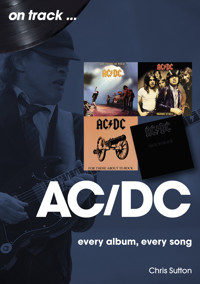
AC/DC are a global rock institution and big brand name. The secret to their success has always been that they are a rock ‘n’ roll band, pure and simple, undiluted by trends with a solid authenticity and no frills or pretentiousness. Chris Sutton examines the recorded output of the band in detail, helped by new interview material with former members, collaborators and friends in manager Michael Browning, drummers Peter Clack, Noel Taylor and Tony Currenti, engineer/producer Mike Fraser, logo designer Gerard Huerta, bassist Ian Hampton and engineer Dave Thoener.
They have one of the world’s biggest-selling albums in Back In Black, but is it their best album, and which are their best songs? As well as commentary and analysis of every track on every studio album, space is also given to B-sides and out-takes, while the live albums and box sets are also discussed. The background to each album is also covered as the band navigate tragedy and setbacks with a determination to keep going – rock or bust!
Whether you wish to revisit old favourites or learn about those gems you missed, AC/DC On Track is the essential guide to this legendary band’s music.
Chris Sutton manages Smethwick Heritage Centre Museum and has written several publications for them. He has also written several plays. This book is his fourth for Sonicbond Publishing, with several more to follow. He lives in Great Malvern, UK.
Das E-Book können Sie in Legimi-Apps oder einer beliebigen App lesen, die das folgende Format unterstützen:
Seitenzahl: 335
Veröffentlichungsjahr: 2024
Ähnliche


















For Belinda and Brent Fleming
Author Notes
Interviewees
Many were asked, but the following are those who agreed to contribute to varying degrees. Their thoughts and opinions remain theirs alone. My grateful thanks to Michael Browning, Peter Clack, Tony Currenti, Mike Fraser, Gerard Huerta, Ian Hampton, Noel Taylor and Dave Thoener. Where no other source is mentioned, all quotations are taken from these interviews.
The Australian albums
The Australian releases are the closest in integrity to AC/DC’s vision for each album. The international releases differ in track choices up until Powerage, while the album covers were also changed, often completely, up until Highway To Hell. This infuriating state of affairs ended with the Bon Scott era. From Back In Black onwards, there was uniformity at last.
Although the official remaster series used the international releases, we are taking a purer route in this book through the albums, following the Australian releases. These albums, for the most part, are how they were originally conceived to be by the band. The differences between those albums and the international releases will be discussed following each related Australian release.
Contents
Introduction
Tales Of Old Grand-Daddy – Marcus Hook Roll Band (1973)
High Voltage (1975)
T.N.T. (1975)
High Voltage (1976)
Dirty Deeds Done Dirt Cheap (1976)
The 1976 European Sessions
Let There Be Rock (1977)
The 1977 Sydney Sessions
Powerage (1978)
Highway To Hell (1979)
Back In Black (1980)
For Those About To Rock (1981)
Flick Of The Switch (1983)
Fly On The Wall (1985)
Blow Up Your Video (1988)
The Razor’s Edge (1990)
Ballbreaker (1995)
Stiff Upper Lip (2000)
Black Ice (2008)
Rock Or Bust (2014)
Power Up (2020)
The Future?
Live Albums
Compilation Albums and Film Soundtracks
Appendix 1: Selling The Brand – Gerard Huerta
Appendix 2: Stevie Wright’s Solo Albums
Introduction
The Essence Of AC/DC
The secret to their success has always been their solid authenticity, with no frills or pretentiousness. This is a rock ‘n’ roll band, pure and simple, undiluted by trends. The Bon Scott era, with some noteworthy exceptions, defined their three main lyrical interests as sex, drinking, and rock ‘n’ roll – note, not drugs! The long era since then, with Brian Johnson, has seen no major change to this gold standard, except that the wordplay is less adroit. The songs are generally simpler in approach than with Bon!
At the heart of the sound have been the guitars of the Young brothers: Angus Young and his Gibson SG, alongside Malcolm and his trusty 1963 model Gretsch Jet Firebird. Mix in the human metronome that is Phil Rudd and Cliff Williams’s pulse-beat bass lines, and you have the classic AC/DC sound. If you were to distil it down even further, you would surely be looking at the titanic rhythm playing of band ‘governor’ Malcolm, who lived and breathed rock ‘n’ roll. It’s an enormous testament to the character and playing of Stevie Young that the band could continue at all after Malcolm’s departure.
The Importance Of Family
Although founded in Australia, many of the early band members were immigrants from the UK, most notably, Bon Scott and the Youngs, all of whom hailed originally from Scotland. Bon was born Ronald Belford Scott in Forfar on 9 July 1946. His parents, Charles ‘Chick’ Scott and Isabelle ‘Isa’, emigrated to Melbourne from their home in Kirriemuir in 1952, taking Bon and his brother Derek with them. They sailed on the Asturias from Southampton on 5 March 1952, arriving 25 days later on 30 March in Fremantle, Perth. They initially stopped with Eleanor Laing (Isa Scott’s sister) at 89 Couch Street, Sunshine, Victoria. It was while at school in Melbourne that he acquired the nickname Bon (for ‘Bonnie Scotland’), which would stay with him for the rest of his life. The Scott family left Melbourne, after four years there, to live in Fremantle, Western Australia.
It was a tough working-class background for William and Margaret Young and their children at number 6 Skerryvore Road in the Cranhill area of Glasgow. The newspaper adverts promising a better new life in the sun proved irresistible. So, William and Margaret took the plunge and emigrated with four of their children by plane to Australia in May 1963. Their first home at the Villawood Migrant Hostel in Sydney turned out to have similar rough edges to their roots back in Glasgow. Speaking to The Coda Collection in 2003, Malcolm Young recalled the move to Australia:
Glasgow got bombed quite extensively in World War II, and it never really recovered. Unemployment was high, and you could get to Australia for about £20. That was for the whole family to fly over. Not everybody left. Me and Angus were the youngest, so we went along with George. My sister (Margaret Horsburgh) came with her husband and their young kid at the time. There wasn’t a lot to do in Australia unless you liked sports.
The direct musical influences on Malcolm Mitchell Young (6 January 1953 – 18 November 2017) and Angus McKinnon Young (born 31 March 1955) came from their father William and older brother, George. Malcolm recalled the musical background to The Coda Collection in 2003:
Dad didn’t play an instrument, but he would tap-dance and play the spoons. He had rhythm. On my mum’s side, she had a nephew in Germany who played piano. All the brothers played acoustic guitars. A lot of Big Bill Broonzy songs. One of ‘em used to play Scottish songs on the squeeze box. There always seemed to be instruments in the house. Angus and I picked up the guitar, like learning how to walk, as soon as we could. We’d see our older brothers knock up a tune, so we learned how to do it. We were basically brought into the world with guitars.
Older brother and mentor George Redburn Young (6 November 1946 – 22 October 2017) achieved success with The Easybeats in the 1960s. He got started at the Villawood Migrant Hostel: ‘To pass the time, the kids would go to the recreation hall and play table tennis and strum guitars and so on.That’s basically where the Easybeats started’ (Friday On My Mind, The Story Of The Easybeats).
George’s songwriting skills and the production talents that he learned, along with his close partner in The Easybeats, Harry Vanda, gave the duo a second career after the demise of their band. Vanda and Young, as they became better known, were the guiding lights for AC/DC and George remained on hand for advice to Angus and Malcolm till the day he died. It wasn’t just about music; it was about family. The Youngs have always relied on each other and turned to family members for support, and you get a sense that everyone else in their world is very much outside of that circle. I put this to their former manager Michael Browning, who tactfully concurred that ‘the Youngs are a very tight-knit family’. It was, and still is, an admirable strength.
Two older siblings also went on to work in the music business. Stephen Crawford Young (26 June 1933 – 13 December 1989) worked as part of the AC/DC organisation. He also emigrated to Australia in 1963 with his wife Janet and two sons. His oldest son is Stevie Young (born 11 December 1956), who went on to replace his uncle Malcolm in AC/DC. Alexander Young (28 December 1938 – 4 August 1997) played bass and saxophone under the pseudonym George Alexander with a UK-based band called Grapefruit. He later worked for Proud and Loud Management, based in Hamburg, who unsurprisingly had business dealings with AC/DC. He also wrote a song that AC/DC nearly recorded.
Tales Of Old Grand-Daddy – Marcus Hook Roll Band (1973)
Personnel:
George Young: vocals, guitar, bass, piano
Harry Vanda: vocals, lead guitar
Alan Waller: bass, vocals, piano
Angus Young: guitar (album and possibly third single)
Malcolm Young: rhythm guitar, lead guitar (album and third single)
John Proud: drums (album and third single)
Alex Young: tenor saxophone on ‘Louisiana Lady’ (single)
Howie Casey: saxophone (singles)
Freddie Smith: drums (first two singles)
Ian Campbell: bass (first two singles)
Produced by Wally Allen at Abbey Road Studios, London, between June and November 1972 and EMI Studios, Sydney, between July and August 1973
Release date: 1973
Label: EMI
Highest chart places: Australia: 89, UK: -, USA: -
Running time: 39:51
All songs by Harry Vanda and George Young except as noted
Malcolm recalled to The Coda Collection in 2003 the steps towards forming a band with Angus:
Angus and I had silent dreams about playing in a band. We played every day, and when George was around, we’d play with him too. We weren’t competing with each other. We practised on our own, sorting out our styles. We never really played together. I was more into The Beatles and The Stones, and Angus was more into the heavier stuff, Hendrix and Cream, with the lead guitar. I used to listen to songs as songs – the drums, the vocal, the music side of it. I tended to pick up on the chords, the whole picture around the guitar. It just happened when I was putting together a band; we were going to get a keyboard player, but I got Angus instead. Angus had his own band, a little rock outfit, but they just packed it in. He told me they were finished, and I said, ‘Come down tomorrow and have a bash’. We were going to play rock ‘n’ roll; it was as simple as that.
At this point, it’s worth noting that Malcolm Young’s legendary rhythm guitar playing has direct routes in big brother George’s stellar work with The Easybeats, something else that Malcolm learned from him.
Malcolm and Angus’s first recordings came not with AC/DC, but as part of a project George Young was working on. George and his fellow musical partner, and also a former Easybeat, Harry Vanda, had hooked up with Alan Waller from The Pretty Things. Originally, Marcus Hook Roll Band was a London-based project that came together for two singles – ‘Natural Man’ and ‘Louisiana Lady’. When an album was mooted, Vanda and Young were keen to record it in Australia with a session band. It’s likely that George had Malcolm already in mind to play on it, and Angus wasn’t far behind in his thoughts. Malcolm had already been in a band of some note. He joined The Velvet Underground (Sydney version) in 1971. By the time they changed their name to Pony in 1972, Malcolm was on his way out looking for a band that better suited his outlook and ambition.
The Australian album sessions commenced with the core band of Allan Waller, Harry Vanda, George and Malcolm Young and John Proud. Alan Waller described the set-up for the Australian sessions to Billboard in2014:
At first, Malcolm and Harry were playing (guitar) and George started playing the bass. After a couple of days, Malcolm was really coming on brilliantly; he sounded like he should be about 30 or 50 years old ’cause he had so much maturity in his playing. I said to George one night, ‘Your kid brother is something. He’s great’. And he said, ‘There’s another one like him at home. You wouldn’t believe it’. So, the next day, he showed up with Angus as well, and he was astonishing. He must’ve been 15 or 16 or something; he looked like a fresh-faced kid, but he played like a monster. So he would come along now and again, too. I think George wanted to let them know what it was like working in the studio. Malcolm was around the whole time, and Angus showed up occasionally.
The sessions went well. Waller tantalisingly added to Rolling Stone in 2014 that there had been a surfeit of material:
The Youngs are an incredibly talented family and an absolute joy to work with; no egos, no rubbish, just a ‘good vibe’ throughout the recordings. I came back from Australia with way too much material for an album, and after I’d finished mixing everything at Abbey Road, it was difficult to know what to leave out.
The fundamental point – that it was largely two different bands in London and Australia – was lost on Rolling Stone, who held up ‘Louisiana Lady’ (in 2014) as a focal track to hear early Angus and Malcolm, despite neither being on it!
The album title is a reference to Jim Beam Old Grandad bourbon whiskey, which Waller brought into the sessions as liquid encouragement! The original cover had a certain charm that fitted the title but was replaced for the reissue CD in 2014 with a misleading AC/DC Black Ice style cover. It’s an album worthy of investigation because the roots of Harry Vanda and George Young working together with Malcolm, and to a lesser degree Angus, are right here. The core album band also features future AC/DC drummer John Proud on drums. As well as the album there was also a single release of ‘Can’t Stand The Heat’ with a non-album B-side. The reissue CD pulled together all the singles, the album, plus some session outtakes.
‘Can’t Stand The Heat’
It’s an R&B chugger with a catchy chorus, but there’s not a lot going on of interest other than a brief ‘morse code’ guitar part. The prominent saxophone is rather distracting. This was also released as the third single.
‘Goodbye Jane’
Bright screeching guitar notes open this one before it settles into a steady chugging riff. The chorus is not far off being something Slade would have come up with and it has a positive good-time feel. The lead guitar sounds like it could be Malcolm and the rhythm track has some real energy to it. The piano-led outro takes things into boogie-woogie territory.
‘Quick Reaction’
The melody of ‘T.N.T’. can be heard in the chorus here, which implies that George Young had a lot to do with the writing of that song as well. There’s a real Rolling Stones ‘Honky Tonk Women’ feel on the verses. George and John Proud are great on the rhythm, along with either Malcolm or Harry Vanda on rhythm guitar. It sounds like Malcolm’s style and might well be him taking the solo, too. It’s one of the best songs on the album.
‘Silver Shoes And Strawberry Wine’
Time to slow things down for a reflective, slow blues ballad that reminds me of UFO. Waller sings it well in a light, bluesy style. There’s a fluid blues-based guitar solo to match, which works well with a heavily strummed acoustic guitar backing it. It’s followed later by rasping saxophone and squealing lead guitar duelling all the way to the outro. This excellent song is well worth hearing.
‘Watch Her Do It Now’
The glam feel returns, but it falls short in terms of how powerful it might have been. The vocals let it down, being a bit too understated. The slide guitar part is rather distracting and wasn’t the best choice for the song. It doesn’t enhance the music in any way.
‘The People And The Power’
This is the best song by far and Harry and George knew it. They later offered it up to their former Easybeat comrade Stevie Wright for his excellent album Black Eyed Bruiser (1975) – see Appendix 2. This version is looser than Wright’s but still effective. There are twin guitars on both rhythm and lead, so Malcolm, at least, is involved. George’s bubbling bass runs are melodic and John Proud’s cymbals sizzle satisfyingly. The solos are great, too, especially the saxophone.
‘Red Revolution’
This track has a thicker sound. The verses have a Thin Lizzy quality with the twin guitar riff, not unlike Lizzy’s later ‘Don’t Believe A Word’. The choruses have an early T. Rex glam/ hippy vibe in the style of their ‘Hot Love’. Curiously, it incorporates a reprise of the lyrics of ‘The People And The Power’, which relates perfectly to the subject matter of carrying on as best you can under the oppression of ‘the man’.
‘Shot In The Head’
This is one of the closest to AC/DC territory. The rhythm and overlaid lead guitar have a dirtier, riff-heavy sensibility than much of the album. The slide guitar part adds some welcome extra texture and there are some effective lead guitar solos. The song stands up well to repeated listening.
‘Ape Man’
One of the heavier songs. The main riff is very similar to Bad Company’s later ‘Feel Like Making Love’, which is no bad thing by any means. Sadly, there’s little other than that to admire. They stick to the riff and rhythm in what is a very simple song, where they successfully go for a simple, primal thud to suit the title.
‘Cry For Me’
The album’s closer is another ballad. An odd way to go out because its plaintive lyrics wear thin. It’s pretty indistinct musically, too, other than the lead guitar solos, which sound like two different players trading off licks. Who the players are is unknown, but it’s two of Harry Vanda, Malcolm and Angus. This could have been a better song with more dynamics to it.
Related Tracks
‘Natural Man’
The first single by the London-based band has a bass pulse and some guitar riffs, which would later turn up in ‘Live Wire’. The choppy rhythm chords, courtesy of George Young, are very AC/DC.
‘Boogalooing Is For Wooing’(Alan Waller)
This R&B number, with plenty of energy, was the B-side of ‘Natural Man’. There’s nothing of note to it. Waller’s material is pretty derivative and lacks the touches and melodic flair of Vanda and Young’s work.
‘Louisiana Lady’
The second single by the London-based band is a muscular driving rocker with a catchy chorus. You can really hear the Easybeats pop sensibilities in it and the song crackles with energy. It also benefits from a wild lead saxophone part by Alex Young.
‘Hoochie Coochie Har Kau’(Waller/ Waller)
The B-side of ‘Louisiana Lady’ sounds like a poor Paul McCartney B-side or out-take. It’s dreadful.
‘Moonshine Blues’(Alan Waller)
The B-side to ‘Can’t Stand The Heat’(the third single) is one we have some firm information on for the credits. Waller worked on it in London and brought it with him for the Sydney sessions. Harry Vanda added the raw lead vocals, Malcolm added the guitar and George played bass. It’s not a great song; it all sounds too polite and contained. But it’s nice to hear Malcolm’s lead guitar fills and solos.
‘One Of These Days’
An outtake from the Sydne-y album sessions. Harry and Malcolm have been directly credited on guitars and George as the bass player on this one. Oddly, this great little song is better than anything that made the album. The lead guitar fills are terrific and the choruses and verses are strong. There’s some wah-wah guitar for added colour. It all hangs together really well.
‘Ride Baby Ride’
Another Sydney sessions outtake. All the guitars are played by Harry and George. The latter also sings it in his own inimitable talkie style, which he would later use with Flash And The Pan. It’s pleasant and sounds like a fun Lynyrd Skynyrd-type song, but it’s not one you rush back to hear again.
The Beginnings Of AC/DC
The name of the band came from their older sister, Margaret Horsburgh. She saw the initials AC/DC (which stands for ‘alternating current/direct current’) on a sewing machine. Malcolm and Angus loved the name, which, to them, summed up exactly the energy they were going for.
They appointed Denis Loughlin as band manager, who occasionally stood in for vocalist Dave Evans if he had to miss a gig. Their official debut performance was on 31 December 1973 at Chequers Club in Sydney. Dave Evans recalled the night to VWMusic in 2021:
It was the most prestigious gig in Australia – to be doing New Year’s Eve – going through midnight and counting in the new year. That was our first show and people were excited about us because of Colin Burgess in the band and because of Malcolm and Angus, the younger brothers of George. It was an amazing show and I’ll never forget it. We started off with a bang.
Burgess’s ‘prestige’ was down to him having been a member of successful Aussie band Master’s Apprentice, while the link to George Young and The Easybeats was certainly a big draw.
While the band went on to conquer arenas and stadiums around the world, there are many fans who remain rightly nostalgic for the early days of the club and pub gigs. For that debut performance, the band consisted of Angus and Malcolm Young, Dave Evans (vocals, born 20 July 1953 in Carmarthen, Wales), Larry Van Kriedt (bass, born 4 July 1954 in San Francisco) and Colin Burgess (drums, born 16 November 1946 in Sydney). As the band gigged and built a following, the rhythm section kept changing. Finding the right combination appeared to have been a real problem. In mid-February 1974, they seemed to have settled on Neil Smith (bass) and Noel Taylor (drums). Taylor says, ‘Me and Neil Smith were selected together to join the band’ and he feels that in his brief time with them, ‘AC/DC were a band looking for its individual presence in music and stage presence’.
In March 1974, the first known live recording of AC/DC surfaced. Taylor recalls that ‘we had a residency at the Hampton Court Hotel in Kings Cross, Sydney, working on our repertoire, which included some originals. I recorded us at one show we did there. It’s been bootlegged and is on the web, although I am not sure where my original copy is now’. The recording is of good quality and an important historical record of AC/DC, featuring several great cover versions. It’s well worth seeking out. Taylor points out that it wasn’t him who leaked the recording: ‘Rumour has it that Dave Evans put it out, I only did a couple of copies. I never thought at the time that a recording I made on my little Aiwa tape deck for personal critique would be available to the world. I do chuckle!’
Part of the development of the band was Angus working on a formidable stage presence on lead guitar, dressed as a schoolboy. Malcolm credited his siblings, George and Margaret, for helping Angus, telling TheCoda Collection in 2003that:
They thought a good act always had something people could relate to. My sister said, ‘Why don’t you get your school uniform with the shorts?’ She knocked that up for him and this little guy became larger than life.
The school uniform struck Margaret as a good choice simply because she thought her brother looked cute when he would come home from school and play guitar in his uniform. It wasn’t till April 1974 that Angus first appeared on stage in school uniform. The venue was Victoria Park in Sydney and Taylor recalls that the whole band had ‘been thinking of wearing costumes because we thought it would get us noticed more’. Angus was already a focal point of the band and his costume enhanced that. The audience commented on it from that very first performance. He recalled to Total Guitar in 2020 that he walked onto the stage...
...the most frightened I’ve ever been, but thank God, I had no time to think. I just went straight out there. The crowd’s first reaction to the shorts and stuff was like a bunch of fish at feeding time – all mouths open. I had one thing on my mind: I didn’t want to be a target for blokes throwing bottles. I thought if I stand still I’m a target. So, I never stopped moving.
But while the other band members’ costumes didn’t last (see the photo pages), Angus’s look caught on and it marked the band out. Taylor says that the band were now a distinctive live act:
Gigs were very interesting, to say the least. Angus looked the part in his schoolboy uniform, as it made him look 16 or 17. I seem to remember him not being allowed in through the front door at some venues for underage reasons. The audience were always interested in the band. Angus already had stage presence and was more than competent on guitar. Dave Evans played the rock star frontman with precision.
Angus’s move to the lead guitar position was still a work in progress. Dave Evans pointed out to VWMusic in 2021 that, ‘Malcolm was a better rhythm player; he was a strong rhythm player. When we first started, they both used to play lead. Angus wasn’t the lead guitarist; he was one of the guitarists’. The band grew in strength with every gig and the audiences lapped them. Malcolm talked about their progress to The Coda Collection in 2003:
We had a good thing with the clubs. Rowdy, mad, brawling Aussies, it made Angus do it more. By the end of the night, everyone was won over. He wore the outfit, but he could play that guitar. We used to go to clubs and check out what was going on, and none of them were playing music that was getting people up and rocking and dancing. They didn’t have a clue. It was just wide open for us. The very first show, the very first song we did, we had them won over. We’d play ‘Jumpin’ Jack Flash’ and jam in the middle, drag it out, then some Little Richard, ‘Great Balls Of Fire’ and a couple more Stones tracks. Stuff we all roughly knew. Have a quick bash, and we just bluffed our way through. As long as they were up dancing, we were doing our job.
The band had a promo photo put together. Taylor recalls that ‘It was made up from a photo shoot done at a gig on the top of a swimming pool centre at Broadway, Sydney. It was a regular outdoor gig for us at the time’. The promo photo indicated things were looking good for the band, but there were changes afoot. Malcolm wanted changes and, in April 1974, out went Noel Taylor and Neil Smith. Taylor didn’t see it coming and recalls that...
...when Malcolm came to Neil and mine’s residence to sadly inform us that we weren’t the right rhythm section for the band, I was disappointed, but Neil was relieved. Malcolm was sad it didn’t work out because we got on really well. It was a short but sweet and memorable time. Malcolm was always confident of success for the band and the rest is history!
Rob Bailey came in on bass and Peter Clack on drums. The band were due to record a single, but the line-up on just two tracks recorded for the single was still fluid.
‘Can I Sit Next To You Girl’ b/w ‘Rockin’ In The Parlour’ (1974) Single
Personnel:
Dave Evans: lead vocals
Angus Young: lead guitar on ‘Can I Sit Next To You Girl, rhythm guitar on ‘Rockin’ In The Parlour’
Malcolm Young: lead guitar on ‘Rockin’ In The Parlour’, rhythm guitar on ‘Rockin’ In The Parlour’
George Young: bass
Peter Clack: drums on ‘Can I Sit Next To You Girl’
Colin Burgess: possible drums on ‘Rockin’ In The Parlour’
Produced by Harry Vanda and George Young at Albert Studios, Sydney, between February and May 1974
Release date: 22 July 1974
Label: Albert Productions
Highest chart place: Australia: 50
Both songs by Angus and Malcolm Young
George Young and Harry Vanda signed the band to Albert Productions, which they were a part of, and also came on board as AC/DC’s producers. But who actually were the rhythm section on the single? Peter Clack says: ‘It was Rob Bailey and me on ‘Can I Sit Next To You Girl’’. He adds that ‘George played with me for six to eight weeks, and he taught me a lot – e.g. It’s not always what you play but what you don’t play! I didn’t play on the B-side, which was recorded before I joined’. Clack joined the band in April 1974, so the A-side must have been recorded in April or later. Engleheart and Durieux (AC/DC: Maximum Rock ‘N’ Roll) say that the bass part was replaced by George Young, but they claim it was Larry Van Kriedt’s part he replaced and not Rob Bailey’s.
That leaves the B-side of ‘Rockin’ In The Parlour’. The probable pair in the rhythm section are Colin Burgess and George Young. According to Clack, the recording (circa February 1974) ties in with Larry Van Kriedt’s brief tenure in the band on bass. Burgess was certainly experienced enough to record the drums, but George Young never thought long about replacing a bass part if he thought it needed it. It could well be him instead of Van Kriedt.
It is puzzling why there is a gap between the recording of the two songs, but a plausible explanation is that the A-side was intended to be ‘Rockin’ In The Parlour’, but they bumped it to the B-side while they worked up another song.
This is a fine enough debut offering, although it suffers in comparison to their later work. But if this had been all we ever had from AC/DC, it would be heralded as a lost, forgotten gem. Instead, it symbolises the first tentative steps of one of the greatest rock bands of our time. It’s the only recorded output with Dave Evans and although he’s a good singer, he doesn’t have the power or strength of either Bon or Brian. For what the band wanted and where they were heading, they were right to dispense with his services.
We can thank Dave Evans for revealing to VWMusic in 2021 who played what on guitar:
You got Angus playing lead guitar on ‘Can I Sit Next To You Girl’. But on the B-side, you got Malcolm playing the lead on ‘Rockin’ In The Parlour’. We were on tour when Malcolm announced to us that he was going to stick with the rhythm because he was better at it than Angus. And, of course, Malcolm was writing the songs anyway at the time. He said that Angus was going to be the show pony, as it were, and do all the lead. That was Malcolm’s decision.
There were, of course, other songs that could have been recorded. Dave Evans discussed two of them with VWMusic in 2021:
There’s one song called ‘The Old Bay Road’, which was a great song. They never ever recorded it, but we did it every night. There are one or two others. At the very first gig, I wrote a song called ‘Sunset Strip’ – on the spot. We didn’t have enough songs, so Malcolm said, ‘Just make something up’. So, I just introduced ‘Sunset Strip’ and Malcolm started a 12-bar rocker. We kept it in the set for the whole time that I was with the band. But after I split, they never recorded it.
Other known original unrecorded songs from the era include ‘Midnight Rock’ and ‘Fell In Love’. The latter was reworked for the debut album.
‘Can I Sit Next To You Girl’
This is nearly a minute shorter than the better-known version with Bon. The intro is completely different, displaying a bright (almost Joe Meek), shrill, poppy sound. Angus and Malcolm play off each other in a melodic guitar wrestle before this is broken, a mere 22 seconds in, by the band, as they launch into the familiar, almost Status Quo-like, riff. It still sounds too thin and Dave Evans’ vocals are glam/poppy, which is a hard sell for those of us brought up on Bon and Brian.
In the rhythm section, Peter Clack is adequate, but George Young’s melodic bass lines stand out. Angus picks up on them for his fills. His guitar sound, however, is a little shrill, lacking the fuller tone he is better known for. The other worthy mention is Malcolm, whose crunching rhythm guitar heralds the beginnings of the classic AC/DC sound.
‘Rockin’ In The Parlour’
The B-side opens with drums and cowbell, the Stones-esque intro being firmed up by a riff that The Cult would get close to on ‘Lil Devil’. It’s a very different AC/DC sound, far more poppy and lightweight, with only the rhythm guitar and Malcolm’s lead guitar standing out in any way. Quite why they decided to choose the parlour as the venue for the ‘action’ is strange, to say the least. Not surprisingly, it was one they never came back to during the Bon Scott era.
The Highway To The Debut Album
AC/DC appointed Michael Browning as their manager in September 1974, the next step up on the road to success. He recalls his initial meeting with the band:
I had the Hard Rock Cafe in Melbourne, which was a live music venue – no relation to the British Hard Rock Cafe chain. It was pretty much the live Melbourne venue at the time. All the Australian, and some international, bands played there. I had asked a friend of mine in Sydney if there were any bands from there I should be looking at to play at my venue and the name AC/DC popped up. I immediately pricked up my ears because I’d always been a fan of The Easybeats and, of course, George and Harry from The Easybeats were behind the band. So, they came and played for me when they were on their way to Perth and I thought they were great.
The Perth gig would mark the parting of ways with their manager Denis Loughlin (later to be lead singer with Sherbet). Browning wasn’t surprised that things went so badly wrong in Perth:
They had a guy (Loughlin) who was so cool managing them (he says sarcastically) that he booked them to Perth and then Adelaide on the way back. They arrived in Perth after driving over the desert; this was a long way, you know – like driving from New York to LA. They arrived there to discover they were booked to support a drag queen in a cabaret. So, the owner of the club obviously had assumed, with the name AC/DC, that they were some kind of gay band or something. So, they fired their manager and went to Adelaide.
Having sacked Loughlin, the band quickly found they were in dire straits. Cash, specifically the lack of it, was a pressing problem. They turned to Browning:
They were due to come back to Melbourne and play a bunch of dates, the Hard Rock cafe included, and they had run out of money. So they called me and asked if I would lend them some money. I said sure and they came and played my gig and that’s where the conversation started about me managing them. I had been a manager of a very successful Australian band, Billy Thorpe & The Aztecs, and the band wanted someone who had a proven track record to take them over. So, me and my partner in the Hard Rock Cafe, Bill Joseph, financed them. We paid them a $60 per week wage each, resolved all their financial problems and gave them a road crew and a bus to travel around in. We got them a house to live in, too – we paid for everything. In return for that, we received all the money; that was the deal we struck up to consolidate them financially. After six months, it reverted to just a normal manager percentage commission scenario. So, we were very highly motivated to make it happen, to break them, within that six months so that we could not only pay their costs, but so we could actually make some money.
While Browning stabilised the band’s operations, it was still clear that the band itself was still not right. Dave Evans became the next casualty, following his final dates in September 1974. Dave feels that money, not his vocals, was the main reason for his departure, as he told VWMusic in 2021:
We had a Top-Five hit record and we were doing the big shows there in Adelaide. And still, no money. We had a night off, and I confronted the manager (Browning) over this for all of us – not just for me. He smart-mouthed me and I stuck into him, and it was pulled apart pretty quickly; I didn’t really hurt the guy. But that was it. I said, ‘I want this resolved. I’m not leaving Sydney – I’m not doing all these shows unless I get paid something’. At the end of the tour, we had a meeting. They’d already talked and the manager was already pissed off. In the meantime, he’d spoken to Bon Scott to try to get him into the band because of what happened with me with him. My problem was not resolved, and so I split with the band because of that. That was the main reason.
Bon Scott came into the band’s orbit via Vince Lovegrove, who ran the Jovan booking and management agency. Lovegrove took a call from George Young, enquiring if he knew of a singer. He had one right there as it happened. Living with Lovegrove at the time was his former Valentines bandmate Bon Scott, who was recovering from a motorbike accident. Lovegrove suggested Bon for the job, but George was uncertain on account of Bon still being unfit and, more importantly, his age.
At 28, he was indeed significantly older than his prospective bandmates and he had a history of bands behind him – including The Spektors, The Valentines and Fraternity. He was now ‘resting’, still hoping for the big career break. Angus tactfully recalled to Total Guitar in 2020 that ‘Bon joined us pretty late in his life, but that guy had more youth in him than people half his age. That was how he thought, and I learned from him. Bon used to say to me, ‘Whatever I do, you don’t’.’
Bon’s shared Scottish roots were surely a plus for the Youngs. They had a similar life experience and world view and they also had a shared admiration for one of Scotland’s finest performers, Alex Harvey. Harvey also hailed from Glasgow (born 5 February 1935), and, like Bon, he achieved his major success when he hooked up with a younger band. Harvey was 37 when he joined up with Tear Gas in 1972, promptly renaming them as The Sensational Alex Harvey Band. The band’s rise was, in large part, based on Harvey’s charisma and his unique way with words and delivery. Bon Scott was a big fan and the parallels between the two are there to be seen and heard.
High Voltage (1975)
Personnel:
Bon Scott: lead vocals
Angus Young: lead guitar, rhythm guitar
Malcolm Young: rhythm guitar, backing vocals, lead guitar on ‘Little Lover’, ‘Soul Stripper’, ‘You Ain’t Got A Hold On Me’ and ‘Show Business’.
George Young: backing vocals, bass on ‘Stick Around’ and ‘Love Song’, percussion on ‘Soul Stripper’
Rob Bailey: bass on all except ‘Stick Around’ and ‘Love Song’
Peter Clack: drums on ‘Baby Please Don’t Go’
Tony Currenti: drums on all tracks except ‘Baby Please Don’t Go’
Harry Vanda: backing vocals
Produced by Harry Vanda and George Young at Albert Studios, Sydney, November 1974
Release date: 17 February 1975
Label: Albert
Highest chart places: Australia: 14
Running time: 39:51
All songs by Angus Young, Malcolm Young and Bon Scott, except as noted
High Voltage is where it all starts in earnest for the band’s recording career, their first album for Albert Productions. Chris Gilbey, Vice President of Alberts, was confident in the band because of George Young’s presence. He told Double J Radio in 2017 that:
In the early period, George was a far greater controlling influence than any of the members of the band. Because George was the big brother and he’d been there with The Easybeats, he knew the ropes, he’d gone to England and he’d had hit records. I think he imparted a very strong ethic as to what the music business was about, what music was about and staying close to the roots. I think that was one of the things that George really communicated.
The songs were (mostly) ones that had been tried and tested on stage, including one cover version. Michael Browning says one was enough: ‘We didn’t want to start off recording covers. Malcolm was pretty much the main songwriter. When Bon joined, he was an amazing lyricist, so we had lots of songs quickly and away they went’.
It does enormous credit to Vanda and Young that the album feels like the work of one band, considering that the personnel in the rhythm section differs from song to song. In theory, the band was Bon, Angus, Malcolm, Rob Bailey (bass) and Peter Clack (drums). In the studio, both Bailey and Clack had their parts replaced on songs to a greater or lesser extent. Clack, in fact, is only heard on ‘Baby Please Don’t Go’, replaced on everything else by Tony Currenti. Clack told Sleaze Roxx in 2021 how and why that happened:
It had to be done in a week and it had to be done at one o’clock in the morning. So, the only track that I got down was ‘Baby Please Don’t Go’. I had been playing every night and I just didn’t have the stability or the constant reproduction. (George)




