


Erhalten Sie Zugang zu diesem und mehr als 300000 Büchern ab EUR 5,99 monatlich.
- Herausgeber: The History Press
- Kategorie: Geisteswissenschaft
- Sprache: Englisch
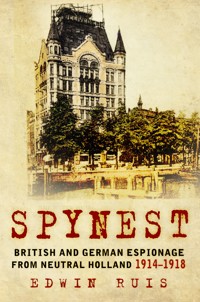
After the First World War broke out, Holland, and the port city of Rotterdam in particular, became a prolific breeding ground for secret agents and spies. The neutrality of the Netherlands, its geographical position between the warring nations and its proximity to the Western Front meant that the British and German secret services both chose Holland as the main base for their pioneering spy operations. It was here that the new intelligence agencies fought their battles, each in pursuit of the other's secrets. Both sides sent in their own agents, but they also hired local men and women to work for them, as couriers, trainspotters and infiltrators. Many of them were recruited from the shadowy criminal underworld and brought with them their own concerns; others sacrificed their lives for love of their country. Author Edwin Ruis has plumbed the depths of the international archives to bring to light the unexplored and often wellguarded secret histories of intelligence in the First World War. But even this is only half the story. Those who were not found out, the truly successful spies, remain a mystery to this day.
Sie lesen das E-Book in den Legimi-Apps auf:
Seitenzahl: 443
Veröffentlichungsjahr: 2016
Das E-Book (TTS) können Sie hören im Abo „Legimi Premium” in Legimi-Apps auf:
Ähnliche




















The spy system which was to make Rotterdam the biggest international spy centre of the world had begun.
James Dunn (MI5)
***
Spying is at all times a battle of wits.
Gustav Steinhauer (N)
***
In the dark future the development of the intelligence service will continue, to investigate and influence you […] In the future the secret power of the intelligence service will be larger than in the past and present.
Colonel Walter Nicolai (IIIb)
Acknowledgements
When I first researched Spionnennest 1914–1918, I did so on my own. After its Dutch publication by Just Publishers in 2012 it attracted the attention of people whose input I have used for this revised international version by The History Press. The risk you take when writing a word of thanks is that you might forget people … but nevertheless, I would like to add a word of thanks to the following people: Dr Nicolas Hiley for his additional information and seeding the idea of a possible English version; Dr Thomas Boghardt for his additional information on the German Consulate General; Mr Etienne Verhoeyen for sending his unpublished article on Leopold Vieyra; and the late Mr Yvo Coninx for his information about Charel Willekens and the Moreau family. This book would not have been written without Hans van Maar of Just Publishers, who suggested I did so after publication of an article in Wereld in Oorlog (World at War) magazine on this subject. Thanks also to Michael Leventhal of The History Press for taking a chance with an unknown foreign author. And, last but not least, my thanks to family and friends who suffered and still suffer my tales of First World War espionage and other obscure tales of history with which I am fascinated.
Contents
Title
Acknowledgements
‘The Spy’
Introduction
1 The Devil and the Deep Blue Sea
2 An Old Profession Re-invented
3 The Uranium Steamship Company
4 The Imperial Consulate General
5 Behind The Death Wire
6 Death of Two Salesmen
7 Trials and Executions
8 T for Trouble
9 The Spying Arts
10 Black Book and White Lady
11 Inspector Broekhoff’s Bluff
12 The Secret War Continues
Bibliography
Plates
Copyright
The Spy
Once he was young and brave and fair,
Free from the strain of guilt and care;
His mind was pure, his heart was clean,
His face bore marks of happy mien;
His teacher looked with hopeful pride,
Upon the joys that thrift betide;
And often said: ‘Life well begun,
Assures the laurels will be won.’
He grew to manhood tall and fair,
With manly strength and shoulders square;
He stood six feet, and every inch
Was born to work and not to flinch;
When others fainted by the way
He did his part without dismay;
With all his mind and all his heart
He ever strove to do his part.
Then came the temper and he fell
Before the vile seducing spell;
He learned to fetch and feint and lie,
Which fitted him to be a spy;
Although oftimes he was dismayed,
From day to day he plied his trade,
But proved a traitor to his cause
And wronged the mandates of the laws.
He shrank from man. His silent mood
Made him but for solitude;
He hid his face and breathed a sigh,
When he met others eye to eye;
And when a sound came to his ear
He trembled much with deadly fear;
And, as his dubious course he ran,
He palled beneath the curse of man.
Bernhart Paul Holst (1916)1
Note
1. Bernhart P. Holst, My Experience with Spies in the Great European War, 8–9.
Introduction
When Willem Roos smoked his last cigarette early on the morning of 30 July 1915, he was about to become the second Dutchman in history to be executed in the Tower of London. Ten minutes earlier, at 6 a.m. precisely, his compatriot, Haicke Janssen, had been shot dead by the Scots Guards’ execution squad. Two weeks earlier, both men had been sentenced to death by a court martial after being found guilty of espionage. They had not been spying for Queen Wilhelmina and the Netherlands, but for Kaiser Wilhelm and Germany.
Despite their fate, the story of Janssen and Roos did not become well known in Dutch history. The first time I came across them was in the Imperial War Museum in London, where I had decided to kill some time before taking a train to Harwich and catching the ferry to Hoek van Holland (Hook of Holland). In the museum there was an exposition on espionage. The names Janssen and Roos seemed to me to have a Dutch ring and I memorised them, planning to find out more back home.
Alas, there was not a lot to find out, at least not about Janssen and Roos. However, my research did open up a box of other spy stories, many never told to a general audience before. They will paint a good picture about the circumstances in which these two unfortunate Dutch sailors were drawn into the spy game. This book, first published in spring 2012 in Dutch by Just Publishers B.V., is the result. For this international version by The History Press I have corrected some minor mistakes and added new material and insights.
In Dutch historiography, the First World War has never received much attention. The Netherlands was neutral and, even though the war did not go by unnoticed, it did not have the same effect because the country did not participate in the mass killing and destruction. Understandably, the Dutch are much more occupied with the history of the Second World War, when they did get their share of killing, destruction, occupation and oppression.
However, it is no wonder that Dutchmen got involved in the Great War’s spy game. The neutral Netherlands was an excellent springboard for the German secret services to field operations in Great Britain, and for the British the country was an excellent base for espionage operations in Germany and German-occupied Belgium. The preferred route from the German side of the Western Front to the Belgian-British-French side and vice versa went through the Netherlands. As both sides opened shop there, they also hired local men and women to work for them, ranging from relatively harmless jobs as receptionists or clerks to full-blown spies.
During the First World War, spy clichés that are nowadays very familiar from pulp fiction and Hollywood were hatched. However, this book will show the reader, hopefully unnecessarily so, that the James Bond type of superspy has little to do with reality. That reality during the years 1914 to 1918 was of a surprisingly amateurish and often outright ridiculous nature. Keep in mind that many of those named in this book were not the best of spies. They are the ones who were exposed, got caught or sought publicity during and after the war. Those who were not found out, the truly successful spies, remain a secret to this day.
Many agents of the First World War were, as you will see, swindlers, charlatans, ne’er-do-wells and opportunists. The cause of that lay in the military and political leadership’s disdain for espionage and the profession of spy. Sly people – or those regarded to be sly on the basis of prejudice, such as Jews – and borderline criminals were considered very suitable for this dirty, lowly line of work.
Only years after the war, a re-evaluation of the secret agent took place. In a world that faced collectivisation under pressure of socialism and nationalism, the need grew for stories of heroic individuals who led adventurous lives and they became seen as people who took great personal risks to realise their ideals. Thus, the spy transformed from a semi-criminal into a lonesome hero.2
Writing spy history is a tricky business. It is almost by definition a history of misfits, unhappy incidents and failure. Research is problematic as, by its very nature, very little was trusted to be written down on paper. And a lot that was, was destroyed; a paper shredder is essential equipment for every secret service. And even if something was saved, it is often well guarded in inaccessible government archives. That is why we still know so little about the true nature of Mata Hari’s fate, as France will release the information on her only as late as 2017, if at all. In 2014, MI5 released its dossiers on the infamous Dutch femme fatale, but they had not a lot to tell and lacked any serious proof that she was a spy.
The Dutch secret service archive has not a lot to tell either. With the German invasion of May 1940, the archive of the military intelligence service GSIII was destroyed to prevent it from falling into the hands of the Nazis. That job was done by Lieutenant-General Hendrik A.C. Fabius. He became head of GSIII in November 1939 after the previous chief had to resign because of the so called ‘Venlo Incident’ in which GSIII was implicated in a failed SIS plot to kill Adolf Hitler. For Fabius it must have been a particularly miserable task; in 1914 he had founded the same service and led it until 1919 as a young ritmeester, or cavalry captain. So in a way he had to destroy his own heritage.
Before Fabius destroyed the secret service archive, that of the Rotterdam Municipal Police Corps, which has been very important to my research, had been cleansed of all sensitive pieces that stemmed from the First World War and the years after. Of special concern were those documents highlighting the relationship between the Rotterdam police and the British secret services, the reason for which will become clear.
So it is difficult to get a complete picture of what really happened in that shady underworld of international espionage, but not all traces have vanished. Here and there the past leaks into the present. Some dossiers survived archival destruction by being missed or forgotten. Former spies, secret agents and intelligence officers have written their memoirs, and in the recent past the British secret service has released its First World War records.
Many books on British intelligence history have been published but there remains mostly silence from the German side. The archives of the then German secret services were destroyed after the German defeat and subsequent collapse of society, so little remains. One of the very few academic works on the subject of the German intelligence service of this period is Dr Thomas Boghart’s Spies of the Kaiser. What now remains is to fill in some of the blind spots from the Dutch side of the story.
This book will explore the special role played by the Netherlands in general, and the city of Rotterdam in particular, as the most important international spy centre of the First World War. Why did everybody who was somebody in the world of international espionage during the years 1914–18 flock there? Who were these people that operated in a shady, harsh world full of danger and betrayal? What did they do and what drove them to put their lives at risk?
Note
2. Michael B. Miller, Shanghai on the Métro: Spies, Intrigue and the French Between the Wars, 349.
1
The Devil and the Deep Blue Sea
The days when the Netherlands was a great European power, able to fight Great Britain and France simultaneously, were long gone when the First World War broke out. Eighteenth century complacency and Napoleon Bonaparte had seen to the downfall of the Dutch Republic. An attempt in 1813 to regain some of its previous glory as the United Kingdom of the Netherlands, a project conceived by the British to control the French, was killed off by the Belgian or Southern Netherlands’ secession in 1830. The (Northern) Netherlands or Holland* became a small European nation with an agricultural and trade-based economy and a relatively large but weakly defended colonial empire in Asia, a remnant of its seventeenth-century trading-post empire.
As Napoleon had proven that size mattered when it came to armies, practically all European nations adapted conscripted military service at the beginning of the nineteenth century. For a country with a total population of 6 million at the beginning of the twentieth century, there is only so much the Netherlands could do against nations whose armies were the same size as its total male population. International peace and free trade became the Netherlands’ best political strategy in international affairs, which resulted in a strict neutrality in all military conflicts. With the exception of its internal colonial wars, which were fought with the same ferocity as the British or French ones, the Dutch kingdom reinvented itself as a neutral, peace-loving country.
Prior to the First World War, the Netherlands hosted two major international peace conferences in The Hague (Den Haag), the historical seat of government and capital city of the Netherlands in all but name. The First Hague Conference was held in May 1899 on the initiative of the Russian tsar, Nicholas II. He felt that peace would be better for the prosperity and progress of mankind, although the backward state of the Russian armed forces could also have been a motive. Under pressure from an influential international peace lobby, representatives of twenty-six nations conferred with some reluctance on the limitation of certain types of weapons, including poison gas, hollow-point bullets and aerial bombardment from hot air balloons.
Due to the intimate surroundings of the conference centre, Huis ten Bosch, a relatively modest royal mansion, the world leaders were forced to live close to each other for a while. As a result, the conference was a surprising success and agreements were made on the laws of war and subsequent war crimes. In 1907, there was a Second Hague Conference at the instigation of the American president, Theodore Roosevelt. It had been planned for 1904 but had to be postponed because of the Russo-Japanese War that would foreshadow the Great War in terms of trench warfare and loss of life. The second conference is generally considered a failure. At the end it was agreed to have a third conference in 1915, but by then the world’s most powerful nations were at each other’s throats. Still, the philanthropic American steel magnate Andrew Carnegie financed the building of the Peace Palace in The Hague to house the International Court of Justice. Today The Hague is still a centre of international law.
***
In 1914, the two most important foreign powers to the Netherlands were big brother Germany in the east and overseas cousin Great Britain in the west. Both countries also had colonies bordering the Dutch East Indies, a vast collection of more than 17,000 islands that form present-day Indonesia. British Malaya lay to the north-west and shared a land border with the Dutch colony in northern Borneo. To the east lay one of the few colonies of Germany: Kaiser Wilhelmsland and the Bismarck Archipelago, or the northern half of present-day Papua New Guinea. Britannia ruled the waves that led to the Dutch East Indies and Germany was the biggest export market for Dutch European and colonial produce.
When war broke out in August 1914, the Dutch desired to stay neutral. This was not only because neutrality was the chosen political strategy until May 1940, but also because a choice between the two neighbouring countries was simply an impossible one to make. Choosing the German side was not unthinkable at the beginning of war in August 1914. Germany had historically never waged war against the Netherlands, unlike France and Britain, and had always been a friendly neighbour and good economic partner. Many members of the Dutch politico-cultural elite had studied there and considered it a place of great cultural, scientific and technical achievements.
Great Britain was not exactly popular with both the Dutch public and the elite after its bloody war against their Boer brethren in South Africa a decade earlier. Besides, Britain displayed the irritating arrogance that comes naturally with being the world’s leading superpower. But siding with Germany would certainly lead to a repetition of the Napoleonic Wars, when Britain took over the complete Dutch overseas colonial empire during the French occupation, only returning the Dutch East Indies for political reasons in the European theatre. On the other hand, choosing the British side would certainly lead to a German invasion and the subsequent loss of the country itself to the whims of Kaiser Wilhelm II and his generals.
Although on the eve of the war public opinion in the Netherlands was leaning towards sympathy for Germany, the German invasion of Belgium and its criminal misbehaviour against the Belgian people, such as the sack of Leuven (Louvain), rapidly decreased any Dutch sympathies. On top of that, the Dutch government realised a German victory followed by an annexation of Belgium would lead to a total encirclement by Germany and a certain loss of independence, if not outright annexation. But in the end it would not be the Dutch themselves who determined their neutrality and place in the First World War, but the interests of the two most powerful warring nations: the German Empire and the United Kingdom. In the words of the Dutch Minister of Foreign Affairs, John Loudon, the Netherlands was caught between the devil and the deep blue sea.
***
When, on the morning of 28 June 1914 in Sarajevo, the radical Bosnian-Serb nationalist Gavrilo Princip shot dead the Austro-Hungarian crown prince Archduke Franz Ferdinand and his wife Sophie, it did not lead to a lot of consternation in the Netherlands. Most people there were fed up with the Balkans and its shenanigans. Two weeks earlier a well-known, highly decorated Dutch military officer, liberal politician and former MP, Major Lodewijk Thomson, had been killed in Albania while trying to bring law and order to that newly independent nation. He had been part of a Dutch military mission that operated on the request of the six great European powers and the Albanian central government, led by the German-Dutch princeling Wilhelm zu Wied, who fled his unruly new country after only six disappointing months.3
The Netherlands was led by Prime Minister Pieter W.A. Cort van der Linden (1846–1935), who in the previous summer had formed a centrist liberal minority government after general elections had failed to produce a clear political winner amongst liberals, Christian conservatives and socialists of all sorts. Key figures of the government went on summer holiday light-heartedly after the Archduke’s assassination, so by the time of Austria–Hungary’s ill-fated declaration of war on Serbia on 28 July, they had to hurry back to The Hague and officially proclaim neutrality in the conflict. Among them were Queen Wilhelmina (1880–1962), the German-born Queen Mother Emma von Waldeck-Pyrmont and the chief of the General Staff, Lieutenant-General Cornelis J. Snijders (1852–1939), who was holidaying in Germany.
On 30 July, the Netherlands proclaimed its neutrality in the conflict between the Austro-Hungarian Empire and the Kingdom of Serbia. During the next week, many such proclamations had to follow for every country that declared war on another. Through a web of mutual agreements and treaties, two warring factions were formed in Europe: the Triple Entente comprising France, Russia and Britain and the Central Powers comprising Germany and Austria–Hungary. During the war other countries would choose sides, such as the Ottoman Empire that joined the Central Powers in November 1914 and declared international jihad.
The Dutch proclamation consisted of eighteen articles, each specifying the nature of the neutrality. The most important were that hostilities were not allowed within Dutch territory and waters (including overseas); that it was not allowed to use said territory and waters as a base for military operations; and that foreign soldiers whom, for whatever reason, crossed into Dutch territory would be interned in POW camps for the duration of the war.4
On 31 July, the short, but tenacious and energetic Chief of Staff Snijders was appointed commander-in-chief of land and sea forces and promoted to full general. He was only subordinated to Prime Minister Cort van der Linden’s Cabinet, that would last to September 1918 – an unusually long period for a Dutch government. The position of commander-in-chief existed only during wartime and was reserved traditionally for a senior male member of the Royal House of Orange-Nassau. However, in 1914 the only male member of the Royal House was the German Prince Consort Heinrich Duke zu Mecklenburg-Schwerin (1876–1934). Apart from his limited intellectual capabilities and questionable, philandering lifestyle, which included the services of public women of the more expensive type, Prince Hendrik (Henry), as he is known in the Netherlands, could hardly suppress his enthusiasm for the German cause. Therefore, he was justly considered not suitable to play any role of importance in Dutch politics or the military. He was limited to honorary positions including chairman of the Red Cross, wearing fancy uniforms and cutting a ribbon now and then.
Also on 31 July, the Dutch government ordered a full military mobilisation of its 200,000-man-strong conscript army, including reserves and regional militias. For all continental armies in 1914, the speed of mobilisation was detrimental to military success. Waiting for the other party to attack first and then getting the guns out was no option in major warfare. As the Netherlands knew it stood little chance against Germany if its neutrality was not recognised, on 29 July it had asked Belgium for co-operation in organising a joint defence. However, the francophone Belgian government of Catholic conservative Prime Minister Count Albert de Broqueville declined. They felt that collaborating with another neutral country was not neutral.
On 2 August, Germany recognised Dutch neutrality. The Belgians, who contrary to the Netherlands were obligated to neutrality by their constitution, were not so lucky. When they realised this, they asked the Netherlands for the same deal they had refused previously. The Dutch, however, felt that the need for military co-operation had gone and now it was their turn to say no. For the Germans, Belgium formed an excellent back entry into France, outflanking the French fortresses at their eastern border. They demanded free passage through Belgium to northern France, using the excuse they needed to prevent an imminent French attack on Belgium. The Belgians had to refuse this absurd demand. Germany declared war on Belgium and invaded during the night of 3 to 4 August. But why did the Germans accept Dutch neutrality?
The whole German military strategy revolved around the so-called Schlieffen Plan. This plan was created in 1905 by General Alfred Count von Schlieffen and was designed to defeat France in case of war. As France was allied to tsarist Russia, General von Schlieffen developed a scheme wherein the German armies would first defeat the French rapidly, before boarding trains that would carry the bulk of the army to the east, where they would defeat the slower-mobilising Russians.
For this plan to be successful the Germans would have to go around the French fortresses that guarded their common border. The best way to do that was via Belgium and Luxembourg. But take a look at the map and you will see that the Belgian–German border is rather short and Flanders is shielded by the appendix-like Dutch province of Limburg, also known as the ‘Maastricht Appendix’ after the provincial capital. This leaves only a small entry through the mountainous Ardennes region of Wallonia. Therefore, General von Schlieffen envisioned an invasion of the Netherlands as well.
His successor, General Helmuth von Moltke the Younger, whose uncle had in 1871 defeated the French in the Franco-Prussian War, revised the Schlieffen Plan in 1908 and scrapped the part in which the army would march through Dutch Limburg. There were two reasons for this change: defeating the Dutch army could take too long in the very tight schedule of the Schlieffen Plan and a neutral Netherlands would cover the northern flank of the German invasion force. More importantly, a neutral Netherlands and its international port of Rotterdam could act as a ‘windpipe’ through which Germany could stay connected to the world economy in case of the inevitable British maritime blockade.5
Thus, the Netherlands was spared a German invasion but there was another consideration on the part of the Germans linked to the first. A German invasion of the Netherlands could trigger a British counter-invasion of the Dutch coast, complicating and slowing down the Schlieffen Plan even more.
Before and during the war, a British invasion of Germany via the Netherlands was always considered a serious possibility by the German generals. While before the war some British were fearful of a German invasion of their island, Emperor Wilhelm II made a personal demand to Queen Wilhelmina for the Netherlands to invest more in its coastal defences, especially around the Scheldt river estuary in the province of Zeeland. It was a strategically important area as it controlled the Belgian seaport of Antwerp. The German fear of a British invasion through the Netherlands would remain during the war and put the country in a tight spot.
On 2 August 1914, three British spies were arrested in the town of Breskens, opposite Vlissingen (Flushing) on the river Scheldt, where they were making drawings of the harbour. The Germans themselves would maintain until as late as August 1918 their own network of secret watchmen standing on lookout along the Zeeland coast.6
Notwithstanding the British recognition of Dutch neutrality, on 5 August, First Lord of the Admiralty Winston Churchill advocated declaring war on the Netherlands until September 1914. This was for the same reason why Moltke left the Netherlands out of the war: with free Dutch ports, the British naval blockade would never be complete.
The main reason for the British not to violate Dutch neutrality was that they joined the Great War in the first place to defend ‘poor little Belgium’ against the brutal infringement of its neutrality by ‘barbarian’ Germany. The British doing the same to Holland as the Germans did to Belgium would create a strange and disadvantageous impression internationally and weaken the moral high ground that British propagandists would exploit so superbly during the war. So, as long as the Dutch would grant it and its allies the same rights as the Central Powers, Great Britain would respect Dutch neutrality.7 Still, during the war the Netherlands had to stay on its guard, because the threat of invasion by one or the other did not disappear.
The Dutch military strategy was purely defensive and rested on three pillars. First there was the ‘Nieuwe Hollandse Waterlinie’ (New Holland Waterline), a defensive ring of rivers and lowland surrounding Holland proper that would be inundated. An older version had existed since the sixteenth century and had succeeded in keeping out the French army of Louis XIV in 1672. A second line of defence was formed by a circle of nineteenth-century fortresses and further inundations surrounding the capital Amsterdam, called the Vesting van Amsterdam (Fortress of Amsterdam). The third pillar was the Veldleger, or mobile field army, that would operate outside the Waterline in the rural eastern and southern provinces.
During the war, militarily sensitive border areas and places essential to the national defence would be declared in ‘state of siege’, a phase preceding the ‘state of war’. There, military authorities would rule under martial law and non-residents could only go there with a special permit. These prohibited border areas would expand during the war in order to fight espionage and expel suspect individuals.
Although the Royal Netherlands Army was not a walkover at the beginning of the war, during the war it lost out rapidly to the armies of the warring nations in size, weapons (especially artillery) and experience. Total boredom wrecked the Dutch soldiers’ morale during more than four years of sentry duty.
A military career was not considered prestigious before the war and this attitude had resulted in a shortage of officers. The military had no practical experience in warfare. The colonial wars were fought by the separate Royal Netherlands East Indies Army (KNIL) that consisted mostly of lightly armed and self-sufficient indigenous warriors from the South Maluku Islands and Java. They fought ruthless and bloody guerrilla-style jungle wars with fundamentalist Islamic jihadis in Aceh and Bornean cannibals. It gained their Dutch commanding officers medals and malaria but no skills in modern mass warfare.
After the war, Commander-in-Chief Snijders would comment on the shortage of soldierly enthusiasm by saying that the Dutch lacked a strong feeling of national identity. This was the result of the Dutch Republic’s tradition of hiring mercenary armies, followed by the practice of the ruling classes in the nineteenth century to buy off conscript service. According to the general, this had undermined the popularity of military service and had put the burden of national defence on a small group of resilient men.8 Although some Dutchmen did volunteer for service in the French, British and German or Austro-Hungarian armies – exact numbers are unknown – neither war party involved considered the Dutch soldier to be suited for the mass suicidal attacks that became the standard on the Western Front. The average Dutchman had better things to do with his life than to run into machine-gun fire and barbed wire.
***
Soon after the German invasion of Belgium, the Netherlands was flooded with Belgian refugees. The first wave consisted of Belgian Germans, German-speaking East Europeans and Jews who fell victim to the Belgian public’s outrage directly after the invasion. Their businesses and homes were raided by angry mobs, who did not hesitate to grab the table silver while they were at it.
The second wave was caused by the German army’s onslaught and war crimes against civilians. Hundreds of thousands of Belgians fled in fear over the border to Dutch safety. Between August and October 1914, a total of 1 million of 7.4 million Belgians would flee to the Netherlands, which had a population of 6 million. Most of those refugees would return when the war reached calmer waters and concentrated itself along the Western Front’s muddy trenches. Others would stay in refugee camps or start a new life somewhere else. Many would travel by ferry to Folkestone or London and from there onwards to France and the little slice of free Belgium in western Flanders surrounding the town of Ieper (Ypres).
The British Daily Mail journalist James C. Dunn was sent to Rotterdam on the fall of Antwerp on 10 October 1914, but when he arrived there he was not the only newcomer. He found the city flooded with thousands of Belgian refugees coming from Antwerp and there was practically no place to stay:
The place was packed with Belgian refugees, frantic and pitiful. You could not get a bed on the billiard table, but you might get a place underneath if the proprietor was friendly.9
In a very crowded Grand Hotel Coomans, Dunn met a colleague from The Times who was sitting in the lobby in a chair with no place to rest his head, while he clasped his umbrella between his knees and Belgian refugees spilled their cigarette ash on him.
The fall of Antwerp had caused a new wave of refugees to the Netherlands and Rotterdam in particular. From 7 to 12 October, they arrived in overcrowded, northbound passenger trains and also in packed cattle and freight wagons at the Rotterdam train stations. Most of the refugees would be spread over the country in refugee camps and others would move on to England and France, but a good 23,000 would stay in the city. They were housed in the basic Uranium Hotel, the Holland-America Line’s transit hotel, and other hotels from the flea-ridden budget types to the more luxurious ones. Others stayed with people at home, in shelters from the Red Cross or other aid charities and even on board empty Rhine barges. The lucky ones stayed with family or friends. Those who could afford to rented a private room or apartment.10
Belgian soldiers and the men of Winston Churchill’s 1st Naval Brigade, who sought refuge in the Netherlands after the fall of Antwerp, were unpleasantly surprised to find themselves in Dutch internment camps for the duration of the war. Then there were German soldiers who, by mistake, got stuck on the wrong side of the Belgian–Dutch border, which can be confusing in some places, and were taken prisoner of war as well. More than 35,000 foreign soldiers of various armies had to be interned during the war in accordance with international law. Of these soldiers, 33,105 were Belgian, 1,751 British, 1,461 German, 8 French and 4 American.11 Among these were also pilots who had flown into Dutch airspace and crashed.
Apart from the British and German seizing, torpedoing or sinking by sea mines of Dutch ships during the war (the seaside town of Scheveningen alone would lose more than 300 fishermen this way), it was aeroplanes that would bring a bit of the actual war to the Netherlands. On 22 September 1914, a British plane dropped two bombs on Maastricht, damaging a house, and on 30 April 1917 another confused British pilot for some reason dropped six bombs on a single house in the Zeeland town of Zierikzee, killing a family of three. After initial denial, the British government apologised and agreed to compensate for damage and loss of life.
Although the Germans dropped some bombs by mistake as well, without casualties, it was Allied aircraft in particular that violated Dutch airspace, with the Germans ready to gift anti-aircraft guns to shoot down British planes and the British willing to send anti-aircraft guns to shoot down occasionally trespassing German Zeppelins on their way to bomb London.12
Apart from stray soldiers, many Germans deserted the army or escaped conscription altogether by fleeing to the Netherlands. As deserters were by law not considered soldiers any more once they stepped on neutral ground, they technically became illegal aliens. In general, the authorities would take a tolerant stance on them but they did have to fend for themselves. An alternative was for them to check into the appropriate war internment camp voluntarily, where at least they would have a roof above their heads and food in their stomachs. The same went for soldiers who escaped German POW camps and fled to the Netherlands, among whom were a lot of Russians. All these people, both refugees and deserters, would form a plentiful fishpond for representatives of foreign secret services.
Notes
* Strictly speaking, Holland is only the dominant western part of the Netherlands.
3. Edwin Ruis, Vechtmissie: Nederlandse militairen in Albanië 1913–1914.
4. Paul Moeyes, Buiten Schot: Nederland tijdens de Eerste Wereldoorlog 1914–1918, 54.
5. Maartje M. Abbenhuis, The Art of Staying Neutral: The Netherlands in the First World War, 1914–1918, 31–32.
6. Middelburgsche Courant, 3 August 1914; NL-HaNA, GS, 2.04.53.21, inv.nr. 7.
7. Abbenhuis, 33–34.
8. Moeyes, 22.
9. James Dunn, Paperchase, Adventures In and Out of Fleet Street, 110
10. Evelyn de Roodt, Oorlogsgasten: Vluchtelingen en krijgsgevangenen in Nederland tijdens de Eerste Wereldoorlog, 151–153.
11. De Roodt, 16, 139–140, 173; Moeyes, 105.
12. Abbenhuis, 91, 186.
2
An Old Profession Re-invented
Spying is sometimes referred to as the second oldest profession in the world, and is often looked down upon in much the same way as the oldest, but the modern intelligence service actually came about on the eve of the Great War. In the centuries prior to this, espionage was an informal activity and intelligence was collected by politicians, diplomats and military officers abroad and at home. They used personal networks of freelancers, friends, family and colleagues, and whispered this on to each other, often without accountability and professional analysis. Sometimes there would be a brilliant spy master, such as Queen Elizabeth’s Sir Francis Walsingham or the nineteenth-century Russian Count Ignatyev, although professional spies worked mostly on an ad hoc, freelance basis, without a lasting organisational structure. They were hired when they were needed and often paid to provide exactly the kind of information that fitted their employers’ schemes, regardless of whether it was real or concocted. Secret or political police organisations were directed against internal enemies of the state and its rulers.
In ancient times, c. 500 BC, the Chinese sage Sun Tzu had already identified five types of spy in his classic work The Art of War: local spies, internal spies, double agents, sacrificable spies and non-sacrificable spies. According to Sun Tzu, local spies live in enemy territory, internal spies are enemy officials in your service, double agents are spies of the enemy who report to you, sacrificable spies are spies who are supplied with false information to give to the enemy and non-sacrificable spies are those who come back from the enemy camp with information. On the coming pages we will find them all in some form or another. If all the types are active and nobody knows their methods of operation, said Sun Tzu, then this is called ‘the invisible web’ and it is the greatest of assets for a ruler. He further states that only the most sharp-minded ruler can use spies, only the most humane and just commander can deploy them, and only the most sensitive and alert person can get the truth out of spies. ‘So delicate! So secretive! There is no place where one cannot use spies.’13
Another, more recent, great mind of military strategy is less enthusiastic about spies. The Prussian general Carl von Clausewitz (1780–1831) warns the readers in his classic work On War that a large part of the intelligence gathered in war is contradictory. An even larger part is wrong and the largest part is highly dubious.14 In any case, espionage seems to have a special attraction to the dubious and the devious. Perhaps for that reason experienced policemen were considered the best spy leaders in the early days of organised intelligence gathering.
***
The idea of an invasion of their so splendidly isolated island nation was a potent one for the British people and it was exploited commercially by newspapers such as the Daily Mail. The paper published the stories of William Le Queux, a prolific pulp fiction author and real-life fantasist who specialised in invasion scare, for whom the line between fantasy and reality had become a blurry one. At first his stories featured the French and Russians as bad guys. In The Great War in England in 1897, the Germans were on the British side, helping to fight off a French invasion. But in 1903, the Irishman R. Erskine Childers had a bestseller with The Riddle of the Sands that described two intrepid holidaying Britons thwarting a German plot to invade the isles from the German north-west coast. Le Queux had his own bestseller in 1906 with a book called The Invasion of 1910, wherein the Germans were plotting to invade Great Britain, followed in 1909 by Spies of the Kaiser: Plotting the Downfall of England. Le Queux’s and other authors’ quite hysterical stories featured villainous ‘Hun’ agents, who set up large spying networks and fifth columns of British-based saboteurs, posing as waiters and barbers, who were preparing for an invasion from the sea.
Adding to a lack of confidence in Britain created by the course of the Boer War from 1899 to 1902 was the fact that Germany rapidly became more powerful both economically and militarily, and strived openly to equal the British as a naval superpower. It made the public susceptible to these grave, overblown spy fantasies. In reality, in 1914 there was only a small and rather amateurish intelligence network set up by Gustav Steinhauer, a former Pinkerton detective and bodyguard to the Kaiser. Although in Germany he was promoted as Der Meisterspion, or the master spy, and had proven to be brave, resourceful and impossible to catch, he was not very good at his job.15
It was not just the British who were susceptible to spy scares. In France, spy paranoia mixed with a virulent anti-Semitism had led to the infamous Dreyfus affair, where the Alsatian Jewish army Captain Alfred Dreyfus was convicted of treason as a German spy on the basis of false evidence. Only after many years of hard struggle by his defenders, among whom was the writer Emile Zola, was Dreyfus exonerated. The real culprit, Major Ferdinand Esterhazy, fled to Britain, where he lived untouched in Hertfordshire until his death in 1923.
***
The German military had founded two intelligence services. The most important of the two was IIIb, or fully ‘General Stab, Abteilung IIIb’ or ‘Department 3b of the General Staff’. IIIb was the intelligence service of the Great General Staff of the four state armies that made up das Deutches Heer, or the German army, in which the Prussians were dominant. Officially, IIIb was founded in 1889, but in peacetime it led a mostly dormant existence, much as other countries’ military intelligence departments. In 1913, Major, later Colonel, Walter Nicolai (1873–1947) became its chief. Under his command, IIIb became one of the largest secret services during the war with, according to his own figures, 1,139 staff at the end in 1918. IIIb was not only responsible for military intelligence but also for censorship, reporting on public opinion and counter-espionage in co-operation with police authorities.
Although after the First World War Colonel Nicolai played no further role in German intelligence in both the Weimar Republic and Hitler’s Third Reich, after the Second World War the Soviet Union’s secret service, NKVD, arrested the 72-year-old at his home in East Germany. They interrogated him for two years until he died miserably in a Moscow prison in May 1947.
In his 1925 book Geheime Mächte (Secret Powers), Colonel Nicolai states that, from 1910, Switzerland, Belgium, Luxembourg and Holland functioned as forward bases for enemy secret services of the Triple Entente. These also recruited their spies among the local population – but of course Germany did the same. In line with the Schlieffen Plan, IIIb’s main attention was directed towards France and Russia. Britain belonged to the territory of a second, smaller secret service.
In 1911, the Imperial Navy founded the Nachrichten-Abteilung im Admiralstab, or ‘Intelligence Department in the Admiralty’, which became known simply as ‘N’. It recruited the above-mentioned Gustav Steinhauer as a head agent for Great Britain, although he does not seem to have played any role of importance during the war. Naval Commander Walther Isendahl would lead ‘N’ for the better part of the war until February 1918.
‘N’ would concentrate its efforts almost exclusively on Britain as the Royal Navy was by far its largest opponent. At first it recruited its secret agents among German naval personnel abroad, maritime officers, shipping agents and consular personnel.16 Just like IIIb, ‘N’ had sub-sections for counter-espionage, or Abwehr, and a section for sabotage. But the most important was the first section, or NI, for foreign intelligence gathering, led by naval Commander Fritz Prieger. Where the army’s IIIb had a clear goal in the realisation of the Schlieffen Plan, and spun an invisible web in France and Russia for its emperor, the admiralty did not. This lack of a clear and dominant strategy resulted in different visions and changing instructions, making it hard for ‘N’ to work efficiently and purposefully.17
During the war, IIIb and ‘N’ co-operated in so-called Kriegsnachrichtenstellen (KNSt), or war intelligence bureaus. These bureaus were located in German or occupied cities close to the fronts. The KNSt of Wesel, a garrison town on the banks of the Rhine near the Dutch city of Nijmegen, and the KNSt Antwerp would be especially active in trying to spy on and in Britain, and in infiltrating Allied spy services in occupied Belgium from the Netherlands.
Each KNSt was divided into an army section (IIIb) and a naval section (N). The KNSt Antwerp was led by naval Captain Kefer and the KNSt Wesel by naval Lieutenant-Commander Walther Freyer. Antwerp, and from 1915 onwards Wesel, would be under the command of ‘N’ because of the importance of both offices in the gathering of maritime intelligence through the Netherlands.
The organisation of intelligence gathering in separate KNSts, often with overlapping work fields, would encourage a culture of infighting and competition between them, especially between the bureaus of Antwerp and Wesel.
Although sources on the German intelligence services are very scarce, we know that of the 120 spies the KNSt Antwerp sent over to Britain, at least nineteen were Dutch, making the Dutch the third ethnic group after the Germans themselves and German immigrants with foreign, mostly American, passports. The N-spies of Antwerp were designated by a number preceded by the letter A for Antwerp. Most became known by their real names when, after the German retreat from Antwerp in November 1918, some dummy left a list of employed spies in the evacuated office of the KNSt.
***
We know now that pre-war espionage by ‘N’ in Great Britain produced few tangible results and hardly posed a threat to British security.18 However, in London at the time it was felt that, apart from all the agitation and exaggeration by the likes of Le Queux, the potential threat posed by German and other spies was real. Both counter-espionage and espionage had to be taken to a new level. In March 1909, a committee of high-ranking military and civil officials of the Foreign Office, War Office and Admiralty founded the Secret Service Bureau. This way, the dark art of espionage could be dealt with by disposable professionals, thus keeping important diplomats and high-ranking officers from dirtying their hands.19
The Secret Service Bureau was compiled of two sections: the Home Section under command of army Captain Vernon Kell, alias ‘K’, and the Foreign Section under command of Royal Navy Commander George Mansfield Smith-Cumming, or ‘C’. Both sections are still active under their present-day names of the Security Service, or MI5, for home security and counter-espionage, and the Secret Intelligence Service (SIS), or informally MI6, for foreign intelligence gathering.
Of the two-headed leadership, Kell had the easier job. Because of the spy scare, the need for the Home Section in combating German spies was not questioned. On the other hand, Smith-Cumming, as a sidelined naval officer, had no relevant experience in intelligence gathering and had to fight high-ranking army officers who did not want to deal with some obscure naval officer. Undeterred, ‘C’ started building up his own organisation, opening up branches in the international spy hub of Brussels, where espionage was legal, and the Danish capital of Copenhagen, a good base for keeping an eye on the German Imperial Navy.
In the meantime, Kell mopped up Steinhauer’s network, so before the outbreak of war Germany had only one operative left in Britain: the soon to be caught and executed Carl Hans Lody. Lists of people who should be arrested in case of war were made, as well as those who should be watched.20 Espionage as such had only been punishable by imprisonment since 1911, but in 1914 espionage by foreigners was considered to be a military crime to be judged by court martial and was ultimately punishable by death.
During the war, both sections of the SSB became independent services and frequently changed their designation: for the sake of convenience I will refer to them as MI5 and MI1(c), as that is how they were known for the better part of the war, although that may not strictly be correct.
***
Cumming’s MI1(c) would not be the only British service in charge of gathering military intelligence on foreign soil. When the war’s open and mobile character changed into immobile trench warfare, conventional military intelligence gathering with scouts, who looked in the field for tactical information such as troop strength and positions, became impossible. The trenches formed a solid iron curtain that could only be bypassed by travelling around it by way of neutral countries. That was not a job for uniformed and armed military scouts, but for secret agents and spies. Technically, a secret agent and a spy are not the same. A secret agent is a field employee of an intelligence service and a spy is someone who works for and/or lives among the enemy. However, the functions often overlap and are used as synonyms.
In the early stages of the war, the Grand Head Quarters of the British Expeditionary Force (BEF) in France was not satisfied with Cumming’s results. His intelligence was meagre and took too long to reach the army officers in France to be of real tactical value. Furthermore, as ‘C’ operated directly for the War Office and two other departments, the BEF’s generals had no direct influence or command over him. Therefore, they decided to set up their own spy shops.
The first of these army secret services was led by Major Cecil Aylmer Cameron, a well-connected Scotsman with family members in senior army ranks. Cameron worked initially as a secret agent for ‘C’ in Belgium but returned to the military after the German invasion of Belgium. He was just the borderline criminal type that this history is riddled with, as he was a convicted fraudster.21 When Cumming’s Brussels office was vacated, he and his army friends tried to take over MI1(c)’s networks and personnel while Cumming was in hospital after a traffic accident in France, where his son lost his life and he himself part of his right leg. The coup was largely thwarted by Cumming’s supporters in the War Office, only succeeding in luring away the military personnel.
Cameron’s service was based at 8 The Parade, in Folkestone, Kent, and became known as Cameron Folkestone (CF). The British port was linked to the Netherlands by the Zeeland Steamship Company’s ferry service from Vlissingen. The Dutch Vlissingen to Folkestone ferry would become of great importance as the fastest connection between occupied Belgium and England. At the Folkestone quays, many Belgian and French refugees would disembark and form a welcome source of intelligence and recruits.
When in November 1914 the Allies decided to put up a joint intelligence centre, they chose the well-connected port of Folkestone. In the so-called Bureau Central Interallié (BCI), the French secret service Deuxième Bureau de l’État-major general, or Deuxième Bureau (Second Bureau of the General Staff), would work together with their British and Belgian counterparts. At the BCI, gathered intelligence would be sorted, checked and shared, and agents and operations would be co-ordinated, although every nation’s service remained under the control of its own GHQ. The main British participant would not be MI1(c), but the British GHQ’s own Major Cameron.
The second secret service put up by British GHQ was founded in April 1915 and led by Major Ernest Wallinger (WL). In the first instance he would operate from Folkestone as well but, as he and Cameron could not stand each other, he moved over to London.22
Both GHQ services would concentrate mostly on spinning spy webs in occupied Belgium and northern France. Using local resistance groups, they would concentrate on German troop movements and strength by means of train watching or spotting. The overlapping of three British services doing the same job in the same field of operation would lead to inefficiency and create a culture of infighting, to the point where intelligence officers of MI1(c), CF and WL would be more afraid of each other than of German counter-espionage agents. For all three services, the Netherlands would become an essential stepping stone into the enemy’s territory.
***
When hell broke loose in August 1914, the Netherlands had nothing worth the name of secret service. Dutch military officers would take notice of military things while on holiday, mostly in Germany, but that was about it. There was an embryonic military intelligence service, but all its only officer did was read lots of open sources such as foreign books, newspapers and magazines for intelligence on foreign armies. Cavalry Lieutenant Hendrik A.C. Fabius’ (1878–1957) main occupation was compiling a newsletter based on his readings. On 25 June 1914, this so-called ‘study bureau for foreign armies’ was reinvented as the third section of the General Staff, or GSIII.23
Even with a major European war about to break out, the Dutch government was very frugal in spending taxpayers’ hard-earned money. Only after the war had definitely started was Commander-in-Chief General Snijders able to expand GSIII by adding more intelligence officers. Fabius was promoted captain and was to be assisted by Captain Carel van Woelderen. By the end of the war, he would have twelve officers and thirteen other staff, still a small service in comparison to the foreign competition.24 And for a neutral country, that competition would mean everybody else.
But GSIII had some help. On 1 August, a second staff section was founded called GSIV. It was subordinate to GSIII and served as a technical and cipher department in charge of censoring mail, telephone connections, newspapers and crypto analysis. This section, under command of Major C. van Tuinen, would become prolific in tapping telegraph and telephone communications of practically everybody involved in, or suspected of, espionage. And in the field of crypto analysis it would produce some stunning results thanks to the mathematical talents of KNIL-Lieutenant Henri Koot, who broke both German and British cyphers.25




