


9,99 €
Mehr erfahren.
- Herausgeber: Political Book Summaries
- Kategorie: Fachliteratur
- Sprache: Englisch
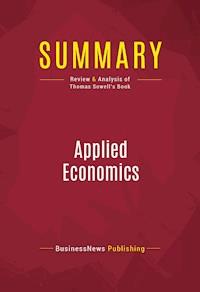
The must-read summary of Thomas Sowell's book: "Applied Economics: Thinking Beyond Stage One".
This complete summary of "Applied Economics" by Thomas Sowell, a renowned American economist and social theorist, presents his examination of the decisions made in American politics and the impact they have on the economy. In his book, the author presents his arguments alongside researched evidence and his own experience, to show how similar decisions have produced similar outcomes elsewhere in the world.
Added-value of this summary:
• Save time
• Understand how political decisions influence the economy
• Expand your knowledge of economics and politics
To learn more, read "Applied Economics" and discover how the decisions being made in American politics have huge consequences on the economy.
Das E-Book können Sie in Legimi-Apps oder einer beliebigen App lesen, die das folgende Format unterstützen:
Seitenzahl: 21
Veröffentlichungsjahr: 2017
Ähnliche

Book Presentation: Applied Economics by Thomas Sowell
Book Abstract
In Applied Economics, Thomas Sowell examines the economic consequences of today’s political decisions. Whereas politicians are frequently concerned with the “stated” goals of their policies and the results of the next election, few voters or policy makers stop to look closely at proposals beyond “stage one” and their long-term impact.
Sowell looks closely at the economic constraints and incentives created by the crucial policies of today, including insurance, economic development, and discrimination, to determine their true costs and effects, particularly those costs often endured by taxpayers or consumers as a result of excessive government intervention in the market.
About the Author
Thomas Sowell is the Rose and Milton Friedman senior fellow at the Hoover Institute of Stanford University. He previously taught at Cornell, UCLA, and Amherst, among other institutions. He has published many books on economics, race, and social issues, and has also written widely for publications such as The Wall Street Journal, Forbes, and Fortune.
Summary of Applied Economics (Thomas Sowell)
Introduction
Political and economic decisions are made for very different reasons, and political solutions to economic issues too frequently do not proceed beyond “stage one” thinking. Politicians’ proposals are typically evaluated by both the politicians and the public in terms of their goal to “do something” about a current problem – problems often subject to rhetoric and ideology, such as rent control, drug prevention, or gun control. These political proposals are seldom examined for their efficacy or long-term consequences.
Consider how much more effort most consumers spend on researching their purchase of a car or house than they do learning about a political candidate’s views and policy proposals. Political and economic decisions are simply made in different ways. Political choices in an election are one-time choices – a vote for one candidate takes into consideration their positions on a number of different issues.




