


9,99 €
Mehr erfahren.
- Herausgeber: Business Book Summaries
- Kategorie: Fachliteratur
- Sprache: Englisch
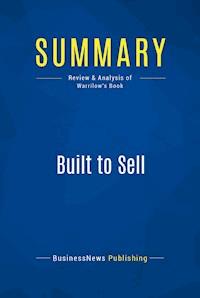
The must-read summary of John Warrilow’s book: “Built to Sell: Creating a Business that Can Thrive Without You”.
This complete summary of the ideas from John Warrilow’s book “Built to Sell” shows how difficult it can be for business owners to become less involved in their business. In his book, the author explains an eight-step process that entrepreneurs can use to ensure that the business can run without them and become a valuable asset that can be sold. By following this plan, you can increase the value of your business and ensure it is successful in its own right.
Added-value of this summary:
• Save time
• Understand key principles
• Expand your business knowledge
To learn more, read “Built to Sell” and follow the eight-step process to make your company more independent and a high-value asset.
Das E-Book können Sie in Legimi-Apps oder einer beliebigen App lesen, die das folgende Format unterstützen:
Seitenzahl: 35
Veröffentlichungsjahr: 2014
Ähnliche


Book Presentation Built to Sell by John Warrillow
Book Abstract
About the Author
Important Note About This Ebook
Summary of Built to Sell (John Warrillow)
Book Presentation Built to Sell by John Warrillow
Book Abstract
MAIN IDEA
One key problem which many business founders and entrepreneurs strike is they create a business which cannot function without their hands-on involvement. In doing this, they create a rather obvious problem – when it comes time to sell their business and go do something else, their business is not worth much without their ongoing input. They become trapped in an unsellable business because the company is totally reliant on its owner’s input.
To avoid this problem, business builders need to create a business which can thrive and grow without them. Once your business can run without you, it then takes on a life of its own and can grow to the point at which it becomes a valuable asset you can sell. Getting to that stage is usually an eight step process as shown below.
“There are approximately twenty-three million businesses in the United States, and yet only a few hundred thousand are able to be sold each year. That means for every small business owner who creates a business that someone will buy, there are about a hundred businesses that do not sell. This eight-step process provides a framework and action plan for ensuring that you are among that desired 1 percent.”
– John Warrillow
About the Author
JOHN WARRILLOW is a writer, speaker, entrepreneur and angel investor. He has personally founded four companies (thus far) including one which he tried to sell in 2004 only to be told the business was too dependent on him personally to be worth anything to anyone else. Mr. Warrillow managed to remodel that business using the plan set out in Built to Sell and the company was subsequently acquired by a public company in 2008. Mr. Warrillow has also set up an organization called Kiva (www.kiva.org) which lends money to entrepreneurs in developing countries. John Warrillow is a graduate of Queen’s University
The Web site for this book is at www.BuiltToSell.com
Important Note About This Ebook
This is a summary and not a critique or a review of the book. It does not offer judgment or opinion on the content of the book. This summary may not be organized chapter-wise but is an overview of the main ideas, viewpoints and arguments from the book as a whole. This means that the organization of this summary is not a representation of the book.
Summary of Built to Sell (John Warrillow)
1. The Problem
Lots of business builders go into business because they love doing something and are good at it. They therefore end up creating a company which takes full advantage of their talents and interests. This is all well and good and if you do that you can end up making good money, but having a company which is totally reliant on your talents and input becomes a problem:
When you want to retire and would like to cash out on all of your efforts over the years to create a viable business.When you want some cash to start another business which looks interesting but the only major asset you currently own is the business you’ve built.You need cash to deal with a personal financial matter of any significant shape or size.You want more time to pursue your other interests and would like to have less hands-on involvement in the day-to-day running of your business.You want the security and peace-of-mind which comes with knowing you could sell your business tomorrow if you wanted to or needed to.If that’s the case, then the key to resolving your problem is to restructure your enterprise so it will run and make money without your constant hands-on involvement. In other words, you need to build a business which will function without you being there to generate all the deals, follow through and see everything is done and be the chief mover and shaker behind everything that happens.




