


9,99 €
Mehr erfahren.
- Herausgeber: Political Book Summaries
- Kategorie: Sachliteratur, Reportagen, Biografien
- Sprache: Englisch
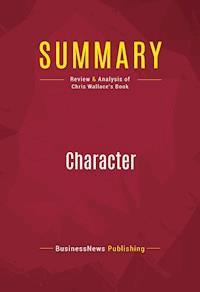
The must-read summary of Chris Wallace's book: “Character: Profiles In Presidential Courage”.
This complete summary of "Character: Profiles in Presidential Courage" by Chris Wallace, a renowned American political commentator, outlines his account of stories of presidential decisions and how their prior experiences shaped and influenced them, and gave them the courage to choose the hard way. He examines events such as the Cuban Missile Crisis, the Iraq War, the Whiskey Rebellion and the Berlin Airlift.
Added-value of this summary:
• Save time
• Understand presidential decisions and their implications
• Expand your knowledge of American politics and history
To learn more, read "Character" and discover what motivated certain presidents to make tough decisions for the good of the nation.
Das E-Book können Sie in Legimi-Apps oder einer beliebigen App lesen, die das folgende Format unterstützen:
Seitenzahl: 27
Veröffentlichungsjahr: 2017
Ähnliche
















Book Presentation: Character by Chris Wallace
Book Abstract
In Character: Profiles In Presidential Courage, Wallace showcases American Presidents who have made difficult choices with serious political and personal consequences. In acts of courage, these men made the decisions that were right for the country regardless of public opinion or their own political futures. Judgment and steadiness of purpose is what Wallace sees as the core of character and courage.
Written in a narrative story-telling style, Wallace shares several stories of presidential decisions made during major historical moments changing America and the world forever. He takes readers through the story as the build up unfolds, detailing the victories and defeats, unexpected reactions, pressures and consequences these men faced along the way. Wallace also gives details of the men’s lives prior to reaching the oval office, which lay the foundation for their values while adding another dimension to the complexity of their decisions.
About the Author
Chris Wallace is the host of the Sunday morning public affairs program, FOX News Sunday. He also contributes to the network’s political and election news coverage. Prior to FOX, Wallace worked at ABC News as the senior correspondent for Primetime Thursday and substitute host for Nightline. He spent seven years as NBC’s Chief White House correspondent.
Summary of Character (Chris Wallace)
INTERNAL STRIFE
In this section, Wallace gives examples of Presidents who faced a domestic crisis. They were challenged with making decisions that weren’t popular with America and they, at times, went against their own desires, but these decisions were necessary to achieve peace or avoid disaster.
SADDLE UP: GEORGE WASHINGTON
President Washington’s difficult choice on military action to quell the Whiskey Rebellion of 1794 was based on his understanding of the state of the nation – an understanding that others seemed unable to comprehend.
As the leader of a new nation, Washington was under pressure to enforce the whiskey excise tax, passed by an Eastern dominated Congress. Most whiskey distillers were in the West and refused to pay. His administration pressured him to use force, but he refused and worked hard to convince an angry Congress why. Washington understood that his young nation, with ties still new and fragile, was not certain to survive a rebellion. The use of force at this time would be seen more as an effort to suppress dissent than to defend the nation. Many taxpayers believed the point of freedom from Britain was to avoid taxes and most distillers simply couldn’t afford the tax.
Then, in 1794, after three years of collectors being humiliated, beaten, tarred and feathered, the rebellions were resulting in death. The West was threatening to secede and talking to Spain about an alliance. Washington knew he had to use force, but with no real standing army, he had to draft troops and he returned to the battlefield to lead them. His presence proved to be a source of motivation and pride for the soldiers. That, along with an unorganized group of rebels, quelled the rebellion quickly.




