


9,99 €
Mehr erfahren.
- Herausgeber: Business Book Summaries
- Kategorie: Fachliteratur
- Sprache: Englisch
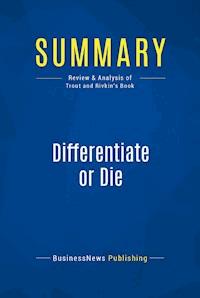
The must-read summary of Jack Trout and Steve Rivkin’s book: “Differentiate or Die: Survival in Our Era of Killer Competition”.
This complete summary of the ideas from Jack Trout and Steve Rivkin’s book “Differentiate or Die” shows that in order to succeed, you have to stand out from the crowd. The authors explain how you can differentiate your brand and stand out from competitors by following the best practices of some of the most successful companies. By learning and applying their differentiation techniques, you can use them to reinforce your brand and give yourself a competitive advantage.
Added-value of this summary:
• Save time
• Understand the key concepts
• Expand your business knowledge
To learn more, read “Differentiate or Die” and find out how you can differentiate your brand and stand out from the competition!
Das E-Book können Sie in Legimi-Apps oder einer beliebigen App lesen, die das folgende Format unterstützen:
Seitenzahl: 34
Veröffentlichungsjahr: 2013
Ähnliche






Book Presentation: Differentiate Or Die by Jack Trout, Steve Rivkin
Summary of Differentiate Or Die (Jack Trout, Steve Rivkin)
Book Presentation: Differentiate Or Die by Jack Trout, Steve Rivkin
Book Abstract
To succeed, you have to stand out from the crowd. You need to offer something nobody else can match. In other words, you need to differentiate yourself.
The process of differentiation takes place in the mind of your prospect, where a game of mental association runs. When the prospect hears a brand name, they automatically think of whatever attribute they have come to associate with that brand. The most successful brands in history are differentiated by being linked to very basic, very essential attributes – like “safety”, “refreshment” or “performance”. The process of differentiation is the technique by which those mental associations are formed and then reinforced in the mind of the prospect.
Any company’s ultimate and sustainable competitive advantage is its ability to differentiate itself from all its competitors. Unless a company achieves this and sustains the effort, it’s unlikely to survive, much less excel.
About the Author
JACK TROUT is president of Trout & Partners, a marketing firm. He is the author of Positioning: The Battle For Your Mind, The 22 Immutable Laws of Marketing and The Power of Simplicity. A highly regarded speaker, Mr. Trout is widely acknowledged as one of marketing’s most influential gurus and the “father” of the idea of positioning products and ideas in the minds of consumers. His Web site is at www.troutandpartners.com.
STEVE RIVKIN heads his own communications consulting firm. He is co-author of The New Positioning and The Power of Simplicity. Earlier in his career, Mr. Rivkin worked at International Utilities Corp., a Philadelphia-based conglomerate, in advertising, public relations and corporate identity. A journalism graduate from the University of Missouri, he began his career as an associate editor of Iron Age magazine, a weekly trade publication. Later, he was co-founder and editor of Financial Marketing Abstracts, a monthly newsletter.
Important Note About This Ebook
This is a summary and not a critique or a review of the book. It does not offer judgment or opinion on the content of the book. This summary may not be organized chapter-wise but is an overview of the main ideas, viewpoints and arguments from the book as a whole. This means that the organization of this summary is not a representation of the book.
Summary of Differentiate Or Die (Jack Trout, Steve Rivkin)
Section 1: The Business Case For Differentiation
Main Idea
Today’s marketplace is exceptionally crowded – for every product or service, there are a number of direct and indirect competitors. In that sort of environment, the companies that succeed aren’t those who try to be everything to everybody. Rather, those that do best are those which stand for something unique.
Differentiation is the process of identifying, amplifying and communicating what makes you different.
Supporting Ideas
Choice in consumer products is the natural consequence and result of success in the marketplace. What starts out as a single product soon breaks into multiple segments which in turn then break into numerous categories or niche markets.
For example, when computers first were developed, the same machines were used in a number of applications. Then, over time, computers started being broken down into two broad categories:
Later, as new products were developed for specialized applications, still finer and smaller markets emerged:
Similarly, automobiles have evolved from a single product into luxury cars, mid-range cars, budget cars, full-sized, intermediates, compacts, sports cars, four-wheel-drives, RVs, minivans, SUVs and so on.
Division is the end result of success to such a degree that an entire industry has sprung up dedicated solely to helping people sort through all the choices and find the product that best suits their needs. The only problem is that quite often, these advisors go into so much detail picking one product over another that at the end of the process, consumers are even more confused that when they started.
The Internet and improving communication technology has accelerated this explosion of choice. Marketers are not entirely unfamiliar with the phenomena. In fact, in 1960, Rosser Reeves wrote the book Reality in Advertising




