


9,99 €
Mehr erfahren.
- Herausgeber: Business Book Summaries
- Kategorie: Fachliteratur
- Sprache: Englisch
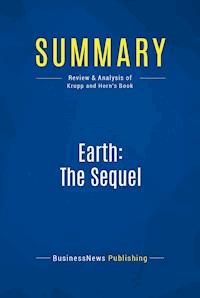
The must-read summary of Fred Krupp and Miriam Horn's book: "Earth: The Sequel: The Race to Reinvent Energy and Stop Global Warming".
This complete summary of the ideas from Fred Krupp and Miriam Horn's book "Earth: The Sequel" explains how capitalism, as the most powerful economic force in the world, is the only engine of change that has the strength to stop global warming. In their book, the authors demonstrate how this can be achieved by installing a cap-and-trade initiative, providing genuine economic incentives for companies and reducing their carbon footprint. This summary explains their theory in detail and exactly how it can be used to stop global warming once and for all.
Added-value of this summary:
• Save time
• Understand key concepts
• Expand your knowledge
To learn more, read "Earth: The Sequel" and discover what really needs to be done to make a change to global warming and who needs to take on the task.
Das E-Book können Sie in Legimi-Apps oder einer beliebigen App lesen, die das folgende Format unterstützen:
Seitenzahl: 40
Veröffentlichungsjahr: 2013
Ähnliche










Book Presentation:Earth: The Sequel by Fred Krupp and Miriam Horn
Summary of Earth: The Sequel (Fred Krupp and Miriam Horn)
Book Presentation:Earth: The Sequel by Fred Krupp and Miriam Horn
Book Abstract
MAIN IDEA
Capitalism has been proven time and again to be the most powerful economic force in the world. It’s now time to bring this engine of change fully to bear on the most pressing problem facing civilization today – global warming.
The way to do this is simple – by installing a cap-and-trade mechanism which will provide genuine economic incentives for companies to cut their pollution and reduce their global warming emissions. It could work this way. The U.S. Congress would first need to set a legally binding and steadily declining limit on the amount of global warming pollution U.S. companies could emit. The emissions allowances could then be divvied up among current emitters or auctioned by the government to raise revenues. Polluters who want to emit more than their fair share would then need to pay more to buy extra credits while those who reduce their emissions can profit by selling their credits in an open market.
By offering genuine financial benefits to those who develop new ways to generate carbon-free energy and to those who develop new technologies to remove carbon emissions from existing industries, a huge amount of ingenuity and innovation would be unleashed. This has always born fruit in the past and there is no reason to believe the markets cannot be harnessed now to solve the growing global warming problems facing the world today. A cap-and-trade market mechanism of this nature would set off an intensive commercial race to find new and creative ways to reinvent energy and the various ways it gets used. A lot of promising new energy sources are already under development and it is time to let the free markets decide which of these technologies should be scaled up and put into prime time use and which will lack genuine commercial viability.
In short, let the markets decide how energy should be reinvented – not some government bureaucrat or environmental special interest group.
About the Author
FRED KRUPP has been president of the Environmental Defense Fund for 23 years. He is considered a pioneer in the use of market forces to achieve ambitious environment goals. Mr. Krupp, a graduate of Yale and the University of Michigan Law School, was instrumental in the strengthening of the 1990 Clean Air Act which The Economist hailed as “the greatest green success story of the past decade.” Mr. Krupp has advised presidents of the United States and partnered with DuPont, FedEx, GE, McDonalds and Wal-Mart to lessen their impact on the environment.
MIRIAM HORN is an employee of the Environmental Defense Fund. She previously worked for the U.S. Forest Service and as a writer for Vanity Fair and the New York Times. She is the author of Rebels in White Gloves. She is a graduate of Harvard University, and studied environmental science at Columbia University.
The Web site for this book is at www.earththesequel.edf.org.
Important Note About This Ebook
This is a summary and not a critique or a review of the book. It does not offer judgment or opinion on the content of the book. This summary may not be organized chapter-wise but is an overview of the main ideas, viewpoints and arguments from the book as a whole. This means that the organization of this summary is not a representation of the book.
Summary of Earth: The Sequel (Fred Krupp and Miriam Horn)
How a Cap-and-Trade market would work
At the present time, no cost is attached to companies which emit the pollution which contributes to global warming. Equally, no benefit flows to those who come up with workable ways to actually reduce that pollution. The cap-and-trade market concept is designed to provide just such economic incentives and disincentives.
How it would work would be very simple:
The United States Congress must set a legal and steadily declining limit on the amount of global warming pollution the country is able to generate each year.The allowances must be divvied up among the current pollution emitters in the form of “carbon credits” – an arbitrary unit which allows the owner to generate a specified amount of pollution.Alternatively, the allowances could be auctioned off by the government to raise some revenue.The ongoing market price of carbon credits is then set by the market itself.If companies want to generate more pollution than they currently have carbon credits for, they will need to purchase additional carbon credits at whatever price the open market sets it at.




