


9,99 €
Mehr erfahren.
- Herausgeber: Business Book Summaries
- Kategorie: Bildung
- Sprache: Englisch
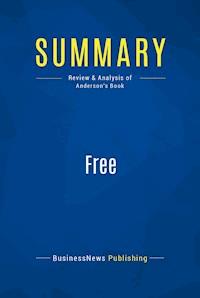
The must-read summary of Chris Anderson's book: "Free: The Future of Radical Price"
This complete summary of the ideas from "Free" explains that, in today’s business environment, companies can profit more by giving things away than they can by charging for them. But this isn’t just a digital economy phenomenon; it applies right across the global economy. In more and more industries, abundance thinking is becoming a far more powerful engine for commerce than scarcity thinking ever has been. Free is becoming a business strategy which might just end up being essential for any company to survive. This summary points out that sooner or later, every company is going to have to figure out how to use Free or compete with Free, one way or another.
Added-value of this summary:
• Save time
• Understand the key concepts
• Increase your business knowledge
To learn more, read the summary of "Free" and you will understand why the most effective price in the digital marketplace is no price at all.
Das E-Book können Sie in Legimi-Apps oder einer beliebigen App lesen, die das folgende Format unterstützen:
Seitenzahl: 37
Veröffentlichungsjahr: 2013
Ähnliche
Book Presentation: Free by Chris Anderson
Book Abstract
About the Author
Important Note About This Ebook
Summary of Free (Chris Anderson)
1. The history of free – and why it has such power
2. How digital electronics has revolutionized free
3. Freeconomics – how and why free works and what it does
Book Presentation: Free by Chris Anderson
Book Abstract
MAIN IDEA
At one time, giving away free stuff was an attention grabbing sales gimmick. That’s now changed dramatically. In today’s business environment, companies can profit more by giving things away than they can by charging for them. Notably this isn’t just a digital economy phenomenon. It applies right across the global economy. In more and more industries, abundance thinking is becoming a far more powerful engine for commerce than scarcity thinking ever has been. Free is becoming a business strategy which might just end up being essential for any company to survive.
The online economy’s costs continue to go down dramatically. This has created the unique situation where the primary inputs of the entire industrial economy are falling faster today than at any other time in recorded history. To take a case in point in 1960, a single transistor sold for $10. Today, when you buy Intel’s latest microprocessor chip, you’re in effect purchasing two billion transistors for $300 – which works out to around 0.000015 cents a transistor. These and other similar cost decreases are generating a tremendous reduction in costs for all three of the basic building blocks of online commerce – processing power, bandwidth and hard-drive storage.
“At the beginning of the twentieth century, Free fueled a consumer revolution that defined the next hundred years. The rise of Madison Avenue and the arrival of the supermarket made consumer psychology a science and Free the tool of choice. Free-to-air radio and television united a nation and created the mass market. Free was the rallying cry of the modern marketer and the consumer never failed to respond. Now, at the beginning of the twenty-first century, we’re inventing a new form of Free, and this one will define the next era just as profoundly. Today, the most interesting business models are in finding ways to make money around Free. Sooner or later, every company is going to have to figure out how to use Free or compete with Free, one way or another.”
– Chris Anderson
About the Author
CHRIS ANDERSON is the editor-in-chief of Wired magazine. He was previously the U.S. business editor for The Economist where he launched their coverage of the emergence of the Internet. Mr. Anderson also worked at the journals Nature and Science. He is the author of The Long Tail. Mr. Anderson is a graduate of George Washington University (in physics) and the University of California (in quantum mechanics and science journalism) and has conducted research projects at the Los Alamos National Laboratory.
Important Note About This Ebook
This is a summary and not a critique or a review of the book. It does not offer judgment or opinion on the content of the book. This summary may not be organized chapter-wise but is an overview of the main ideas, viewpoints and arguments from the book as a whole. This means that the organization of this summary is not a representation of the book.
Summary of Free (Chris Anderson)
1. The history of free – and why it has such power
The word “free” can mean lots of different things but these all boil down to variations of the same thing: shifting the cost of a product or service from person to person, between now and the future or into nonmonetary markets and back out again. There are four basic business models by which things can be made available for free:
Four basic business models of Free
Direct cross-subsidiesThree-party marketsFreemiumNon-monetary markets“Free can mean many things, and that meaning has changed over the years. It raises suspicions, yet has the power to grab attention like almost nothing else. It is almost never as simple as it seems, yet it is the most natural transaction of all.”
– Chris Anderson
The phrase “there’s no such thing as a free lunch” refers to a tradition of seventeenth-century saloons in New Orleans and elsewhere to offer “free” food to anyone who purchased at least one drink. In practice, this was more like a cross-subsidy – the saloon-keepers were betting the cost of a meal that most customers would not be able to have just the one drink but would end up buying more than enough to pay for the food as well.




