


9,99 €
Mehr erfahren.
- Herausgeber: Business Book Summaries
- Kategorie: Religion und Spiritualität
- Sprache: Englisch
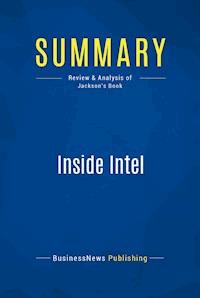
The must-read summary of Tim Jackson's book: "Inside Intel: How Andy Grove Built the World's Most Successful Chip Company".
This complete summary of the ideas from Tim Jackson's book "Inside Intel" shows how Robert Noyce and Gordon Moore built their company thanks to their reputations and their dedication to their goals. In his book, the author tells their compelling story and analyses what made their business decisions so effective. According to Jackson, Intel's success was based on three things: expertise, persistence and hiring the right people. This summary explores the actions behind the company's success and is sure to inspire you to overcome obstacles and stay on the path to achieving your goal no matter what.
Added-value of this summary:
• Save time
• Understand key concepts
• Expand your business knowledge
To learn more, read "Inside Intel" and discover the secrets behind the success of the global computing company and the journey taken by its founders to get there.
Das E-Book können Sie in Legimi-Apps oder einer beliebigen App lesen, die das folgende Format unterstützen:
Seitenzahl: 44
Veröffentlichungsjahr: 2013
Ähnliche











Book Presentation: Inside Intel by Tim Jackson
Important Note About This Ebook
Summary of Inside Intel (Tim Jackson)
1.
2.
3.
4.
5.
6.
7.
8.
9.
10.
11.
Book Presentation: Inside Intel by Tim Jackson
Important Note About This Ebook
This is a summary and not a critique or a review of the book. It does not offer judgment or opinion on the content of the book. This summary may not be organized chapter-wise but is an overview of the main ideas, viewpoints and arguments from the book as a whole. This means that the organization of this summary is not a representation of the book.
Summary of Inside Intel (Tim Jackson)
1.
When most people think of the start-up phase of a high technology company like Intel, they have a mental picture of a lone scientist working feverishly away in a garage late at night to develop a device everyone else thinks is impossible. The establishment of Intel in 1968, however, was nothing like this cliche.
Intel’s co-founders were Robert Noyce and Gordon Moore.
Robert Noyce was 40 years old in 1968. He had been hired by Bell Laboratories in 1956 and had assisted in the development of the transistor – for which he and two other engineers had been awarded a Nobel prize. Robert Noyce was widely regarded as one of the pre-eminent engineers in his field.
When Noyce had left Bell Laboratories in 1957 to set up Fairchild Semiconductors, he came into contact with Gordon Moore who was hired to head up Fairchild’s research and development program. Moore, like Noyce, had a PhD in chemical engineering.
By 1968, both men had become disillusioned with how Fairchild was going, and decided to start their own company. To fund it, Noyce called Arthur Rock, an investment banker based in San Francisco. They put together a two-page document outlining their business plan, and made 15 phone calls to people they thought might be interested in investing in the as yet unnamed company. All 15 people agreed to provide funding – they literally lined up $2.3 million of start-up funding in one afternoon of phone calls.
It helped, of course, that both Noyce and Moore were quite wealthy themselves, and were each contributing around $300,000 themselves to the new company. Nevertheless, most of the start-up funding was provided solely on the strength of the professional reputation of the two founders.
Within a couple of weeks, they had decided on a name for their new venture, deciding that “NM Electronics” didn’t sound right but “Integrated Electronics” sounded much better. This was eventually shortened to Intel, and the new company was formally incorporated on July 16, 1968. (Once the company was formed, they then found another company called Intelco was already in existence, but they were able to buy the right to use the Intel name from Intelco for $15,000).
While the new company’s initial “Business Plan” could have been described as sketchy and vague at best, in reality the company founders knew exactly what they wanted to develop and build – memory devices for computers using the new semiconductor devices, built from silicon chips.
“Fabricating silicon chips was the modern world’s answer to medieval alchemy, the turning of base metals into gold. Except here, the raw material was sand, which was turned into a crystalline silicon which arrived at the fab molded into a long sausage, two inches in diameter. The silicon would then be sliced into thin “wafers” a fraction of an inch thick. By a series of secret, almost magical processes, each wafer would be coated with scores of identical miniature circuits, neatly stepped in rows and columns. Then the wafers would be scored with a diamond cutter, and the individual chips would then be sawn away from their neighbors and wired individually into black ceramic packages, often with a line of metal pins down each side.”
– Tim Jackson
Noyce and Moore found an old Union Carbide plant in Mountain View, California, which was set up for manufacturing. They leased the building, which was about 17,000 sq. feet in size, and started ordering manufacturing equipment that would have the capacity to manufacture around 10 million integrated circuits a year – an ambitious goal for a new company without even a circuit design of its own yet.
Noyce and Moore also hired a director of operations to assume responsibility for the manufacturing side of the company. They chose Andrew Grove, a PhD physicist who had no manufacturing experience whatsoever.
“In 1968, people who met Grove for the first time usually noticed three things. One was that he was very bright, very good at explaining things – particularly semiconductor devices, whose physical behavior he had written a book about. Another was that he was very organized, and seemed to know exactly what he wanted and how he was going to achieve it. A third was that he was very keen to make an impression, to justify his position. Grove knew that Noyce and Moore had taken a risk by giving him the job of director of operations, and he was determined to prove they had made no mistake.”
– Tim Jackson
At around this same time, Noyce and Moore also hired Bob Graham, one of Fairchild’s star salesmen, to become Intel’s marketing director.
2.




