


9,99 €
Mehr erfahren.
- Herausgeber: Business Book Summaries
- Kategorie: Fachliteratur
- Sprache: Englisch
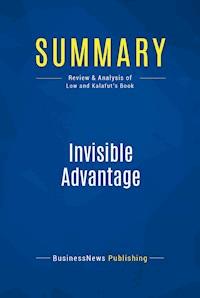
The must-read summary of Jonathan Low and Pam Kalafut's book: "Invisible Advantage: How Intangibles Are Driving Business Performance".
This complete summary of the ideas from Jonathan Low and Pam Kalafut's book "Invisible Advantage" explains how every business has intangible assets, such as customer loyalty or brand equity, which do not appear on financial statements but add significant value to your company. In their book, the authors demonstrate how these intangibles are the hardest aspects of your business for competitors to emulate, therefore making them all-important in the creation and maintenance of competitive edge. This summary shows the 12 drivers of the intangible economy and how you can measure and implement them in your business.
Added-value of this summary:
• Save time
• Understand key concepts
• Expand your knowledge
To learn more, read "Invisible Advantage" and discover the key to using your intangible assets to boost your competitive advantage.
Das E-Book können Sie in Legimi-Apps oder einer beliebigen App lesen, die das folgende Format unterstützen:
Seitenzahl: 37
Veröffentlichungsjahr: 2013
Ähnliche








Book Presentation: Invisible Advantage by Jonathan Low and Pam Kalafut
Book Abstract
About the Author
Important Note About This Ebook
Summary of Invisible Advantage (Jonathan Low and Pam Kalafut)
1. The Rise of Business Intangibles
2. The Twelve Drivers of the Intangibles Economy
3. The Keys to Managing Intangibles
Book Presentation:Invisible Advantageby Jonathan Low and Pam Kalafut
Book Abstract
MAIN IDEA
Intangibles – like brand equity, the ability to execute a chosen strategy, reputation and know-how – don’t show up on your firm’s financial statements and yet they are already transforming both the way you do business and the way investors value your company. Therefore, how you manage a business in the future should also change to reflect the increasing importance of intangibles. Or to be more specific, the means by which value will be created in the future has shifted dramatically from the tangibles to the intangibles as the key generators of future growth. Therefore, instead of treating intangibles as a by-product of whatever else you do, it makes good sense to start actively managing your intangibles to create future growth opportunities.
Why bother? Numerous studies have found that already, about one-third of your company’s current market value is attributable to intangibles which you probably don’t even presently measure, disclose or even attempt to manage. That proportion is likely to go up even more in the future as the “Intangibles Economy” gathers momentum. Therefore, if you fail to take an active role in managing your business’s intangibles, you essentially abdicate control to the marketplace.
Equally important, however, is the fact a competitive marketplace advantage built on intangibles can be exceptionally difficult for your competitors to emulate. In this regard, a competitive advantage built on intangibles is invisible – competitors aren’t exactly certain precisely what they need to do to match it. Thus, the more you can strengthen and build your intangibles, the harder you make it for others to understand what you’re doing and to attempt to do likewise.
“If a company faces constant competition, after all, what does it have to fall back on? Size alone isn’t enough. Physical assets – factories, stores, equipment – can help, but only until someone changes the rules of the game. Financial strength is always a plus, but it doesn’t necessarily translate into competitive advantage. The major players in the global economy don’t suffer from lack of access to resources. Thanks to the venture capital market, even upstarts are likely to have plenty of cash at their disposal. What companies can fall back on are precisely those assets and competencies that are hardest for competitors to emulate: an ability to innovate – to come out regularly with new products and services; adaptability, or the ability to turn on a dime as market conditions change; dedicated, loyal, well-trained employees, along with leaders who are capable of inspiring them; a powerful brand (as important now as ever); a sterling reputation (more important than ever); and systems – information systems, production systems, service-delivery systems – that can provide customers what they want when they want it, with a bare minimum of problems or delays. The key sources of value creation have shifted from the tangible to the intangible.”
– Jonathan Low and Pam Kalafut
About the Author
JONATHAN LOW is currently a senior research fellow at the Cap Gemini Ernst & Young Center for Business Innovation. He specializes in the valuation of business intangibles and is the author of Enterprise Value in the Knowledge Economy: Measuring Performance in the Age of Intangibles. Mr. Low is a graduate of Dartmouth College and Yale University’s School of Management.
PAM KALAFUT is currently the president of Cohen Kalafut Associates, a consulting firm specializing in strategic business modeling and linkages to firm performance. Dr. Kalfut is a qualified behaviorist specializing in intangible valuation, maximizing the utility of human capital, and researching the role of emotions in the workplace. She is a graduate of the University of Michigan and the University of Texas at Austin.
The Web site for this book is at www.invisibleadvantage.com.
Important Note About This Ebook
This is a summary and not a critique or a review of the book. It does not offer judgment or opinion on the content of the book. This summary may not be organized chapter-wise but is an overview of the main ideas, viewpoints and arguments from the book as a whole. This means that the organization of this summary is not a representation of the book.
Summary of Invisible Advantage(Jonathan Low and Pam Kalafut)
1. The Rise of Business Intangibles




