


9,99 €
Mehr erfahren.
- Herausgeber: Business Book Summaries
- Kategorie: Lebensstil
- Sprache: Englisch
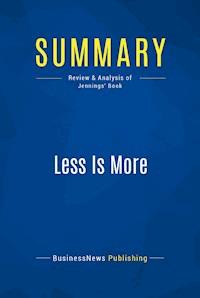
The must-read summary of Jason Jennings' book: "Less Is More: How Great Companies Use Productivity as a Competitive Tool in Business".
This complete summary of the ideas from Jason Jennings' book "Less Is More" shows that productive companies know the different between tactics and strategy. These companies also know how to achieve more with less. In his book, the author reveals the secret to success of these levels of productivity, including having an open structure and good managers. This summary provides the reader with valuable advice on how to do more with less and becoming as productive as possible.
Added-value of this summary:
• Save time
• Understand key concepts
• Expand your knowledge
To learn more, read "Less Is More" and discover the secrets behind the world's most productive companies and how you can follow their example.
Das E-Book können Sie in Legimi-Apps oder einer beliebigen App lesen, die das folgende Format unterstützen:
Seitenzahl: 37
Veröffentlichungsjahr: 2014
Ähnliche



Book PresentationLess is more by Jason Jennings1
Book Abstract
About the Author
Important Note About This Ebook
Summary of Less is more (Jason Jennings)4
Rule #1. Keep things simple.
Rule #2. Build an open culture, not a business model.
Rule #3. Have managers that believe and practice what they preach.
Rule #4. Always ask one key question – “What’s the good business reason for doing this?”
Rule #5. Get rid of any special perks for executives.
Rule #6. Never use lay-offs to cover bad management decisions.
Rule #7. Teach everyone the real financial drivers of the business.
Rule #8. Put everyone on a team, and pay teams for what they achieve.
Rule #9. Systematize everything – and constantly look for ways to improve each system.
Rule #10. Implement new processes quickly.
Rule #11. Have fun – by being competitive and keeping score.
Rule #12. Embrace new technology – but realize your competitors will do likewise.
Book PresentationLess is more by Jason Jennings
Book Abstract
MAIN IDEA
Everyone in business wants to be more productive – to achieve more with less. So why is it some companies actually achieve that and become “highly productive” while others seem to go around in circles trying to achieve the same goal?
“As I crisscrossed the United States and traveled the world identifying a group of the world’s most productive companies, hanging out with the customers, workers, managers and leaders of companies where ‘Less is More’, a single indisputable fact kept confronting me: Unlike other companies, productive companies know the difference between tactics and strategy. That difference is the foundation that allows them to stay focused and build remarkable companies. They have institutionalized their strategy.”
– Jason Jennings
More than anything else, productive companies work hard to keep everything clear and simple. Frequently, there is a tendency in business to inadvertently seek complication, or to try some management theory which is currently in vogue and attracting loads of attention. As a result, the average company bounces from one new idea to another without ever really getting down to the real work of getting the job done better. Highly productive companies avoid that by focusing everyone’s attention on the job at hand.
In all, what highly productive companies do differently can be summarized in twelve basic rules. These rules buck conventional wisdom. They also require single-mindedness and dedication before they can be embraced, but those companies which do apply them will begin an exciting journey into greater productivity.
“As I came to the end of my in-depth interviews with the CEOs, I was struck by the fact that each shared this in common: the ownership of and fierce loyalty to a very simple big objective. The big objective was the strategy and it became the culture; everything else was tactics on how to achieve it. While having everyone in a company share this simple, big objective might seem to be simply common sense, as the age-old maxim goes, the most common thing about common sense is how uncommon it is.”
– Jason Jennings
About the Author
DARYL CONNER is president and CEO of ODR Inc. (www.odrinc.com), a consulting firm which works to help organizations prepare for and implement major change initiatives. He is the author of Managing at the Speed of Change (1993) and has more than 25 years’ experience as a business consultant to Fortune 500 companies, government agencies, nonprofit institutions, and multinational firms. Mr. Conner has a master’s degree in behavioral psychology.
Important Note About This Ebook
This is a summary and not a critique or a review of the book. It does not offer judgment or opinion on the content of the book. This summary may not be organized chapter-wise but is an overview of the main ideas, viewpoints and arguments from the book as a whole. This means that the organization of this summary is not a representation of the book.
Summary of Less is more (Jason Jennings)
Rule #1. Keep things simple.
Highly productive companies focus their strategies around achieving one key objective. Or more precisely, in productive companies, the objective is the strategy and it becomes the culture of the company. The entire internal discussion centers around finding the best tactics to achieve that objective.




