


9,99 €
Mehr erfahren.
- Herausgeber: Business Book Summaries
- Kategorie: Religion und Spiritualität
- Sprache: Englisch
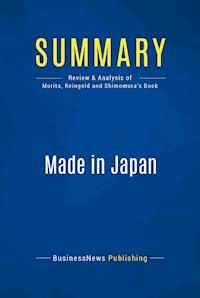
The must-read summary of Akio Morita, Edwin Reingold and Mitsuko Shimomura's book: "Made in Japan: Akio Morita and Sony".
This complete summary of the ideas from Akio Morita, Edwin Reingold and Mitsuko Shimomura's book "Made in Japan" tells the story behind the fascinating journey of Sony, right from its early rocky stages to their status as a world leader. In their book, the authors reveal how the company realised that marketing would be as important as the product itself. This summary describes the ups and downs of the journey and the secrets behind Sony's global success.
Added-value of this summary:
• Save time
• Understand key concepts
• Expand your knowledge
To learn more, read "Made in Japan" and discover the story behind the technology giant and why so many of its ideas have been implemented by others.
Das E-Book können Sie in Legimi-Apps oder einer beliebigen App lesen, die das folgende Format unterstützen:
Seitenzahl: 38
Veröffentlichungsjahr: 2014
Ähnliche
















Book Presentation: Made In Japan by Akio Morita and Sony1
Important Note About This Ebook
Summary of Made In Japan (Akio Morita and Sony)2
1.
2.
3.
4.
5.
6.
7.
Book Presentation: Made In Japan by Akio Morita and Sony
Important Note About This Ebook
This is a summary and not a critique or a review of the book. It does not offer judgment or opinion on the content of the book. This summary may not be organized chapter-wise but is an overview of the main ideas, viewpoints and arguments from the book as a whole. This means that the organization of this summary is not a representation of the book.
Summary of Made In Japan (Akio Morita and Sony)
1.
On May 7, 1946, a new company was formed in Tokyo called Tokyo Tsushin Kogyo or Tokyo Telecommunications Engineering Corporation. Today, that company, renamed as Sony Corporation, is one of the world’s most successful consumer electronics company, but at the time of establishment, the company’s prospects seemed far from certain.
The founders of the company were Masaru Ibuka, a 38-year old electronics designer, and Akio Morita, then 25-years old with a background in physics. The new company’s first offices were on the third floor of a bombed out department store in downtown Tokyo.
(The Second World War with Japan ended with Japan’s surrender on August 15, 1945, following the dropping of an atomic bomb on Hiroshima on August 6, 1945. The devastation of Tokyo at that time was extensive, with an estimated 46-percent of the population having had their houses and factories destroyed).
The new employees of Tokyo Telecommunications sat around for weeks debating what to do to make some money to survive. Since food was in short supply, they decided to develop a rice cooker which used the electrical connectivity of wet rice to good effect. Once the rice was cooked, it would no longer be moist, and the electrical circuit would be broken. Despite building several prototypes, the product was never perfected and never released onto the market.
Ibuka, however, came up with a better idea. He developed a short-wave adapter that could be fitted to AM radio receivers enabling the listener to hear the short-wave radio broadcasts. In post-war Japan, the product was very popular, and the company was soon selling a good volume of adapters. The company also manufactured and sold replacement parts for phonographs, small heating pads and a variety of other products.
The objective, however, was always to get into the manufacture of high-tech equipment. Therefore, when the Japan Broadcasting Company put out a tender for audio mixing units and studio broadcasting equipment, Ibuka submitted a bid which was ultimately accepted because Ibuka had a close friend who was in charge of engineering reconstruction at Japan Broadcasting.
When Ibuka was delivering the mixing unit to Japan Broadcasting, he saw a tape recorder machine manufactured by Ampex and using magnetic tape manufactured by Minnesota Mining and Manufacturing Company, 3M. He arranged for an American officer to bring the tape recorder over to his factory, to demonstrate it to his workers. Everyone liked the idea of going into manufacturing tape recorders except the company accountant. Eventually, though, even the company accountant signed on to the idea.
The only problem, though, was the fact the company knew nothing about how to manufacture magnetic tape. Ibuka, Morita and a young engineer Nobutoshi Kihara set about learning how to make magnetic tape. Their first idea was to use coated cellophane, but the material stretched too easily distorting the sound. They also tried using craft paper as the base onto which the magnetic coating was applied. That was partially successful, but once they were able to source some better plastic material, they were then able to start producing magnetic tape of consistent quality and durability.
Finally, in 1950, the company released its first tape recorder – a big, boxy machine weighing 35 kg (approx. 75 pounds) priced at 170,000 yen (about US$470). The machine worked well, but nobody knew what a tape recorder was or what they could do with one.
“I then realized that having a unique technology and being able to make unique products are not enough to keep a business going. You have to sell the products, and to do that you have to show the potential buyer the real value of what you are selling. I was struck with the realization that I was going to have to be the merchandiser of our small company. We were fortunate in having a genius like Ibuka who could concentrate totally on innovative product design and production while I learn the merchandising end of the business.”
– Akio Morira




