


9,99 €
Mehr erfahren.
- Herausgeber: Business Book Summaries
- Kategorie: Fachliteratur
- Sprache: Englisch
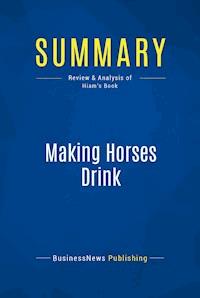
The must-read summary of Alex Hiam's book: "Making Horses Drink: How to Lead and Succeed in Business".
This complete summary of the ideas from Alex Hiam's book "Making Horses Drink" shows that, in a commercial setting, your employees are your horsepower - the people with the potential to take the company to great results. In this book, the author explains that realising this potential is the central challenge and goal faced by every leader and, just like the proverbial horse, you can't force employees to be exceptional if they don't want to be. This summary reveals the key to motivating your workforce and how you can make small changes to improve your leadership skills.
Added-value of this summary:
• Save time
• Understand key concepts
• Expand your leadership skills
To learn more, read "Making Horses Drink" and discover the key to getting the best from your employees.
Das E-Book können Sie in Legimi-Apps oder einer beliebigen App lesen, die das folgende Format unterstützen:
Seitenzahl: 34
Veröffentlichungsjahr: 2014
Ähnliche



Book Presentation: Making Horses Drinkby Alex Hiam
Book Abstract
About the Author
Important Note About This Ebook
Summary of Making Horses Drink (Alex Hiam)
1. Commitment
2. Communication
3. The Leader’s Personal Touch
4. Supervision
5. Innovation
6. The Workplace
7. Transitions
8. Encouragement
9. Good Decision Making Skills
10. Personal Development
Book Presentation: Making Horses Drinkby Alex Hiam
Book Abstract
MAIN IDEA
Everyone knows the cliché which states leading a horse to water is one thing and then making it drink is a different challenge altogether. In a commercial setting, the people who are on your payroll represent the raw “horsepower” of your business – its potential to produce extraordinary results. Realizing that potential and transforming it into tangible results is the central challenge facing all business leaders.
In just the same way as a horse cannot be forced to drink, people cannot be forced to turn in an exceptional performance. If the business leader uses a controlling or directive management style, all that will result is blind obedience, discipline and compliance. Rather, employees need to be inspired. Only then will they get out and find ways to use their personal initiative. Only if they are enthused will they actually collaborate and work together as a team – which is generally what’s required to produce world-class results.
In short, a better management paradigm is needed. The manager’s role is not to crack the whip and force the people in the business to win. That can’t be done. It would be the equivalent of a jockey trying to carry the horse to the finish line in a race. Instead, the motivation to win has to come from within each employee. The manager’s job is to inspire the people in the organization individually to reach deep within themselves and produce exceptional results. Or, put differently, great managers produce extraordinary results with ordinary people. This happens when managers awaken the enthusiasm of their people and nurture a thirst for success.
“How do you win that leadership race to achieve business success through the efforts of others? It is a question as old as the urge to achieve itself. Which horses win races – the ones the jockey whips the hardest, or the ones who enjoy running the most?”
– Alex Hiam
About the Author
ALEX HIAM is the founder and CEO of his own management firm, Alex Hiam & Associates. He is a successful manager, consultant, educator, writer and speaker. Mr. Hiam is a graduate of Harvard University (B.A.) and the University of California, Berkeley (M.B.A. in strategic planning). He has previously served on the faculty of the University of Massachusetts’ School of Business.
The Web site for this book is atwww.makinghorsesdrink.com.
Important Note About This Ebook
This is a summary and not a critique or a review of the book. It does not offer judgment or opinion on the content of the book. This summary may not be organized chapter-wise but is an overview of the main ideas, viewpoints and arguments from the book as a whole. This means that the organization of this summary is not a representation of the book.
Summary of Making Horses Drink (Alex Hiam)
1. Commitment
The first task facing any rider is to make certain the horse wants to win. In other words, organizations succeed when everyone within them wants to excel. It isn’t enough just to have highly motivated managers.
Traditionally, it was thought the key to success was just to get people to show up for work. Today, the organizations which succeed engage their people – everyone is invited to come up with ideas on how the work can be improved.
To build commitment:
Look for new employees who not only have training and experience but also high levels of commitment and motivation.Make certain every employee knows exactly what’s required of them and has all the resources he or she needs to be efficient. Also check employees aren’t waiting for further information or instructions from their supervisors before getting on with their work.




