


9,99 €
Mehr erfahren.
- Herausgeber: Business Book Summaries
- Kategorie: Lebensstil
- Sprache: Englisch
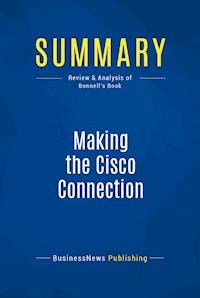
The must-read summary of David Bunnell's book: "Making the Cisco Connection: The Story Behind the Real Internet Superpower".
This complete summary of the ideas from David Bunnell's book "Making the Cisco Connection" tells the story of Sandy Lerner and Len Bosack, founders of Cisco. In his book, the author reveals all, right from the development of a local network system at Stanford, to starting their business making routers in 1984. This summary is a must-read for anyone who wants to know more about the story and the people behind this company.
Added-value of this summary:
• Save time
• Understand key concepts
• Expand your knowledge
To learn more, read "Making the Cisco Connection" and discover the story of drama, great ideas, passion and excellent strategic
maneuvering that lies behind Cisco.
Das E-Book können Sie in Legimi-Apps oder einer beliebigen App lesen, die das folgende Format unterstützen:
Seitenzahl: 41
Veröffentlichungsjahr: 2014
Ähnliche




Book PresentationMaking the Cisco Connection by David Bunnell
About the Author
Important Note About This Ebook
Summary of Making the Cisco Connection (David Bunnell)
The Early Years (1984 - 1987)
The Morgridge Era (1988 - 1995)
John Chambers - CEO In Waiting (1977 - 1995)
1996 - A Watershed Year For Cisco
Routing The Industry (1997 - 1998)
The Virtual Corporation (1997 - Present)
The New Battle (1996 - 1998)
Giving Cisco A Voice (1998 - Present)
Book PresentationMaking the Cisco Connection by David Bunnell
About the Author
DAVID BUNNELL is CEO and Editor of Upside Magazine and UpsideToday.com. He was formerly chairman and editor-in-chief of PC World Magazine. Mr. Bunnell started Macworld Magazine, Publish Magazine, the Macworld Expo, Macintosh Today and a number of other media products. He has also served as chairman and CEO of Hypermedia Communications, where he launched NewMedia Magazine.
Important Note About This Ebook
This is a summary and not a critique or a review of the book. It does not offer judgment or opinion on the content of the book. This summary may not be organized chapter-wise but is an overview of the main ideas, viewpoints and arguments from the book as a whole. This means that the organization of this summary is not a representation of the book.
Summary of Making the Cisco Connection (David Bunnell)
The Early Years (1984 - 1987)
The Cisco story began when Sandy Lerner and Len Bosack met and fell in love while students at Stanford University in 1977. They were an unusual pairing simply because of their strikingly different backgrounds – Sandy was a graduate student (economics major) at Stanford’s Business School whereas Len was a nerd over at the computer science department.
This was in the early days of computer networks, and the business school used DEC minicomputers while the computer science department had a local-area network (LAN) of Altos computers. In fact, Stanford had around 5,000 different computers on campus, but getting any of them to talk to and exchange messages with each other was extremely difficult.
At that time, the early version of the Internet, the ARPAnet did exist, but only dedicated machines called ARPANet IMP terminals could be used to send or receive messages. These terminals were expensive (more than $100,000 each) and limited in their usefulness.
As the need to get these networks in different buildings talking to each other without needing to go through the ARPANet became obvious, a number of techos at Stanford worked on the problem. They first developed data bridges, which extended networks at the data layer level. Then by June 1980, they had developed routers – which allowed networks to remain distinct but have the ability to send and receive data to other networks. Len Bosack was assigned to set up a router between Stanford’s medical school and the computer science department.
At the same time, Len, Sandy and a handful of others were also working on their own project which used ethernet cards as a better way to achieve the same thing. Without any permission, they even ran a few miles of coaxial cable between buildings and around the Stanford campus. They then set up a series of routers and servers to power their “unofficial” network, using software developed by some other friends. Soon, they had a system in place which allowed normally incompatible networks to exchange data.
When word of their success leaked out, other techos started clamoring to buy the black boxes they had developed. Len and Sandy went to Stanford’s administration with a proposal to design and build the routers, but Stanford refused. By this time, Sandy was director of the computer facilities at Stanford’s Business School while Len was a director at Stanford’s Computer Science Department.
With Stanford’s refusal to allow them to develop routers, Sandy and Len decided to quit their jobs and start their own business making routers. This was in late-1984. They had no money, so they financed their new business, which they called “cisco Systems” (with a lower-case c), with their credit cards. They converted the living room of their house into a manufacturing operation, and soon they and their friends were writing code, putting together black boxes and assembling cables.
“As Len remembers, the interminable work became a true gauge of stamina and dedication, with “sincerity” beginning when an employee spent more than 100 hours a week working. When employees worked beyond 110 hours a week, according to Len, they weren’t just sincere, they were “committed”.”
– David Bunnell
By 1986, the company was finally able to afford to move to its own office space in Menlo Park. Despite the fact the company had no sales staff or marketing campaign, business was booming. Sandy and Len used e-mail to get the message out about what they had to offer. Pricing was rather vague, with routers being sold for whatever they thought the purchaser could afford (which ranged from $7,000 to $50,000 each). But by the end of 1986, the company was generating a profit of more than $250,000 a month – which caused some disquiet for Sandy who was a self-confessed socialist.




