


9,99 €
Mehr erfahren.
- Herausgeber: Business Book Summaries
- Kategorie: Fachliteratur
- Sprache: Englisch
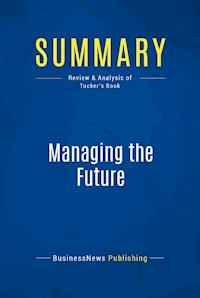
The must-read summary of Robert B. Tucker's book: "Managing the Future".
This complete summary of the ideas from Robert B. Tucker's book "Managing the Future" shows how no business can afford to rest on its laurels and on the successes of the past. If there’s one hallmark of long-term companies, it’s the ability to manage the future as well as the present. In his book, the author demonstrates how great companies do this and presents three strategies used by them which you can adapt and implement. This summary provides the key to constantly re-assessing your business in order to ensure future success.
Added-value of this summary:
• Save time
• Understand key concepts
• Expand your business knowledge
To learn more, read "Managing the Future" and discover how you can manage the unpredictability of the future through systematic awareness and customer focus.
Das E-Book können Sie in Legimi-Apps oder einer beliebigen App lesen, die das folgende Format unterstützen:
Seitenzahl: 24
Veröffentlichungsjahr: 2014
Ähnliche




Book PresentationManaging The Future by Robert B. Tucker
Book Abstract
Important Note About This Ebook
Summary of Managing The Future (Robert B. Tucker)
Introduction
1. Speed – Exploiting the “FedEx” Imperative
2. Convenience – Creating Your Own Dominos Effect
3. Age Waves – Profiting from three generations
4. Choice – Exploiting the “Have It Your Way” Imperative
5. Lifestyle – Benefiting from Changes in the Way We Live
6. Discounting – Positioning A Business in Price Competition Eras
7. Value-Adding – Creating Alternatives in Price Competition
8. Customer Service – Building Competitive Advantage Through People
9. Techno-Edge – Using Technology to Lead the Field
10. Quality – Cashing In on Customer Satisfaction
Book PresentationManaging The Future by Robert B. Tucker
Book Abstract
Main Theme
The key to being in business now is to manage the future - to put your business in a situation where it is progressively improving the way it serves customers rather than resting on past victories.
You can do this by:
Creating ways to get close to your customers so you can look at your business through their eyes.Staying aware of the trends that developing in society.Constantly introducing innovations and improvements. Never be satisfied with current performance levels.The best way to predict the future is to invent it. By managing the future actively, you take a positive approach to where your company will be in the future. No business stands still. You either take an active role in managing the future or face being left behind by changes now occurring in the marketplace.
Important Note About This Ebook
This is a summary and not a critique or a review of the book. It does not offer judgment or opinion on the content of the book. This summary may not be organized chapter-wise but is an overview of the main ideas, viewpoints and arguments from the book as a whole. This means that the organization of this summary is not a representation of the book.
Summary of Managing The Future (Robert B. Tucker)
Introduction
Main Idea
Change can be turned into a competitive advantage rather than a drawback. It’s an opportunity to prosper rather than merely survive and to increase market share. The winners in business in the 90s will be those who cannot only envision the future of their company but who work to make that vision a reality.
Supporting Ideas
Two years after In Search of Excellence was published, 14 of the 43 companies profiled were in financial trouble. The reason wasn’t that they were badly run, but simply that they failed to react and respond to change.
A large number of companies fail today because they fail to creatively respond to changes in the marketplace. Today, change occurs at a faster rate than at any other time in history. Quite simply, businesses that don’t know how to adapt and respond won’t survive.




