


9,99 €
Mehr erfahren.
- Herausgeber: Business Book Summaries
- Kategorie: Wissenschaft und neue Technologien
- Sprache: Englisch
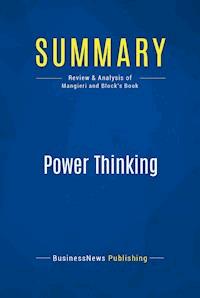
The must-read summary of John Mangieri and Cathy Block's book: "Power Thinking: How the Way You Think Can Change the Way You Lead".
This complete summary of the ideas from John Mangieri and Cathy Block's book "Power Thinking" highlights that very few people are formally taught how to think, thus most managers and leaders try to get by on the patterns and habits of thinking, which were acquired in childhood. In their book, the authors provide you with advice on how to improve and enhance the efficiency of your thinking skills, focusing on three major domains: reasoning, insight and self-knowledge. This summary is a must-read for any leader that wants to improve the way they think and become a better manager.
Added-value of this summary:
• Save time
• Understand key concepts
• Expand your knowledge
To learn more, read "Power Thinking" and find out how you can change the way you think to improve your efficiency.
Das E-Book können Sie in Legimi-Apps oder einer beliebigen App lesen, die das folgende Format unterstützen:
Seitenzahl: 37
Veröffentlichungsjahr: 2014
Ähnliche

















Book Presentation Power Thinking by John Mangieri and Cathy Block
Book Abstract
About the Author
Important Note About This Ebook
Summary of Power Thinking (John Mangieri and Cathy Block)
1. The Reasoning Domain
2. The Insight Domain
3. The Self-Knowledge Domain
4. Putting It All Together
Book Presentation Power Thinking by John Mangieri and Cathy Block
Book Abstract
MAIN IDEA
Very few people are formally taught how to think. Instead, most managers and leaders try and get by on the patterns and habits of thinking which were acquired by chance in childhood. A better approach is to analyze and then systematically improve how you actually think.
“Power thinking” is the science and art of becoming better at thinking. Power thinkers are highly adept and competent in three major thinking domains:
Reasoning – the ability to think before acting.Insight – harnessing instincts to develop superior ideas.Self-knowledge – clearly-defined attitudes and beliefs.By improving the quality of your thinking habits in each domain, you can become better at making decisions, solving problems and acting creatively. Quite simply, enhancing the efficiency of your thinking skills will help you become a better manager and business leader, and may form the foundation for a sustainable competitive advantage, both for you personally and for any organization you work for.
About the Author
JOHN MANGIERI is president of the Center for Leadership and Personal Development. A graduate of the University of Pittsburgh, Dr. Mangieri has served on the faculties of three universities. He has also acted as a consultant and leadership training program provider to a number of major corporations. Dr. Mangieri is the author of ninety-one professional articles and twelve books.
CATHY BLOCK is a professor at Texas Christian University. A graduate of the University of Wisconsin – Madison, Dr. Block has a broad range of experience in the field of education. She is the author of fifty-three research articles and seventeen books.
Important Note About This Ebook
This is a summary and not a critique or a review of the book. It does not offer judgment or opinion on the content of the book. This summary may not be organized chapter-wise but is an overview of the main ideas, viewpoints and arguments from the book as a whole. This means that the organization of this summary is not a representation of the book.
Summary of Power Thinking (John Mangieri and Cathy Block)
1. The Reasoning Domain
Reasoning is located in your conscious mind. This is where your mind reaches decisions and solves problems after a considerable amount of thought. Power thinkers are highly skilled at employing exceptional levels of reasoning. They use four internal processes to generate high quality thoughts and then take four external actions as a consequence of their decisions.
Internal reasoning processes
The four internal reasoning processes which power thinkers are highly proficient at are:
1. Fair-minded Arbitrator
Arbitrators facilitate a negotiation and resolve conflicts through dialogue rather than by exercising authority. A good arbitrator will have the ability to cope with conflicting points-of-view, operate under pressure, demonstrate discretion and integrity, and be fair-minded about developing a solution. When power thinkers are presented with a new idea, they don’t dismiss it immediately. Instead, they act like an arbitrator. They analyze the pros and cons of the new idea. Their objective is to do what’s best for the individual or the organization, rather than to reward friends and punish enemies. Power thinkers always look at new ideas objectively with a view towards improving the quality of the first idea which comes to mind.
To become more of a fair-minded arbitrator:
Avoid rushing to judgement when hearing a new idea – by first making an attempt to rephrase the idea put to you in your own words. This will show whether you really understand it first.Observe the other person’s body language – and seek more information if what they say conflicts with how they say it.Discard your own personal biases – and be willing to explore a new idea from many different directions and points-of-view.2. Unconstricted Thinker
Unconstricted thinkers have no self-imposed restrictions. They don’t let prior knowledge or experience become an impediment to effective decision making. Power thinkers try and look at each new idea on its own merits rather than through the lens of their previous experience base.
To become more of an unconstricted thinker:
Avoid black-and-white thinking – and acknowledge that in the real world, there is usually more ambiguity than you’d like. Get comfortable with the gray areas embedded in each new idea.




