


9,99 €
Mehr erfahren.
- Herausgeber: Business Book Summaries
- Kategorie: Fachliteratur
- Sprache: Englisch
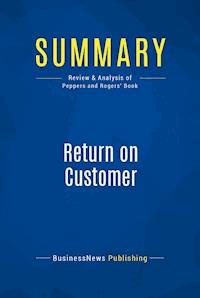
The must-read summary of Don Peppers and Martha Rogers' book: "Return on Customer: Creating Maximum Value from Your Scarcest Resource".
This complete summary of the ideas from Don Peppers and Martha Rogers' book "Return on Customer" presents their concept of the same name, which is a new business metric designed to measure the amount of value that a business creates by acquiring, retaining and then growing its customer base. In their book, the authors explain what causes your ROC (Return on Customer) to be negative, and how you can make changes to ensure that it is positive and value is being created. This summary provides readers with seven reasons why they should use Return on Customer as a management metric and the benefits this could bring for your business.
Added-value of this summary:
• Save time
• Understand key concepts
• Expand your business knowledge
To learn more, read "Return on Customer" and discover the new way to measure your business success and add value.
Das E-Book können Sie in Legimi-Apps oder einer beliebigen App lesen, die das folgende Format unterstützen:
Seitenzahl: 41
Veröffentlichungsjahr: 2014
Ähnliche








Book Presentation:Return On Customerby Don Peppers and Martha Rogers
Book Abstract
About the Author
Important Note About This Ebook
Summary ofReturn On Customer(Don Peppers and Martha Rogers)
1. Scarcity
2. Wall Street
3. Balance
4. Perspective
5. Personalization
6. Leverage
7. Education
Book Presentation:Return On Customerby Don Peppers and Martha Rogers
Book Abstract
MAIN IDEA
Most people are familiar with the concept of return on investment – how well a firm creates added value from a given investment. There is, however, no equivalent metric which measures how well a company creates value from its most scarce and therefore most valuable asset – its customers. Return on customer (ROC) is a new business metric which is designed to measure the amount of value a business creates by acquiring, retaining and then growing its customer base. It is calculated in this way:
where:
Current period cash flow is the revenue the company will generate in this period through the sale of products and services.Customer equity is the net present value of all cashflows the company expects to generate from customers over their lifetimes.Change in customer equity is the increase or decrease generated in this period by the actions of the company.When ROC is positive, your firm is creating value from your customer base, either by increasing sales in the current period or by enhancing the likelihood the customer will do more business with your firm in the future. This lifetime value of future business is captured by changes in customer equity, which in essence is the current discounted-cash-flow value of a customer’s future business. Conversely, when ROC is negative, your firm is destroying customer equity or customer lifetime value, making it less likely you will be able to generate profits from your customer base in the future.
Return on customer represents the costs and trade-offs which are inherent in business. For example, if a firm carries out an aggressive telemarketing campaign, it might increase current period sales but also erode the likelihood customers will buy again in the future. That harm to the customer lifetime value won’t be captured by any other established business metric, and yet it might even exceed the boost in current sales which was achieved. Conversely, if a firm always focuses on customer equity, it may not generate enough profit on a current basis to stay in business. To maximize return on customer, companies need to optimize their mix of short-term profit and long-term customer equity created.
The arguments in favor of return on capital as a management metric are:
About the Author
DON PEPPERS is a founding partner of Peppers & Rogers Group, a consulting firm specializing in customer-focused relationship management strategies. His business background is in marketing and advertising. Mr. Peppers has also worked as an economist in the oil business and as director of accounting for a regional airline. He is a graduate of the U.S. Air Force Academy and Princeton University. Don Peppers and Martha Rogers have co-authored six books on customer strategy including The One to One Future and Enterprise One to One.
MARTHA ROGERS is also a founding partner of Peppers & Rogers Group. Dr. Rogers, a graduate of the University of Tennessee, is widely considered to be one of the world’s leading experts on customer-based business strategies and growing customer value. She began her career as a copywriter and advertising executive and has experience as an adjunct professor at Duke University’s school of business. In addition to the six books co-authored with Don Peppers, Dr. Rogers has been widely published in academic and trade journals.
The Web site for this book is atwww.returnoncustomer.com.
Important Note About This Ebook
This is a summary and not a critique or a review of the book. It does not offer judgment or opinion on the content of the book. This summary may not be organized chapter-wise but is an overview of the main ideas, viewpoints and arguments from the book as a whole. This means that the organization of this summary is not a representation of the book.
Summary ofReturn On Customer(Don Peppers and Martha Rogers)
1. Scarcity
Customers are any company’s scarcest resource.
In this era of globalization, capital is exceptionally mobile and costs have been reduced as far as they can go. There is an excess of most products and most services. In today’s business environment, nothing is as scarce as customers.
In many markets and product categories, there are too many products chasing a finite pool of customers. Traditionally, it was assumed availability of capital was the limiting factor in growing an enterprise. Today almost anyone can get access to all the capital they need, and it is customers which are difficult to find and hard to keep. To remain competitive, businesses have to figure out:
How to keep customers longer.How to grow small customers into bigger customers.How to make each customer more profitable.




