


9,99 €
Mehr erfahren.
- Herausgeber: Business Book Summaries
- Kategorie: Religion und Spiritualität
- Sprache: Englisch
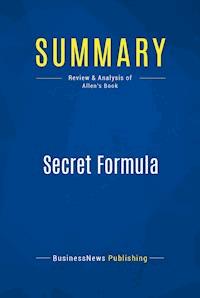
The must-read summary of Frederick Allen's book: "Secret Formula: How Brilliant Marketing and Relentless Salesmanship Made Coca-Cola the Best-Known Product in the World".
This complete summary of the ideas from Frederick Allen's book "Secret Formula" tells how Coca-Cola co-founder Robinson and early investor Candler realised early on that their only intellectual property was the trademark name. In his book, the author describes the aggressive marketing campaign that focused on the trademark and branding, which yielded extraordinary results and set the standard for all of its future promotional material. This summary reveals all of the secrets to Coca-Cola's success and how the company's innovation and originality was the key to it becoming the biggest global brand.
Added-value of this summary:
• Save time
• Understand key concepts
• Expand your knowledge
To learn more, read "Secret Formula" and discover the exciting story behind the world-class company, Coca-Cola.
Das E-Book können Sie in Legimi-Apps oder einer beliebigen App lesen, die das folgende Format unterstützen:
Seitenzahl: 43
Veröffentlichungsjahr: 2014
Ähnliche











Book Presentation Secret Formula by Frederick Allen
Important Note About This Ebook
Summary of Secret Formula (Frederick Allen)
1.
2.
3.
4.
5.
6.
7.
8.
9.
10.
Book Presentation Secret Formula by Frederick Allen
Important Note About This Ebook
This is a summary and not a critique or a review of the book. It does not offer judgment or opinion on the content of the book. This summary may not be organized chapter-wise but is an overview of the main ideas, viewpoints and arguments from the book as a whole. This means that the organization of this summary is not a representation of the book.
Summary of Secret Formula (Frederick Allen)
1.
Coca-Cola – the most successful soft drink in history – was actually the brainchild of two quite different men:
Doc Pemberton, who developed the first batch of a dark, sugary syrup which would later evolve into Coca-Cola.Frank Robinson, who named the drink Coca-Cola and developed one of the company’s greatest assets – its tradename.In fact, while Doc Pemberton became acknowledged the legendary father of Coca-Cola, it was actually Frank Robinson, the father of the idea of Coca-Cola, who would nurture the company through its lean early years.
Doc Pemberton never actually studied as a doctor, but purchased a temporary physicians license for $5 from the Southern Botanico Medical College in 1850 when he was 19 years old. He then went on to build a business selling potions and elixirs made from herbs, plants and vegetables. By 1879, he had set up a company manufacturing proprietary medicines in Atlanta, including medicines and wines based on a new wonder drug that had just gained prominence in the United States – cocaine.
To manufacture and distribute a French wine Pemberton had developed, he set up a new company in January 1886, called Pemberton Chemical. Frank Robinson and David Doe bought an equity stake in the company. Both men came from a strong marketing and entrepreneurial background, and a working arrangement soon ensued in which Pemberton mixed the elixirs, Robinson kept the books and assisted with marketing and Doe ran the overall marketing program.
With the arrival of the first soda fountains in 1886, the Pemberton Chemical principals realized there were greater profits in selling a soft drink at 5 cents a glass than there ever would be in selling elixirs at $1 per bottle. There were already some fruit flavored soft drinks available, so they set out to develop something distinctive, using the kola nut (which had caffeine as its main active ingredient) as a cold substitute for the traditionally hot caffeine beverages.
By May 1886, Pemberton had developed a syrup made up of sugar, caffeine, caramel, lime juice, citric acid, phosphoric acid, vanilla extract, elixir of orange, fruit and herb oils, lemon, nutmeg, spicebush, coriander, neroli, oil of cassia and the extract from coca leaves. The principals of Pemberton Chemical each submitted a suggestion on what to call the drink, and Robinson’s suggestion – Coca-Cola – carried the day.
Initial sales were less than spectacular. In the first summer, in fact, only 25 gallons of Coca-Cola were sold, generating $50 in revenues which prompted David Doe to pull out of the company. Pemberton, meanwhile, sold the rights to Coca-Cola for $1,200 without the consent of his partners in Pemberton Chemical. After a yearlong battle, Frank Robinson, in partnership with Asa Candler, was finally able to wrestle back a controlling interest in the company, which was then renamed Asa G. Candler & Company, with Frank Robinson as general superintendent
With the death of Doc Pemberton in August 1886, Robinson and Candler threw themselves into the work of further perfecting the formula for Coca-Cola. In the interests of security, they started referring to the ingredients in their revised formula as “Merchandise” – that is, sugar was code named Merchandise No.1, caramel Merchandise No. 2 and so on. Candler and Robinson also launched an aggressive sampling program - people were sent tickets good for a free glass of Coca-Cola at their local soda fountain. The campaign worked exceptionally well, and by the summer of 1890, more than 8,855 gallons of Coca-Cola syrup was sold. The following summer, sales exceeded 19,831 gallons.
2.
The growing company’s only intellectual capital asset was its trademark name. There was no patent on the syrup itself, as that would require disclosing exactly what went into Coca-Cola. Protecting the company’s trademark became of paramount importance.
Therefore, in the 1890s, Candler and Robinson worked at eliminating cocaine from Coca-Cola as better medical information came to light about the effects of that drug. Similarly, they also worked to eliminate the need for kola nuts in their formula.
By 1901, Coca-Cola’s annual sales had grown to more than 500,000 gallons of syrup. The company’s annual revenues were almost at the magic $1 million milestone. The company now had factories in Dallas, Chicago, Baltimore and Los Angeles, and was selling syrup as fast as it could manufacture it. And despite all that success, Asa Candler decided to sue the U.S. Federal Government, for the return of $29,502 which Coca-Cola had been forced to pay as a stamp tax on medicines.




