


9,99 €
Mehr erfahren.
- Herausgeber: Business Book Summaries
- Kategorie: Lebensstil
- Sprache: Englisch
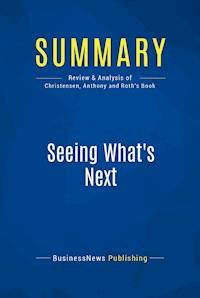
The must-read summary of Clayton Christensen, Scott Anthony and Erik Roth's book: "Seeing What's Next: Using the Theories of Innovation to Predict Industry Change".
This complete summary of the ideas from Clayton Christensen, Scott Anthony and Erik Roth's book "Seeing What's Next" shows that successful businessmen, investors and entrepreneurs all share one trait: they have the ability to predict industry change and either exploit the resulting opportunities or dodge pitfalls. In their book, the authors suggest that such people do not possess supernatural powers, but simply follow four guiding principles that can very accurately predict the fate of companies, technologies and industries. This summary reveals and explains each of these four principles, demonstrating how good research into the current market, as well as past markets, can inform excellent decision-making.
Added-value of this summary:
• Save time
• Understand key concepts
• Expand your knowledge
To learn more, read "Seeing What's Next" and discover the key to successfully navigating your business.
Das E-Book können Sie in Legimi-Apps oder einer beliebigen App lesen, die das folgende Format unterstützen:
Seitenzahl: 26
Veröffentlichungsjahr: 2014
Ähnliche

Book Presentation Seeing What’s Next by Clayton Christensen, Scott Anthony and Erik Roth
Book Abstract
About the Author
Important Note About This Ebook
Summary of Seeing What’s Next (Clayton Christensen, Scott Anthony and Erik Roth)
Book Presentation Seeing What’s Next by Clayton Christensen, Scott Anthony and Erik Roth
Book Abstract
MAIN IDEA
Is it possible to actually see what’s next in the marketplace, or do we always have to wait for market forces to make themselves obvious? This is more than just a matter of idle curiosity. For investors, business managers and others, long-term success depends on being able to consistently predict the fate of firms, industries and new technologies. Fortunately, a four-step process is available which allows us to rationally look into the future and forecast in a repeatable and methodical fashion how the various competitive battles of the marketplace will turn out.
The four step process revolves around determining the answer to four straight-forward questions about an industry:
Are there signs that someone is already starting to capitalize on the opportunities for change that may have arisen?What is the most likely result of the head-to-head battles for market share?Are the industry participants currently making decisions that enhance or degrade their ultimate chances of success?How will nonmarket forces like government regulations help decide which firms prosper in this industry over the long haul?“The historian in all of us cares about the past. The decision maker in all of us cares about the future. The good news is that theory that explains the past can – if used properly – provide insight into the future. Using theory in a meticulous, rigorous fashion can shine a light where darkness once prevailed. It can thankfully bring an end to an era when hucksters and augurs made their livings telling splendid tales to desperate disciples who needed something, anything to guide their decision-making processes. Using theory allows us to see the future more clearly and act more confidently to shape our destiny.”
– Clayton Christensen, Scott Anthony and Erik Roth
About the Author
CLAYTON CHRISTENSEN is a professor of business administration at Harvard Business School. As the author of two widely accepted books The Innovator’s Dilemma and The Innovator’s Solution, Dr. Christensen is widely acknowledged as the world’s preeminent specialist in the management of technological innovation. He is a graduate of Brigham Young University, Oxford University and Harvard Business School.
SCOTT ANTHONY is a partner at Innosight LLC, a management consulting and education company. In addition to consulting with clients, he also serves as the editor of Strategy & Innovation, a business management journal. Mr. Anthony graduated from Dartmouth College and Harvard Business School.
ERIK ROTH is a consultant with McKinsey & Co. He specializes in the consumer packaged goods, retail and telecommunications industries. In addition, Mr. Roth has also co-authored a number of case studies and academic papers. He is a graduate of Middlebury College and Harvard Business School.
The Web site for this book is atwww.seeingwhatsnext.com.
Important Note About This Ebook




