


9,99 €
Mehr erfahren.
- Herausgeber: Business Book Summaries
- Kategorie: Bildung
- Sprache: Englisch
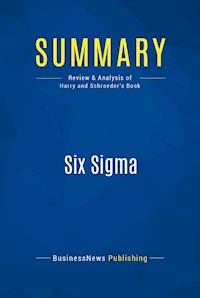
The must-read summary of Mikel Harry and Richard Schroeder's book: "Six Sigma: The Breakthrough Management Strategy Revolutionizing the World's Top Corporations".
This complete summary of the ideas from Mikel Harry and Richard Schroeder's book "Six Sigma" presents the simple Six Sigma philosophy that can have powerful ramifications. Companies should focus on improving quality and aiming for perfection in the products it offers. In their book, the authors explain how to apply this philosophy at all levels of your company and how to establish it as a long-term practice. This summary is a must-read for any leader who wants to follow in the footsteps of the world's biggest companies and understand the benefits of the Six Sigma strategy.
Added-value of this summary:
• Save time
• Understand key concepts
• Expand your knowledge
To learn more, read "Six Sigma" and find out how you can achieve great business success on the path to perfection.
Das E-Book können Sie in Legimi-Apps oder einer beliebigen App lesen, die das folgende Format unterstützen:
Seitenzahl: 32
Veröffentlichungsjahr: 2014
Ähnliche





Book PresentationSix Sigma by Mikel Harry & Richard Schroeder
Book Abstract
About the Author
Important Note About This Ebook
Summary of Six Sigma (Mikel Harry & Richard Schroeder)
Section 1: The Six Sigma Philosophy
Section 2: Applying The Six Sigma Philosophy
Section 3: The Key Players In Any Six Sigma Project
Book PresentationSix Sigma by Mikel Harry & Richard Schroeder
Book Abstract
MAIN IDEA
The traditional approach to improving corporate profitability has generally been to attempt to reduce costs. Six sigma is a management theory which states the key to greater bottom-line profitability lies not in reducing costs but in improving quality.
Specifically, those companies that re-create their business processes in such a way that defects never arise in the first place have and maintain a significant competitive advantage over companies that are forced to spend time and resources identifying and rectifying product defects or process mistakes. In short, whichever company can operate to the highest quality standards will always have the lowest rather than the highest cost structure in its industry.
Historically, companies have tended to be happy with a three- to four-sigma defect level - which corresponds statistically to between 66,807 and 6,210 defects per million opportunities. At that level, the cost of fixing those defects is usually in the 20- to 30-percent of revenues range. When a company undertakes a successful six sigma program, its defect level will ultimately fall to the six-sigma level - less than one defect every 3.4 million opportunities. At that level of performance, the cost of quality drops to less than 1-percent of sales, leaving the balance of the revenue that would otherwise be spent on fixing defects to flow directly to the bottom-line profit.
The message is simple. The company that achieves the greatest level of quality will always win. Six sigma provides the tools for improving quality - by recreating and redesigning the way processes work.
About the Author
MIKEL HARRY is a co-founder and CEO of the Six Sigma Academy Inc. He helped develop the Six Sigma strategy in the 1980s while working at Motorola. Dr. Harry graduated from Ball State University with a B.S. and M.A., and earned a Ph.D. at Arizona State University. In addition to working at Motorola, he has also worked as corporate vice president at Asea Brown Boveri Ltd.
RICHARD SCHROEDER is a co-founder and president of the Six Sigma Academy Inc. Mr. Schroeder received a B.S. in Business Administration and Mechanical Engineering from Pennsylvania State University. He has worked at Motorola, Asea Brown Boveri Ltd. and as vice president at Allied Signal.
The Web site for the Six Sigma Academy Inc. is located at http://www.6-sigma.com
Important Note About This Ebook
This is a summary and not a critique or a review of the book. It does not offer judgment or opinion on the content of the book. This summary may not be organized chapter-wise but is an overview of the main ideas, viewpoints and arguments from the book as a whole. This means that the organization of this summary is not a representation of the book.
Summary of Six Sigma (Mikel Harry & Richard Schroeder)
Section 1: The Six Sigma Philosophy
Main Idea
Six sigma is a business process which empowers companies to dramatically and immediately increase their profitability by:
Streamlining operations.Improving quality.Eliminating defects or mistakes.In essence, six sigma provides specific methods organizations can use to re-create business processes so that less defects and errors will arise in the future. As such, six sigma is proactive rather than reactive - it focuses on changing processes so less errors arise rather than fixing errors.




