


9,99 €
Mehr erfahren.
- Herausgeber: Business Book Summaries
- Kategorie: Fachliteratur
- Sprache: Englisch
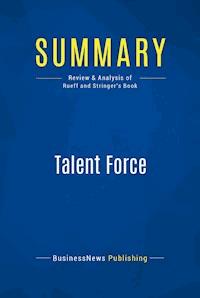
The must-read summary of Rusty Rueff and Hank Stringer's book: "Talent Force: A New Manifesto for the Human Side of Business".
This complete summary of the ideas from Rusty Rueff and Hank Stringer's book "Talent Force" shows how few businesses make the effort to create a true talent force, rather than a workforce. In their book, the authors explain that the people within an organisation will always be the differentiator, more than marketing, brand recognition or even its products. This summary presents specific strategies and techniques that every good business should use in order to align employees' talents with business processes.
Added-value of this summary:
• Save time
• Understand key concepts
• Expand your business knowledge
To learn more, read "Talent Force" to discover why your employees are the biggest asset to your company and how you can benefit from them most.
Das E-Book können Sie in Legimi-Apps oder einer beliebigen App lesen, die das folgende Format unterstützen:
Seitenzahl: 39
Veröffentlichungsjahr: 2014
Ähnliche





Book Presentation:Talent Forceby Rusty Rueff and Hank Stringer
Book Abstract
About the Author
Important Note About This Ebook
Summary ofTalent Force(Rusty Rueff and Hank Stringer)
1. Marketplace trends with regards to talent
2. Responding to these trends – Create a talent plan
3. Executing your talent plan
Book Presentation:Talent Forceby Rusty Rueff and Hank Stringer
Book Abstract
MAIN IDEA
Every business has a “workforce” but only relatively few companies ever make a serious attempt to develop a genuine “talent force” – putting the right talent in the right places at every key position in the organization. This is a mistake because it’s your people alone that differentiate your company – not your market position, your brand reputation or even your products or services. High quality talent has always been and always will be the key competitive differentiator.
With this in mind, it’s time for companies to get serious about finding, recruiting, and then retaining high-quality performers. The engine room for this program will be this three-stage talent plan:
Capture – talent relationships by using new Web-based technologies which attract the attention of the best talent through ongoing regular updates of the Web site and pushing your message.Nurture – talent by forming long-term relationships and by regularly providing them with information they will value.Qualify – match prospects with specific job openings they will be interested in, or build some bench strength so if one key person leaves, a suitable replacement will be available.“Your company might have 10, 50, 500, 1,000 or 20,000 people, but do you have the right talent in the right places at every key position in your company? Do you see your employees not as a collection of bodies, but as the best collection of talent for your business? In short, do you have a workforce or a talent force? Quality talent is always scarce. Even during the employer’s market of the past 50 years, there has been – and always will be – a shortage of quality talent. Think about it. Do your colleagues, directors and managers – each one of them – continuously exceed expectations? Have you turned away ideal job candidates because your organization already overflows with stellar talent? No leader of a company, country, or economy, has ever claimed his people are just too effective and that he does not know what to do with all their skills. When you internalize the fact there is always a shortage of quality talent, you can plan accordingly.”
– Rusty Rueff and Hank Stringer
About the Author
RUSTY RUEFF is CEO of SNOCAP, Inc., a company which manages digital licensing and copyrights. Mr. Rueff previously served as executive vice president of human resources for Electronic Arts and as vice president of international human resources for PepsiCo. A graduate of Purdue University, Mr. Rueff currently serves on the boards of directors for three companies and has numerous other business interests.
HANK STRINGER is CEO of Q Talent Partners, an executive search service and recruiting firm. Mr. Stringer, a graduate of Texas State University, previously founded Hire.com, an interactive recruiting company. He has also worked for Pedley-Stringer, Inc., a high-tech recruitment firm and as an internal recruiting consultant for Tandem Computers and Dell Computer.
The Web site for this book is atwww.talentpartners.net.
Important Note About This Ebook
This is a summary and not a critique or a review of the book. It does not offer judgment or opinion on the content of the book. This summary may not be organized chapter-wise but is an overview of the main ideas, viewpoints and arguments from the book as a whole. This means that the organization of this summary is not a representation of the book.
Summary ofTalent Force(Rusty Rueff and Hank Stringer)
1. Marketplace trends with regards to talent
Irrespective of anything else which happens in business, quality talent is always scarce and in demand. It’s imperative to get the right people in the right place at the right time. You have to plan accordingly. The current mix of demographics, technologies and economies is creating both challenges and opportunities to find the best people. Most of the old assumptions about the availability of talent are no longer true.
At every level of an organization, quality talent counts. Having quality people involved with an enterprise can obviously mean the difference between success and failure. It can also mean the difference between just barely getting by and excelling.
So what, exactly, is quality talent, and why is it now in such short demand in the marketplace? The definition of quality talent is:




