


9,99 €
Mehr erfahren.
- Herausgeber: Business Book Summaries
- Kategorie: Fachliteratur
- Sprache: Englisch
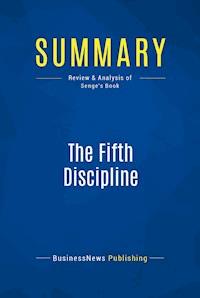
The must-read summary of Peter Senge's book: "The Fifth Discipline: The Art & Practice of the Learning Organization".
This complete summary of the ideas from Peter Senge's book "The Fifth Discipline" shows how important it is to learn faster than the competition. In his book, the author explains how you can get rid of obstacles that stop your company from learning and create a learning organisation. By mastering the principles detailed by Serge, you will stay ahead of the competition and boost motivation.
Added-value of this summary:
• Save time
• Understand the key principles
• Expand your business knowledge
To learn more, read "The Fifth Discipline" and discover how you can become a learning organisation and stay ahead of competitors.
Das E-Book können Sie in Legimi-Apps oder einer beliebigen App lesen, die das folgende Format unterstützen:
Seitenzahl: 31
Veröffentlichungsjahr: 2014
Ähnliche





Book Presentation: The Fifth Discipline by Peter Senge
Book Abstract
About the Author
Important Note About This Ebook
Summary of The Fifth Discipline (Peter Senge)
Section 1: The Competitive Advantages of Learning Organizations
Section 2: The Five Core Disciplines of Learning Organizations
Section 3: The Key Challenges, Practical Problems and Issues Learning Organizations Face
Book Presentation: The Fifth Discipline by Peter Senge
Book Abstract
MAIN IDEA
Organizations which embed collective learning practices as a core competency are well positioned to prosper in the future - because they will be able to develop whatever new skills are required to succeed. In other words, any organization’s future earning capacity is directly proportional to its total ability and capacity to learn new things.
Thus, the organizations which will prosper in the future will be “learning organizations” - organizations which harness the collective experience, talents and capabilities of everyone to learn how to succeed together. Learning will become a way of life and an ongoing process rather than solely being refined to one specific part of each person’s career.
For corporations, learning is the lifeblood of future success.
About the Author
PETER SENGE is a founding member and the chair for the Society for Organizational Learning at the Sloan School of Management, Massachusetts Institute of Technology. In addition to lecturing at MIT, Dr. Senge studies how firms and other organizations can develop learning capabilities in a world of increasing complexity and rapid change. He is the author, co-author or editor of several books including The Dance of Change, Schools That Learn and The Fifth Discipline Handbook.
Important Note About This Ebook
This is a summary and not a critique or a review of the book. It does not offer judgment or opinion on the content of the book. This summary may not be organized chapter-wise but is an overview of the main ideas, viewpoints and arguments from the book as a whole. This means that the organization of this summary is not a representation of the book.
Summary of The Fifth Discipline (Peter Senge)
Section 1: The Competitive Advantages of Learning Organizations
Main Idea
Learning organizations harness the capacities of everyone involved to learn and then relearn how to produce extraordinary results. With the ongoing rapid changes which characterize today’s business environment, the adaptive abilities of the learning organization are profoundly beneficial.
Learning organizations find ways to excel, no matter what external changes occur.
Supporting Ideas
A learning organization continually expands its capacity to create and harness a bright future through effective learning techniques. Most organizations tend to learn rather poorly for a variety of reasons:
Employees create emotional links between their current positions and their personal identities, discouraging change.External competitors are blamed when sometimes the organization’s own systems are the real enemy.People focus on and react to events rather than become proactive in designing solutions to the way those problems came about in the first place.Employees are fixated with external events rather than the slow, gradual systems changes taking place in the background.Staff realize they learn most effectively from experience but most often, there’s quite a substantial time lapse between an action and its results. Thus, cause-and-effect relationships become blurred.Internal teams (including management teams) care more about protecting their turf and avoiding embarrassment than dealing with complex issues.In essence, non-learning organizations tend to simply react to events whereas learning organizations focus on the underlying systems generating the behavior which ultimately leads to the events.
The importance of this distinction is that non-learning organizations are solely reactive whereas learning organizations have the ability to change the underlying systems to create different behavior and events. In this way, learning organizations have the ability to create their own future.
Thus, learning organizations:




