


9,99 €
Mehr erfahren.
- Herausgeber: Business Book Summaries
- Kategorie: Fachliteratur
- Sprache: Englisch
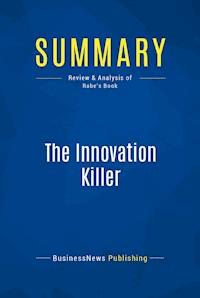
The must-read summary of Cynthia Rabe's book: "The Innovation Killer: How What We Know Limits What We Can Imagine - And What Smart Companies Are Doing About It”.
This complete summary of the ideas from Cynthia Rabe's book "The Innovation Killer" shows that thinking innovatively is a challenge for many organisations because it requires a rather delicate balancing act. On the one hand, creative ideas need to draw on some specific and well established expertise but at the same time, the conventional thinking needs to be challenged. In her book, the author explains the importance of bringing in temporary team members who can look at the situation from a fresh perspective and think outside the box. This summary is a must-read for every manager who wants to encourage innovation and creativity in their business.
Added-value of this summary:
• Save time
• Understand key concepts
• Expand your knowledge
To learn more, read "The Innovation Killer" and find out how you can make changes to allow for more innovation in your company.
Das E-Book können Sie in Legimi-Apps oder einer beliebigen App lesen, die das folgende Format unterstützen:
Seitenzahl: 36
Veröffentlichungsjahr: 2014
Ähnliche

















Book Presentation: The Innovation Killer by Cynthia Rabe
Book Abstract
About the Author
Important Note About This Ebook
Summary of The Innovation Killer (Cynthia Rabe)
1. Why Innovation is Difficult For Most Organizations
2. The Solution – Zero-Gravity Thinking
3. How to Make Zero-Gravity Thinking Work in Practice
Book Presentation: The Innovation Killer by Cynthia Rabe
Book Abstract
Main Idea
Thinking innovatively is a challenge for many organizations because it requires a rather delicate balancing act. On the one hand, creative ideas need to draw on some specific and well established expertise but at the same time the conventional thinking needs to be challenged. The trick lies in getting this balance just right.
In practice, highly creative organizations bring in outsiders who are not weighed down unduly by the “way things have always been done”. These outsiders come with a fresh perspective, and therefore exercise what can be described as “zero-gravity” thinking – that is, clear thinking which is unfettered by established practices, internal politics or any other impediments. These temporary team members can then push people to think outside the limits of their existing mindset.
Zero-gravity thinking addresses directly the human side of innovation. It is based on the fact every invention, every great idea and every breakthrough product is the brainchild of a real person or a group of people combining their thoughts and talents.
About the Author
CYNTHIA RABE held the position of Innovation Strategist for Intel Corporation until she left Intel to found her own consulting firm, Zero-G, LLC. Her prior business experience includes acting as Director of Consumer Marketing for Intel’s home networking product line and as manager of consumer product lines for Ralston Purina and Eveready Battery Company. At Eveready, Ms. Rabe was a member of the 4-person development team who introduced the “Energizer Bunny” advertising campaign in 1988. A graduate of Washington University in St Louis, Missouri and the Stanford University Executive Institute for Management, Ms. Rabe has more than 20 years of experience in senior business and marketing management roles for consumer product and technology companies.
The Web site for this book is atwww.innovationkiller.com.
Important Note About This Ebook
This is a summary and not a critique or a review of the book. It does not offer judgment or opinion on the content of the book. This summary may not be organized chapter-wise but is an overview of the main ideas, viewpoints and arguments from the book as a whole. This means that the organization of this summary is not a representation of the book.
Summary of The Innovation Killer (Cynthia Rabe)
1. Why Innovation is Difficult For Most Organizations
When innovating, human nature is an obstacle which must be overcome. Our thinking is constrained by the fact we accept blithely what others have said and what the experts say is possible or impossible. All of this limits our field of vision and puts blinders on our thinking. To innovate successfully, we need to put aside what is known and let our imaginations run free. We need to break away from what we know, what our organization believes and what the experts in our field accept are the established boundaries.
Innovation is defined as “the development and application of an original idea which results in a valuable improvement being made”. Some innovations are breakthroughs (radical departures from what was used before) while others are incremental improvements on existing ideas.
Everyone loves the idea of being innovative because that can be highly profitable. If you or your organization can come up with a breakthrough idea, it can make a huge difference in the marketplace. Yet despite this appreciation of the benefits of being innovative, many organizations find it difficult to innovate.
Why is innovation so difficult?
In some organizations, new ideas need to pass through numerous filters of various kinds before they get picked up on. These filters may consist of requiring management approval, needing resources to be made available or even something as simple as expecting new ideas to come from the top down rather than the bottom up. It isn’t at all unusual for those filters to block off any encouraging new ideas which don’t have the right backing or pedigree.




