


9,99 €
Mehr erfahren.
- Herausgeber: Business Book Summaries
- Kategorie: Religion und Spiritualität
- Sprache: Englisch
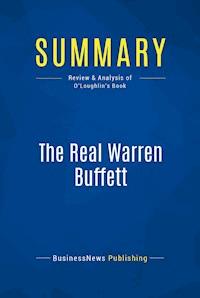
Th must-read summary of James O'Loughlin's book: "The Real Warren Buffett: Managing Capital, Leading People".
This complete summary of the ideas from James O'Loughlin's book "The Real Warren Buffett" tells the story of Warren Buffett, who served for 37 years as chairman and chief executive of Berkshire Hathaway. During that time, the company’s market value has grown from $600 million to $109 billion – a compound growth rate of 25% per year. Today, Berkshire generates annual revenues of $30 billion and employs 112,000 people. In his book, the author reveals what Buffett does differently and better than everyone else and describes the framework that allows him to do three important tasks exceptionally well. This summary is a must-read for anyone who wants to understand Warren Buffett's success story and learn from his actions.
Added-value of this summary:
• Save time
• Understand key concepts
• Expand your knowledge
To learn more, read "The Real Warren Buffett" and discover the secrets to success of Berkshire Hathaway and its chief executive.
Das E-Book können Sie in Legimi-Apps oder einer beliebigen App lesen, die das folgende Format unterstützen:
Seitenzahl: 35
Veröffentlichungsjahr: 2014
Ähnliche
Book Presentation: The Real Warren Buffett by James O’Loughlin
Book Abstract
About the Author
Important Note About This Ebook
Summary of The Real Warren Buffett (James O’Loughlin)
1. Act like the owner of the entire business
2. Lead and motivate able people
3. Allocate capital intelligently
4. Stay within your Circle of Competence
Book Presentation: The Real Warren Buffett by James O’Loughlin
Book Abstract
MAIN IDEA
Warren Buffett has served for 37 years as chairman and chief executive of Berkshire Hathaway. During that time, the company’s market value has grown from $600 million to $109 billion – a compound growth rate of 25% per year. (If Berkshire were to continue that rate of growth for the next 34 years, it would absorb the entire U.S. economy). Today, Berkshire generates annual revenues of $30 billion and employs 112,000 people.
So what is it Warren Buffett is doing differently (and better) than everyone else? This is more than being a good stock picker and investor. Instead, Warren Buffett acts like a CEO who owns the company. He has developed a framework which allows him to do three specific tasks exceptionally well:
The challenge, therefore, in emulating the accomplishments of Warren Buffett and Berkshire Hathaway is not to become better at assembling a stock portfolio but to become a better CEO.
“Capital markets offer a sophisticated arena in which to emulate Warren Buffett who, with a personal fortune of $37 billion, is currently the second richest man in America behind Bill Gates. They also offer a thousand opportunities to make the mistakes that will ground your compound returns in the average and stunt your growth. Buffett was, and is, able to identify opportunity. He has been, and is, able to circumvent most errors of decision making, and to learn from those he does make. He has combined this into a form of leadership that allows him free expression of his talent. And he has endowed managers within Berkshire Hathaway who also allocate capital with the ability to do so on a similarly informed basis. Warren Buffett appreciates the challenges of attempting to act like an owner of an enterprise when functioning as its manager. He has discovered the difficulties of getting Berkshire’s subsidiary managers to act like owners too. The end product allows Buffett to allocate capital where he sees fit, when he sees fit, and at the pace he sees fit. As Buffet says: ‘When returns are ordinary, an earn-more-by-putting-up-more is no great managerial achievement. You can get the same result personally while operating from your rocking chair. Just quadruple the capital you commit to a savings account and you will quadruple your earnings’. He recognizes that ‘if retained earnings are employed in an unproductive manner, the economics of Berkshire will deteriorate very quickly’. His focus in the allocation of capital therefore revolves around this reality. Ideally, he would prefer to find opportunities to reinvest Berkshire’s excess capital in existing b usinesses. The key to Buffett’s ability to compound is his ability to harvest the cash from cash-generative businesses and reinvest this elsewhere.”
– James O’Loughlin
About the Author
JAMES O’LOUGHLIN is investment manager and head of global equity strategy for the Co-operative Insurance Society, one of the largest insurance companies in the U.K. with more than $36 billion of assets under management. A graduate of the University of Manchester, Mr. O’Loughlin has been a professional investor since 1983.
The Web site for this book is atwww.therealwarrenbuffett.com.
Important Note About This Ebook
This is a summary and not a critique or a review of the book. It does not offer judgement or opinion on the content of the book. This summary may not be organized chapter-wise but is an overview of the main ideas, viewpoints and arguments from the book as a whole. This means that the organization of this summary is not a representation of the book.
Summary of The Real Warren Buffett (James O’Loughlin)
1. Act like the owner of the entire business




