


9,99 €
Mehr erfahren.
- Herausgeber: Business Book Summaries
- Kategorie: Lebensstil
- Sprache: Englisch
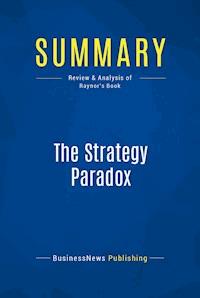
The must-read summary of Michael Raynor's book: "The Strategy Paradox: Why Committing to Success Leads to Failure (and What to Do About It).
This complete summary of the ideas from Michael Raynor's book "The Strategy Paradox" shows that whenever you develop a strategy to achieve a specific objective, you are also automatically making some implicit assumptions about what the future market forces will be. If that forecast of future market conditions turns out to be incorrect, then your strategy which had a reasonable chance of success might turn out to be an absolute failure. In his book, the author explains that this is the essence of the strategy paradox. This summary explains how to hedge your strategic bets by creating a number of strategic options which can be harnessed depending on the actual marketplace conditions and the four phases of the strategic flexibility process.
Added-value of this summary:
• Save time
• Understand key concepts
• Expand your knowledge
To learn more, read "The Strategy Paradox" and discover the key to protecting your business from failure.
Das E-Book können Sie in Legimi-Apps oder einer beliebigen App lesen, die das folgende Format unterstützen:
Seitenzahl: 29
Veröffentlichungsjahr: 2014
Ähnliche













Book Presentation: The Strategy Paradox by Michael Raynor
Book Abstract
About the Author
Important Note About This Ebook
Summary of The Strategy Paradox (Michael Raynor)
Book Presentation: The Strategy Paradox by Michael Raynor
Book Abstract
Main Idea
Whenever you develop a strategy to achieve a specific objective, you are also automatically making some implicit assumptions about what the future market forces will be. If that forecast of future market conditions turns out to be incorrect, then your strategy which had a reasonable chance of success might turn out to be an absolute failure. This is the essence of the strategy paradox. The same behaviors and characteristics which maximize your probability of success also maximize your probability of total failure at the same time.
To overcome the strategy paradox, build in some flexibility and adaptability into your business strategy. Develop multiple choices which can respond appropriately to the different requirements of several market conditions. In simple terms hedge your strategic bets by creating a number of strategic options which can be harnessed depending on the actual marketplace conditions.
Strategic flexibility will have four distinct phases:
Anticipate – Build multiple scenarios of the futureFormulate – create an optimal strategy for each scenarioAccumulate – determine which strategic options are requiredOperate – manage your portfolio of options effectivelyAbout the Author
MICHAEL RAYNOR is a consultant with Deloitte Consulting LLP and a Deloitte Research Distinguished Fellow. In addition to lecturing around the world on corporate and competitive strategy, Dr. Raynor works with leaders of companies in the telecommunications, pharmaceutical, energy and manufacturing industries. Dr. Raynor is a graduate of Harvard University, the University of Western Ontario and Harvard Business School. He is the coauthor of The Innovator’s Solution along with Professor Clayton Christensen.
The Web site for this book is atwww.thestrategyparadox.com.
Important Note About This Ebook
This is a summary and not a critique or a review of the book. It does not offer judgment or opinion on the content of the book. This summary may not be organized chapter-wise but is an overview of the main ideas, viewpoints and arguments from the book as a whole. This means that the organization of this summary is not a representation of the book.
Summary of The Strategy Paradox (Michael Raynor)
The Problem – The Strategy Paradox
Any business strategy, even if perfectly executed, rests on an assumption made today about what the market conditions will be like in the future. If those market conditions end up being different, even a well-conceived strategy for today’s marketplace conditions will fail. Instead of trying to predict the future, build in enough strategic flexibility to be able to respond to the marketplace conditions as they end up unfolding.
To be a success, many times a firm needs to make commitments of resources and capabilities which are hard-to-copy for competitors but also hard-to-reverse. Often these commitments take a substantial period of time before they bear fruit. They are entered into on the basis of set beliefs about what the marketplace conditions will be like in the future. If these beliefs turn out, in fact, to be wrong, an otherwise excellent strategy might fail to achieve the desired objective by a wide margin.
Similarly, if the assumptions about the marketplace or the consumer’s preferences end up being proven wrong, this can also mean a well-conceived, carefully planned and flawlessly executed strategy ends up failing to achieve the objective.




