


9,99 €
Mehr erfahren.
- Herausgeber: Business Book Summaries
- Kategorie: Fachliteratur
- Sprache: Englisch
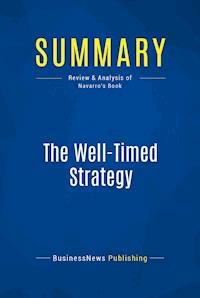
The must-read summary of Peter Navarro's book: "The Well-Timed Strategy: Managing the Business Cycle for Competitive Advantage".
This complete summary of the ideas from Peter Navarro's book "The Well-Timed Strategy" shows how understanding the business cycle and then using it to maximum advantage is an unexploited area of business management expertise. And yet, it makes good sense to use the cycle to gain a competitive advantage over your rivals. In his book, the author presents six areas of corporate activity than can be timed to the general business cycle, allowing you to achieve superior performance. This summary explains each of these areas and what you need to do in order to come out on top.
Added-value of this summary:
• Save time
• Understand key concepts
• Expand your business knowledge
To learn more, read "The Well-Timed Strategy" and discover the key to surviving the business cycle and beating your competitors.
Das E-Book können Sie in Legimi-Apps oder einer beliebigen App lesen, die das folgende Format unterstützen:
Seitenzahl: 34
Veröffentlichungsjahr: 2014
Ähnliche








Book Presentation The Well–Timed Strategy by Peter Navarro
Book Abstract
About the Author
Important Note About This Ebook
Summary of The Well–Timed Strategy (Peter Navarro)
Book Presentation The Well–Timed Strategy by Peter Navarro
Book Abstract
MAIN IDEA
When the strategic actions of 180 companies and their senior management teams were analyzed over a five-year study either side of the 2001 recession, it was shown very few firms even attempted to use the ebbs and flows of the general economy to achieve and then sustain a competitive advantage. Understanding the business cycle and then using it to maximum advantage is an unexploited area of business management expertise.
This is unusual because the business cycle itself is a known quantity. It is also one of the major determinants of corporate profitability and stock price performance. Therefore, it makes good sense to use the cycle to gain a competitive advantage over your rivals. In practical terms, there are six areas of corporate activity which can and should be timed to the general business cycle:
In a majority of these applications, the smart thing to do is to make countercyclical moves – to zig when everyone else is zagging. This will only pay off if you get your timing right but doing so will allow you to achieve superior performance while all your competitors are hemorrhaging cash and other resources. If you time your moves to the upcoming phase of the business cycle, you position your enterprise to be in an advantageous position when the forecasted market conditions eventuate.
“Our five-year quest yielded many insights, a number of them surprising and quite contrary to conventional wisdom, but one giant conclusion stands above the others: We believe that almost any organization can substantially improve its stature and performance, perhaps even become great, if it conscientiously applies the framework of ideas we’ve uncovered.”
– Peter Navarro
“The essence of strategy is to achieve a long-term advantage over the firm’s competitors.”
– Professor Arnoldo Hax, Sloan School of Management
About the Author
PETER NAVARRO is a business professor at the University of California, Irvine. He specializes in the application of sophisticated macroeconomic strategies to the general business environment and financial markets. Dr. Navarro is a graduate of Tufts University and Harvard. He is also a public speaker and the author of several investment books including If It’s Raining in Brazil, Buy Starbucks and an audio lecture series Big Picture Investing: How, When and Why the Stock Market Moves.
The Web site for this book is atwww.peternavarro.com.
Important Note About This Ebook
This is a summary and not a critique or a review of the book. It does not offer judgment or opinion on the content of the book. This summary may not be organized chapter-wise but is an overview of the main ideas, viewpoints and arguments from the book as a whole. This means that the organization of this summary is not a representation of the book.
Summary of The Well–Timed Strategy (Peter Navarro)
#1 – Capital Expenditures & Finance
Cut expenditures in anticipation of recessionIncrease expenditure before a recoveryModernize facilities during a slowdownTo enhance profitability, astute capital expenditure is counter cyclical. Specifically, you want to vary capital expenditure to position your firm for what lies in the future rather than the immediate state of the economy. In practical terms, that means spending more during a recession and less during times of expansion when everyone else is doing the opposite.
Matching capital expenditure to the ebbs and flows of the general economic cycle has the potential to make or break a company in quite far-reaching ways. Nothing can get you into more trouble than ramping up your capital expenditure just as a recession is about to hit (Phase A). This can create a cash squeeze from which many companies never emerge. Conversely, if you have the nerve to make some well-placed investments during a recession (Phase B), you can totally dominate your market when the next expansive phase of the economy arrives.
To take a few examples of companies which got into trouble because they made “Phase A style” investments:




