


9,99 €
Mehr erfahren.
- Herausgeber: Business Book Summaries
- Kategorie: Lebensstil
- Sprache: Englisch
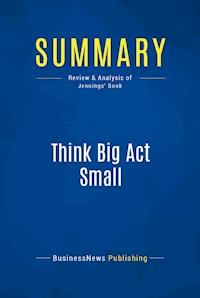
The must-read summary of Jason Jennings' book: "Think Big Act Small: How America's Best Performing Companies Keep the Start-up Spirit Alive".
This complete summary of the ideas from Jason Jennings' book "Think Big Act Small" reveals the results of a study that was carried out in order to identify the organisations that were growing revenue and profits by 10% for at least ten years. Based on these results, Jason Jennings has compiled this guide for what an organisation needs to do to prosper over the long term - think big, but act small. This summary explains how companies can do this by coming up with big ideas that solve their customers' problems or making better products, but they should never stop acting like a start-up.
Added-value of this summary:
• Save time
• Understand key concepts
• Expand your business knowledge
To learn more, read "Think Big Act Small" and discover the most important way to keep your company growing.
Das E-Book können Sie in Legimi-Apps oder einer beliebigen App lesen, die das folgende Format unterstützen:
Seitenzahl: 40
Veröffentlichungsjahr: 2014
Ähnliche
Book Presentation Think Big Act Small by Jason Jennings
Book Abstract
About the Author
Important Note About This Ebook
Summary of Think Big Act Small (Jason Jennings)
Book Presentation Think Big Act Small by Jason Jennings
Book Abstract
MAIN IDEA
More than 72,000 U.S. companies were analyzed to identify those organizations which had grown revenues and profits by ten percent or more, for at least ten consecutive years, not counting acquisitions. This eliminated 99.99% of the companies, and generated a shortlist of around twenty-seven companies which met these criteria. Of those companies, nine from a variety of industries were selected, and researchers met with the CEOs, leaders, managers, workers, customers, vendors and suppliers of each company to try and identify what they were doing right that almost every other company was not. Eventually, a list of the ten most important and actionable findings was compiled as a guide for what an organization needs to do to prosper over the long term.
The common thread in all these findings is that each company thinks big but acts small. They come up with big ideas about how to solve their customer’s problems or how to make better products but they never stop acting like start-ups – they stay humble, treat every employee like an owner and have managers who get their hands dirty working on the frontlines rather than sitting isolated in the corporate headquarters.
In all, it really comes down to simple common sense – but it’s amazing how uncommon common sense can be in business.
“Our findings genuinely surprised us. We didn’t discover any mind-bending tactics or top-secret methods that enabled these companies to grow their revenues consistently. Instead, because each has nailed the fundamentals better than all other companies, their dramatic and consistent growth occurs naturally, even organically. The ten building blocks these companies use to grow their revenues and profits every year would be no less valid if they weren’t practiced by every company, but surprisingly, in almost every instance, everything we found is a way of life at all of these companies.”
– Jason Jennings
“We live in interesting times. Complexity causes people to yearn for simple, profound ideas that can be readily related to diverse situations. These guiding principles are admittedly not academic jargon, nor were they developed in the mountaintop lab of a thought leader. Actually, they’re relatively simple ideas; the genius behind them lies in how they have been applied by these companies, despite differences in location, industry, political persuasion, or ownership model. People gravitate to confidence, decisiveness, and clear, powerful messages, searching for the ultimate metaphysical reference point. So we end with this message: to build an organization with balanced focus, camaraderie, and the ability to prosper over the long term, think big, act small.”
– Brian Solon, lead researcher
About the Author
JASON JENNINGS is a business consultant and acclaimed keynote speaker. He is the author of Less Is More and a co-author of It’s Not The Big That Eat The Small…It’s The Fast That Eat The Slow. Mr. Jennings started his career as a broadcast journalist and then was notably the youngest radio station group owner in America. He subsequently went on to build the nation’s largest media consulting company, in the process developing management and programming strategies that ultimately had the effect of revolutionizing this industry.
The Web site for this book is at www.jennings-solutions.com.
Important Note About This Ebook
This is a summary and not a critique or a review of the book. It does not offer judgment or opinion on the content of the book. This summary may not be organized chapter-wise but is an overview of the main ideas, viewpoints and arguments from the book as a whole. This means that the organization of this summary is not a representation of the book.
Summary of Think Big Act Small (Jason Jennings)
1. Always be humble and down to earth.
The people who lead steady growth companies are genuinely humble. They don’t seek celebrity status or to have their accomplishments acknowledged far and wide. Instead, they’re too busy doing their job to worry about who gets the accolades. They leave their egos at home and get to work.
High growth organizations have leaders who are humble and down to earth. They typically share seven key attributes:
Humble leaders view their role as a steward first and foremost – entrusted with the responsibility to guide the organization and move it forward rather than worry about their personal remuneration packages. They work hard so their organization can be in charge of its own destiny and progressively make the world a better place.Humble leaders act transparently – they make all knowledge and information available to everyone in the company. That allows everyone to focus on the goals of the company rather than worrying about internal politics.Humble leaders are accessible




