


9,99 €
Mehr erfahren.
- Herausgeber: Business Book Summaries
- Kategorie: Fachliteratur
- Sprache: Englisch
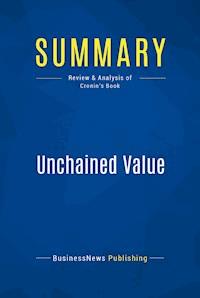
The must-read summary of Mary Cronin's book: "Unchained Value: The New Logic of Digital Business".
This complete summary of the ideas from Mary Cronin's book "Unchained Value" shows that you can’t transform a conventional firm into a digital business by simply grafting a few Web initiatives onto the current business structures. Instead, the existing business chain will need to be replaced in its entirety by a “digital value system” which focuses not on static, internal value chains but on dynamic, external webs of relationships. In her book, the author explains that this is the only way the power and flexibility of the digital business arena can be harnessed to create greater value and derive a stronger competitive advantage. This summary will teach you how to rethink your business and why you should do it sooner rather than later so that you don't get left behind.
Added-value of this summary:
• Save time
• Understand key concepts
• Expand your knowledge
To learn more, read "Unchained Value" and discover the key to aligning your business with the e-revolution.
Das E-Book können Sie in Legimi-Apps oder einer beliebigen App lesen, die das folgende Format unterstützen:
Seitenzahl: 34
Veröffentlichungsjahr: 2014
Ähnliche
















Book PresentationUnchained Value by Mary Cronin
Book Abstract
About the Author
Important Note About This Ebook
Summary of Unchained Value (Mary Cronin)
A Digital Value System
Information
Trust
Real-Time Relationships
Customized Services
e-Marketing
Book PresentationUnchained Value by Mary Cronin
Book Abstract
MAIN IDEA
You can’t transform a conventional firm into a digital business by simply grafting a few Web initiatives onto the current business structures. Instead, the existing business chain will need to be replaced in its entirety by a digital value system which focuses not on static, internal value chains but on dynamic, external webs of relationships. This is the only way the power and flexibility of the digital business arena can be harnessed to create greater value and derive a stronger competitive advantage.
The sooner a company rethinks its business and realigns its systems with the Internet, the better it will be able to benefit from the broad opportunities of the new economy.
About the Author
MARY CRONIN is professor of management at Boston College. She specializes and focuses on the development and implementation of e-business strategies. Dr. Cronin also works as a consultant with numerous Fortune 500 companies and serves on the board of directors for several Internet start-ups. She is the author of several books including Doing Business on the Internet: How the Electronic Highway Is Transforming America, Global Advantage on the Internet and The Internet Strategy Handbook: Lessons From the New Frontier of Business.
Important Note About This Ebook
This is a summary and not a critique or a review of the book. It does not offer judgment or opinion on the content of the book. This summary may not be organized chapter-wise but is an overview of the main ideas, viewpoints and arguments from the book as a whole. This means that the organization of this summary is not a representation of the book.
Summary of Unchained Value (Mary Cronin)
A Digital Value System
Main Idea
In the Internet business era, the traditional business chain – a set of processes, practices and assets – has become a liability instead of an asset. Companies that attempt to use the Internet to simply speed up and improve their existing value chain will be at a disadvantage to entities which take a completely fresh approach.
Digital value systems are the appropriate e-business replacements for business value chains. They more efficiently harness the characteristics of digital business to generate new value at an accelerated rate.
Supporting Ideas
Consider how the Internet is changing the assumptions and goals of each of the five key parts of the conventional business value chain:
LogisticsThere have been dramatic improvements in the speed and efficiency of finding new suppliers and the ease with which supplier relationships can be managed. Thus:
Responsiveness to customer demand is replacing the traditional bias towards controlling the assembly process.Efficient outsourcing of all manufacturing is superseding the conventional “just-in-time” approach to logistics.Managing the information about materials has already become more important than the physical movement and storage of those goods.OperationsConventional businesses have attempted to use tools like enterprise resource planning, reengineering and IT to free up bottlenecks, eliminate redundancies and enhance internal efficiencies. By contrast, in the Internet economy:
Outsourcing provides an ability to scale combined with short lead times to ramp up production.Instead of aligning internal systems with “best practices”, the focus is on finding “best partners” to work with.The development of new product offerings is simplified because of the absence of operational considerations.DistributionWith the Internet’s ability to share information instantaneously and seamlessly, distribution systems can be completely revamped and enhanced. Specifically:
Build-to-order means the time and resources required to store products between manufacture and final delivery is reduced or eliminated.There is no need to focus on the efficiencies of internal warehousing and physical movement systems since these functions are not required– allowing the company to make profits on thinner margins.Inventory management and forecasting of demand are replaced by flexible, scalable alliances with partners who can ramp up or scale back production to precisely match actual real-time demand.Marketing and Sales




