


9,99 €
Mehr erfahren.
- Herausgeber: Business Book Summaries
- Kategorie: Fachliteratur
- Sprache: Englisch
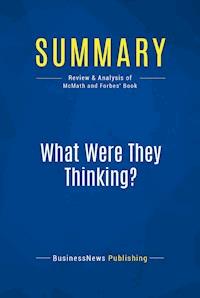
The must-read summary of Robert McMath and Thom Forbes' book: "What Were They Thinking? Marketing Lessons I've Learned from Over 80,000 New-Product Innovations and Idiocies".
This complete summary of the ideas from Robert McMath and Thom Forbes' book "What Were They Thinking?" shows that companies throw away millions of dollars unnecessarily by repeating their marketing mistakes of the past over and over. In their book, the authors state that by studying what has and has not worked in the past, marketers can significantly improve their chances of success. If a marketer tries to emulate the success of previously successful products, there is indeed a lot of money to be made. This summary provides an informative guide for markets, entrepreneurs and advertisers.
Added-value of this summary:
• Save time
• Understand key concepts
• Expand your marketing skills
To learn more, read "What Were They Thinking?" and improve your chances of success by following in the footsteps of successful products.
Das E-Book können Sie in Legimi-Apps oder einer beliebigen App lesen, die das folgende Format unterstützen:
Seitenzahl: 32
Veröffentlichungsjahr: 2014
Ähnliche


Book PresentationWhat Were They Thinking? by Robert McMath and Thom Forbes
Book Abstract
Important Note About This Ebook
Summary of What Were They Thinking? (Robert McMath and Thom Forbes)
1. Marketing Hot Buttons for Success in the Millennium
2. Me-Too Marketing and Product Line Extensions
3. Avoiding Corporate Alzheimer’s Disease
4. New Product Innovation
5. Communicating and Concentrating
6. Fooling With Your Cash Cow
7. Image – Even if it’s Anti-image – Is Everything
8. Trend or Fad?
9. The Proof of the Pudding is in the Eating
10. Question: Who are Our Target Customers?
11. Significant Points of Difference
12. You Shalt Not Deceive
Book PresentationWhat Were They Thinking? by Robert McMath and Thom Forbes
Book Abstract
MAIN IDEA
Companies throw away millions of dollars unnecessarily by repeating their marketing mistakes of the past over and over.
By studying what has and has not worked in the past, marketers can significantly improve their chances of success. This common sense approach to marketing suggests that if a marketer is ignorant of the mistakes of the past, he is likely to repeat them again, losing a lot of money in the process. By contrast, if a marketer tries to emulate the success of previously successful products, there is a lot of money to be made.
New products only succeed when everything that has to go right does actually go right. That is a trough assignment in the real world, but marketers can increase their chances for success by being realistic, by examining product concepts rigorously right at their inception, by questioning their assumptions as they develop them and by remaining flexible enough to make adjustments and corrections as snags and hitches are encountered.
Important Note About This Ebook
This is a summary and not a critique or a review of the book. It does not offer judgment or opinion on the content of the book. This summary may not be organized chapter-wise but is an overview of the main ideas, viewpoints and arguments from the book as a whole. This means that the organization of this summary is not a representation of the book.
Summary of What Were They Thinking? (Robert McMath and Thom Forbes)
1. Marketing Hot Buttons for Success in the Millennium
Main Idea
Products that will excel in the next millennium will be those that meet or exceed customer needs in the following areas:
Greater convenienceEnvironmentally soundEthnically diverseFunNutritionalPackagingSizeYouthSupporting Ideas
Why are these areas of critical importance to marketing programs in the new millennium? Consider:
Greater convenienceConsumers are willing to pay a premium for any product, concept or service that will save them time and make their lives easier. In fact, given a choice between what is politically correct and whatever is more convenient, convenience will win out 90-percent of the time.
Time is the single commodity nobody has enough of. Convenience, in its purest form, is anything that saves time. If you offer a product or service that is genuinely convenient, you have a sustainable competitive advantage.
Environmentally soundMost consumers today feel they have an obligation to preserve the environment as much as possible for future generations - within reason. In other words, they’re willing to do their part as long as they don’t have to go to extremes and put up with inferior products in the name of the environment.
Take advantage of this by incorporating recycling, less packaging and environmentally friendly processes as much as possible, but still turn out a quality product or service.
Ethnically diverseDue to increased awareness of the health risks of a high sodium diet and the ongoing wave of immigration, food tastes are constantly evolving. At present and into the next millennium, for example, the U.S. food market is evolving towards hotter and spicier foods
Expect food to continue to undergo a flavor revolution in the future as more and more consumers become acclimatized to new spices and flavors.
Fun




