


9,99 €
Mehr erfahren.
- Herausgeber: Business Book Summaries
- Kategorie: Lebensstil
- Sprache: Englisch
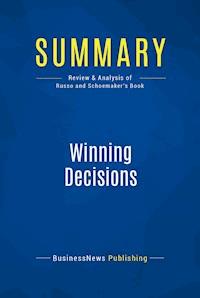
The must-read summary of J. Edward Russo and Paul Schoemaker's book: "Winning Decisions: Getting It Right the First Time".
This complete summary of the ideas from J. Edward Russo and Paul Schoemaker's book "Winning Decisions" shows that in order to make effective business decisions, you need a decision-making process that is structured, sound and consistent. In their book, the authors present a four-stage process for making decisions that will help you to envision the problem as a whole and make the right decision that will be beneficial in both the present and the future. This summary also highlights the importance of learning from the effects of each decision you make in order to constantly improve your skills.
Added-value of this summary:
• Save time
• Understand key concepts
• Expand your decision-making skills
To learn more, read "Winning Decisions" and find out how you can make the right decisions every time!
Das E-Book können Sie in Legimi-Apps oder einer beliebigen App lesen, die das folgende Format unterstützen:
Seitenzahl: 35
Veröffentlichungsjahr: 2014
Ähnliche


Book Presentation: Winning Decisions by J. Edward Russo and Paul Schoemaker
Book Abstract
About the Author
Important Note About This Ebook
Summary of Winning Decisions(J. Edward Russo and Paul Schoemaker)
Book Presentation: Winning Decisions by J. Edward Russo and Paul Schoemaker
Book Abstract
Main Idea
At one time, most business decisions could be made on the basis of intuition, common sense or specialist experience. Unfortunately, those days are now past. Today, it has become important to make sound business decisions quickly, and your chances of actually doing that in practice are enhanced if you have in place a decision making process which is structured, sound and consistent.
Specifically, to make good business decisions, follow a four stage process:
Frame problems accurately – because the framing you use will determine the viewpoint from which the problem is seen.Gather intelligence effectively – the knowable facts as well as everything that is “unknowable” at present.Come to a conclusion – which should flow-on naturally from the framing applied and the intelligence gathered.Keep systematically learning from your experiences – so can improve or even make early refinements during implementation.Add to that a preamble where you take the time to set your course efficiently (by asking the right questions) and a follow-up stage where you take care to apply everything that has been learned and you’ll have a robust and useful decision making process.
About the Author
J. EDWARD RUSSO is professor of marketing and behavior science at Cornell University’s graduate school of management. He has also previously served as an adviser to Boeing, Eli Lilley, General Motors, Harris Bank and SmithKline Beecham. Dr. Russo specializes in the study and application of cutting edge decision technologies to real world problems.
PAUL SCHOEMAKER is the founder and chairman of Decision Strategies International. He also serves as research director at Wharton’s center for technology and innovation. Dr. Schoemaker, in addition to consulting with more than 100 corporations, has previously served as a professor at the University of Chicago and the Wharton School.
Dr. Russo and Dr. Schoemaker are also the co-authors of Decision Traps.
Important Note About This Ebook
This is a summary and not a critique or a review of the book. It does not offer judgment or opinion on the content of the book. This summary may not be organized chapter-wise but is an overview of the main ideas, viewpoints and arguments from the book as a whole. This means that the organization of this summary is not a representation of the book.
Summary of Winning Decisions(J. Edward Russo and Paul Schoemaker)
Preamble: Set Your Course
Main Idea
Before plunging into making a decision, stop and decide how you are going to make a decision. By carrying out a quick initial assessment, you can figure out how best to spend your time and available resources.
Supporting Ideas
A good initial assessment should help you think about the larger issues you’re facing. Find answers to these questions:
What is the crux of this issue?How should this decision be made – individually or in a group, analytically or emotionally, or with help from whom?How much time should be allocated to making this decision – and how should that time be split up?What related decisions and experiences that have been faced in the past will help in making this decision better?What strengths and biases do I bring to the decision making process – and what other points of view would be helpful?How would a more experienced decision-maker approach a decision of this type?Ideally, by the end of this preliminary step, you will at least have identified the general direction you should head. By stopping to think about how you will decide the best way to move forward, you’ll save spending loads of time and scarce resources heading off in the wrong direction altogether.




