


16,99 €
Mehr erfahren.
- Herausgeber: John Wiley & Sons
- Kategorie: Geisteswissenschaft
- Sprache: Englisch
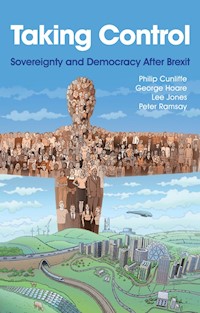
Taking Control argues that neither side in the Brexit debate really understood the European Union or what was involved in reclaiming Britain's sovereignty. The EU is neither a supranational nanny state, nor an internationalist peace project. It is the means by which Europe's elites transformed their own states in order to rule the void where representative politics used to be. Leaving the EU is a necessary but not sufficient step towards closing the chasm between rulers and ruled. This book makes the democratic case for national sovereignty, arguing for a radical, forward-looking reconstitution of the British nation-state through strengthening representative democracy. It is essential for anyone who wonders why British politics is so dysfunctional and who wants to do better.
Sie lesen das E-Book in den Legimi-Apps auf:
Seitenzahl: 351
Veröffentlichungsjahr: 2023
Ähnliche



















CONTENTS
Cover
Endorsements
Title Page
Copyright
Preface
Introduction
1 From Nation-States to Member-States
Getting the EU wrong
Economic constitutionalism and the rise of member-statehood
Conclusion
2 Voiding National Sovereignty
Building the nation
De-nationalization
Ruling the void
Conclusion
3 The Vote
Campaigning in the void
Slandering the voters
The void explains the vote
Conclusion
4 Leaving the EU, Remaining in the Void
Brexit means Brexit: the weakness of Tory Euroscepticism
Impasse: Remain’s contradictions revealed
Getting Brexit done: the limits of populism
Post-member-statehood: from COVID to Ukraine
Conclusion
5 Constituting the Nation
Filling the void
The national form of sovereignty
Constituting the nation
European populists: adrift without sovereignty
Fear of the nation
Conclusion
6 Taking Control: Towards a Democratic Britain
Against ‘Global Britain’
Consolidating the Union
The politics of self-determination
References
Index
End User License Agreement
List of Boxs
Chapter 1
Box 1.1
Procedure to Revise EU Treaties
Chapter 3
Box 3.1
Procedure to Revise EU Treaties
List of Tables
Chapter 3
Table 3.1
Exit Polling: Voters’ Own Explanations Compared
Table 3.2
Right-Wing Populist Parties’ Electoral Results (Lower-House Legislature)
Table 3.3
Polling on Political Disenchantment
Table 3.4
Changing Concerns about Immigration
List of Figures
Chapter 1
Figure 1.1
The Nation-State versus the Member-State
Chapter 3
Figure 3.1
Convictions for Racially and Religiously Aggravated Offences (England and Wales)
Guide
Cover
Table of Contents
Endorsements
Title Page
Copyright
Preface
Introduction
Begin Reading
References
Index
End User License Agreement
Pages
a
iii
iv
vi
vii
viii
1
2
3
4
5
6
7
8
9
10
11
12
13
14
15
16
17
18
19
20
21
22
23
24
25
26
27
28
29
30
31
32
33
34
35
36
37
38
39
40
41
42
43
44
45
46
47
48
49
50
51
52
53
54
55
56
57
58
59
60
61
62
63
64
65
66
67
68
69
70
71
72
73
74
75
76
77
78
79
80
81
82
83
84
85
86
87
88
89
90
91
92
93
94
95
96
97
98
99
100
101
102
103
104
105
106
107
108
109
110
111
112
113
114
115
116
117
118
119
120
121
122
123
124
125
126
127
128
129
130
131
132
133
134
135
136
137
138
139
140
141
142
143
144
145
146
147
148
149
150
151
152
153
154
155
156
157
158
159
160
161
162
163
164
165
166
167
168
169
170
171
172
173
174
175
176
177
178
179
180
181
182
183
184
185
186
187
188
189
190
191
192
193
194
195
196
197
198
199
200
201
202
203
204
205
206
207
208
209
210
211
212
213
214
215
216
217
218
219
220
221
222
223
224
225
226
227
Advanced praise for Taking Control
This is the most important book to come out of the struggles over Britain’s membership of the EU, and it makes all other works on the subject look trivial. The authors provide a profound analysis of the issues involved and show how only thorough-going changes in Britain’s political and constitutional arrangements will be able to respond to the challenges of this near-revolutionary moment.
Richard Tuck, Frank G. Thomson Professor of Government Theory, Harvard University, USA
The condition of post-Brexit Britain is grim. This excellent book shows that this has little to do with having lost the putative benefits of EU membership. Far more important is the British state’s steady incapacitation and the decay of neoliberal political parties. The promise of “taking control” remains, but only if Britain undergoes a democratic and social transformation.
Costas Lapavitsas, Professor of Economics, School of Oriental and African Studies, London, UK
Brexit, this book forcefully argues, was no more than a first step in a long process of rebuilding a democratic nation-state, indeed a democratic nation, out of the ruins of a politics without national sovereignty. Sovereign democracy requires effective institutions of civic representation that disempower a political elite content with ruling the void. This book is a breakthrough for democratic theory and a milestone for political debates on the future of democracy.
Wolfgang Streeck, Professor and Emeritus Director, Max Planck Institute for the Study of Societies, Cologne, Germany
A crucial book for understanding the Brexit paradox: why it failed catastrophically to deliver on its promise to re-democratise British politics, but why it remains a necessary precondition for achieving just that.
Thomas Fazi, journalist and co-author ofReclaiming the State
Taking Control
Sovereignty and Democracy After Brexit
Philip Cunliffe, George Hoare, Lee Jones and Peter Ramsay
polity
Copyright © Philip Cunliffe, George Hoare, Lee Jones and Peter Ramsay 2023
The right of Philip Cunliffe, George Hoare, Lee Jones and Peter Ramsay to be identified as Authors of this Work has been asserted in accordance with the UK Copyright, Designs and Patents Act 1988.
First published in 2023 by Polity Press
Polity Press65 Bridge StreetCambridge CB2 1UR, UK
Polity Press111 River StreetHoboken, NJ 07030, USA
All rights reserved. Except for the quotation of short passages for the purpose of criticism and review, no part of this publication may be reproduced, stored in a retrieval system or transmitted, in any form or by any means, electronic, mechanical, photocopying, recording or otherwise, without the prior permission of the publisher.
ISBN-13: 978-1-5095-5321-1
A catalogue record for this book is available from the British Library.
Library of Congress Control Number: 2022949177
The publisher has used its best endeavours to ensure that the URLs for external websites referred to in this book are correct and active at the time of going to press. However, the publisher has no responsibility for the websites and can make no guarantee that a site will remain live or that the content is or will remain appropriate.
Every effort has been made to trace all copyright holders, but if any have been overlooked the publisher will be pleased to include any necessary credits in any subsequent reprint or edition.
For further information on Polity, visit our website:politybooks.com
Preface
We finished writing this book on 9 September 2022, the day after the United Kingdom’s longest reigning monarch died. Liz Truss had just become the prime minister, the war in Ukraine ground on, and inflation was accelerating worldwide after two years of lockdowns amid a global pandemic. Given such upheaval, the politics of Brexit may seem to be a subject of merely historical interest because the world has moved on. But to consign Brexit to history would be a mistake.
Brexit shares something of fundamental significance with the emergency regimes imposed during the COVID-19 pandemic, with the Ukraine war and with the energy crisis. All are symptoms of the exhaustion and breakdown of the neoliberal world order; of the end of the post-political era that followed the end of the Cold War. And this means that Brexit is unfinished business politically. This is not merely because relations between the United Kingdom and the European Union (EU) remain unsettled. More importantly, it is because the political earthquake that Brexit caused in Britain has exposed the advanced decay and structural weakness of its old political order without prompting the collective effort needed to repair or replace it. Understanding the reasons for Brexit and the unanswered political questions that it has raised therefore remains of the utmost importance. And this is true not only for the British but for anyone who wants to understand or transform the EU’s remaining member-states.
This book is, therefore, very much about the present and future. But its origins lie in the political crisis following the 2016 EU referendum. In June 2018, the four authors were among the founders of The Full Brexit (thefullbrexit.com). This network brought together academics, journalists and others who supported leaving the European Union but were not conservative Eurosceptics. We supported the cause of democracy, presenting arguments that had enjoyed relatively little exposure in the Brexit wars that were dominated by right-leaning Eurosceptics and populists, on the one hand, and liberal and left Europhiles, on the other.
Although we cannot claim that the Full Brexit had much influence on the outcome, we worked hard to offer an account of those extraordinary political events that put the interests of working people at its heart. We flew the flag for those many voters who believed that restoring national sovereignty was only the necessary condition for a politics different from, and far more ambitious than, that imagined by Jacob Rees-Mogg or Nigel Farage. The Full Brexit was not a political party, and it contained a wide variety of left-leaning views. For the four of us, at least, it was a hugely invigorating intellectual and political engagement. Our discussions brought different theoretical perspectives to bear on the most urgent political and constitutional problems posed during that period of crisis. This book is the outcome of our thinking and writing during that project and since.
We are greatly indebted to everyone who contributed to The Full Brexit, especially to Christopher Bickerton, Mary Davis, Maurice Glasman, Pauline Hadaway, Costas Lapavitsas, Martin Loughlin, Danny Nicol, Anshu Srivastava, Wolfgang Streeck and Richard Tuck. We doubt that any of them will agree with everything we have written here, but our discussions with them sustained us through that time, challenged our emerging perspective and influenced the analysis offered here. We are also very grateful to George Owers at Polity for commissioning this book and his colleagues for seeing it to press. In an increasingly intolerant climate, George made Polity’s Politics list a rare space for important and necessary debate. We are also grateful to Ben Caswell, Alex Gourevitch, Aaron Keers, Jake Pier, Daniel Matthews-Ferrero, Sally Turner, Rob Wilson, Suke Wolton, and Polity’s four anonymous reviewers for their comments on the manuscript. Thanks also to Michael Lightfoot and Jamie Grant for their fine graphic representation of the democratic Leviathan for which we argue, and to Suke Wolton for the index.
Taking Control draws on the insights of academics, including political scientists (especially Christopher Bickerton and Peter Mair), political historians (especially David Edgerton and James Heartfield) and constitutional theorists (especially Martin Loughlin and Richard Tuck). However, the book is not a detailed engagement with all the relevant scholarly debates. We wanted it to be accessible to any intelligent reader – whether a British citizen wondering how to make sense of the political chaos of recent years or a fellow European wanting to learn the lessons of Brexit for democracy in their own country. We have therefore produced a short, assertive account, using citations only where essential to support factual claims, or because we are relying on another writer’s ideas, or to guide the reader to more detailed treatments of a particular argument.
Taking Control offers a political account of Brexit and the state of British democracy. We argue that leaving the EU was a necessary but insufficient step for building democratic national sovereignty. We explain why this is so, and we identify what more is needed to create a more democratic nation in which ordinary people can truly begin to take control of our collective life.
Introduction
The title of this book riffs on the famous slogan of the Vote Leave campaign in the 2016 European Union referendum: ‘Take back control’. That slogan summarized a widespread feeling in 2016 that the electorate had lost any real influence over the political life of Britain as an EU member-state. Taking Control embraces the democratic impulse of Dominic Cummings’ masterpiece of political communication, but its implications are very different.
Our core argument is that there can be no going ‘back’ to national sovereignty. Many of the old ways in which the British people once sought to control our nation-state in the days before it became an EU member-state are gone, degraded by the very experience of member-statehood. The process of leaving the EU has only served to prove the exhaustion of British politics. The demand for national sovereignty that the electorate made in 2016 therefore poses tasks that, for the most part, still lie ahead of us. Brexit was a necessary condition of real national sovereignty, but it was not sufficient to restore it.
Indeed, as we wrote this book, the British state, despite having left the EU, seemed to be as far out of the control of its people as it had ever been. From March 2020, the British people were subjected to emergency rule, authorized with barely any scrutiny or criticism by a compliant parliament in which the opposition parties’ only complaint has been that restrictions on political, civil and social freedoms have not been far-reaching enough. The contingent reason for this was the COVID-19 pandemic. But, as we shall argue, the choices made by the British political elite in responding to the virus were characteristic of the political pathologies that had long afflicted Britain as a member-state of the EU, and that are all but universal across the West. The disastrous economic and public health impacts of that panicky and draconian technocratic repression will be felt for years to come. Solving these problems will require the re-engagement of the population in the political life of the nation, something that the EU was deliberately designed to frustrate.
Although the first four chapters of this book give an account of the recent past, the perspective of Taking Control is rigorously forward-looking. We discuss the nature of Britain as a member-state of the EU, the reasons why British voters voted against EU membership, and the tortured process of leaving the EU and its aftermath. But Taking Control is not an exhaustive history of Brexit. That story is told only to explain the circumstances that we find ourselves in now, so that in the last two chapters we can draw out some important lessons for those who want to find a way out of the political stagnation that accompanies EU member-statehood in Britain and beyond. Above all, we emphasize the critical importance of reviving national sovereignty if we are ever truly to take control of our lives together.
For liberals and leftists, who dominate our literary political culture, sovereignty is generally to be feared or derided. It is to be feared as the source of nationalism and war, derided as a hangover of a parochial past, out of touch with the realities of a globalized economy and a cosmopolitan worldview. We neither fear sovereignty nor hold it in contempt. We argue that it is only through embracing the challenges of sovereignty that we can solve our contemporary political malaise. National sovereignty is ultimately a question of the authority of those public institutions through which we represent ourselves as a singular people, as opposed to a multitude of atomized, fearful, mutually hostile individuals, tribes or identities. The sovereignty of the people is also necessarily the sovereignty of the nation. The political authority of the nation-state is the precondition of democracy. Sovereign nations are not necessarily democratic, but no true democracy can exist without sovereignty. Democratic sovereignty involves all kinds of conflicts, but in democracy these conflicts are addressed to the problem of how we live together on the basis of our equality, as opposed to merely policing our differences. True respect for sovereignty also means respect for the sovereignty of other peoples too, and it is the only stable basis for true internationalism and peace.
Taking Control is therefore a political book. It is about the politics of Brexit and what they tell us about our current predicament. It is not a book about the economics or sociology of Brexit, although we touch on those subjects in passing. Our subject is not merely the particular political tendencies we discuss. Above all, it is the realm of politics as such, the realm in which our conflicts of interest are raised and resolved; how that realm has failed and fallen into disrepute in the years of EU membership; and what is to be done about that. We use the experience of Brexit to shed light on the intimate connection between national sovereignty, effective political representation and democratic self-government. Here, Brexit teaches wider lessons to anyone interested in inspiring the people of their own nation to take democratic control of its affairs, especially to those in Europe who realize that advancing the cause of democracy requires them to leave the EU.
The book’s first two chapters explain the anti-democratic character of the EU and how Britain was drawn into it. They also provide the conceptual grounding for the rest of the book. Chapters 3 and 4 discuss the struggle over Brexit, and what it revealed about the degraded state of Britain’s national democracy. The final two chapters discuss what must happen for EU member-states to overcome the void at the heart of their politics.
In chapter 1, we investigate the nature of the EU itself. We demonstrate firstly that neither Eurosceptics nor Europhiles understand the EU for what it really is, and that both sides have good reason to misrepresent it. The EU is neither a foreign superstate that dominates its member-states from without, nor a benign democratic pooling of their sovereignty. Its intergovernmental decision and law making is the external institutional form of the internal political transformation of European states – specifically, the retreat of governing classes from representing their own domestic constituencies, and the formation of a transnational economic constitution that locks in neoliberal policies. European institutions permit national elites to look more to one another than to their fellow citizens for legitimation and support, and to evade responsibility and accountability for their policy decisions and outcomes. In other words, EU member-statehood is the form taken by the failure of representative democracy within Europe’s nation-states. Member-statehood institutionalizes what Peter Mair called a ‘void’ between ruling elites and ordinary citizens. We contrast this political structure with that of national sovereignty, in which the state’s authority derives from lawmakers’ political relations with the people they claim to represent.
In chapter 2 we explain how this cosmopolitan political structure emerged in the UK context – though comparable stories could be told of the other member-states. We find the source of Britain’s turn to member-statehood, and the emergence of the political void, in the decay of the British nation as a political association. In the early post-war decades, European integration was strictly limited by the strength of national democracy, with the left in particular rejecting international rule-making and championing national sovereignty in order to enact social and economic change in response to popular demands. However, the crisis of the capitalist economy in the 1970s, and the subsequent defeat of the organized working class and the political left, led to the acceptance of the Thatcherite doctrine that ‘There is no alternative’ to the market. This stripped democratic politics of its capacity to represent societal interests and to present contending visions of the future, denuding both social-democratic and conservative politics of their old rationales. With similar developments all over Europe, the way was open for the EU as a project of ‘Thatcherism in one continent’. The British nation-state was transformed into an EU member-state, as its domestic politics were hollowed out and national sovereignty decayed from within. The EU is thereby revealed not as a new form of supranational sovereignty or statehood but rather as the means by which Europe’s elites govern the void where representative politics used to be.
Chapter 3 deals with the United Kingdom’s 2016 EU referendum, exploring both the reasons behind the vote to Leave, and the elite’s reactions to it. We recall the dramatic political shock that the vote delivered to the British political system, and how that shock fully exposed the void between the political class and the cultural elite, on the one hand, and the wider population, on the other. Most parliamentary representatives, despite having enacted the referendum in the first place, could not bring themselves to enact the outcome. The call for it to be run again, so as to get the ‘right’ result, was immediate. The shock was just as great for the cultural elite and the chattering classes – the journalists, academics, think-tankers, lawyers and literati who articulate the political life of the nation, and seek to form public opinion and influence the decisions of those tasked with political representation. Their knee-jerk explanations of the vote accused the majority of the electorate of ignorance, gullibility and racism. We demonstrate not only that these explanations were false but also that, when these slanders on the electorate are seen in the light of the actual reasons that people voted to Leave, they offer a window into the political void. They reveal the liberal political and cultural elite’s authoritarian repudiation of the very idea of accountability to the people – symbolizing the deep decay of Britain’s representative democracy.
In chapter 4, we explore the three years of political crisis and chaos between the referendum and Britain’s final departure from the EU. We argue that while the referendum victory for Leave was just enough to take Britain out of the EU, it was inadequate for the British people to ‘take back control’ of the state. This is because Britain’s national sovereignty has not been extinguished by externally imposed restraints, but eroded by the withering of internal domestic representation. The referendum result had to be implemented by political representatives, but the parliamentary drama induced by the referendum only confirmed the utter exhaustion of Britain’s representative politics. During this cold civil war, the Eurosceptics proved unable to impose themselves on the political process owing to the bankruptcy of their underlying Thatcherism, but the Remain majority in Parliament was no more able to resolve the crisis owing to the contradiction at the heart of its Europhile authoritarian liberalism. It tried to use parliamentary sovereignty to secure its minoritarian preference, but ultimately found that Parliament had no mandate higher than that given to it by the people. The remnants of the political left under Jeremy Corbyn dissolved themselves into the ancien régime, throwing in their lot with the authoritarian liberals and the state bureaucracy. The intervention of Brexit Party populists would prove decisive in forcing the Conservative Party to ‘Get Brexit done’, but neither the populists nor the Thatcherite Eurosceptics had an adequate vision for a sovereign Britain.
By the time Brexit finally took place, all of the political traditions through which the British people had represented themselves in the twentieth century were revealed as empty vessels. For ordinary citizens, there was no way ‘back’ to control of the state. Britain had left the EU, but its domestic political void, and the weakness of the state’s authority, remained. Leave voters had successfully defended their political equality by ensuring the referendum result was respected, but an electorally victorious Conservative Party, far from renewing the internal relations of sovereignty, soon embraced the same emergency rule and sweeping restrictions on civil liberties adopted by most of the EU’s member-states in the face of the COVID-19 pandemic. The government’s enthusiastic intervention in the Ukraine war marked a further collapse back into intergovernmentalism and a retreat from addressing deep-seated domestic problems. Neither form of emergency politics provided any lasting authority, with Boris Johnson’s Conservative government imploding in mid-2022 despite the enormous parliamentary majority lent to it by Leave supporters just two years earlier.
In chapter 5, we argue that the lesson of Brexit for democrats, both in Britain and across Europe, is that reviving democratic representation is more than a matter of simply leaving the EU. Political revival requires the wholesale transformation of domestic political structures, and this task is inescapably a matter of nation building. The voiding of the old nation-state means it is not possible to go back to that nation, but only forwards to a new one – building a democratic state out of the contradictions of member-statehood. This requires reasserting the nation against the efforts of authoritarian liberals to discredit it, particularly their promotion of anti-democratic cosmopolitan ideology, and their claims that the nation can only entail racist warmongering. Democratic nationhood, we argue, is in fact the only basis on which an authentic internationalism can flourish. The costs of neglecting national sovereignty are clearly revealed in the failure of European populism. The chapter concludes by briefly responding to the criticisms that liberals, Marxists and conservatives might make of our proposal to constitute political nations.
In chapter 6, we illustrate the idea of constituting the nation by considering what might be involved in building a democratic British nation. We identify three related contradictions that Brexit has revealed in the British state as a political association of its citizens. First, the vote demanded a reassertion of national sovereignty, but implementation fell to a governing class that neither understands nor wants to exercise that sovereignty, and which remains committed to supranational government. Second, Brexit has exposed fundamental territorial weaknesses in the state’s domestic authority, especially in Northern Ireland, which the political class is committed to maintaining. Third, Brexit reasserted the legal supremacy of Parliament without doing anything to restore the political authority that Parliament needs to exercise sovereignty. Based on this analysis, we propose reforms to help resolve these contradictions and strengthen national sovereignty by further democratizing the state’s existing constitution. These proposals include exiting from other global arrangements that constrain democratic accountability, particularly NATO; addressing the internal weakness of the British state’s sovereignty in Northern Ireland by facilitating Irish reunification, and its weakness in Scotland by convincing Scottish voters to end devolution; and reforming Parliament and the party system to incentivize the emergence of new political ideas and bolster political representation. Since Britain’s existing political traditions and parties are bankrupt and incapable of self-renewal, new ones must be created. This is a world-historical problem, afflicting not just Britain but all advanced democracies. Resolving it fully is beyond the scope of any book. Nonetheless, we end by outlining a substantive political perspective that emerges from the ruins of the old order – one that could inspire citizens to advance the democratic project of Brexit and fully take control of the state, and of our collective existence.
1From Nation-States to Member-States
Despite the fact that Britain spent five years passionately debating its membership of the European Union (EU), the EU itself remains surprisingly poorly understood by all sides in British politics. For conservative Eurosceptics and populists, the EU is a sort of supranational nanny state, an unaccountable, foreign bureaucracy that imposes laws on its hapless member-states, depriving them of their sovereignty. For left and liberal Europhiles, it is a cosmopolitan peace project, ‘pooling’ sovereignty and locking in important social protections, without which we would be ravaged by neoliberalism. As we shall see, neither view is accurate.
The EU is best understood as the outgrowth of the decay of democratic representation within its member-states. As James Heartfield (2013: 12) puts it, ‘European integration is driven by the decline of the political life of popular democracy [within] nation states … the bureaucratic institutions of the European Union are growing to fill the vacuum left by [their] shrinking political spheres.’ The EU is not an external imposition but a mechanism developed by national elites through which to rule their societies in a post-democratic era. Europe’s ruling elites have voluntarily surrendered national sovereignty in order to lock in their preferred neoliberal policies against popular opposition, and to avoid having to be responsive to their own domestic constituents.
European integration has fundamentally transformed political relations in what was once the global heartland of democracy. For many decades, the basic unit of political life was the nation-state, which ruled over a national population. Elites drew their legitimacy from, and developed policy to appeal to, their citizens through systems of representative democracy with political parties strongly rooted in particular social constituencies. In the neoliberal era, however, Europe’s ruling elites turned to European integration as a way to de-democratize policy making and lock in neoliberal policies. They increasingly drew legitimacy and policy direction not from their own citizens but from one another. The nation-state was hollowed out and a political ‘void’ replaced the authorizing political relations between government and citizenry (Mair 2013). Nation-states were transformed into member-states (Bickerton 2012).
Getting the EU wrong
Thatcherite Eurosceptics and left-liberal Europhiles have all misunderstood the EU’s true nature. Britain’s right-wing Eurosceptics, predominantly clustered in the Conservative Party and (before 2016) in the United Kingdom Independence Party (UKIP), have seen the EU’s growth as a supranational, federal superstate that threatens British culture and/or democracy through suffocating laws, directives and regulations. They therefore see political conflict as a struggle between beleaguered national politicians and overbearing EU bureaucrats, particularly the unelected Commission and the European Court of Justice (ECJ). From this perspective, the political problem, and the EU’s democratic deficit, is located in Brussels, not London. The implication is that the United Kingdom only had to leave this pernicious organization in order to regain its independence and self-confidence, allowing it to burst free from the EU’s red tape and rediscover its true destiny as a buccaneering, twenty-first-century ‘Global Britain’.
This theory simply does not correspond to the reality of the EU, nor have its breezy expectations proven remotely accurate. The EU is clearly not a supranational actor that has usurped power from member-states through a power-hungry bureaucracy (Bickerton 2016). The European Commission has only 25,000 employees, roughly the same as the BBC. Although these ‘Eurocrats’ certainly lack any democratic mandate, the notion that they can single-handedly dominate the governments and populations of EU member-states (around 450 million people) is simply not credible. There are also important limitations to the Commission’s powers. Although only the Commission can initiate EU legislation, proposals cannot proceed without support from the Council, where member-states’ elected leaders sit. Moreover, the law that they (and the European Parliament) produce is predominantly enforced not by the ECJ but by domestic courts and bureaucracies. The ECJ only takes up matters referred to it by national judiciaries.
The EU’s most powerful institution is actually the Council, not the Commission or Court (Bickerton 2012, 2016; Heartfield 2013: 108–12). Comprising the heads of state or government of EU member-states, the Council makes all the key decisions in the EU. It decides who leads the Commission and on what terms. It can veto any Commission proposals and, through the ‘trilogue’ system, it determines around 80 per cent of EU law through closed-door discussion with the Commission and Parliament. Since the early 1990s, the Council has also weakened the Commission’s power by creating ‘de novo’ institutions that sit outside of the Commission’s jurisdiction. These institutions, dominated by the member-states, now employ more officials than the Council, the European Parliament, and the ECJ combined (Bickerton and Jones 2018). Finally, as we saw during the Eurozone crisis, the refugee crisis and the Brexit negotiations, the Council (or ‘Council Guidelines’) dictates the EU’s political activities. Since the Council is a group of national politicians, its centrality means that the EU cannot simply be seen as something ‘external’ to, or autonomous from, member-states.
Left-leaning Europhiles prefer to see European integration as involving not the ‘loss’ of state sovereignty but rather its ‘pooling’ to achieve shared objectives. However, they fundamentally share Eurosceptics’ view of the EU as an external fetter on member-states – they just see this in a more positive light. For liberals, the EU’s supranational structures have encouraged international exchange, interdependence and cooperation between European countries, creating peace and prosperity in a continent once ravaged by extremism and war. Many on the left also emphasize the project of ‘social’ Europe, arguing that EU regulations lock in protections for workers and the environment, thereby preventing right-wing politicians from destroying the last vestiges of the post-war welfare state. Supporting the EU in this sense signalled a progressive identity: cosmopolitan ‘openness’ to the world and foreigners, and the possibility of mutual enrichment and improvement. By implication, opposing the EU can only signal ‘closedness’: a narrow, parochial ‘little Englander’ outlook, marked by the sort of xenophobic nationalism that fuelled earlier European wars. As chapter 3 will show, this liberal perception of the EU powerfully shaped reactions to the 2016 referendum result.
However, the Europhile perspective also bears scant relation to reality. During the Cold War, peace in Europe was secured not by the EU or its predecessor institutions but by the nuclear balance of terror between the United States and the Soviet Union and their military spheres of influence. The US sphere, institutionalized in the North Atlantic Treaty Organization (NATO), has expanded since the 1990s, provoking increasing conflict with Russia, and destabilizing international relations through interventions in the Balkans, Afghanistan and Libya. For the most part, the EU has blindly gone along with this agenda, with its ‘neighbourhood policy’ towards Ukraine compounding NATO’s provocation of Russia, for example (Mearsheimer 2014).
Far from embodying European solidarity and cooperation, the EU has bred conflict and division, particularly within the Eurozone. The 2011 Eurozone crisis was rooted in a structural mismatch between its constituent economies, with Germany in particular running a persistent trade surplus with the less-advanced southern European members (Lapavitsas 2018). If they had been monetarily sovereign, the latter could have addressed this by devaluing their currencies, which would curb imports while boosting exports. But within a monetary union, the mismatch can only be resolved by introducing a fiscal union to redistribute some of the unequal gains of trade and help promote industrial upgrading. However, again confounding right-wing Eurosceptic expectations, EU leaders rejected this: they wished to avoid the costs, economic and political, of establishing a true superstate. Instead, they forced the southern economies to undergo ‘internal’ adjustment, slashing state and welfare spending to reduce their labour costs. This has imposed colossal suffering and social dislocation, as well as feeding significant international resentments. Germans who did not wish to finance these so-called ‘bailouts’ characterized southern Europeans as lazy, feckless and corrupt, while embattled Greeks revived memories of the Second World War, demanding reparations for the Nazi occupation (Heartfield 2013: 4, 31, 57).
The EU’s cosmopolitanism is also paper thin. European ‘citizenship’ amounts to little more than an EU national’s right to vote in elections for local authorities if they reside in another EU member-state. Nothing more substantial has emerged (Wilkinson 2021: 148–9). Even in the European Parliament elections – where turnout since the 1990s has only once exceeded 50 per cent – there are no European-wide parties appealing to a European demos, only national parties that subsequently join EU-wide groupings. The only place in Europe where a majority of people feel more attachment to the EU than to their region or nation is Budapest (Charron, Lapuente and Bauhr 2021).
Elsewhere, the flip side of thin internal cosmopolitanism is external barbarism. The EU maintains internal ‘freedom of movement’ not as a right of citizenship but to enable factors of production to move smoothly within the Single Market. This so-called ‘right’, however, applies exclusively to EU nationals; ‘Fortress Europe’ confronts migrants externally. Barbed-wire fences and FRONTEX naval patrols keep migrants at bay in the Balkans and Mediterranean respectively, while the EU pays the Turkish authorities and Libyan warlords billions of euros to intercept migrants travelling to Europe. As Hans Kundnani (2021) observes, under Ursula von der Leyen’s self-proclaimed ‘geopolitical Commission’, the EU posits a ‘European way of life’ imperilled by non-white, non-Christian outsiders, in terms redolent of Samuel Huntington’s Clash of Civilizations.
Nor has the EU been a strong guarantor of workers’ rights. All the key labour rights in the United Kingdom were won domestically, well before the EU existed, during the period of relative trade union strength and militancy: the Equal Pay Act (1970), the Trade Union and Labour Relations Act (1974), the Health and Safety at Work Act (1974), the Employment Protection Act (1975), the Sex Discrimination Act (1975) and the Race Relations Act (1976). British workplace standards have also remained consistently higher than the EU’s minimum safeguards – where they exist. For example, as of 2016, the British minimum wage was the equivalent of €1,512 per month, well above the EU average of €821. The EU has no power to mandate an EU-wide minimum wage, and six member-states have none at all (Eurostat 2021).
Even where EU minima are set, this is typically at such a level that they have little practical effect. For example, the 1993 European Working Time Directive (EWTD) limited the working week to 48 hours and entitles workers to rest breaks and at least four weeks’ paid holiday annually. The British government opposed the EWTD, largely to allow the continued overworking of medical personnel, securing an opt-out from the 48-hour limit where workers agree. However, very few people benefited from the Directive because by 1993 Britons’ average working week was already well below the minimum, at 38.2 hours (Office for National Statistics 2021a). This reflected trade unions’ struggles for a 40-hour week, dating back to the 1880s (Davis 2018). For similar reasons, when Britain implemented the EWTD by establishing the first legal entitlement to paid holidays in 1998, the minimum was set at 5.8 weeks.
At best, then, EU regulations have established very low ‘floors’ below which protections could not fall, but the United Kingdom was rarely in any danger of actually doing so. This explains why measures like the EU’s 2008 Temporary Agency Workers Directive have failed to prevent the emergence in Britain of a ‘gig economy’ characterized by precarity, low pay and bogus ‘self-employment’. EU regulations clearly have proven to be a weak substitute for workers’ own struggles.
At worst, the EU has actively undermined workers’ rights. As the labour historian Mary Davis notes:
The Lisbon Programme of 2000 effectively undermined [the ‘social chapter’ of the Maastricht Treaty] by insisting on ‘flexicurity’: more precarious work, supported by a social security ‘safety net’. The Lisbon Treaty of 2008 reversed ‘social Europe’ completely by undermining [the] legal basis of workers’ rights to employment contracts and negotiated collective agreements. This, coupled with the privatisation of public services, has clearly privileged the power of capital as being the dominant EU ‘freedom’. (Davis 2018)
Indeed, the ECJ has consistently sided with employers, citing the provisions of the EU’s directives on posted workers, services and business transfers. For example, in the 2013 Alemo-Herron case, the ECJ nullified the United Kingdom’s Transfer of Undertakings (Protection of Employment) Regulations of 1981, meaning that workers employed in a public service then being privatized lost their contractual rights. Similarly, the notorious 2007 Viking and Laval judgements, and the 2008 Rüffert case, upheld the right of transnational enterprises to employ imported workers on inferior terms to local ones, again undermining hard-won domestic protections (Davis 2018).
Economic constitutionalism and the rise of member-statehood
In contrast to Europhile mythology, EU regulation is actually deeply neoliberal in character. Yet, contrary to Euroscepticism, this is clearly no external imposition by a runaway supranational bureaucracy. National elites often present it in that way, the better to disguise their own role in EU decision making; but the truth is that the EU is a creature of the member-states themselves. Indeed, starting with Margaret Thatcher’s championing of the 1986 Single European Act, British governments have been among the greatest promoters of this form of transnational market integration. This partly explains other member-states’ bafflement and anger at Britain’s attempt to renegotiate its membership in 2015, and the Brexit vote of 2016 (Rogers 2017). EU integration is a process by which European governments have bound their own hands; it is an expression of changes within member-states, rather than something external to them. The central process here is the transformation of democratic nation-states into post-democratic member-states (Bickerton 2012).
EU law and regulation effectively form an ‘economic constitution’ for Europe. This constitution specifies rules and procedures that lock in neoliberal policies, placing them beyond the scope of domestic democratic scrutiny and contestation (Gill 1998). At its core lie the ‘four freedoms’: the free movement of goods, services, capital and labour. European governments have willingly abrogated their own right to regulate these flows across their borders. They have also renounced ‘market-distorting’ practices like ‘state aid’ to industry, adopted monetary and fiscal rules that constrain state intervention in the market, and committed to sectoral packages that promote the privatization of public services like transportation and health care (Streeck 2014: 103–16; Lapavitsas 2018). EU rules comprise self-imposed limits on the political sphere, creating and protecting markets from political ‘interference’ or ‘distortion’.




