


24,99 €
Mehr erfahren.
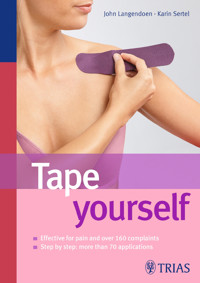
Taping the right way - step by step Learn to tape like a pro Taping is not just for professional physiotherapists: Many (competitive) athletes, patients with chronic pain and people with mobility problems are now using this effective and side effect-free method. But what´s the right way to apply the tapes? More than 70 tapes for 160 common complaints - a hands-on guide Easy to use and astonishingly effective: The first step-by-step guide to applying tapes, not just how they look when they´re in place. - Each step explained simply and clearly, just like in a recipe. No need to practise before you can apply the tapes yourself. - The quickest way to the most appropriate tape: Easy orientation thanks to a comprehensive overview of complaints, including tapes to treat scarring and lymphatic oedema. - Watch rather than read: The 10 most frequently used tapes are included on a DVD. John Langendoen and Karin Sertel show you how to deal with the symptom as well as how to find and treat the possible root cause of your pain - the only way to long-term treatment success.
Das E-Book können Sie in Legimi-Apps oder einer beliebigen App lesen, die das folgende Format unterstützen:
Seitenzahl: 254
Veröffentlichungsjahr: 2013
Ähnliche


















John Langendoen Karin Sertel
Tape yourself
Effective for pain relief and over 160 complaints
About the authors
John Langendoen, is physical therapist since 1976 (Polytec Rotterdam), acupuncturist with diploma, physical therapist in sports, MSc. in pain management (University Cardiff, Wales), instructor and examiner for Manual Therapy and member of the Standards Committee of the international Manual Therapy association IFOMPT as well as founder and joint owner of “Therapy4U Physiotherapie und Training” in Kempten, Germany.
He was introduced to kinesiological taping whilst working with the Korean national football team during the football world championship in 2002. The chance to experiment with functional tapes was offered during the therapeutic care of many athletes and teams (Russian national ice hockey team, the national football teams of Irania and South Korea).
The combination of elastic taping and the traditional approaches in sport and Manual Therapy led him to the development of the comprehensive method: “functional taping using elastic tape – Kinematic Taping® Concept”. John Langendoen has taught this method in over 15 countries like Finland, South Africa/Swaziland, Kazakhstan, Russia, Italy and England. He founded the International Kinematic Taping Academy (IKTA) for taping teachers. The IKTA now has 21 members and teachers in 7 countries.
Karin Sertel, is physical therapist since 1980 – specialized on hand therapy, Manual Therapy (Maitland ® Concept) and Craniosacral Therapy for children and adults. Coaching in the psychosomatic field including meditation evenings and workshops in small groups for woman (“Zeit für Mich” in Kempten) is also an integral in her work.
Her husband John Langendoen infected her with the “taping bug” in 2002. For about 30 years she encourages her patients to participation, individual responsibility and self-help. The ability of patients to tape themselves has become very important for her work for hand rehabilitation.
Preface
Have you been bitten by the taping bug yet? Or maybe you know someone who has. Perhaps somebody has recommended taping to you. Or you are only familiar with tapes from seeing people wearing them on television or on your local sports field.
Whether or not you have already had any experience of taping, this book will show you the wide range of possibilities you have for taping yourself. Taping can be used for various conditions, such as pain, muscle tension, bruising, sore muscles, bad posture, swelling, strains, sprains, to provide support when you are in training, to support a joint, to help with arthritic conditions, menstrual complaints, headaches and bruxism, to name just a few. All you need is a 5 cm wide piece of elastic tape.
We are fascinated by taping and its numerous possibilities. That is how we came to write this book. It was developed and written especially for lay people; you need no physiotherapeutic or medical knowledge to use this book. Everything you need to tape yourself, your friends or your partner safely and effectively is explained in this book. We will start by telling you what taping really is and how it works, where and when it can be applied, and what to do in practice. The second part of the book illustrates 80 proven tape applications that you can either apply yourself or – if it is hard to reach a particular body part yourself – with the help of a partner. All applications are described in such detail, using words and pictures, that the tapes can be applied anytime, anywhere.
You will initially need a little practice to become familiar with the techniques before taping will come easily to you. Once you have got the knack of it, you will be astonished how effective and simple taping for self-treatment, for regeneration and for prevention of just about any complaint can be.
Kempten, Karin Sertel and John Langendoen
Table of Content
About the authors
Preface
What you need to know about taping
What is taping?
How does taping work?
The basics of Kinematic Taping®
How does taping work?
What role does the colour of the tape play?
Preparing and applying tapes correctly
Which tape for which complaint?
All tapes from head to toe
LY-tape: lymphatic tape
H1-tape: haematoma (bruising)
H2-tape: haematoma (bruising)
S3-tape: pain, general
N1-tape: fresh scar
N2-tape: old, adherent scars
L1-tape: longitudinal arch of the foot
Q2-tape: transverse arch of the foot
G2-tape: crooked big toe
S7-tape: ankle
S8-tape: ankle syndesmosis
A1-tape: Achilles tendon, calf
F4-tape: sole of the foot
S1-tape: posterior shin muscle
S2-tape: front of the shin
U5-tape: lower leg muscles
K6-tape: knee, flexion
K7-tape: knee, extension
K8-tape: knee, outward rotation
K9-tape: knee, inward rotation
K10-tape: knee, medial ligament
S4-tape: sartorius muscle
Q1-tape: quadriceps
P1-tape: top of the patella
P2-tape: bottom of the patella
P3-tape: along the inside of the patella
P4-tape: the outside of the patella
O1-tape: outer thigh
I2-tape: hamstrings
I1-tape: sciatic nerve
A2-tape: adductors
H6-tape: hip flexor
H7-tape: hip joint
G1-tape: gluteal muscles
B6-tape: pelvic floor
K12-tape: sacrum
B4-tape: lower abdomen
B3-tape: upper abdomen
L2-tape: lumbar spine
L3-tape: lumbar spine
B5-tape: tilting the pelvis backwards
B2-tape: oblique abdominal muscles
B1-tape: straight abdominal muscles
B8-tape: thoracic spine
Z1-tape: diaphragm
A3-tape: breathlessness
R1-tape: ribs
D1-tape: thumb basal joint
D2-tape: thumb saddle joint
D3-tape: thumb tendon
F2-tape: knuckle joint
F1-tape: finger flexors
F3-tape: finger extensors
H5-tape: wrist
E1-tape: elbow, flexion
E2-tape: elbow, extension
U1-tape: forearm flexors
U4-tape: forearm extensors
U2-tape: forearm rotation
U3-tape: forearm rotation
M1-tape: median nerve
S6-tape: shoulder joint
R2-tape: rotator cuff
R3-tape: rotator cuff
S5-tape: shoulder blade
K2-tape: middle trapezius muscle, centre
K3-tape: lower trapezius muscle
D4-tape: deltoid muscle
B9-tape: pectoral muscle
H3-tape: cervical spine
K1-tape: upper trapezius muscle
K11-tape: headache
E3-tape: first rib
B7-tape: brachial plexus
H4-tape: cervical spine
M2-tape: base of the mouth, neck
K4-tape: jaw muscles
K5-tape: temporomandibular joint
T1-tape: trigeminal nerve
N3-tape: nose and sinuses
Taping special points
Magnetic plasters, cross patches & co
Additional information
Register
Imprint
What you need to know about taping
Even though this is a practical book full of techniques and applications for you to use, you will first need a little theory and background knowledge. Because taping offers such a wide range of possibilities it is important for you to know how it works and, of course, what makes it so effective.
What is taping?
Taping using elastic adhesive tape originated in Japan. From there it moved to the United States, South-Korea, the Netherlands, Germany and many other countries. The bright colours have certainly contributed to the tape's popularity. The colourful tapes are real eye-catchers and draw our attention.
You can see people wearing brightly coloured tapes in sports reports on TV, at sporting events, out jogging or even in the supermarket. You may already be part of the taping community or may soon join in. Skin-coloured tapes (beige, brown, black or white) are also available for those who prefer a more discreet look.
But what exactly is “taping”? Taping is the application of self-adhesive cotton tapes. Tapes are applied directly to the skin. Both elastic and non-elastic tapes are available.
Important
The two types of tape each have different functions and effects. This book deals primarily with elastic tapes. When we refer to “tape”, we mean the elastic type of tape.
What can you use tapes for and how do they help you? One important effect of the tape is to relieve pain. The less pain you are in, the better and more easily you will be able to move, which in turn relieves pain. Pain is one of the main reasons for using a tape. A tape can be applied to any part of the body that is in pain. Pain can arise from various causes, such as sore muscles, muscle injuries (bruising or torn muscle fibres), swelling (e.g. following an insect bite), stiff joints or adherent scars.
Less pain, greater mobility
Pain caused by a sprained ankle is a very impressive example which shows how effective taping can be. Once the tape has been applied, you will immediately be able to walk relatively normally, as it prevents the painful direction of movement. The affected limb is guided and supported and you cannot twist your ankle. However, taping does not prevent pain-free movements of the foot. This principle can be applied to all parts of the body where injured structures need to be supported and stabilised. Taping protects injured tissues without restricting mobility.
A tape can also be used successfully and effectively to relax tight or tensed muscles. A lot of people suffer from painful tension in their neck, shoulder or back muscles. Here again, the same principle applies, namely, that a tape increases pain-free movement. In the case of tight muscles the tape helps to change the tension in the muscles making movements less painful. For example, if cramped back muscles are stopping you from bending forwards, then taping will allow these muscles to relax. When you bend forwards, you will feel the tape pulling on the skin, relaxing the muscles and reliefing the pain. This positive effect is immediately obvious and measurable – it is easier for you to bend forwards and touch your toes.
The motivating factor in taping is the relationship between pain and movement – that is, the less pain is perceived, the more movement is possible. Often, movement can help alleviate pain. However, people in pain tend to avoid movements. As a protective measure, the affected body part is kept still to prevent the pain from increasing. It is, none the less, advisable to try to find out which pain-free movements are possible and during which painful movements the pain is actually relieved when a movement is repeated several times. Treating pain through either passive or active movement is one of the main tasks of physical therapists, osteopaths, chiropractors and physical trainers.
Many people have experienced back pain; 80% of us will suffer from back pain at least once, if not repeatedly, during our lifetime. Pain in the lower back (the lumbar spine) is often so strong that movement is avoided. Fear of the strong, shooting pain makes the affected person not want to move at all. Lying still and doing nothing seems like the best option. I (Karin Sertel) unfortunately know this from personal experience. Applying the appropriate tape to the lumbar spine and pelvis gives me a feeling of support and allows me to feel that my movements are being guided. As a result, I trust myself to move and can cope with normal, everyday activities. I keep the tape in place for up to one week.
In the case of lumbar spine problems, such as a herniated disc, taping can help to restore mobility as soon as possible. We now know that specific and appropriate movements are the most important treatment for such conditions. In the past, people were told to lie down and “take it easy”.
Important
Movement is often the real medicine or therapy. Taping should not to be viewed as a substitute for actual movement. Rather, it is a supportive device that, on the one hand, aims to restrict specific and prevent painful movements and, on the other hand, changes the movement, providing support and relieving pain.
The versatility of tape applications
Taping can be extremely helpful in all stages of arthritic joint changes and the associated painful restricted mobility. In the case, for example, of osteoarthritis of the thumb saddle joint, if abducting the thumb is painful, for instance when grasping a bottle, opening a can or wringing out a cloth, then the joint can be taped in a targeted fashion. The taping restricts the painful movements and thus promotes pain-free movement.
Joint degeneration.
Patients with joint degeneration often complain of pain in the evenings after work when they start to relax. Taping and carefully transferring the strain of everyday activities across the whole joint can improve this problem. The tape reduces muscular imbalances and/or changes in the position of the joint. The following example of pain in the knee joint shows how taping works: The strain on the knee when repeatedly climbing stairs, sitting down, standing up and squatting is easier to tolerate if a tape is applied to correct the rotation in the lower leg in relation to the thigh. All joints and vertebrae affected by osteoarthritis or inflammation can be taped.
Muscle tension.
The use of tape, especially when combined with exercises, can make tight muscles less tight and more flexible within a short period of time. Tight muscles at the back of the thigh (hamstrings) are very much at risk of being injured, specifically in the case of athletes such as footballers. They may also play a role in lumbar problems. It is also easier to train weak muscles after a tape has been applied. One example of this is the large four-part muscle at the front of the thigh (quadriceps) after anterior cruciate ligament reconstruction. Tension or tightness in the muscles can also be present in combination with neural pain such as sciatica. Long tapes that cover two joints can relieve this pain and relax the muscles.
Headaches.
Lots of people regularly suffer from headaches. There are 14 different main types of headache in addition to many subgroups. Some headaches, for example posture or spine-related types of headache provoked by continual poor posture, can be successfully reduced by applying a tape.
Menstrual problems.
Women have reported a marked relief of period pain after applying a horizontal and/or vertical tape to the lower abdomen.
Swelling.
Taping effectively reduces swelling and bruising. Typical examples are swelling in the calf after being kicked during a football match (calf contusion) or swelling around the ankle joint following an inversion trauma. Even swollen arms following the removal of lymphatic nodes during breast surgery can be successfully treated by applying the appropriate tape.
Colds.
If you are suffering from a cold or sinusitis, then a tape can be applied at night across the affected area to help drain the mucus and reduce the feeling of a blocked nose or sinuses, making it easier to breathe deeply.
The following table provides an overview of possible applications. Combinations of tapes may be necessary for more serious conditions or problems. Taping can be supported by Physical therapy or appropriate medication. Rehabilitation following an operation can also be promoted through taping. Here, taping should not be seen as a substitute for therapy but as a helpful and effective adjunct. Taping can also be the only treatment required for more minor everyday aches and pains.
Possible applications
Field of application
Indications
Aim of treatment
Pain
Pain in the locomotor system: Muscle pain Trigger points Aching muscles Muscle contusions or tears Tight muscles
To relieve pain To improve mobility
Joint pain Reduced mobility Unstable joints (feeling of instability)
Nerve pain such as sciatica Several types of headache
Pain in the abdominal area such as period pain
Swelling and oedema
Swelling associated with muscle or joint problems Swelling after tooth extraction Lymphoedema, e.g. after an operation Sinusitis
To reduce the swelling Better and faster healing To support rehabilitation
Scars
Better scar healing Old, adherent or bothersome scars
Better healing To support rehabilitation
Training aid
To activate a muscle Coordination Dynamic control and stability Strength
A better sense of movement Increased stamina
Prevention
Prevention, e.g. to support a wrist or ankle joint during training Joints supported during longer or unusual activities such as a mountain hike
To prevent injuries or signs of overuse To support regeneration
Treatment with no side effects
Taping works without chemical or pharmaceutical substances that may adversely affect the metabolism. If my knee is sore, I have the option of taking a tablet, getting someone to give me a local injection, or else taping myself. Medications can be linked to unwanted side effects. The worst that can happen after taping is a local skin reaction, which can be due to sensitive skin or the poor quality of the tape. Alternatively, the tape may have no effect at all because it has been incorrectly applied. Taping can also be used as an additional treatment. The dosage of pain medication can be reduced when a tape is effectively applied. Treatment with a tape can be combined with other treatments, such as manual therapy, aromatherapy, acupressure, magnetic field therapy or electrotherapy if applied to a wet tape.
Increased treatment success in physical therapy
Taping can be used to supplement treatment to improve, boost and sustain the progress achieved in individual Physical therapy sessions. If you are receiving treatment once or twice a week, the benefit achieved may be lost from one session to the next. Taping can help to prevent this happening. By maintaining the improvement achieved, the treatment goals can be achieved more quickly, which is desirable for both the patient and the physical therapist.
Generally, our patients report that they feel the tape is very comfortable and beneficial. They feel safer, for example when their problems are caused by an unstable joint. The improved stability and the feeling of safety allow them to be more active. Taping gives patients more independence. This is a desirable effect for both the physical therapist and the patient. Patients become more independent of the physical therapist who has applied the tape if they learn how to apply the tape themselves. Many patients who have experienced the positive effects of taping – applied either by a physical therapist or by a doctor – go on to apply tapes themselves. They take a tape home in order to tape themselves during treatment breaks, while on holiday or before sporting activities.
In our experience, the patients’ own initiative motivates them and increases their cooperation. Patients are taking responsibility for their own health. The tape provides a visual stimulus that reminds them to do their exercises regularly. This inner motivation and responsibility for oneself (“compliance”) improves almost by itself thanks to the tape.
How does taping work?
The immediate effect of taping is often bewildering for lay people. Once applied, a tape provides an immediately noticeable and measurable change in the way patients experience their pain and how they move: They can move their arm much higher; their fingers nearly touch the ground when they bend forwards; they can do deeper knee bends.
It is an undisputed fact that taping works. However, we can currently only conjecture and hypothesise as to what causes these effects in any single case. Scientific attempts at providing explanations are limited. So far there is some limited evidence that the decongestant effect works via the lymphatic system, by stimulating blood circulation, and that the pain relief is due to changes in spinal cord activity and a decrease in muscle guarding.
Pain reduction
One model that seems plausible to us is that the tape stimulates certain nerve endings (receptors) in and under the skin. These serve to detect stimuli, such as potential dangers that could damage tissue (and cause pain), temperature changes, movements and touch. There are even so-called “stroke fibres” that are sensitive to a very light touch and have a social function. Being touched and caressed do us good and helps alleviate physical and, especially, emotional problems. If a tape is applied to the skin, it has an immediate effect on these receptors. To understand the possible mechanisms, it is important to be aware of the fact that the skin is our largest organ and is made up of several layers. Numerous nerve endings are located at the borders of the various layers. The receptors that register the movement, pull and pressure of the tape are the most important aspects when it comes to the tape's positive benefits. When a tape is applied to the skin as an additional layer, the shearing properties thereby also modify the receptors located in the skin.
Lesen Sie weiter in der vollständigen Ausgabe!
Lesen Sie weiter in der vollständigen Ausgabe!
Lesen Sie weiter in der vollständigen Ausgabe!
Lesen Sie weiter in der vollständigen Ausgabe!
Lesen Sie weiter in der vollständigen Ausgabe!
Lesen Sie weiter in der vollständigen Ausgabe!
Lesen Sie weiter in der vollständigen Ausgabe!
Lesen Sie weiter in der vollständigen Ausgabe!
Lesen Sie weiter in der vollständigen Ausgabe!
Lesen Sie weiter in der vollständigen Ausgabe!
Lesen Sie weiter in der vollständigen Ausgabe!
Lesen Sie weiter in der vollständigen Ausgabe!
Lesen Sie weiter in der vollständigen Ausgabe!
Lesen Sie weiter in der vollständigen Ausgabe!
Lesen Sie weiter in der vollständigen Ausgabe!
Lesen Sie weiter in der vollständigen Ausgabe!
Lesen Sie weiter in der vollständigen Ausgabe!
Lesen Sie weiter in der vollständigen Ausgabe!
Lesen Sie weiter in der vollständigen Ausgabe!
Lesen Sie weiter in der vollständigen Ausgabe!
Lesen Sie weiter in der vollständigen Ausgabe!
Lesen Sie weiter in der vollständigen Ausgabe!
Lesen Sie weiter in der vollständigen Ausgabe!
Lesen Sie weiter in der vollständigen Ausgabe!
Lesen Sie weiter in der vollständigen Ausgabe!
Lesen Sie weiter in der vollständigen Ausgabe!
Lesen Sie weiter in der vollständigen Ausgabe!
Lesen Sie weiter in der vollständigen Ausgabe!
Lesen Sie weiter in der vollständigen Ausgabe!
Lesen Sie weiter in der vollständigen Ausgabe!
Lesen Sie weiter in der vollständigen Ausgabe!
Lesen Sie weiter in der vollständigen Ausgabe!
Lesen Sie weiter in der vollständigen Ausgabe!
Lesen Sie weiter in der vollständigen Ausgabe!
Lesen Sie weiter in der vollständigen Ausgabe!
Lesen Sie weiter in der vollständigen Ausgabe!
Lesen Sie weiter in der vollständigen Ausgabe!
Lesen Sie weiter in der vollständigen Ausgabe!
Lesen Sie weiter in der vollständigen Ausgabe!
Lesen Sie weiter in der vollständigen Ausgabe!
Lesen Sie weiter in der vollständigen Ausgabe!
Lesen Sie weiter in der vollständigen Ausgabe!
Lesen Sie weiter in der vollständigen Ausgabe!
Lesen Sie weiter in der vollständigen Ausgabe!
Lesen Sie weiter in der vollständigen Ausgabe!
Lesen Sie weiter in der vollständigen Ausgabe!
Lesen Sie weiter in der vollständigen Ausgabe!
Lesen Sie weiter in der vollständigen Ausgabe!
Lesen Sie weiter in der vollständigen Ausgabe!
Lesen Sie weiter in der vollständigen Ausgabe!
Lesen Sie weiter in der vollständigen Ausgabe!
Lesen Sie weiter in der vollständigen Ausgabe!
Lesen Sie weiter in der vollständigen Ausgabe!
Lesen Sie weiter in der vollständigen Ausgabe!
Lesen Sie weiter in der vollständigen Ausgabe!
Lesen Sie weiter in der vollständigen Ausgabe!
Lesen Sie weiter in der vollständigen Ausgabe!
Lesen Sie weiter in der vollständigen Ausgabe!
Lesen Sie weiter in der vollständigen Ausgabe!
Lesen Sie weiter in der vollständigen Ausgabe!
Lesen Sie weiter in der vollständigen Ausgabe!
Lesen Sie weiter in der vollständigen Ausgabe!
Lesen Sie weiter in der vollständigen Ausgabe!
Lesen Sie weiter in der vollständigen Ausgabe!
Lesen Sie weiter in der vollständigen Ausgabe!
Lesen Sie weiter in der vollständigen Ausgabe!
Lesen Sie weiter in der vollständigen Ausgabe!
Lesen Sie weiter in der vollständigen Ausgabe!
Lesen Sie weiter in der vollständigen Ausgabe!
Lesen Sie weiter in der vollständigen Ausgabe!
Lesen Sie weiter in der vollständigen Ausgabe!
Lesen Sie weiter in der vollständigen Ausgabe!
Lesen Sie weiter in der vollständigen Ausgabe!
Lesen Sie weiter in der vollständigen Ausgabe!
Lesen Sie weiter in der vollständigen Ausgabe!
Lesen Sie weiter in der vollständigen Ausgabe!
Lesen Sie weiter in der vollständigen Ausgabe!
Lesen Sie weiter in der vollständigen Ausgabe!
Lesen Sie weiter in der vollständigen Ausgabe!
Lesen Sie weiter in der vollständigen Ausgabe!
Lesen Sie weiter in der vollständigen Ausgabe!
Lesen Sie weiter in der vollständigen Ausgabe!
Lesen Sie weiter in der vollständigen Ausgabe!
Lesen Sie weiter in der vollständigen Ausgabe!
Lesen Sie weiter in der vollständigen Ausgabe!
Lesen Sie weiter in der vollständigen Ausgabe!
Lesen Sie weiter in der vollständigen Ausgabe!
Lesen Sie weiter in der vollständigen Ausgabe!
Lesen Sie weiter in der vollständigen Ausgabe!
Lesen Sie weiter in der vollständigen Ausgabe!
Lesen Sie weiter in der vollständigen Ausgabe!
Lesen Sie weiter in der vollständigen Ausgabe!
Lesen Sie weiter in der vollständigen Ausgabe!




