


24,99 €
Mehr erfahren.
- Herausgeber: John Wiley & Sons
- Kategorie: Fachliteratur
- Sprache: Englisch
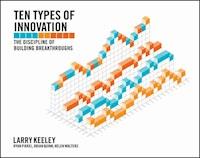
Innovation principles to bring about meaningful and sustainable growth in your organization
Using a list of more than 2,000 successful innovations, including Cirque du Soleil, early IBM mainframes, the Ford Model-T, and many more, the authors applied a proprietary algorithm and determined ten meaningful groupings—the Ten Types of Innovation—that provided insight into innovation. The Ten Types of Innovation explores these insights to diagnose patterns of innovation within industries, to identify innovation opportunities, and to evaluate how firms are performing against competitors. The framework has proven to be one of the most enduring and useful ways to start thinking about transformation.
- Details how you can use these innovation principles to bring about meaningful—and sustainable—growth within your organization
- Author Larry Keeley is a world renowned speaker, innovation consultant, and president and co-founder of Doblin, the innovation practice of Monitor Group; BusinessWeek named Keeley one of seven Innovation Gurus who are changing the field
The Ten Types of Innovation concept has influenced thousands of executives and companies around the world since its discovery in 1998. The Ten Types of Innovation is the first book explaining how to implement it.
Sie lesen das E-Book in den Legimi-Apps auf:
Seitenzahl: 350
Veröffentlichungsjahr: 2013
Ähnliche



















Contents
Preface
Part One: Innovation
Chapter 1: Rethink Innovation
Part Two: Ten Types of Innovation
Chapter 2: The Ten Types
Chapter 3: Profit Model
Chapter 4: Network
Chapter 5: Structure
Chapter 6: Process
Chapter 7: Product Performance
Chapter 8: Product System
Chapter 9: Service
Chapter 10: Channel
Chapter 11: Brand
Chapter 12: Customer Engagement
Part Two: In Summary: Measure Up
Part Three: More Is Mightier
Chapter 13: Go Beyond Products
Chapter 14: Strength in Numbers
Part Three: In Summary: Work Across
Part Four: Spot the Shifts
Chapter 15: Mind the Gap
Chapter 16: Challenge Convention
Chapter 17: Pattern Recognition
Part Four: In Summary: Shift Your Focus
Part Five: Leading Innovation
Chapter 18: Declare Intent
Chapter 19: Innovation Tactics
Chapter 20: Using the Innovation Playbook
Part Five: In Summary: Go Deep
Part Six: Fostering Innovation
Chapter 21: Get Cracking
Chapter 22: Sponsors and Authors
Chapter 23: Installing Innovation
Chapter 24: Execute Effectively
Part Seven: Appendix
Acknowledgments
Innovation Bibliography
Notes and Research Data
Image Credits
Index
About the Authors
About Doblin and Monitor Deloitte
Praise for Ten Types of Innovation
“I have long admired the innovation work of Larry Keeley and am thrilled that he has shared his concepts, insights, and experience with the world in his terrific book. Ten Types of Innovation is a must-read for any manager seriously interested in building an innovation culture rather than waiting around hoping for the next immaculate conception.”
—Roger L. Martin, Dean, Rotman School of Management
“Innovation is not for amateurs and most meaningful developments are not accidents. Great innovators follow disciplined approaches and Larry Keeley outlines an evidence-based methodology which takes innovation well beyond product tweaking. At Mars we are leveraging sophisticated innovation techniques and creating hard to copy, distinctive propositions which we know will delight our consumers and will remain relevant over time. Ten Types of Innovation provides great frameworks to help you rethink the role innovation plays in your business and will raise the quality of the innovation dialogue from a black art to a serious science.”
—Ralph Jerome, VP of Corporate Innovation, Mars, Inc.
“Ten Types of Innovation will become the indispensable ‘how to do it’ textbook of disruptive innovation, providing an executable roadmap for transformative change in any industry.”
—Dr. Nicholas F. LaRusso, Medical Director, Mayo Clinic Center for Innovation
“When innovation is defined only as a new product or service, this view ignores a larger, integrated process that must function seamlessly for optimal value creation. Ten Types of Innovation, by contrast, captures the entire innovation ecosystem, from essential organizational structures and processes to critical aspects of the product or service being introduced. Equally important, the book explores diverse elements of innovation’s impact on the total customer experience. It distills three decades of innovation research into an action-oriented framework, offering a comprehensive map to guide creative teams as they venture into challenging new territory.”
—Dipak C. Jain, Dean, INSEAD
“Doblin helped us achieve our goal to continuously and successfully introduce transformational innovations to our customers. Ten Types of Innovation provides the insights necessary to get you started on your innovation journey.”
—Curt Nonomaque, President and CEO, VHA
Cover design and image: Pentagram
Copyright © 2013 Deloitte Development LLC. All rights reserved.
Published by John Wiley & Sons, Inc., Hoboken, New Jersey.
Published simultaneously in Canada.
This publication contains general information only and is based on the experiences and research of Deloitte practitioners. Deloitte is not, by means of this publication, rendering business, financial, investment, or other professional advice or services. This publication is not a substitute for such professional advice or services, nor should it be used as a basis for any decision or action that may affect your business. Before making any decision or taking any action that may affect your business, you should consult a qualified professional advisor. Deloitte, its affiliates, and related entities shall not be responsible for any loss sustained by any person who relies on this publication.
As used in this document, “Deloitte” and “Monitor Deloitte” means certain member firms of Deloitte Touche Tohmatsu Limited (DTTL) that participated in the acquisition of the business of Monitor Company Group Limited Partnership (Monitor). Each of DTTL and its member firms is a legally separate and independent entity. Please see www.deloitte.com/about for a detailed description of the legal structure of DTTL and its member firms. Certain services may not be available to attest clients under the rules and regulations of public accounting.
No part of this publication may be reproduced, stored in a retrieval system, or transmitted in any form or by any means, electronic, mechanical, photocopying, recording, scanning, or otherwise, except as permitted under Section 107 or 108 of the 1976 United States Copyright Act, without either the prior written permission of the Publisher, or authorization through payment of the appropriate per-copy fee to the Copyright Clearance Center, 222 Rosewood Drive, Danvers, MA 01923, (978) 750-8400, fax (978) 646-8600, or on the web at www.copyright.com. Requests to the Publisher for permission should be addressed to the Permissions Department, John Wiley & Sons, Inc., 111 River Street, Hoboken, NJ 07030, (201) 748-6011, fax (201) 748-6008, or online at www.wiley.com/go/permissions.
Limit of Liability/Disclaimer of Warranty: While the publisher and author have used their best efforts in preparing this book, they make no representations or warranties with the respect to the accuracy or completeness of the contents of this book and specifically disclaim any implied warranties of merchantability or fitness for a particular purpose. No warranty may be created or extended by sales representatives or written sales materials. The advice and strategies contained herein may not be suitable for your situation. You should consult with a professional where appropriate. Neither the publisher nor the author shall be liable for damages arising here from.
For general information about our other products and services, please contact our Customer Care Department within the United States at (800) 762-2974, outside the United States at (317) 572-3993 or fax (317) 572-4002.
Wiley publishes in a variety of print and electronic formats and by print-on-demand. Some material included with standard print versions of this book may not be included in e-books or in print-on-demand. If this book refers to media such as a CD or DVD that is not included in the version you purchased, you may download this material at http://booksupport.wiley.com. For more information about Wiley products, visit www.wiley.com.
ISBN: 978-1-118-50424-6 (pbk)
ISBN: 978-1-118-57144-6 (ebk)
ISBN: 978-1-118-57141-5 (ebk)
ISBN: 978-1-118-57139-2 (ebk)
Note to the Reader:
The print edition of this book is designed around large, four-color, two-page spreads.
This digital version has been reformatted for smaller e-book readers and mobile devices.
Preface
On Innovating Effectively
In the middle of August in 2012, Congressional approval rating hit an all time low.1 This is saying something—the same figure has been less than impressive in earlier eras. Yet the United States Congress isn’t the only institution with lukewarm support. People expect very little good news about the wars being fought (whether in Iraq, Afghanistan, or on Terror, Drugs, Poverty, or Ignorance). The promising Arab Spring has given way to a recurring pessimism about progress. Gnarly health problems are on a tear the world over—diabetes now affects over eight percent of Americans—and other expensive disease conditions such as obesity, heart disease, and cancer are also now epidemic. The cost of education rises like a runaway helium balloon, yet there is less and less evidence that it nets the students a real return on their investment. Police have access to ever more elaborate statistical models of crime, but there is still way too much of it. And global warming steadily produces more extreme and more dangerous conditions the world over, yet according to about half of our elected “leaders,” it is still, officially, only a theory that can conveniently be denied.
And yet . . .
We steadily expect more from our computers, our smartphones, apps, networks, and games. We have grown to expect routine and wondrous stories of new ventures funded through crowdsourcing. We hear constantly of lives around the world transformed because of Twitter or Kahn Academy or some breakthrough discovery in medicine. Esther Duflo and her team at the Poverty Action Lab at MIT keep cracking tough problems that afflict the poor to arrive at solutions with demonstrated efficacy, and then, often, the Gates Foundation or another philanthropic institution funds the transformational solution at unprecedented scale.
Storytelling is in a new golden age—whether in live events, on the radio, or in amazing new television series that can emerge anywhere in the world and be adapted for global tastes. Experts are now everywhere, and shockingly easy and affordable to access. Indeed, it seems clear that all the knowledge we’ve been struggling to amass is steadily being amplified and swiftly getting more organized, accessible, and affordable—whether through the magic of elegant little apps or big data managed in ever-smarter clouds or crowdfunding sites used to capitalize creative ideas in commerce or science.
One way to make sense of these opposing conditions is to see us as being in a time of radical transformation. To see the old institutions as being challenged as a series of newer, more agile ones arise. In history, such shifts have rarely been bloodless, but this one seems to be a radical transformation in the structure, sources, and nature of expertise.2 Indeed, among innovation experts, this time is one like no other. For the very first time in history, we are in a position to tackle tough problems with ground-breaking tools and techniques.
What Do You Do When the Problems Are Real, the Stakes Are High, Time Is Short, and Abstract Answers Are Inadequate?
That is what we’ve written this book to address: how you can innovate effectively. How you can get the future to show up just slightly ahead of its regularly scheduled arrival. How you can give teams that can’t afford to fail the robust methods they need to succeed—whether the problem they are tackling is small or large, trivial or epic.
Part of the innovation revolution is rooted in superior tradecraft: better ways to innovate that are suited for tougher problems. Yet most teams are stuck using goofy techniques that have been discredited long ago. This book is part of a new vanguard, a small group of leading thinkers who see innovation as urgent and essential, who know it needs to be cracked as a deep discipline and subjected to the same rigors as any other management science.
Our Journey to This Book
Ten Types of Innovation has had a long gestation period. Broadly stated, it codifies, structures, and simplifies three decades of work from a consulting firm in Chicago, Doblin, which I cofounded along with the brilliant design methodologist Jay Doblin. From its inception in 1980, Doblin has asked one pervasive, deceptively simple-seeming question: “How do we get innovation to succeed instead of fail?”
Over the years we have kept three important dimensions in dynamic tension. We have a theoretical side, where we ask and seek real answers to tough questions about innovation. Simple but critical ones like, “Does brainstorming work?” (it doesn’t), along with deep and systemic ones like, “How do you really know what a user wants when the user doesn’t know either?”3 We have an academic side, since many of us are adjunct professors at Chicago’s Institute of Design,4 and this demands that we explain our ideas to smart young professionals in disciplined, distinctive ways. And third, we have an applied side, in that we have been privileged to adapt our innovation methods to many of the world’s leading global enterprises and start-ups that hanker to be future leading firms.
From the beginning, Doblin has itself been interdisciplinary, mixing social sciences, technology, strategy, library sciences, and design into a frothy admixture that has always tried to blend both analysis, breaking tough things down, with synthesis, building new things up. Broadly, we think any effective innovation effort needs plenty of both, stitched together as a seamless whole.
The heart of this book is built around a seminal Doblin discovery: that there are (and have always been) ten distinct types of innovation that need be orchestrated with some care to make a game-changing innovation. If you stick with the book, you’ll read about that soon enough. What you need to know now, at the outset, is that this is not just one thin discovery. Along with the framework itself, we also describe what you should do to surround this better way of innovating with even more robust protocols and processes.
Our Authoring Team
It is an axiom in writing that when you have a bunch of authors the resulting work is likely to be a compromised hash. Any movie you see with a whole string of screenwriters listed is unlikely to be brilliant. But at Doblin we do nearly everything in teams. This stems from the unique nature of innovation itself: no individual can possibly know enough all by himself or herself to crack tough innovation challenges, and the best teams have many different disciplines involved. So too with this book. It may help you to know the roles each of us played and thus better glimpse what kinds of contributions go into any complex synthesis.
As the long-time president of Doblin, I have pioneered many ideas and methods at the core of innovation effectiveness, including the Ten Types. I have dedicated my entire professional career to thinking about how to create appropriate tools and techniques—and about how our clients can most effectively use them in practice. I have spent more than 30 years learning and thinking about what makes innovation succeed or fail. As the principal author of the text, I am responsible for the basic arguments throughout, and the system of ideas here either succeeds or fails because of me.
Ryan Pikkel has an advanced degree in innovation skills from the Institute of Design and is himself a skilled designer. He managed the collaboration with a deep and talented team from our colleagues at Pentagram and he worked to ensure that every page in the book is as clear, concise, and accessible as possible. He is also personally responsible for the creation of the incredible Innovation Tactics Cards, which now permit us to codify and deconstruct any valuable innovation—or to help you to build one of your own with the help of robust, reusable modules.
Brian Quinn was for many years a traditional strategist, who left consulting to become a screenwriter, and then returned to the field—but only on the condition that he could focus on solving innovation problems for clients. This makes him one of the rare individuals who really can integrate most of the necessary components for innovation effectiveness—and he has done so repeatedly and reliably for several of our largest clients. His voice in the book has been crucial in helping to make the ideas more actionable for firms that need to innovate.
Helen Walters was the innovation and design editor at Bloomberg Businessweek. She has built an amazing personal network of practitioners and practices the world over. Of course, as a journalist, she values telling clear stories with solid facts and getting details right—an indispensable skill for a book with tales on every page.
Finally, our work was materially aided by Bansi Nagji. While he was not an author of this book, he played a role in refreshing and advancing the Ten Types of Innovation. More broadly, Bansi made innovation a strategic priority at Monitor and continues to do so today as a leader in Monitor Deloitte. The team is grateful for his support.
None of this may matter to you as a reader, since the book stands or falls as a unified whole. It mattered a very great deal to us as a team, though. We wanted to make a book that would reveal the whole, remarkable, and important emerging discipline of innovation, because so many people now see the urgent need to innovate. They sense that old ideas and structures must give way. They imagine that newer, better futures are out there, lurking in the loaming, just out of reach.
Well, reach for them, we say.
Start here. Start now. Foment your very own revolution.
We’ll show you how.
Larry Keeley
Chicago, 2013
1 This depressing statistic comes to you courtesy of Gallup. See the back of the book for extensive links to additional notes and research data.
2 One elegant recent book that posits such a theory with far more elaboration is Too Big to Know by David Weinberger, one of the authors of the earlier and perennially interesting The Cluetrain Manifesto.
3 This allowed us to be one of the first consulting firms in the world with a full-time social science research unit. Ours was initially pioneered by the brilliant cultural anthropologist Dr. Rick E. Robinson, who went on to cofound (along with John Cain) the seminal research firm, e-Lab.
4 This leading graduate school was the first in the United States to issue PhD degrees in design.
We Discovered the Ten Types of Innovation in 1998. This Book Explains What We have Learned Since.
Innovation mostly fails. It doesn’t need to. You shouldn’t let it.
Innovation almost never fails due to a lack of creativity. It’s almost always because of a lack of discipline.
The most certain way to fail is to focus only on products. Successful innovators use many types of innovation.
Successful innovators analyze the patterns of innovation in their industry. Then they make conscious, considered choices to innovate in different ways.
Innovations can be broken down and analyzed. When you do so, you will learn why most fail and a few succeed.
Innovations can be built up systematically. Doing so increases your odds of success exponentially.
We know you might be skeptical now. Suspend your disbelief for the moment. After spending some time with this book and applying its concepts to your work, we believe you’ll see these assertions as emerging laws of innovation.
Part One
Innovation
A New Discipline Is Leaving the Lab
Now and then a new science emerges that radically changes how a field is conducted. This is precisely what is occurring now in the modern practice of innovation. But beware: myths are abundant and are exceptionally hard to eradicate.
Chapter 1
Rethink Innovation
Eradicate Lore, Substitute Logic
When it comes time to innovate, even executives who deeply appreciate the discipline that modern management science has produced in finance, marketing, or logistics seem willing to tolerate all sorts of nonsense.
Too often, innovation is reduced to a series of brainstorming sessions, where facilitators proclaim things like, “Hey, there’s no such thing as a bad idea!” (Actually, there really is such a thing as an indisputably bad idea.) Or innovation may be separated from the rest of the enterprise in a special lab or unit, a thin effort to quarantine the crazies. There, we feel like it’s only proper to crank up the creativity. We put people in a room, festoon the tables with toys, Nerf balls and guns, Post-it Notes, markers, and fun foods—all because innovation is supposed to be playful. Our use of sticky notes and black Sharpie markers has become almost fetishistic,1 one of the many rituals in our collective cult of innovation.
Here’s the problem—evidence shows that such techniques do not actually lead to better outcomes. A number of years ago, we researched innovation efforts in industries such as manufacturing and services. A full 95% of these efforts failed. A glance around at the state of contemporary innovation suggests we’ve gotten a little better, but still do plenty of things that are more grounded in hope or habit than evidence. This is unacceptable. We are overdue for a revolution in the way innovation is diagnosed, developed, fostered, de-risked, launched, and amplified.
Our ambition is to make innovation a systematic approach, moving the field from a mysterious art to more of a disciplined science. The Ten Types of Innovation is part of the foundation of that ambition. We know we are not working on anything as fundamental as the Human Genome Project nor as empirically proven as the periodic table (though we were inspired by the latter). The last thing we are trying to do is to shroud innovation with a different cloak. We use scientific analogies throughout this book to help illustrate our ambition rather than mirror our claims.
Lesen Sie weiter in der vollständigen Ausgabe!
Lesen Sie weiter in der vollständigen Ausgabe!
Lesen Sie weiter in der vollständigen Ausgabe!
Lesen Sie weiter in der vollständigen Ausgabe!
Lesen Sie weiter in der vollständigen Ausgabe!
Lesen Sie weiter in der vollständigen Ausgabe!
Lesen Sie weiter in der vollständigen Ausgabe!
Lesen Sie weiter in der vollständigen Ausgabe!
Lesen Sie weiter in der vollständigen Ausgabe!
Lesen Sie weiter in der vollständigen Ausgabe!
Lesen Sie weiter in der vollständigen Ausgabe!
Lesen Sie weiter in der vollständigen Ausgabe!
Lesen Sie weiter in der vollständigen Ausgabe!
Lesen Sie weiter in der vollständigen Ausgabe!
Lesen Sie weiter in der vollständigen Ausgabe!
Lesen Sie weiter in der vollständigen Ausgabe!
Lesen Sie weiter in der vollständigen Ausgabe!
Lesen Sie weiter in der vollständigen Ausgabe!
Lesen Sie weiter in der vollständigen Ausgabe!
Lesen Sie weiter in der vollständigen Ausgabe!
Lesen Sie weiter in der vollständigen Ausgabe!
Lesen Sie weiter in der vollständigen Ausgabe!
Lesen Sie weiter in der vollständigen Ausgabe!
Lesen Sie weiter in der vollständigen Ausgabe!
Lesen Sie weiter in der vollständigen Ausgabe!
Lesen Sie weiter in der vollständigen Ausgabe!
Lesen Sie weiter in der vollständigen Ausgabe!
Lesen Sie weiter in der vollständigen Ausgabe!
Lesen Sie weiter in der vollständigen Ausgabe!
Lesen Sie weiter in der vollständigen Ausgabe!
Lesen Sie weiter in der vollständigen Ausgabe!
Lesen Sie weiter in der vollständigen Ausgabe!
Lesen Sie weiter in der vollständigen Ausgabe!
Lesen Sie weiter in der vollständigen Ausgabe!
Lesen Sie weiter in der vollständigen Ausgabe!
Lesen Sie weiter in der vollständigen Ausgabe!
Lesen Sie weiter in der vollständigen Ausgabe!
Lesen Sie weiter in der vollständigen Ausgabe!
Lesen Sie weiter in der vollständigen Ausgabe!
Lesen Sie weiter in der vollständigen Ausgabe!




