


4,99 €
Mehr erfahren.
- Herausgeber: Olympia Press
- Kategorie: Geisteswissenschaft
- Sprache: Englisch
Beat poet Corso's only novel. Inspired by his days in Europe, anxiously waiting for royalty checks and advances that were slow to appear, this freewheeling and farcical tale is the account of a birth in AmEx, and what came of it. With illustrations by the author. First published 1961 as No. 85 in the Traveller's Companion Series. Never reprinted.
Das E-Book können Sie in Legimi-Apps oder einer beliebigen App lesen, die das folgende Format unterstützen:
Veröffentlichungsjahr: 2015
Ähnliche




















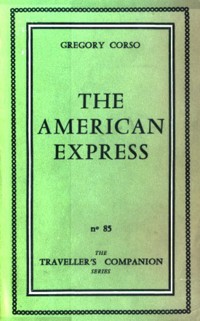
The American Express
Gregory Corso
This page copyright © 2005 Olympia Press.
PRINTED IN FRANCE
GREGORY CORSO
THE
AMERICAN EXPRESS
with illustrations by the author
THE TRAVELLER'S COMPANION
PROLOGUE
“He's beautiful—” said the young lady of the only man in the American Express.
“Why don't you go speak to him,” nudged her lady friend.
“But will he speak to me?”
“What man wouldn't?”
“He is beautiful—”
“Go. Go and say something nice to him—”
The young lady approached the man.
He smiled.
“Sir, will you present me with a baby?”
The man looked at her with squinted eyes —then his eyes widened and his face became aglow.
“My hotel is a street away,” said the man.
“Have you ever presented a woman with a baby before?”
“I don't remember,” gleamed the man. “Have you ever had sex?”
“Yes—”
“What happened?”
“What happened? What do you mean what happened?”
“Something must have happened—”
“Nothing happened—I had fun, that's what happened—”
“Where is your hotel, sir?”
Nine months later she sirened through the night, her pregnancy had come to an end.
They wheeled her into the basement of the American Express, they held her down, they spread her legs, they plunged into her womb, they yanked the child from her, they punched it into life, they threw it out into the street, it lay there until dawn—
Dawn, and something small and sad rose and walked into the world.
PART ONE
1
“Granted they all wish you aboard,” Thimble was saying to Dad Deform as they hurried toward the ship. “But they really don't like you, you know.”
“Hi diddle dee dee, nothing ever worries me—” sang Dad Deform. His legs were thin, his belly was fat, his back was humped, his nose was long. He was nimble. He was quick. He was always happy.
“Just what is it with you, Deformy?” asked the two murderers.
“I do not understand,” said Dad Deform.
“Why you going cheap class instead of first class like the rest of us?”
“Oh, I wish Simon were here to tell us a fairy tale as we go to our ship,” sighed Dad Deform.
“There you go, taking it all so lightly,” reproved Thimble. “I've been watching you, Mr. Deform, I've been watching you for a long time—”
“Yes, tell us what you are up to—”
“Tell us—”
“Tell us in whose employ you are—”
“Tell us—”
“Tell us—”
“Tell us all, Dad Deform.”
“You want to know too much, gentlemen. Can't altogether blame you for wanting to know. Can altogether blame you for coming out so childish about it. Been watching me, eh? By whose orders? No mind. The cornery the corner you spy from, the freer and happier the spied. And as for going tourist class, do we belong to the same political party? Now, gentlemen, the boat. We must not miss the boat.”
“Deform,” said Thimble, “you seem to ignore the time at hand—at hand, sir, the Now!”
Dad Deform hobbled and skipped, “Hurry, hurry, for I swear I hear All Aboard!”
Joel ran to catch the ship. It was his first trip. Angus Plow reached out and grabbed him.
“Joel, can you tell me why the elegant Mr. D invited that ill-mannered Simon to sail with us?”
“Was it Mr. D who bought the tickets?”
“No one knows who bought the tickets, Joel,” said Albie in passing.
“Simon eats too much,” cried Angus Plow, “I can't bear people who eat too much!”
“Actually Simon isn't all that bad,” said Joel, “he really has very fine taste in statuettes, and people tell me he gets on very well with children. As for Mr. D inviting him—I did not know that—you must realize Mr. D is quite odd and has many secret reasons.”
“Mr. D is incomprehensible, have you ever heard him speak?”
“I always thought Mr. D spoke well, though I haven't gone through the experience of listening to him very often.”
“Why are you going on this ship, Joel?”
“Mr. Plow, I really do not know why. I just feel that something vast and beautiful will happen—and I want to be as near to it as possible.”
Rodger Wolfherald and Carrol Grilhiggen sat like late 18th-century dandies in an elegant coach drawn by four fiery white horses.
“To the boat!” called Carrol to the vulture-like back of the driver.
“Easy, Carrol,” said Wolf herald, “it cannot leave without us.”
Carrol laughed. “A funny thought indeed! Just what would they do without us?”
The carriage stopped for a traffic light—in jumped Scratch Vatic. “Gentlemen,” he greeted, “I can see that you are young men of action.” He had a huge cucumber in his hand, he took a bite, he gulped it down. “Yes, soldiers of fortune—”
“What is the purpose of all this, Mr. Vatic?” asked Wolf her aid in a very disturbed tone.
“No purpose, no purpose,” swore Vatic.
“What are you doing in our carriage?” asked Carrol.
“I've come for the ride, what else?” And Vatic offered a bite of cucumber to Wolf-herald, Wolfherald pushed it away.
“There's the ship!” exclaimed Carrol.
Harry was bundled in furs. He trudged toward the ship like a bear. It was nearing 100 degrees but to Harry it was like zero.
Ephraim Freece ran breathlessly up to Harry. “Are we late?” he asked.
“People thinking about the time all the time, are they early, are they late—they never think about the weather!” growled Harry.
“Of course they do,” disagreed Freece, “everybody thinks about the weather.”
“It better be hot where we're going, that's all I can say.”
“Harry, was there ever a time in your life when you were nice and warm?”
“I've been hot in my time. Lived ten years on the highest spot in the world. Ten years! and I thought I would be forever hot so close to the sun like that—I thought if I got on the highest place on earth I would be done with the cold. But it was cold, it was hideously cold up there!”
“I'm sorry,” said Freece.
“Don't be sorry, lend me your sweater.”
“But the sweater is all I have—”
“Real sorry, yes sir, that's what I like to see, somebody who is real sorry.”
“All right, here, I'll lend you my sweater.”
Freece pulled the sweater up and over his head and handed it to Harry. Harry wrapped the sweater around his neck. His neck was already wrapped with a fur scarf.
Hinderov like a spider nimbled up to them and hissed: “Boys, this is slowing the works! I advise you to hasten!”
The great ship Here They Come was ready to sail.
Everyone was aboard.
No one was on the pier to wave goodbye.
The steam engines began to huff and the smokestake began to puff and the blasthorn blasted and the ship was off.
Mr. D locked his cabin door and meticulously unpacked his sole suitcase.
Molly, Shiva, and Daphne, the only females aboard, were frantically trying to get the steward to change their table. They did not want to sit with Hinderov and Angus Plow. Their complaint was fair enough. Hinderov hated women, and Plow hated food. The steward refused.
Joel was in the steering room excitedly watching the captain scream his orders.
Harry and Noble Grant, much to Noble Grant's discomfort, huddled close to the engine room's furnace.
Dad Deform hobbled happily through tourist class—he had it all to himself.
Angus Plow was scheming to foul the ship's food.
Scratch Vatic immediately grabbed the cook into his confidence. “Tonight we eat roast swan!” hailed Vatic.
Wolfherald and Grilhiggen sat in the bar arguing the ontological proof of God.
Freece spread out his stamp collection on the bed and began pasting in stamps. Simon held a holy statue in his big hands. Hinderov carefully counted his bombs. The two murderers were arguing a sport. Danger tiptoed on the rim of the smokestack.
2
Waiting at the pier for the ship to arrive was Detective Horatio Frump. He was surrounded by reporters and TV implements.
“Mr. Frump, when do you think that boat will arrive?”
“Hard to say, gentlemen. A boat like that doesn't run on time, that is, not on time as we know it.”
“Word has it that there might be something other than humans on board, Mr. Frump.”
“We know the boat has left, and the boat, if all permits, will arrive. Therefore it is my belief that whatever departs must arrive.”
“Can you be clearer, Mr. Frump?”
“Well, in a relative sense nothing starts and nothing ends. But for humankind things do start and end. Man, unlike the universe, is beginning with end. He is born into that which always was, and he dies from that which always is. The boat will come into what always was and what always will be. It is my firm belief that the passengers aboard are determined to disembark with the sole intent to change things somewhat. They do not like the idea that they depart and arrive. They too would like to be without beginning without end, just like the universe, gentlemen.”
“Mr. Frump, where do they operate from?”
“'From the underground—but they have a front—”
“What's their intention, Mr. Frump?”
“I don't know. Though I do know that their intentions, among themselves, differ. Each intention, I am sure, is more hideous than the other—so you can imagine what the overall intention must be—”
When the great ship Here They Come like a prophet sailed the prophetic sea and reached the land prophecy, what strange cargo did the stevedores unload? The pinched merchants were busily bidding and pricing their good fortune with high hopes of purchasing palaces and mayorial honors.
The reporters and TV implements rushed to the lowering gangplank.
Frump remained in the distance, sitting on a stump, feeding birds, watching all.
The merchants pushed to the ship crying, “Our cargo! Our cargo!—”
“Don't let them rats on board!” screamed the captain.
“Our cargo! Our cargo!” surged the merchants.
“I am nobody's cargo!” growled Hinderov.
Simon leaned on the railing and broke a chalk statue in his big hand as he looked at the houses fading into the mountains.
Joel threw confetti at the people below. Hinderov rushed up to him. “This is no pleasure trip, sonny.”
Mr. D stood tall and spectral, holding a small suitcase. He watched the groping merchants below and laughed “heh-heh.”
Down the apocalyptical gangway came Wolf herald, pale and aristocratic; he waved the reporters out of the way.
Behind him followed Carrol Grilhiggen.
“Carrol,” informed the reporters, “your father's pig won its tenth medal yesterday!”
“That's nice to know, gentlemen,” said Carrol, and he quickly moved on.
Down came Ephraim Freece, ragged and wild-haired, his stamp collection gripped under his arm. He smiled and waved into the TV cameras. The reporters ignored him.
Lightly, rapidly, insectly, came Hinderov in a huge brown coat.
“Hinderov,” asked the reporters, “what is your mission?”
“Explosions!”
“Could you elaborate on that, sir? Here, move over to the cameras, let the people get a good look at you; there, that's it. Now, sir, what kind of explosions?”
“Bombs!” screeched Hinderov, shaking a stiff bony fist at the cameras.
“Why bombs, Hinderov?”
“Because... because everything is in a deadlock. The universe... everything... in a deadlock. Something must break, and break soon... history does not allow deadlocks... too much mind spreading going on... too much talk... not enough bombs... bombs break deadlocks!”
Down came Simon—tall, stiff, bony, and his orange hair stood straight and his long orange beard reached his trousers. He wore a long orange coat and if he had green hair he would have been a human carrot but as he only had green eyes he resembled a carrot.
“What is your mission, Simon?” asked the reporters.
“I have no mission,” said Simon.
Down came Scratch Vatic dressed in bright clothes. He leered into the TV cameras and said, “Do nothing but eat! I guarantee you will see something!”
Down came Angus Plow, carrying himself like a pale Polish nobleman. “'Tis my destiny to expose all vile ingredients, meats, vegetables, ad infinitum! Food hath deprived us of angelhood! Shame on your gluttonous fatbacks and neckbones!”
Down came Dad Deform grinning and swinging like a monkey. The crowds backed away—he hobbled through them singing, “Hi diddle dee dee, another life for me—”
Down came Shiva, Molly and Daphne. Shiva and Daphne had the faces of queens, and they stood tall and proud. Molly was small, lovely, very princess-like.
“Girls, are your objectives directed to man?”
“We are women,” said Shiva, “therefore our objectives are boundless.”
“I feel something awful will happen to us because we're girls,” said Daphne.
“I feel the same way,” said Molly trembling—“I feel I'm going to be murdered! Why! Why do I feel that!”
“What do you ladies want?” asked the reporters.
“I have what I want,” said Daphne. “I have my telling watch given to me by my great-grandmother who said it was made in heaven. I know my time; I need nothing else. I will not hurt my life by wondering about things I cannot conclude with truth.”
“But everyone must wonder about his life,” said Molly. “I'm wondering about my life; somebody wants to take it away from me!”
“And even if I did conclude my wonder with truth,” continued Daphne, “I would immediately wonder what truth was. What I already know of truth I don't like.”
“Don't listen to her!” screeched Hinderov. “She is a mad woman, she seeks to belittle the importance of man, don't listen to her—
“Molly Shiva and myself must die in a world of men—they have plans, and women are in their plans—”
Hinderov turned purple. He ran up to Daphne and yanked her sleeve. “Better be still! Say nothing about plans!”
Down came Albie, trying to keep as close to Molly as possible without arousing any attention. Albie's heart was breaking. He was very much in love with Molly. Molly did not know if she loved him—she liked him and felt safe by him—that was all. It was Hinderov who abhorred the idea. Not only because he did not respect women, but because he had high hopes for Albie. And Bronskier, Albie's father, was absolutely in accord with Hinderov in everything.
Down came the two murderers; they both were the same height and wore the same clothes.
“What's it with you two guys?” asked the reporters.
“We abide.”
Down came Joel, the youngest passenger, coming down the gangway for the first time.
“How's it going, Joel?”
“Great! Everything is so strange and new! I don't think I'll ever be unhappy here—”
Down came Harry, a big man, wrapped in furs.
“Write any new books lately, Harry?”
“Wrote one,” shivered Harry.
“What's it called?”
“The Kicks of Heat.” Harry's teeth were clashing.
“What's it about?”
“Desert people.”
“Yes?”
“Well, I don't complain,” said Harry. “I'm all right. Nothing is wrong with me. It's just that I'm too cold! Got to live with desert people all the time! I write all my books about desert people! I'm sick and tired of desert people! If I'm not living with them I'm living in Turkish Baths or in furnaces! They all speak of man, of God; what do they know? What kind of God is it that puts a thing in an alien clime, I ask? There is no place for me. I would live in fire! were it not for my burning. I differ with those fools, for me it is not man who is victory but the weather, that thing we all talk about when we have nothing to say. Gentlemen, when you speak about the weather, believe me, you are saying much! You cannot imagine how much! It is my mission to triumph over the elements! I will demand the elements become suitable to my condition! I will have my kind of weather!”
“But not everybody can live in your kind of weather, Harry,” said the reporters.
“Do you want to be the only man on earth?” asked the police. They no longer held back the crowd. The crowd was calm, attentive.
Harry decided he had said enough.
“I gotta go!” and he trudged away like a brown bear.
Down came Thimble, a portly man with a bald head and a white walrus mustache.
“Mr. Thimble, just what is this? A convention of men on man?” asked the reporters.
“How's that? What say? Hu-rumph! Well, er, yes, I say! What man? What means all this madness of brotherhood? Biggest trouble makers are the ones who try to get people to look at people. Leave man alone, I say, leave him alone!”
Down came Bronskier.
“Mr. Bronskier, do you believe Hinderov's plan will prevail?”
“It think it was my son Albie who said Christ is the victory of man. Well, let it not be said I have an oaf for a son. But, gentlemen, Christ will not last.”
“And then what?”
“I don't say hate man, no, what I say is get rid of him! Hinderov's plan will prevail—”
Down came Chan in a white suit.
“What these gentleman say about I will hold and value, but! if I may express self, what means Christ to me, me, an Asian? Pray do not encompass all man on a Western chart. I am a different man than the Western man. Your Christ has not known victory in Asia. Your Christ has failed to capture the world.”
Down came Noble Grant, Harry's literary critic, dressed like a diplomat.
“Mr. Grant, Molly is afraid she will be murdered, have you any idea?” asked the police.
“Ah!” exclaimed Noble Grant. “So man is a murderer too! Ha-ha!”
“Do you know who the murderer will be?” asked the police, moving closer in on Noble Grant.
“How can I tell if a man be a murderer? I might have met a man and imagined him a murderer, but if he did not kill me, then indeed I have been imagining.”
“Mr. Grant, what about Harry, is he really that great a writer?”
“The greatest!” thundered Noble Grant.
“But he's always writing about hot things. And his vocabulary, it consists of fire, sun, blast, burn, fry, steam, flame, he knows nothing else!”
“You missed the whole point,” said Noble Grant.
Down came Mr. D—his presence demanded the respect of the crowd.
Silence fell like a bell over the port.
No one stirred.
Mr. D walked magnificently by through beyond and out of the entire scene [...]




