


0,49 €
Mehr erfahren.
- Herausgeber: Quickie Classics
- Kategorie: Gesellschafts- und Liebesromane
- Sprache: Englisch
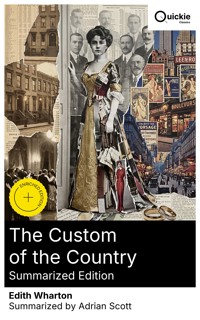
Published in 1913, The Custom of the Country anatomizes the brisk commerce of status in New York and Paris through Undine Spragg, whose radiant will-to-consume turns marriage, art, and lineage into negotiable currency. With cool, surgical irony and supple free indirect discourse, Wharton stages a transatlantic comedy of manners whose settings—from clubrooms to divorce courts—expose the hinge between old money's codes and new money's appetites. Even the title plays on habit and tariff: the custom that sanctions predation, and the customs that tax every crossing. Wharton wrote from inside knowledge. Born into Old New York and later resident in Paris, she observed both genteel hypocrisies and raw plutocratic energies at close range. Her difficult marriage and cosmopolitan circle, including Henry James, sharpened her sense of marriage as marketplace and of women's agency constrained by law, money, and decorum. Recommended to readers of James and Balzac, to scholars of gender and capitalism, and to anyone curious about consumer modernity, this novel feels startlingly current. Its crystalline sentences and unsentimental intelligence make Undine's ascent both exhilarating and terrifying—a classic that clarifies the prices we pay for wanting everything. Quickie Classics summarizes timeless works with precision, preserving the author's voice and keeping the prose clear, fast, and readable—distilled, never diluted. Enriched Edition extras: Introduction · Synopsis · Historical Context · Author Biography · Brief Analysis · 4 Reflection Q&As · Editorial Footnotes.
Das E-Book können Sie in Legimi-Apps oder einer beliebigen App lesen, die das folgende Format unterstützen:
Veröffentlichungsjahr: 2026
Ähnliche















The Custom of the Country (Summarized Edition)
Table of Contents
Introduction
Between the promise of American self‑invention and the price exacted by the social codes that police every ambition, The Custom of the Country stages a glittering contest in which appetite, money, and reputation ceaselessly renegotiate the terms of success, revealing how a culture that advertises boundless mobility quietly binds its brightest strivers to rituals of display, transactions of marriage, and old‑new hierarchies, while asking whether the will to rise—sheened with beauty, nerve, and charm—can ever be satisfied without transforming desire itself into a commodity that consumes the very lives it was meant to elevate.
Edith Wharton’s The Custom of the Country is a satirical novel of manners first published in 1913, set chiefly in early twentieth‑century New York and extending into European drawing rooms where American fortunes meet older aristocratic codes. Written by an author renowned for anatomizing elite society, the book observes the mechanisms of status with exacting realism while maintaining a cool, incisive irony. Its world is one of hotels, clubs, opera boxes, and swiftly changing addresses, where taste operates as currency. Wharton grounds the narrative in concrete social detail, aligning it with realist traditions even as its satire sharpens every scene.
The premise is straightforward and potent: a young woman from the Midwest arrives in Manhattan determined to claim the life she believes she deserves, and the city’s guardians of pedigree, money, and fashion decide whether to admit her. The novel follows Undine Spragg’s maneuvers through parlors, offices, and salons, tracking the costs and thrills of ascent without revealing its full trajectory. Wharton’s third‑person narration moves with brisk clarity, alternating close interiority with wry social commentary. The tone is sparkling and unsparing, the prose sculpted and exact, so that each choice feels both personal and symptomatic of a larger system.
At the novel’s core is the marriage‑money nexus: relationships appear as contracts shaped by law, capital, and reputation, and the language of romance often masks negotiations over security and display. Wharton shows how consumption—of clothes, apartments, travel, even experiences—organizes identity, and how the pressure to be seen in the right places produces a restless churn of novelty. She examines ambition as a social force that rewards performance while punishing vulnerability, and she probes the asymmetries that gender creates in the pursuit of status. The result is a portrait of desire disciplined by custom and monetized by a modern marketplace.
Across its transatlantic stages, the book juxtaposes American wealth’s speed and volatility with the slower currencies of European prestige—names, manners, and memory. Wharton maps the exchanges that occur when cash seeks pedigree and pedigree seeks cash, tracing how accents, furniture, and address can function as passports. The narrative catalogs thresholds—doorways, club lists, opera tiers—through which inclusion and exclusion are enacted. In this geography of privilege, real estate becomes theater and clothing becomes argument. By showing how old and new orders borrow from and disdain each other, the novel clarifies the grammar of status that still animates global elites.
For contemporary readers, the book’s insight into curated identity and transactional intimacy feels strikingly current. Its attention to publicity, networking, and the monetization of attention anticipates dynamics now amplified by digital platforms, where visibility can seem both omnipotent and precarious. The novel interrogates the myth of meritocratic mobility by revealing how institutions and unwritten rules shape opportunity. It also scrutinizes the double standards that greet female ambition, and the way legal frameworks around marriage and divorce define choices. Wharton’s analysis of consumption’s satisfactions and voids reads as a clear‑eyed guide to desire in a culture of relentless display.
To approach The Custom of the Country is to enjoy a high‑gloss comedy of manners that doubles as an X‑ray of power’s hidden circuitry. The pleasures are immediate—swiftness of plot, satiric sparkle, social detail—yet the afterimage is reflective, inviting readers to consider what success costs, who pays, and how taste disguises coercion. Without announcing theses or spoiling outcomes, Wharton lets rooms, invoices, and small gestures reveal the stakes. The novel endures because it marries narrative propulsion to moral intelligence, giving us a story about ascent that also asks what ascent is for, and what remains when the ladder ends.
Synopsis
The Custom of the Country (1913), by Edith Wharton, follows the ascent of Undine Spragg, a striking young woman from the Midwestern town of Apex City, whose family relocates to New York to secure her a place in high society. The narrative moves through hotels, drawing rooms, and brokerage offices, charting how taste, wealth, and publicity shape reputation. Wharton situates Undine’s ambitions amid an established social order resistant to outsiders, building a study of aspiration at the intersection of money and manners. Without relying on melodrama, the novel examines how mobility is achieved, what it costs, and how institutions—family, law, and custom—mediate personal desire.
Upon arrival in New York, the Spraggs pursue introductions that might convert money into status. Undine masters the signals of fashion, relying on intermediaries who trade in gossip and access, while encountering old New York families who prize lineage and restraint. Her beauty and self-possession attract attention, but her impatience with limits becomes evident. Wharton contrasts the closed world of inherited culture with a newer world driven by advertising and display. In this setting, Undine meets Ralph Marvell, a cultivated descendant of a prominent clan, whose beliefs about art and duty differ sharply from her own. The courtship sets competing values—tradition versus acquisition—on a collision course.
Marriage brings Undine into the orbit of old New York, yet also exposes the fragility of appearances sustained by finite means. Ralph’s literary leanings and modest professional prospects prove ill-suited to her appetite for novelty and social reach. Expenses mount, obligations multiply, and Undine’s father, Abner Spragg, negotiates on the family’s behalf, revealing business’s hidden role in genteel life. The couple’s domestic routine, punctuated by entertainments and a child’s arrival, does not temper Undine’s restlessness. Wharton delineates the growing mismatch between a hierarchy that honors understatement and a temperament that seeks ever brighter stages, establishing tensions that drive later choices.
As invitations ebb and coveted doors remain half open, Undine refines the arts of self-presentation—fashion, portraiture, and the strategic cultivation of acquaintances. The city’s social calendar and the newspaper society pages become instruments for advancing her visibility. Tempted by the prestige associated with European travel and titles, she begins to see New York as a stepping stone rather than a destination. Wharton treats these developments not as scandal but as social mechanics, showing how reputations are built and spent. The allure of broader stages sharpens conflicts at home and tests the elasticity of marital compromise, foreshadowing more radical attempts at reinvention.
Divorce, a recurring motif in the novel, is portrayed as both a legal mechanism and a cultural symbol of American modernity. Wharton examines how law, religion, and public opinion shape the practice, and how differing jurisdictions can facilitate or constrain change. For Undine, a legal severing represents an opportunity to recalibrate alliances, finances, and status, while for others it signals loss or disgrace. The process implicates families on both sides, with custody and support revealing the human stakes behind social mobility. Rather than sensationalize, the narrative dissects procedure and consequence, making institutional structures as vivid as the personal dramas they govern.
Paris expands the canvas. In salons and hôtels particuliers, Undine encounters circles that value lineage, ritual, and continuity. Her association with Raymond de Chelles, a member of an old French family, brings her into contact with traditions that restrict spending, remarriage, and personal freedom. The contrast between American individualism—buoyed by money and legal flexibility—and European restraint—shaped by religion and inheritance—becomes a central conflict. Undine navigates these codes with characteristic adaptability, but finds that prestige abroad exacts a different price. Wharton uses the transatlantic setting to test how far charm, wealth, and will can stretch against custom without breaking it.
Throughout, Wharton tracks the financial underpinnings of status. Abner Spragg’s negotiations expose how credit, investments, and discreet settlements shore up social facades. Elmer Moffatt, a self-made magnate linked to Undine’s Apex past, embodies the brash energy of American enterprise and the way capital can rewrite one’s social script. Deals concluded in offices reverberate in drawing rooms; fortunes, whether inherited or newly minted, dictate what kind of respect can be purchased—and what cannot. The novel attends closely to the circulation of money and news, showing how ledgers and newspaper clippings are as decisive as bloodlines in determining who advances and who falls back.
As Undine’s world grows, so too do the costs for those around her. Friends and relatives measure their commitments in patience, pride, and solvency, while a child’s welfare becomes entangled with adult maneuvering. Wharton’s tone remains analytic, allowing irony to reveal characters’ blind spots without reducing them to caricature. Artistic vocation, conjugal duty, and parental feeling all strain under the pressure of appearances. The book’s critique is balanced by close attention to motive: ambition appears as a rational response to a culture that rewards visibility, even as the pursuit of it alters affections, exhausts resources, and tests the limits of personal responsibility.
The narrative culminates not in a single revelation but in a clear portrait of a society that makes aspiration both irresistible and perilous. Without disclosing specific outcomes, Wharton leaves readers with a view of modern life in which institutions accommodate change while preserving their own interests. The title’s phrase captures a system of expectations that shapes choices about love, money, and identity. The Custom of the Country endures for its lucid anatomy of consumer desire and social engineering, its transatlantic perspective on class, and its unsparing yet humane depiction of how, in a world governed by custom, the self is made and unmade.
Historical Context
Edith Wharton’s The Custom of the Country appeared in 1913, drawing on the social geography of New York and Paris in the years bridging the late Gilded Age and the Progressive Era. The novel’s world revolves around institutions that ordered elite life: the Social Register, private clubs, the Metropolitan Opera, exclusive hotels, and the seasonal round of balls and country-house visits along the American resort circuit. Pre–World War I transatlantic travel by ocean liner linked American fortunes to European salons and embassies. Wharton situates personal ambition within these visible structures, using their codes and rituals to frame the possibilities and constraints of status, marriage, and money.
By the 1890s–1910s, the United States had produced unprecedented private fortunes through railroads, steel, finance, and urban real estate, while antitrust politics and financial panics revealed the system’s vulnerabilities. The Panic of 1907, quelled largely by J. P. Morgan’s intervention, underscored the power of bankers over social life and philanthropy in New York. Thorstein Veblen’s The Theory of the Leisure Class (1899) named the era’s “conspicuous consumption,” visible in opulent mansions, jewelry, and entertainments. Expanding department stores, advertising, and charge accounts normalized high-end consumption. Wharton’s milieu is this collision of new wealth with older privilege, where money can purchase access yet not effortless legitimacy.
Elite society maintained strict gatekeeping between “old” families and recent millionaires. Ward McAllister’s famous “Four Hundred” list in the 1890s symbolized a social ceiling policed by etiquette, patronage, and kinship. The winter season in Manhattan, summers in Newport, and European sojourns created a calendar of appearance in which opera boxes, cotillions, and charity boards signaled rank. The Social Register, launched in 1886, codified acceptable names and addresses. Debutante rituals and chaperoned visits staged the marriage market as a public institution. Such machinery of inclusion and exclusion forms the background against which social ascent or exile is negotiated in Wharton’s narrative.
Marriage and divorce law shaped strategies for status. New York retained especially restrictive divorce statutes, with adultery as the sole ground for absolute divorce well into the twentieth century, prompting residents to seek decrees elsewhere. Several Western jurisdictions, notably South Dakota around the turn of the century and later Nevada, became widely known for permissive statutes and short residency requirements that attracted national attention. Newspapers covered “Dakota” and “Reno” divorces as social theater, discussing alimony, custody, and remarriage. The patchwork of laws made marital status partly a matter of geography, a reality Wharton leverages to show how legal loopholes enable personal reinvention and social recalibration.
Women in Wharton’s circles navigated expanding rights amid persistent constraints. The Married Women’s Property Acts had improved control over separate property, but coverture’s legacies shaped inheritance, guardianship, and domestic expectations. Professional opportunities for elite women remained limited, and paid work could carry social stigma. The suffrage movement reached a new crescendo in 1912–1913, including the large Washington, D.C., parade on March 3, 1913. Fashion’s authority radiated from Paris couture houses, with designers like Worth and Poiret helping define silhouette and status. Wharton traces how appearance, manners, and patronage function as forms of capital when formal avenues to power remain narrowed by gender.
From the 1870s through the early 1910s, American heiresses sometimes sought European titles, while cash-strapped aristocrats pursued dowries—a phenomenon the press nicknamed “dollar princesses.” Highly publicized marriages, such as Consuelo Vanderbilt’s 1895 wedding to the Duke of Marlborough, fixed the pattern in popular imagination. Parisian high society, especially circles around the Faubourg Saint-Germain, prized lineage and Catholic affiliations, presenting obstacles to outsiders regardless of wealth. Luxury hotels, embassy receptions, and private salons mediated contact between American money and European prestige. Wharton uses this transatlantic stage to examine the exchange rates between cash, culture, and pedigree in a society attuned to every nuance of name and address.
Wharton was born into New York’s old elite in 1862, educated informally, and steeped in the codes she later analyzed. By 1907 she had settled largely in France; in 1913—the novel’s publication year—her own marriage to Edward Robbins Wharton ended in divorce. Publishing with Charles Scribner’s Sons, she developed a realist, socially diagnostic style indebted to Henry James yet distinct in its economic acuity. Earlier works like The House of Mirth (1905) had already dissected status, consumption, and feminine vulnerability. Writing on the eve of World War I, she brought an expatriate’s double perspective to American manners, contrasting national self-confidence with European hierarchies.
The Custom of the Country distills these conditions into a critique of modern social commerce. It maps how capital flows, publicity, and legal asymmetries transform marriage into a transactional arena and turn taste into a weapon of distinction. The novel’s hotels, opera houses, brokerage offices, and embassies are not merely backdrops; they are institutions that reward display and punish missteps. Its transatlantic itinerary tracks a prewar elite whose habits were soon to be disrupted by global conflict. Without revealing plot, it is clear that Wharton exposes an era in which ambition and consumption shape identity, while questioning the moral cost of that ascent.
Author Biography
Edith Wharton (1862–1937) was an American novelist, short-story writer, and essayist whose work mapped the moral and social terrain of the Gilded Age and early twentieth century. Dividing her adult life between the United States and Europe, she became a discerning interpreter of transatlantic culture, examining status, desire, and constraint with forensic clarity. Her prose fused classical control with ironic social observation, and her narratives probed the costs of ambition and conformity. She wrote in multiple forms—novels, tales, criticism, travel writing, and design treatises—and was the first woman to receive the Pulitzer Prize for Fiction, awarded for The Age of Innocence.
Wharton was raised in New York City within an environment that prized decorum, travel, and private study rather than formal schooling. Tutors and extensive time in Europe gave her languages, art history, and a cosmopolitan frame of reference. From an early age she read widely in English and French literature, drawing on realist and naturalist models that emphasized social causation and psychological nuance. She learned by observation—of interiors, dress, and ritual—skills later central to her fiction. In adulthood she formed a lasting literary friendship with Henry James, whose explorations of consciousness and manners complemented her own interests without determining her distinctive style.
She began publishing in periodicals in the 1890s, developing a reputation for polished short fiction. The Greater Inclination (1899) gathered early stories and announced her themes: the pressures of reputation, the bargaining of marriage, and the uneasy allure of success. A novella, The Touchstone (1900), and the historical novel The Valley of Decision (1902) preceded her breakthrough. The House of Mirth (1905) offered a devastating portrait of New York’s high society and brought critical and commercial success. Critics praised its elegance and moral intelligence, noting a realist method sharpened by satire. Throughout this period, correspondence and conversation with Henry James enriched her craft.
Wharton’s range was striking. In Ethan Frome (1911) and Summer (1917) she left drawing rooms for austere New England landscapes, exploring thwarted desire in pared, economical prose. The Custom of the Country (1913) anatomized social mobility and consumer culture through a relentless social climber. The Age of Innocence (1920), set in earlier New York, reflected on tradition and change and earned the Pulitzer Prize. She also excelled in shorter forms—Tales of Men and Ghosts (1910) shows her command of the uncanny—and wrote influential nonfiction, including The Decoration of Houses (1897), Italian Villas and Their Gardens (1904), and A Motor-Flight Through France (1908).
Settling in France in the early twentieth century, Wharton remained there during the First World War and undertook extensive humanitarian work. She organized hostels, workrooms, and aid for refugees and displaced workers, and reported from the front lines of civilian life. Her wartime articles and books, including Fighting France, documented resilience and devastation while advocating for relief efforts. French authorities recognized her service with the Legion of Honor. The experience affirmed her international outlook and complicated the moral perspectives of her fiction, which increasingly measured private desire against public crisis and the ethical claims of community.
The 1920s were productive and varied. Wharton published The Glimpses of the Moon (1922), the linked novellas of Old New York (1924), Twilight Sleep (1927), and The Children (1928), alongside essays and criticism. She continued to design and write about houses and gardens, and her Massachusetts estate, The Mount, stands as a testament to her architectural and horticultural interests. In A Backward Glance (1934), her autobiography, she reflected on craft, travel, and the literary world she inhabited. While critical fashion tilted toward experimental modernism, reviewers continued to value her precise structures, social acuity, and the ethical weight of her narratives.
Wharton died in France in 1937, having sustained a cosmopolitan career that linked American letters to European traditions. Her novels and stories remain central to the study of class, gender, money, and modernity, and they are regularly adapted for stage and screen. Scholars prize her ability to dramatize the unseen rules of status and desire, and readers respond to her elegant sentences, irony, and compassion for compromised choices. She helped bridge nineteenth-century realism and twentieth-century sensibility without abandoning narrative clarity. Today, her work endures as a vital account of how social systems shape individual lives—and of the costs of resisting them.




