


Erhalten Sie Zugang zu diesem und mehr als 300000 Büchern ab EUR 5,99 monatlich.
- Herausgeber: Books on Demand
- Kategorie: Geisteswissenschaft
- Sprache: Englisch
Jesper Trier Gissel began training film actors at Nørgaards Højskole in 2006. He soon took his point of departure in the simple but powerful, intuitive approach developed by Harold Guskin and dedicated his work to develop a course which could stay as true as possible to Guskin’s principles while accomodating a classroom full of actors. "The Generous Actor" contains a complete description of the course he now teaches (including his exercise flow choreography) and also his thoughts on art and acting developed over years of both academic studies, acting, and especially training actors. At this point Gissel has turned out a number of actors appearing and starring in Danish television and movie theatres and has established an solid network of directors, actors, casters, and producers in the Danish movie and television business. "The Generous Actor" also contains endorsements from a number of actors, directors, and acting coaches calling Gissel’s work, ‘useful and liberating for readers and actors‘, ‘a non-method that avoids the restraining rules of technique and liberates the artistic creativity of the individual’ and ‘no bullshit acting’.Among these are Danish Academy Award Nominee , Claes Quaade and life-long producer/director, Steen Herdel. For more information and full endorsements, visit www.facebook.com/thegenerousactor/
Sie lesen das E-Book in den Legimi-Apps auf:
Seitenzahl: 238
Veröffentlichungsjahr: 2016
Das E-Book (TTS) können Sie hören im Abo „Legimi Premium” in Legimi-Apps auf:
Ähnliche




















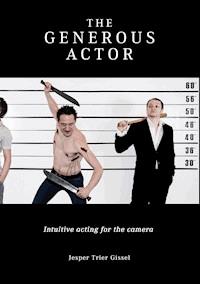
Cover photo: Morten Rygaard
Cover design: Darius Vaikas
Acknowledgements
Many people have helped in many ways bringing this book about, and first and foremost, I would like to thank Nørgaards Højskole’s staff and students for giving me the opportunity to do what I think I do best! Furthermore, special thanks go to: Carsten Myllerup, Nanne Parbst, Claes Quaade, Kenneth Carmohn, Tobias Lund, Gro Therp of Art Cast, Lukas Løkken, Steen Herdel, Thomas Dalmo, Kristian Fjord, FFD, Jesper Zuschlag, Ida Cecilie Kildeberg Jørs, Anne Brix, Therese Helga Emborg, Mads Klougart, and Rasmus Gissel (the Kaffir Buffalo of Proof-Reading!)
Testimonials
For full testimonials go to the final pages orfacebook.com/thegenerousactor
Over the years I have sharpened my own approach, and of course reflected a lot on the subject only to realize that this book in a broad sense explains exactly how I work now. To read so concrete and detailed a presentation of what feels like my own, private approach was indeed very interesting and rewarding.
Claes Quaade, actor and Danish Academy Award Nominee
There are many ways to enter the world of acting. The Generous Actor is a great and useful tool to opening the door and entering that magical world.
Carsten Myllerup, director of film and television, founder of the Super 16 film school
Jesper has a profound understanding of the core of acting and has used his knowledge and abilities to create a well-structured course, which despite our different approaches complements my work at The National Danish Film Acting Academy really well. I hereby recommend this book to anyone interested in acting and film!
Kenneth Carmohn, actor, acting coach, founder of Carmohn Technique and The National Danish Film Acting Academy
Working with Trier has taught me that the path to good acting leads through myself. Trier has created an approach which really embraces and supports the actor in his or her training. I give The Generous Actor my strongest recommendations!
Kristian Fjord, actor and acting coach
It is my impression, that his book could be very significant in shaping the standard view on film acting, and I hope that it will reach a wide audience among acting students and professionals alike.
Steen Herdel, producer and director
Do we really need another book on acting, when it doesn’t even present us with a new method? Well, maybe that is exactly what we need: A non-method that avoids the restraining rules of technique and liberates the artistic creativity of the individual.
Jesper Zuschlag, actor and acting coach
…I would call (Trier’s approach, red.), ‘no bullshit acting’. If you need to do this or that to act well, by all means do it. But if you don’t, then don’t and let’s work and enjoy it, no matter whether it’s comedy, action, or heavy, hardcore realism. (…) Despite his long experience and in-depth knowledge of acting theory and training, he still has an enthusiasm which sweeps you away and makes you want to have fun while doing your best. And it’s all here in this book.
Lukas Løkken, actor
For Asta, Magnus, Marie,and Katrine!
Thoughts, Theory, and Background
Preface
What’s This Book About?
What is Good Acting?
But if I tell you a story
Further into the Woods! – about Comedy, Action, and Unreal Acting
Training and Exercises
Lazy Egyptians, Course Overview, and Principles of Structure
Preparation
Common Problems
Memory Monologues
The Packing Exercise
Blanks, Stories, and Pitbulls
Flow Choreography
Training with scenes
Shakespeare
Comedy
Under Direction and Casting
Appendix A: Like Jorn to a Canvas
Appendix B: Actor’s Agonism – a small warning to young actors
Preface
‘It’s Just Fucking Around’
As acting teachers we find ourselves facing a classroom with a bunch of actors longing for us to help them realize a dream. These actors are entitled to the same amount of attention and training, which we of course strive to provide. The problem here is that acting training almost cannot exist without people working in pairs. And even if we tell them and ourselves that 'it's good training to watch others work', even the most dedicated actors sometimes find it hard to concentrate through a long session of watching pairs working on scenes.
Another issue is that if we really wish to be good at our jobs, we can't help but try to find a way to train our actors in some clever way where we do something which is not acting, but which somehow makes them better at the things actors do when they act. So, what do actors do? Well, they speak, they move, they feel, they listen, they prepare, they understand, and they react. But does this mean that we can simply devise a heap of exercises focusing on each of these actions individually? It is a tempting thought. And doing it makes us feel competent because it satisfies our desire to sound like we know about acting. Actors also love it because it makes them feel like they are really learning something by having the craft broken down into these essential parts.
But, and yes, there is a 'but', it simply does not work that way; at least not for me. I did all of the above in the beginning. And it worked too, in the sense that my actors were really happy. It just turned out that I was not. It actually made me miserable. In the beginning, I could not understand why. I had happy actors and great feedback, so there really was nothing to complain about. Until I realized that, as an actor, I would never do what I taught my actors to do.
My own acting was developed on stage or in front of a camera, not through tuition, and I started teaching without ever having been taught myself. Out of a sheer desire to do well, I bought the main books in circulation at the time and set to work. The material was mostly modern variations on Stanislavsky, and it felt great to dive into all the academic speculations and hands-on tools and feel how I learned all these new things and how I grew as a teacher. I became more serious and more conscious about the different elements of character analysis. It tickled my knack for academic thinking (developed through my literature studies and teaching at the university) to be using these skills for acting. I felt professional. I was able to do something which I could teach others.
The actors loved it. They showed up all eager to learn, and with my hands-on analytical approach I soon turned them into serious aspiring professionals. They did the exercises. They learned how to take notes on intonation and pauses etc. and the feeling of mastering acting by gaining control is extremely gratifying to both actors and teachers. Especially if they want to reassure themselves that they are learning something. When their parents asked them what they had learned, they could talk about all the different tools and the parents could nod and feel reassured that their kids’ acting dreams were being seen to in a constructive manner.
But, like I said, I started feeling miserable and in the beginning I couldn’t figure out why. As I watched my actors happily gaining control, I would smile and compliment them, but I grew more and more sick to the stomach. It actually came to the point where I went to my boss and asked her to find another teacher because I felt something to be amiss. She told me to calm down and mentioned my excellent actor feed-back, so I stuck with it. Out of sheer desperation I turned to amazon.com where I looked up ‘acting’. I still have no clue why I decided on Guskin’s How to Stop Acting. Perhaps something in the title signaled a departure from the work I was doing but the fact remains that I bought that book, and only that book.
When it arrived, I started reading immediately. And already after a page or two I felt more at home and alive than I had ever done in all my professional life as an acting coach. I knew right there that this was what I wanted to teach. Here was a guy saying all the opposite things of what I was doing in classes and it instantly resonated with me. I turned page after page knowing that each line would be wonderful. I ran to the kitchen and told my wife that I had to change everything. She of course looked at me the way wives do when their husbands are clearly out of balance and told me to calm down, which I tried. But I knew then that this was it for me. Guskin had pulled me out of the hole I had been digging for myself and shown me my way.
I was finishing a group of actors at the time, and I tentatively started opening up the possibility of there being another way even if I could find no proof of anyone teaching like that in Denmark. By sheer luck, I had the highly acclaimed Danish director and film acting teacher Charlotte Sieling, now a well established as a major league director with series like Homeland, visit my school shortly afterwards. She sat down in front of my actors and said, ‘I am now going to tell you what I tell everyone, no matter how much experience they have. I want you to forget everything you’ve learned and just do what I say’. And then she started teaching in a way so much in the same vein as Guskin’s that my mind went on the second rollercoaster ride in around two weeks. Someone in the Danish business thought as I did, and I was on the right path.
Since then, I have discovered more and more like-minded people in the business and my network of directors, casters, producers, actors, and acting coaches has been increasing ever since. And I have the pleasure of seeing some of my former students appearing in leading roles in both the cinema and on television, and even more of them appearing in smaller roles, commercials, sketches and the like. Many of these people have contributed to this book by reading and commenting, so I have been able to draw upon the experience and insight of professionals on many levels of the business. Especially, director, Carsten Myllerup, actor and Danish Academy Award Nominee, Claes Quaade, and acting coach, Kenneth Carmohn of The National Film Actors’ Academy of Denmark have been invaluable through their comments, suggestions, and willingness to discuss my work and their own.
Harold Guskin
Harold Guskin lives in New York City and has worked with a truly impressive selection of the most celebrated actors in the industry (Matt Damon, Jean Reno, Michelle Pfeiffer, Michael J. Fox to name a few). In 2013, I went to New York to work with him and discuss my approach, exercises, and course structure. And at the end of my first session he said the words which by know have become almost a mantra of my studio: ‘Do you know what acting is? It’s just fucking around’.
This statement, this culmination of a life in acting is the simple, crisp, unavoidable conclusion. The actor needs to free himself of his desire to control his art by methods, tools, and technique. Only by making himself completely available to the script and the moment will he be able to free all his creative power, creating true, surprising, interesting, arresting performances. He needs to truly acknowledge and embrace the simplest and biggest truth of acting: 'It's just fucking around'.
This is not particularly difficult to say. And you can easily line up your actors the first day and tell them that they should not be burdened with technique or method. But how do you teach it? How do you make actors really feel and understand it? And how do you develop them into the kind of actors who are courageous enough to put themselves completely at the mercy of their own instinct and intuition?
To me, the ultimate lesson taught by Guskin is this: when you stop expecting, controlling and searching, you are suddenly open to all your impulses, and your instinct can work freely and release all the wonderful, quirky, poetic, and brilliant ideas inside if you TRUST yourself enough! My big challenge has been to make his idea work in a classroom full of actors. Guskin usually works with one actor at a time. And since I can’t simply take one actor at a time while the others wait I have had to figure out how to apply what I so strongly believe to be the best approach to acting to a group of up to 14 actors.
What’s Different about this Book?
This book is fueled by the acting philosophy of Harold Guskin, but it is a very different book from How to Stop Acting. It contains my own explorations into both the thoughts behind why I think as I do and how I teach it. Guskin’s approach is only truly Guskin’s when he teaches it himself. More than anyone else I’ve encountered, who dared to write about his work, he is an integral component of his own work.
My hope is that this book can build on Guskin’s foundation, shedding new light on the connections between art and acting and provide exercises which may be applied to both studios and personal acting development. Only in the section on preparation do I rely heavily on Guskin’s famed ‘Taking it off the Page’. But that is because, to me, there is no better way to forge the connection between actor and script. It’s how I work, so of course it’s part of my book. And I hope it can be a source of inspiration to anyone interested or working with acting. But I strongly recommend also reading Guskin’s ‘How to Stop Acting’. It’s crisp, it’s clear, and it’s endlessly inspiring.
What’s This Book About?
The great Russian director, Eisenstein, once made a film sequence where, first, an old man was filmed up close. Then came a scene where his son was being tortured whereupon we again turned back to a close-up of the old man. Now we could see him experience the pain suffered by his son and we understood there to be a deep bond between father and son. Spectators were all impressed with the old man’s skill in portraying the developing pain he felt while his son was being tortured. Without him overacting or playing for effect everyone saw his internal agony written in the thin lines of his aged face. It was in other words a truly commendable performance. Nevertheless, Eisenstein soon revealed that the two shots of the old man were actually identical, meaning that there was no development in what the father did. It was just the same shot again.
What Eisenstein managed to prove here is a thing which most acting schools to my knowledge are not very keen to admit, namely that the meaning of a film is to a very large degree created by the audience and not by the actors. The effect of the torture scene in between the two shots of the father is that the audience experiences the second shot of the father with an emotion and understanding, making them believe that they see the father sensing the torture of his son. But this story was not played by the actor. He just sat there…
Eisenstein regarded filmmaking as ‘a juxtaposition of images’. He thereby called attention to his view that making sense of and understanding a movie is always orchestrated by the director but performed by the spectator. And this idea that the audience plays a great part in writing the story themselves is fundamental to the type of acting described in this book.
Another example is Sean Penn in the end of Mystic River where his whole world collapses and he breaks down and is dragged away. Allegedly he was asked afterwards what he had been thinking of while portraying such deep internal agony. Penn answered ‘lunch’. The moviegoers wrote the story. Penn was just there. If he had been trying to show us his pain, we would have seen agony but have felt the lie that he wasn’t actually hurting and it would have been a lot less powerful. But because he was true to his feelings whatever they were in that moment, we automatically deduced all the pain needed for this amazing shot. If the actor manages to be truly free and ‘in the moment’, the audience will read their own feelings into whatever the actors do.
Pick-up Lines
In the beginning inexperienced actors often say to me ‘but I’m trying’ and I always tell them ‘if you’re trying, you’re lying’. If they try to feel, to look, to act, to cry, to scream, they are not doing it; they are trying to be something they are not, which makes them liars. And audiences do not respond well to liars. Usually they do not think about such actors as liars, but an odd feeling of being manipulated settles in their stomachs. Either you do it, or you don’t. If Penn had been trying to show us he hurt, he would have been lying. But he did not try; he just ‘did’, and that made the audience create the story they needed.
I always compare this to young men at parties trying to pick up girls. Young men, especially, have a strong tendency not to trust themselves in such situations, so they try to come across as better looking, smarter, funnier etc. than they really are. Out of insecurity they end up trying to be something they are not. And we all know what a young man trying to impress a girl with lame pickup-lines looks (and feels) like; it’s not pretty, and it doesn’t work. And girls usually develop an odd feeling of uneasiness because their instinct tells them they cannot trust the guy. They sense the lie. Any guy would stand a much better chance just being himself. But we all know how difficult that is. It is actually as difficult as it is for an actor to simply let go and be himself while acting. Same as the guy at the party, the actor must not lie! If he does, the audience senses the lie and starts wondering what the guy in costume is up to. If he stays true, the audience is (hopefully) swept away by the director’s juxtaposed images and start telling themselves stories.
It is very common to consider actors storytellers, and it does sound impressive and important so it’s easy to agree with. But I don’t. It is NOT the job of the actor to show and tell the story; the job of the actor is simply to live the parts and scenes chosen by the director so he can get the shots he needs. If anything, the actors are secret keepers whose job it is to intrigue and fascinate us so we stay with the movie.
Summing up: I promote an intuitive approach to acting. I want logic and academic, analytical thinking to be as far removed from the process as possible. I want actors to let go and be in the moment – not only when acting, but also when preparing and training. I want actors to make no choices what so ever about how they are going to act a scene or say a line. I want their preparation and talent to ensure that the scene is completed from beginning to end without relying on conscious decisions. I want the actor’s inspiration to be the engine behind everything he does. I want the actor to let go. I want free and fascinating actors. I want the actor to be alive and have fun! And that is what this book is about.
How to Teach it?
So what do I actually teach if not analytical tools to uncover the deeper meanings of characters and script? My teaching is to a much larger degree training. I believe actors should strive to do without tools. A recent book on Stanislavski claims that we all know the parts that just fit us instinctively, where we do not need to work, but when that does not happen you need a ‘wrench’ (i.e. a tool to fix it). I disagree. When that does not happen, you need to make it happen by working on and with your instinct. Tools can be necessary to solve problems here and now if you have a strict deadline and your preparation didn’t leave time for your instinct to kick into action. As I see it, tools like objective, point of views, and turning points will almost always limit the actor, which can be necessary while working, but should be avoided while training.
The idea behind my teaching is to work on my actors’ ability to open themselves up to their instincts so they become able to absorb any kind of script or role without worrying about objectives and points of view. It takes longer and it is hard work. It is frustrating to suddenly not have the safe haven of a tool to guide you. But when they do get it, it is a liberation. Acting becomes fun, surprising, and intense to a degree which it is very difficult to attain in any other way. Many actors remember ‘that time when something went terribly wrong on stage but they managed to get through in a way which was much better than the original plan’. They remember how alive they felt, how thrilling it was to be unsafe and out of control. That is my goal. Truly living actors who feel safe without being in control and whose every moment working is a step into the unknown.
I have chosen to divide this book into two parts: The first part discusses the nature of art and acting as an art form. Some of it may seem rather heavy and academic and if this does not interest you, I suggest you skip them (but try reading them first). But in case you wish to know why I think as I do these are where you will find my underlying philosophy of acting. The second part is an almost complete description of the course I teach so this part deals directly with acting, preparation, training, working, and casting. I’ve also added two appendix essays which didn’t fit in the progression of the theoretical chapter, but which are both included because I find them highly relevant. They are in other words darlings I couldn’t kill.
I should also stress that I teach acting for the camera. This means that many exercises are filmed and evaluated as opposed to ‘just’ performed. But the main difference from stage acting is merely that the actors get used working under film set conditions. Instead of always having an audience somewhere, there is a camera, which makes the scenes turn out very differently from a stage version. But the fundamental philosophy actually applies to both the stage and the camera. The difference, as I understand it, is more a question of getting used to working in front of the camera, which basically means that it’s mainly a question of training.
How is my work different?
Through my expIorations over the last years, I have ended up with a course which is structured like Grotowski used to work by using a via negativa. Via negativa means that Grotowski did not train individual elements of acting in separate exercises, but developed exercises where the actors’ various areas of improvement would become apparent. In the same way, I aim to make all exercises bring all aspects of acting into play in a way so that 1) the actors undergo as many experiences as possible of what it is like when it really works, and 2) their various obstacles and short-comings are discovered and dealt with. This means that e.g. I don’t do voice training for everyone as an integrated part of the course. But if an actor is discovered to have a problem in that area, we deal with it; but not unless it is necessary.
By far the most part of the problems I discover are actually dealt with automatically through the exercises I use. I believe this is because the sheer training in letting go and trusting yourself in itself is a very powerful way of getting to the bottom of who you are. And when the actors start getting the feel of who they are, their tensions, their fears, and their obstacles have a way of solving themselves.
I had a male actor once who was tall, handsome, cool, clever, fun, and somehow undeniably feminine in his movements. It wasn’t much, but it was there. He was one of those people where you somehow simply assume that they are homosexual. Now this obviously becomes a problem when he has to act scenes where he is supposed to flirt or have some sort of sexual chemistry going with a girl because we get a whole different story. So I, of course tentatively, had to try to talk to him about this. Slightly stammering I muttered the word ‘feminine’ and he just said flat out: ‘You’re saying I look gay?’ ‘Well, yes’. ‘Well, I am gay so what do we do?’ At the time I really didn’t know how to deal with this. But we talked about it and agreed not to dwell on it and simply continue working. And, very interestingly, after a couple of weeks it was gone. He suddenly became strong and masculine while acting to a degree where it was almost embarrassing for us straight guys to look at. And all that we had done was to articulate it, let it go, and get on with the training.
Obviously, one should not read too much into this one example. But I have seen many young actors lose all kinds of habits and tics by simply committing to the acting training. I am convinced that something happens when you start surrendering to each moment. You are forced to being honest, to let down your guards, to tear down the emotional safe-houses you have built all your life to protect and hide your true self. The actor as a person has to be the same as the actor working. And therefore there is no way around the fact that acting training must necessarily also deal with the actor as a person. There is an old saying that the actor’s person is his instrument, so it has to be in tune. This may sound corny to some, but it’s true none the less.
To me there are roughly speaking three platforms on which to work with actors:
Training focusing on familiarizing the actor with his body, mind, emotions, experience, focus etc. (his instrument) and developing these to make the actor more responsive and available. We expand the actor’s range and make everything he contains available to him so more things can happen while working.
Training dealing with the actors’ working with script. How do you prepare? How do you build a relationship to script/character? How do you learn something by heart in a way which sets you free while working? How do you merge with the script so the outcome becomes unique, fascinating, and surprising? How do you train and develop while working with text?
Training focusing on how to work under direction. How do you deliver the goods while actually working on a set? How do you make your inspiration merge and grow with the director’s inspiration?
By far the most acting training I have witnessed, tried, or read about falls into categories one and three. Number one is where e.g. Meisner (at least as taught by many), Grotowski, and my fellow explorer of intuitive acting, Kenneth Carmohn of The National Danish Film Acting Academy put their emphasis while training actors. Number three is where by far the most film acting courses I’ve come across focus: ‘we have some actors and now we make the best scenes we can’.




