


22,99 €
Mehr erfahren.
- Herausgeber: John Wiley & Sons
- Kategorie: Geisteswissenschaft
- Serie: New Directions in Ethics
- Sprache: Englisch
In The Good Representative, Suzanne Dovi argues that democratic citizens should assess their representatives by their display of three virtues: they must be fair-minded, build critical trust, and be good gatekeepers.
- This important book provides standards for evaluating the democratic credentials of representatives.
- Identifies the problems with and obstacles to good democratic representation.
- Argues that democratic representation, even good democratic representation, is not always desirable.
- Timely and original, this book rejects the tendency to equate respect for the preferences of citizens with neutrality on the standards used in choosing their representatives.
Sie lesen das E-Book in den Legimi-Apps auf:
Seitenzahl: 501
Veröffentlichungsjahr: 2012
Ähnliche




















Table of Contents
Cover
Dedication
Title
Copyright
Preface
Acknowledgments
Chapter 1: Who is a Good Representative?
An Ethics of Democratic Representation
The Proper Scope of an Ethics of Democratic Representation
Three Assumptions
The Theoretical Contribution of
The Good Representative
The Structure of
The Good Representative
Chapter 2: Moving beyond Descriptive Representation
Democratic Representation and Descriptive Representation
Two Problems with Descriptive Representation
Justifying the Silence about Criteria
The Need for Criteria
The Need for Democratic Standards
Chapter 3: Democratic Advocacy and Good Democratic Representation
The Scope of Democratic Representation
Sources of Authority for Democratic Representatives
Holding Democratic Representatives Accountable
Existing Standards for Identifying Bad Representatives
Why Democratic Standards?
The Importance of Function
The Three Virtues
Democracy and Democratic Citizens’ Preferences
Chapter 4: The Virtue of Fair-Mindedness
Political Efficacy
Democratic Efficacy
Why Civic Equality?
The Meaning of Civic Equality
Using the First Virtue to Evaluate Representatives
Two Problems with the First Virtue
Chapter 5: The Virtue of Critical Trust Building
Democratic Representation and Participation
Problems with Evaluating Representatives by Citizen Participation
The Virtue of Critical Trust Building
Promoting Critical Trust
Problems with the Second Virtue
Chapter 6: The Virtue of Good Gatekeeping
Developing the Right Relationships
The Scope of Mutual Relations
The Virtue of Good Gatekeeping
A Perspective of Exclusion
Problems with the Third Virtue
Conclusion
Chapter 7: Preferable Democratic Representatives: Real-World Political Virtues
Preferability and the Virtues
Preferability and System-Dependency
Are Good Descriptive Representatives Good Democratic Representatives?
Choosing among the Virtues
Bad Democratic Representatives
Notes
References
Index
End User License Agreement
Guide
Cover
Table of Contents
Begin Reading
Pages
Cover
Contents
ii
iii
iv
viii
ix
x
xi
xii
xiii
xiv
1
2
3
4
5
6
7
8
9
10
11
12
13
14
15
16
17
18
19
20
21
22
23
24
25
26
27
28
29
30
31
32
33
34
35
36
37
38
39
40
41
42
43
44
45
46
47
48
49
50
51
52
53
54
55
56
57
58
59
60
61
62
63
64
65
66
67
68
69
70
71
72
73
74
75
76
77
78
79
80
81
82
83
84
85
86
87
88
89
90
91
92
93
94
95
96
97
98
99
100
101
102
103
104
105
106
107
108
109
110
111
112
113
114
115
116
117
118
119
120
121
122
123
124
125
126
127
128
129
130
131
132
133
134
135
136
137
138
139
140
141
142
143
144
145
146
147
148
149
150
151
152
153
154
155
156
157
158
159
160
161
162
163
164
165
166
167
168
169
170
171
172
173
174
175
176
177
178
179
180
181
182
183
184
185
186
187
188
189
190
191
192
193
194
195
196
197
198
199
200
201
202
203
204
205
206
207
208
209
210
211
212
213
214
215
216
217
218
219
220
221
222
223
224
225
226
227
228
229
230
231
232
233
234
235
236
237
238
239
240
241
242
243
244
245
246
247
248
249
250
251
252
253
254
255
256
257
258
To Houston, my love
The Good Representative
Suzanne Dovi
University of Arizona
This paperback edition first published 2012© 2012 Suzanne DoviChapter 2 is largely based on Suzanne Dovi’s “Preferable Descriptive Representatives: Or Will Just Any Woman, Black or Latino Do?” pp. 745–54 from American Political Science Review 96 (2002). Reprinted by permission of Blackwell Publishing Ltd.
Edition history: Blackwell Publishing Ltd (hardback, 2007)
Blackwell Publishing was acquired by John Wiley & Sons, in February 2007. Blackwell’s publishing program has been merged with Wiley’s global Scientific, Technical, and Medical business to form Wiley-Blackwell.
Registered OfficeJohn Wiley & Sons, Ltd, The Atrium, Southern Gate, Chichester, West Sussex, PO19 8SQ, United Kingdom
Editorial Offices350 Main Street, Malden, MA 02148-5020, USA9600 Garsington Road, Oxford, OX4 2DQ, UKThe Atrium, Southern Gate, Chichester, West Sussex, PO19 8SQ, UK
For details of our global editorial offices, for customer services, and for information about how to apply for permission to reuse the copyright material in this book please see our website at www.wiley.com/wiley-blackwell.
The right of Suzanne Dovi to be identified as the author of the editorial material in this work has been asserted in accordance with the UK Copyright, Designs and Patents Act 1988.
All rights reserved. No part of this publication may be reproduced, stored in a retrieval system, or transmitted, in any form or by any means, electronic, mechanical, photocopying, recording or otherwise, except as permitted by the UK Copyright, Designs and Patents Act 1988, without the prior permission of the publisher.
Wiley also publishes its books in a variety of electronic formats. Some content that appears in print may not be available in electronic books.
Designations used by companies to distinguish their products are often claimed as trademarks. All brand names and product names used in this book are trade names, service marks, trademarks or registered trademarks of their respective owners. The publisher is not associated with any product or vendor mentioned in this book. This publication is designed to provide accurate and authoritative information in regard to the subject matter covered. It is sold on the understanding that the publisher is not engaged in rendering professional services. If professional advice or other expert assistance is required, the services of a competent professional should be sought.
Library of Congress Cataloging-in-Publication Data
Dovi, Suzanne Lynn, 1966–The good representative / by Suzanne Dovi.p. cm.Includes bibliographical references and index.
ISBN: 978-1-4051-5578-6 (hardcover : alk. paper) ISBN: 978-1-118-36061-3 (paperback : alk. paper)1. Representative government and representation. I. Title.JF1051.D68 2007321.8—dc22
2006022219
A catalogue record for this title is available from the British Library.
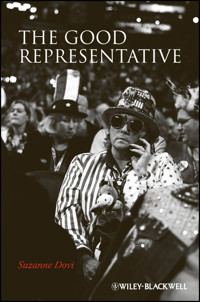
Cover image: Cell Phone Nation: the 2004 Democratic National Convention, Boston.Photo © 2006 Karen Ballard. Cover design by Cyan Design.
Preface
Is President George W. Bush a good or a bad representative? How about Russian President Vladimir Putin? Who is a better representative according to democratic standards: former Representative Tom DeLay or Senator Hillary Clinton? Contemporary political theorists do little, if anything, to help us answer such questions. Indeed, some treat citizens' preferences for representatives as sacrosanct, something that political theory should remain silent about.
However, as more and more nation states become democratic (at least in the sense that they hold elections), evaluating states simply by their institutional design is not enough to determine how democratic those states are. The actions of representatives need also to be evaluated. Political representatives matter. They matter a great deal. After all, political representatives can undermine democratic institutions by, for example, writing discrimination into constitutions. If democratic institutions are to survive, representatives need to resist the pull of extremism, and fight for the legitimacy of those institutions. And democratic citizens need to appreciate representatives who undertake such battles. Otherwise, representatives can and will give democracy a bad name.
In fact, what motivated me to write this book was my realization that democratic citizens can make very bad choices in selecting their representatives. When they choose their representatives simply by their looks, or by whom they would like to have a beer with, citizens put democratic institutions at risk. They should not ignore the impact that a representative is apt to have on those democratic institutions. And political theorists need to speak up about this risk.
We need to identify democratic standards for selecting representatives because the legitimacy of a polity's democratic institutions depends on the representatives and citizens who make up that polity. Everyone realizes that democratic institutions do not live up to their ideals. In fact, no democratic institution has ever lived up to democratic ideals. However, the ability of democratic institutions to approximate their ideals depends, in no small part, on who represents democratic citizens and how they represent them. Representatives and citizens alike need to know what it means to represent in a democratic fashion. And they need to be equipped with standards that help them differentiate the good representatives from the bad.
This book tries to do just that. It offers three distinctly democratic standards that democratic citizens should use in selecting their representatives. I do not expect everyone to agree with my standards. The goal of this book is not to settle all disagreements about who are good representatives. Rather, I will count the book a success if it starts a public dialogue about what democratic citizens should look for in a representative. My book argues that democratic citizens need to do more than apply existing standards of "moral character." They need to evaluate representatives by their ability to settle political conflicts fairly and justly. And this requires attending to three virtues of democratic representation: good representatives are fair-minded; good representatives develop critical trust; and good representatives are good gatekeepers.
When I say "good representatives," I mean good democratic representatives. I recognize that citizens choose representatives who they consider good for a wide variety of reasons: Some representatives are regarded as good because they make people rich. Other representatives are seen as good because they condemn sin when they see it. Some representatives are judged good because they are progressive. My understanding of the good representative differs. A good representative, in my sense, excels at representing in a democratic fashion. The three virtues of democratic representation specify what it means to be a good democratic representative. They serve as standards that citizens can use to identify those representatives who will allow democratic institutions to approximate their ideals.
The Good Representative will also be controversial because it argues that good democratic representation might not always be desirable. Of course, democratic representation offers a lot of potential benefits for democratic citizens. But democratic representation – even good democratic representation – suffers from certain problems. It takes time. It is inefficient. It can require sacrifices on the part of citizens. Sometimes, it is easier to let other people rule us than it is to monitor our representatives. What is more, democratic representation can be dangerous. Bad representatives can use democratic institutions as tools of domination. Democratic citizens need to choose their representatives with an eye on these problems. Under certain circumstances, it is not desirable to be represented in a democratic fashion. How much democratic representation is desirable will depend on the capacities of citizens and their representatives to sacrifice for the sake of their democratic institutions.
The three virtues that distinguish the good representatives from the bad make up the heart of this book. Chapters 4, 5, and 6 articulate these virtues, and explain how they serve as standards that citizens can use in evaluating their representatives. Those who want to cut to the chase, so to speak, may want to begin with Chapter 1 and then skip Chapters 2 and 3, to get to the detailed discussion of the three virtues. Chapter 2 deals with the relationship between descriptive representatives and democratic representatives. It suggests that the experiences of those who have been deeply betrayed by democratic institutions can teach us why it matters who represents us. The past experiences of certain groups show that all democratic citizens need to remain suspicious of their representatives. Chapter 3 is for the more philosophically minded. It provides a justification for my understanding of democratic representation and for my ethics of democratic representation. In particular, it shows that existing standards cannot explain why Tom DeLay is a bad democratic representative.
Chapter 7 considers whether the virtues of democratic representation are naïve – too idealistic for real-world politics. In particular, I argue that these democratic ideals are not a coherent bundle – sometimes, we need to choose among the virtues. Such choices are hard, but we need to attend to them – and not rest content with pointing fingers at the failings of our representatives. It is also important that democratic citizens have good enough choices. Not only do democratic citizens need to appreciate democratic representatives who are good enough; when a democratic system gives them uninspiring and anti-democratic choices, they need to demand alternatives. The rhetoric of politicians is not enough to make them democratic. I will argue that to represent in a democratic fashion, they need to advocate in a way that fosters the legitimacy of democratic institutions. And to be good democratic representatives, they need to do even more.
Suzanne Dovi
Acknowledgments
I could not have written this book without the help of many people. In fact, this book took such a long time to write that I have incurred a serious number of intellectual and personal debts in the process. I apologize in advance to those whom I have inadvertently forgotten. First and foremost, I need to thank my family for their love and support. As usual, my mom, Pat Dovi, went above and beyond maternal obligations. She provided help with the references, crucial babysitting services during the final stages of the book, and an endless supply of warmth and laughter. My dad, Sebastian Dovi, taught me how to argue about politics. My big sister, Patty Kent, and my little sister, Cynthia Bucalo, were dependable and loving, helping me keep the daunting project of writing a book in perspective. I have a long list of other relatives whose love has made all the difference: my grandparents, Mary and Vince Bresan; my brother, Sebastian Dovi; and also Kelli Young Dovi, Susan Kuzy, Sebastian Dovi, Shelbey Dovi, Skyler Dovi, Sydney Dovi, Jack Kent, Katie Kent, Sam Kent, Edna Smit, and Mary Smit. My son, Hayden, would have liked his mommy to work on the book less and play more. I cannot thank him enough for providing so many giggle breaks.
Second, I have also been blessed with truly great and inspiring teachers. This book grew out of my doctoral dissertation, completed in the Department of Politics at Princeton University under the supervision of Amy Gutmann, Jennifer Hochschild, George Kateb, and Gerry Mara. Each provided important insights that were incorporated into the book. Amy Gutmann taught me the importance of conceptual clarity and precise thinking. George Kateb taught me the importance of remaining skeptical toward ideals. His provocative questions helped keep me from simply taking for granted the importance of democratic community. Jennifer Hochschild taught me how political theory can be done in a way that balances empirical political science and normative theory. I have benefited tremendously from her constant supply of advice and her nose for interesting ideas. My conversations with Gerry Mara have been an enduring source of intellectual excitement. I would also like to acknowledge the support of Mark Warren, whose work and friendship have had an exceptional influence on my thinking. Finally, I would also like to thank my graduate and undergraduate teachers: Nancy Bermeo, Alisa Carse, John Diulio, Bruce Douglass, George Downs, Elizabeth Kiss, Roger Masters, Alan Ryan, Carol Swain, and Sue Thomas. Each of these teachers contributed to the thinking in this book in important ways. Of course, the mistakes and errors there are all mine.
Princeton University provided an exciting intellectual environment for developing one's ideas. I am particularly grateful to the Woodrow Wilson Foundation for a fellowship from 1996 to 1997, and to the Center of Human Values for a fellowship from 1995 to 1996. In addition, I would like to thank the Mellon Foundation and the Spencer Foundation for, respectively, a fellowship and a summer research grant. I would also like to thank my friends from graduate school: Jonathan Allen, Sharon Barrios, Dana Ansel, David Callahan, Hawley Fogg-Davis, Stephanie Jencks, Michael Jones-Correo, Victoria Kamsler, Jessie Klein, Jacob Levy, the late Moshe Levy, Tony Lucero, Brenda Lyshaug, Kimberly Morgan, Kris Palmer, Scarlett Soriano, Peter Rowinsky, Rueul Rogers, Dietlind Stolle, Carol Tracy, Alex Tuckness, David Wecker, Brian Williams, Andrew Zawecki, and particularly, the marvelous and irreplaceable Judy Failer.
I started turning the dissertation into a book as an Assistant Professor at the University of Arizona. My junior year sabbatical, funded by the College of Social and Behavioral Science, and a fellowship from the Udall Center gave me the time to make this transformation. For their helpful advice, support and conversations during this process, I would like to thank Denise Allyn, Julia Annas, Mark Chavez, Tom Christiano, Lis Clemens, Richard Dagger, Sally Deutsch, Bill Dixon, Tim Duvall, Martha Fenn, Caryl Flinn, John Garcia, David Gibbs, Gretchen Gibbs, Michael Gill, Gary Goertz, Sarah Griffiths, Bernard Harcourt, Kristen Hessler, Cindy Holder, Reeve Huston, Brad Jones, Kris Kanthak, Margaret Knight, Paulette Kurzer, Orsi Lazar, Colleen Loomis, Mike Mann, Bill Mishler, Ami Nagle, Cary Nederman, Cara Nine, Barbara Norrander, Antxon Olarrea, David Owen, Spike Peterson, Kathy Powers, Rob Reich, Mia Ruyter, Andy Sabl, David Schmidtz, John Schwarz, Sarah Soule, Bea Urrea, Tom Volgy, Chad Westerland, Pat Willerton, and Christine Wolbrecht. I would like to thank the graduate and undergraduate students whose questions often fueled my own research. Deep appreciation for reading various parts of this book goes to Robin Brande, Sigal Ben-Porath, Ben Berger, Simone Chambers, Tom Christiano, Kristen Hessler, Jacob Levy, Cary Nederman, Andrew Rehfeld, Andrew Sabl, John Schwarz, Jeff Spinner-Halev, and Mark Tessler. Giorgios Sotiriou and Becky Wyatt were helpful research assistants. Melissa Williams made some crucial suggestions about using virtue theory at an early stage of the project.
I have presented bits and pieces of this project at a number of different academic forums. I would like to thank the audiences from the following departments of political science: the University of Notre Dame, Stanford University, the University of Colorado, Boulder, McGill University, Rochester University, Queens University in Belfast, Ireland, and the University of Arizona. I am also grateful to the participants in the 2003 meeting of the Cactus Political Theory League and to the participants in the workshop "The Transformation of Democratic Representation," organized by Mark Warren and Dario Castiglione and held at The Center for Democracy and the Third Sector at Georgetown University, Washington, DC, in 2004. I have also presented versions of this work to the American Political Science Association and to the Midwest Political Science Association. I am particularly grateful to Bill Bianco, Eileen Botting, Dario Castiglione, Yasmin Dawood, Richard Fenno, Russell Hardin, Jane Mansbridge, David Mapel, Patchen Markell, Horst Mewes, Susan Okin, Andrew Rehfeld, Jennifer Rubenstein, Dara Strolovitch, Alvin Tillery, Nadia Urbinati, Dorian Warren, Mark Warren, Laurel Weldon, and Iris Marion Young for their comments and criticisms on this project.
I also have many other dear friends to thank. My gratitude goes to Geeta Anand, Carrie Brennan, Jodi Washburn Christophe, David Earling, Gretchen Gibbs, Judith Greenberg, Ira Joseph, Matthew Lansburgh, Mike Mann, Jenny Raskin, and Nina Zitani. Without their encouragement and support, I would never have made it through this process. Robin Brande provided the carrots, or more specifically the chocolate, for finishing this project. Most of all, I would like to thank Sigal Ben-Porath, my dream friend and dream colleague, whose phone calls kept me going.
I literally could not have written this book if not for the childcare provided by Lisette DeMars, Loreen Jones, and Gabriela Novakova.
I am thankful to Patchen Markell and two anonymous reviewers for Blackwell Publishing for their incredibly helpful comments on the book.
Nick Bellorini was a wonderful editor, supportive and encouraging. My gratitude also goes to Geoffrey Palmer for this helpful copy editing.
Finally, I need to thank the person who literally made this book possible. Houston Smit read and commented on every word of this book. He talked through the various philosophical problems that I encountered. He had faith in the project when I lost mine. However, there's more. Houston took over the childcare duties when I needed time to work, let me sleep in when it wasn't my turn, and cooked delicious meals. For all that and more, I dedicate this book to Houston.
S. D.
Chapter 1Who is a Good Representative?
Most everyone writing on democracy today agrees that democratic institutions must be representative in order for democracy to work. The size of nation states and the complexity of public policy issues rule out direct democracy. Democratic practices require representation. Or as David Plotke (1997) succinctly put it, “representation is democracy.”
Despite this general agreement about the importance of representation for democratic practices, there is relatively little discussion of what it means to represent in a democratic fashion. There is an extensive literature evaluating democratic institutions.1 And there is an extensive literature that discusses the proper behavior of representatives.2 But theorists writing on representation have not focused on representing in a democratic fashion. As a result, theorists have overlooked the possibility that there are substantive and distinctively democratic standards for distinguishing good representatives from bad ones. The aim of this book is to offer just such standards, standards that democratic citizens ought to employ in evaluating their representatives.
Now, not everyone will agree that we need substantive democratic standards for evaluating representatives. After all, some theorists maintain that a good representative is simply one who advances the policy preferences of her constituents (provided that those policy preferences are lawful). Good representatives are good lackeys (the theoretical literature calls such representatives “delegates”). In fact, most contemporary empirical research on representation assumes that democratic representation occurs when a representative’s actions reflect and respond to constituents’ expressed policy preferences. According to this way of thinking, there is nothing more to representing in a democratic fashion than responsiveness to democratic citizens’ policy preferences.
Others will reject the project of articulating a single set of distinctively democratic standards. For instance, Hanna Pitkin (1967) maintains that the concept of representation is paradoxical, and that as a consequence representatives are subject to multiple and conflicting standards of evaluation. Following Pitkin, many contemporary political theorists simply celebrate the diversity of standards that democratic citizens use in evaluating their representatives. That diversity is itself understood as a characteristic of democratic institutions (e.g., Mansbridge, 2002; Sabl, 2002, 2005). For this reason, political theorists often refrain from characterizing any particular choice of representatives as undemocratic. So long as other citizens have the opportunity to oppose that choice and/or citizens are presented with alternative candidates, democratic practices are sufficiently safeguarded. Those who, in this way, equate a commitment to democracy with a commitment to pluralism tend to hold that all criteria for identifying good representatives are contingent, varying with the particular opinions, interests, and perspectives of different democratic citizens. And they defend this position on the grounds that it is minimalist and inclusive. It is minimalist because it does not assume that any particular ethical outlook underlies a theory of good democratic representation. It is inclusive because it is consistent with all citizens’ evaluations of their representatives.
However, on my view, democratic standards for evaluating representatives are more constraining. For such standards derive from an ethical outlook that privileges the legitimacy of democratic institutions. Consequently, these standards for evaluating representatives place substantive constraints on what good representatives can and should do. I call political representatives3 within a democratic polity who meet these standards “good democratic representatives.”4 Such political representatives excel at representing in a democratic fashion. More specifically, good democratic representatives are those political representatives whose advocacy work maintains and advances the legitimacy of democratic institutions.5 Such political representatives may be formal political actors, such as presidents, 6 senators, or other elected officials. But they may also be informal political actors, such as lobbyists or leaders of social movements. What matters is not a political actor’s official title or her specific political office, but what she does.7
In particular, a representative acts as a good democratic representative only if her advocacy work fosters the norms and values distinctive of democratic institutions. These norms and values are crucial to the well- functioning of democratic institutions – that is, to their facilitating peaceful and just resolutions of political conflicts. Good democratic representatives, then, advance public policies on behalf of democratic citizens in ways that facilitate peaceful and just resolutions of political conflicts. The degree to which democratic institutions, through the agency of good democratic representatives, realize the norms and values distinctive of democratic institutions is the degree to which those institutions are fully democratic.8 Three such norms and values are central to the purposes of this project: civic equality, self-governance, and inclusion.9
Other political values, such as liberty, toleration, the rule of law, or even piety, might coexist with democratic institutions, but they are not distinctive of democratic institutions. Consider, for example, that a benevolent dictator could support the norms and values of toleration and liberty, such as the freedom of religion, or the rule of law. A monarchy could promote a theocratic rule.
For a norm or value to be distinctive of democratic institutions, it must provide some guidelines for structuring formal political institutions as democratic institutions. It follows that these norms and values, including those of civic equality, self-governance, and inclusion, can only be fully realized in democratic institutions.
Of course, democratic governments do not always support or respect the norms and values of civic equality, self-governance, and inclusion. One only needs to survey the ways in which democratic governments have historically excluded or even enslaved certain groups to realize that democratic governments can violate these norms and values. However, we criticize such governments as democratic governments for failing to live up to these norms and values – a point that confirms that these norms and values are distinctive of democratic institutions.
So good democratic representatives are those who respect the norms and values distinctive of democratic political institutions. But this still leaves obscure the answer to the neglected question, “How should democratic citizens evaluate their representatives, as democratic representatives?”
Put simply, democratic citizens should evaluate their representatives by the way in which they advocate – that is, by how they advance public policies on behalf of democratic citizens. Democratic representatives represent democratically only when, in advancing public policies on behalf of their constituents, they aim to foster the legitimacy of democratic institutions, to promote citizens’ participation, and to increase their identification with democratic institutions. Those who represent in a democratic fashion honor these constraints on their advocacy work.
Articulation of these constraints on democratic representation provides guidelines for determining when individual representatives are no longer representing in a democratic fashion. These constraints, then, draw a line that good democratic representatives do not cross. Moreover, corresponding to each of these constraints is a way of excelling at representing in a democratic fashion, a way in which representatives can, in advocating on behalf of their constituents, respect and foster these distinctively democratic norms and values. I will call these forms of political excellence the “virtues of democratic representation” or, simply, “the virtues.” Each virtue provides a general criterion that democratic citizens ought to use in choosing their representatives. Together, these virtues provide a normative framework within which representatives should be evaluated.
That said, evaluations of democratic representatives cannot and should not be formulaic. Judgment plays an ineliminable role in the application of any criteria of good representation to particular democratic representatives. For example, it requires judgment to determine whether a particular president is, in meeting with the Black Congressional Caucus, reaching out to African-Americans and increasing their inclusion in the political process. After all, such a meeting could be just another “photo op.” Moreover, judgment must, in any such application, be sensitive to an array of particular considerations that cannot possibly be codified, or captured in a formula. For this reason, any adequate ethics of democratic representation must permit a variety of opinions about who are good democratic representatives. At the same time, it should provide a general framework through which public debates about who are good democratic representatives can be properly conducted.
It is important to acknowledge the difficulties that the virtues of democratic representation may pose, ones that may complicate the task of distinguishing good democratic representatives from bad ones. Indeed, the difficulties posed by the virtues may be fundamental. As we shall see, the three virtues of democratic representation that I distinguish can be in tension with one another. Some democratic representatives, despite their best efforts and intentions, will face situations in which they can fulfill the demands of one virtue only at the cost of failing to fulfill those of another. Furthermore, there are circumstances under which pursuit of a virtue of democratic representation may pose a cost – which can potentially be prohibitive – to a polity. If democratic institutions are to resolve conflicts fairly and peacefully, a balanced approach to the virtues of democratic representation, one that attends to the problems they pose, as well as to the benefits they provide, is crucial.
Indeed, I hold that the purpose of democratic institutions simply is to resolve conflicts within a pluralist society fairly and peacefully. And the legitimacy of democratic institutions relies both on adjudicating these conflicts properly and on democratic citizens recognizing the fairness of these resolutions. So, to the extent that good democratic representation is crucial for the proper operation of democratic institutions, it is also crucial to the legitimacy of those institutions. The virtues serve as constraints on representatives that help to insure the fairness and legitimacy of democratic institutions.
Further, the stability and sometimes the survival of democratic institutions depend on citizens seeing that the institutions are adjudicating conflicts fairly. For if a disgruntled minority or majority holds that democratic institutions are unfair, then such groups are likely to employ undemocratic practices – for example, violence – to settle their political conflicts. Unfair and illegitimate democratic institutions are more likely to devolve into totalitarian and authoritarian forms of government.10 And democratic citizens can, in turn, become accustomed to democratic institutions functioning as tools of domination.
A democratic society can only survive, let alone function properly, if it shows a kind of moderation toward the virtues of democratic representation. Here, too, it will be important to see that democratic representatives cannot always exhibit all of these virtues, but must sometimes choose among them. An examination of the various trade-offs among these virtues that good democratic representatives must make will help us to discern the requisite moderation. It will also suggest that good democratic representation might not always be possible.
The extent to which good democratic representatives can successfully negotiate the problems with democratic representation will depend, in part, on the capabilities of citizens and of their representatives. Sometimes a particular society might not be ready for democratic representation. Here, I follow John Stuart Mill (1991 [1861], 13), who recognizes that the appropriate form of government for any given society depends on the capacities of citizens. When citizens lack the proper capacities, democratic institutions cannot always function properly. Under such circumstances, democratic institutions can be used to dominate and oppress democratic citizens, and good democratic representation may even be undesirable. Good democratic representation is therefore a contingent political good. It is only desirable under certain conditions. Part of the job of good democratic representatives is to help make it possible for democratic institutions to function properly, by promoting conditions in which democratic citizens can come to appreciate the importance of having democratic representative institutions for settling disagreements among citizens fairly and peacefully.
The Good Representative proceeds on the working assumption that the norms and values that guide the design of institutional structures for democratic polities can also provide some guidance for the selection of the representatives who occupy positions within those institutions. Indeed, my argument draws on existing theoretical discussions of how formal institutions are to be designed in light of democratic norms and values to show how these norms and values should also inform citizens’ choice of democratic representatives. And, in doing so, I further the insights of those who have recognized the importance of informal political actors in representative democracies.11 In fact, one purpose of this book is to expand the scope of the theoretical literature on democratic representation beyond formal governmental institutions. Democratic representation is an activity of formal as well as informal representatives.
By identifying a function common to both formal and informal representatives – that is, the function of advocating public policies in ways consonant with democratic norms and values – I provide a common currency for evaluating all democratic representatives, one independent of their particular offices. Instead of focusing on the fairness of procedures for authorizing and holding representatives accountable, this book addresses an important, albeit often overlooked, question: What criteria should democratic citizens use in selecting democratic representatives? How democratic citizens answer that question will affect not only who is selected to serve as a representative, but also the performance of democratic institutions.
An Ethics of Democratic Representation
There are two basic questions that an ethics of democratic representation must address: What are the proper criteria for assessing democratic representatives and identifying the good ones? Are there any drawbacks to having good democratic representation? We will see that answering these two questions adequately turns on clarifying what it means to represent in a democratic fashion. And in clarifying that – in other words, the proper function, or characteristic activity, of democratic representatives – we also clarify what it means to be a good democratic representative – that is, one who excels at representing in a democratic fashion.
In focusing on the function, or characteristic activity, of democratic representatives, and deriving my account of a good representative from this function, I follow Aristotle. And I am assuming that there is a conceptual connection between the function, or characteristic activity, of a thing and its excellence as the thing that it is. Chapter 3 develops and defends this view. For now, it will suffice to see, quite generally, how virtues of a thing are read off of its function. For example, the function of a knife is to cut. A good knife is a knife that cuts well. The virtue, or excellence, of a knife, then, is sharpness. And, more generally, what it is for a thing to have the virtue or excellence proper to its kind is nothing other than its being disposed, in exercising its characteristic activity, to engage in that activity well. I am proposing that, in parallel fashion, the virtues of democratic representatives are to be read off of the function, or characteristic activity, of democratic representatives. (Compare, here, Aristotle’s argument concerning the moral virtues at Nicomachean Ethics Book I Chapter 7, 1097b25-28: see Aristotle, 1970 [1831].)
The function of democratic representatives is to advocate on behalf of their constituents in ways that allow for the fair and peaceful resolution of political disagreements within a pluralist society. In other words, the characteristic activity of democratic representatives is democratic advocacy. The degree to which a democratic representative engages in this characteristic activity well is the degree to which that representative excels at representing in a democratic fashion. As we will see, to engage in democratic advocacy well, a democratic representative must realize three virtues: the virtue of fair-mindedness, through which a representative contributes to the realization of the value of civic equality; the virtue of critical trust building, through which a representative contributes to the realization of the value of self-governance; and, finally, the virtue of good gatekeeping, through which a representative contributes to the realization of the value of inclusion.
It is worth reemphasizing that my understanding of democratic representation applies to all political actors who advance public policies in democratic institutions. Informal as well as formal representatives perform the function of democratic representation.12 My account of democratic representation, and the virtues of democratic representation, articulates a general ethical outlook that should underlie and inform the activity of all those who act as political advocates within a democratic polity.
In fact, a benefit of attending to democratic advocacy, as I conceive it, is that doing so provides standards for assessing informal, as well as formal, representatives. Attending to the controversies surrounding advocacy, especially the advocacy of informal representatives, in light of my account of democratic advocacy, reveals how democratic norms and values are to be brought directly to bear in assessing democratic representatives. In the case of many informal representatives, there is no temptation to try to settle such controversies simply by appealing to formal procedures that authorize the representative: after all, not all informal representatives are authorized by formal procedures. Consequently, one cannot appeal to authorization procedures to settle the matter of who is a legitimate, and therefore preferable, representative. Moreover, an examination of controversial instances of political advocacy – specifically, instances of informal representation – will put us in a better position to identify how and where representatives, even when they are properly formally elected and abide by the law, can nonetheless violate democratic norms and values.
To understand why democratic advocacy is the characteristic activity of democratic representatives, it is useful to consider one of the most persuasive arguments for the legitimacy of democratic authority. The argument, made forcefully by Thomas Christiano (1996), is that democratic institutions are necessary under certain conditions of diversity. In particular, democratic institutions are necessary to provide fair procedures for adjudicating disputes about public policy when citizens’ interests, values, and perspectives conflict. It is, I would argue, in virtue of realizing the norms and values of civic equality, self-governance, and inclusion that democratic institutions provide these procedures, and adjudicate conflicts and disagreements in ways that legitimate democratic authority. The function of a democratic representative, then, is to advocate public policies for her constituents in a way that contributes to the fair adjudication of such disputes within her society. A good democratic representative is one who performs this function well. And, I will argue, a democratic representative performs this function well only if her advocacy work is consonant with the norms and values that underlie the legitimacy of democratic institutions.
Of course, not all democratic representatives do in fact engage in democratic advocacy. Anyone who is elected is thereby a democratic representative. And someone who is democratically elected could fail to engage in the characteristic activity of democratic representatives. For instance, a democratically elected representative fails to advocate in a democratic fashion when he refuses to deliberate with other citizens on the grounds that he is obeying God’s direct command to him and therefore would be corrupted by attending to the opinions and perspectives of others. Moreover, some representatives might be so corrupt or depraved that they do not care at all about conforming to fair procedures, or about the impact of the policies that they pursue on democratic institutions. They solicit citizens’ opinions, not to pander, but to frame issues so that they can lower the potential electoral costs of their policy goals. They disguise the costs that their policies impose on democratic citizens and democratic institutions (cf., Jacobs and Shapiro, 2000). Such representatives might advocate, but they do not – and cannot – advocate in a democratic fashion. But, despite their failure, or even their inability, to advocate in a democratic fashion, and thus to engage in the activity characteristic of a democratic representative, these representatives nonetheless count as democratic representatives simply in virtue of being duly elected. Compare: a knife that is so dull that it cannot cut can still be a knife.
It should now be evident that any adequate ethics of democratic representation must address the ways in which representatives should advance public policies under conditions of pluralism. Given such conditions, democratic representatives will almost inevitably advance public policies that some citizens will endorse and others condemn.13 A good democratic representative is not likely to be approved by, or even appreciated by, every one of her constituents, let alone by all citizens. Thus, my claim is not that a good democratic representative will be valued by every citizen (or even a majority of citizens); rather, my claim is that a good democratic representative will not be the unbridled advocate of her own constituents. In other words, a good democratic representative will constrain her advocacy in light of her appreciation of the conditions of pluralism, and of the demands that the norms and values of civic equality, self-governance, and inclusion place on all democratic representatives.
The Proper Scope of an Ethics of Democratic Representation
The Good Representative provides some guidance for the proper assessment of representatives: democratic representatives should, first and foremost, be assessed by the impact that their actions have on the legitimacy of democratic institutions. If a democratic institution loses legitimacy because the personal misconduct of representatives has contributed to the loss of trust in that institution, then those representatives are properly subject to severe criticism. And if the legitimacy of a democratic institution is compromised because it does not include representatives from marginalized groups, then its representatives are inadequate. In articulating the three virtues of democratic representation, my ethics of democratic representation offers citizens standards they can use in choosing among representatives, and a common set of norms that all good democratic representatives should follow. These virtues, moreover, can help settle contemporary controversies about representation by helping to resolve some of the conflicts about competing standards of good representation that underlie these controversies. These virtues help to resolve these conflicts by clarifying how the norms and values distinctive of democratic institutions are to be brought to bear in assessing the advocacy work of political representatives.
The Good Representative offers guidance for the assessment of democratic representatives by providing a normative framework for determining the extent to which an individual representative excels at representing in a democratic fashion. To be a good democratic representative is to have and exercise all three of the virtues of democratic representation – the virtue of fair-mindedness, the virtue of critical trust building, and the virtue of good gatekeeping – and to avoid the dangers associated with each of them. Consequently, representatives who advance public policies that undermine civic equality, limit the ability of citizens to govern themselves, or exclude certain groups from participation might be excellent delegates of democratic citizens who hold such preferences. However, such representatives are not good democratic representatives. For better or worse, democratic norms and values place certain constraints on the behavior that democratic representatives can engage in and still be considered good democratic representatives.
The virtues of democratic representation also require democratic representatives to advocate out of a correct understanding of their proper function. Now this function, as we saw, consists in contributing to the proper functioning of democratic institutions – providing a fair and peaceful resolution to political conflicts. Moreover, democratic institutions can provide such resolutions only by way of drawing on, and reinforcing, citizens’ shared commitment to certain distinctively democratic norms and values, which justify preferring democratic institutions to nondemocratic ones. The good democratic representative is thus one whose advocacy work contributes, in and through the proper function of democratic institutions, to the realization of these norms and values in her polity.
Democratic citizens ought to prefer representatives who exhibit these three virtues over those who do not. And citizens ought to assess criticisms of, and controversies surrounding, representatives in light of the understanding of good democratic representation that a detailed articulation of these three virtues provides. Each of these virtues provides a different focal point for evaluating representatives. Those who are committed to democratic norms and values should look for representatives who not only exhibit these virtues, but who properly negotiate the problems associated with these virtues. In this way, the three virtues become normative tools of evaluation, assisting the critical assessments of democratic citizens.
My approach bears some important similarities to that of contemporary virtue theory.14 After all, notions of function and excellence are central to virtue theory. Nonetheless, my theoretical aims and those of virtue theorists are fundamentally different. Virtue theorists aim to provide a moral theory within which morally right action is understood in terms of character: what makes an action a right action is that it is one that a morally virtuous agent would perform. My concern, however, is not with this general and fundamental debate among moral theorists concerning the relative priority of character and action.
My main concern is rather with political character – that is, the stable habits, dispositions, and attitudes of representatives that guide their actions as representatives. As recent empirical findings indicate, my focus on political character reflects an approach that US citizens actually commonly take in assessing their representatives: US citizens often select their representatives on the basis of what they perceive to be the representatives’ moral character.15 In concentrating on the virtues of democratic representatives, then, my ethics of democratic representation speaks to democratic citizens in terms they already use in selecting their representatives. Indeed, if we are to aid democratic citizens in their assessments of representatives, we cannot simply avoid talk of character.
One reason for framing an ethics of democratic representation in terms of the virtues is because I am inclined to think that representatives do have political character, and that it is in fact important for the proper operation of democratic institutions that a polity have representatives with democratically excellent political character. Another is that talking in this way is natural, given the way in which I derive standards of good democratic representation, in Aristotelian fashion, from an analysis of the proper, or characteristic, activities of democratic representatives. But the most important reason for talking in terms of political character is the fact it is no accident that democratic citizens assess their representatives in terms of their political character. Given the complexity of the actual policy debates that representatives in modern societies have to navigate, a complexity that makes it impractical for most citizens to follow these debates closely, a natural way of assessing representatives is by their political character. If a representative exhibits excellent political character in a given context in a fashion that a citizen can appreciate, it is not unreasonable for that citizen to support that representative, on the grounds that the representative will exhibit that excellent character in other contexts.
But the virtues of democratic representation are intended to articulate an ideal not only of character, but also of behavior, one that democratic representatives should strive to approximate. The virtues are also intended to provide citizens with critical tools necessary for assessing not only their representatives’ political character, but also their actions, all according to democratic standards. The virtues also provide a general framework within which public deliberation that specifies what actions good democratic representation requires in a given situation can be fruitfully conducted.
Although I am inclined to believe that representatives who perform the actions that the virtues require of them will also possess these virtues of democratic representation – that is, a certain political character – one can imagine a representative who fakes possessing the virtues. Indeed, if we can watch and regulate someone enough, she might engage, much of the time, in the desired behavior, even if she lacks the character that would internally dispose her to that behavior. Call “truly excellent democratic representatives” those who themselves have the right character, one that would dispose them to act as the virtues require, independently of any extrinsic motivation. But a representative could, in principle, not in fact be truly excellent and still satisfy the criteria I have proposed for evaluating good democratic representatives. For my purposes, I want to set aside the question, “Which comes first, the behavior or the character?” I want instead to focus on describing democratic advocacy that exhibits the behavior that is usually indicative of a democratic representative’s possessing the virtues of democratic representation.
Consequently, The Good Representative should be of interest even to those who do not want ultimately to do political theory using the language of political character.16 For talking in terms of the virtues provides democratic citizens with the tools that facilitate their demanding representatives to do a good job of representing in a democratic fashion. If my ethics of democratic representation meets this goal, it will enable the selection of representatives who preserve and foster the legitimacy of democratic institutions. By assisting democratic citizens in their choice of representatives, an ethics of democratic representation puts representative democracies in a better position to realize good representation, and to avoid bad representation.
That said, I do not expect an ethics of democratic representation to eliminate all controversies about the proper behavior of good democratic representatives. Even if democratic citizens reach a consensus about an ethics of democratic representation, the messy work of applying the criteria articulated in that ethics to particular circumstances still needs to be done. Moreover, democratic citizens will need, through public deliberation and debate, to arrive at more determinate understandings of the norms and values that justify adopting democratic institutions.
The importance of articulating an ethics of democratic representation is underscored by the fact, evident in the course of the spread of democratic forms of government, that representative democratic institutions can be favored for unsavory reasons. Some may favor representative institutions because such institutions allow one group of citizens (e.g., a religious or ethnic majority) to dominate another group (e.g., a religious or ethnic minority). Others may favor democratic representative institutions as a way of insuring the charismatic rule of a particular individual; for example, Venezuela’s Hugo Chavez. Given the variety of reasons that citizens can have for supporting representative institutions, political theorists should not assume that remaining silent about the criteria that democratic citizens should use to choose their representatives will necessarily promote pluralism or political freedom. It also means that political theorists should not endorse every norm or value that democratic citizens invoke to justify favoring democratic representative institutions. In order to choose their representatives more wisely, democratic citizens need to articulate and defend their conceptions of democratic norms and values, as well as how their understanding of good democratic representation is connected to the realization of those norms and values in their polity.
The articulation of general criteria for good democratic representatives – the virtues of democratic representation – will serve two purposes. It will help democratic citizens choose representatives who excel at representing in a democratic fashion. It will also help democratic representatives make better judgments about how to go about advancing public policies, judgments that are informed by democratic norms and values. Knowledge of the dangers associated with democratic representation will allow representatives to make better decisions.
Controversies about good representation are likely to intensify as a result of my articulating an ethics of democratic representation. I fully expect The Good Representative to be controversial. Some will disagree with my choice of the virtues of democratic representation, while others will disagree with how I understand and characterize a particular virtue. I welcome and invite such disagreements, for it would be healthy for disagreements to replace the existing silence about democratic standards for evaluating individual representatives. An articulated ethics of democratic representation is, in my opinion, vital to the health of any democratic polity, because democratic citizens can and do choose bad representatives – that is, representatives who actively undermine the legitimacy of democratic institutions. To remain silent about the proper criteria for choosing representatives is to ignore the fact that democratic citizens will not always bring proper standards to bear in evaluating their representatives. Contemporary political theory should not be afraid to challenge the judgments of democratic citizens by offering guidelines for assessing individual representatives. By educating democratic citizens about the importance of democratic institutions, the distinctive values of democracy, and the proper way to represent in a democratic fashion, an ethics of democratic representation can change and, hopefully, improve the criteria by which democratic citizens select their representatives. If democratic citizens are to evaluate their representatives by whether they preserve or undermine the legitimacy of democratic institutions, existing criteria such as “having a good moral character” or “being willing to bring home the bacon” need to be refined. The purpose of this book is not to eliminate disagreements about good democratic representation; rather, it is to provide a framework within which these debates are to be properly, and fruitfully, conducted.
Three Assumptions
There are three assumptions that underlie the argument of this book. The first is that democratic norms and values should inform the institutional design of a pluralist society. I take as a starting point that representative democracies need to provide fair procedures for giving voice to concerns of citizens and for authorizing binding decisions. This book, therefore, is not an argument for the moral superiority of democracy (for such an argument, see Barry, 1990 [1965]). Nor does it offer a justification for democratic political institutions.
I will, to be sure, be questioning those who claim that theoretical discussions of democratic representation ought to focus exclusively on formal political institutions. But in doing so, I do not mean to deny a crucial operating assumption of that approach – namely, that fair elections are necessary features of democratic polities. I deny only that there is no more to a democratic polity’s living up to democratic norms than its routinely providing fair elections. Indeed, we will see that the same democratic norms that should inform the institutional design of a pluralist society ought also to inform assessments of individual democratic representatives – and, indeed, the relations between citizens and their democratic representatives. That representatives advocate in conformity to these norms is, I argue, a crucial source of legitimacy both for democratic representatives and for democratic institutions. But for the record, this book rests on an assumption that democratic political institutions, although flawed, are the best source of political authority for pluralist societies. In fact, I derive my virtues of democratic representation from an already existing ethical outlook that endorses democratic values – specifically, civic equality, self-governance, and inclusion – that ground the preferability and legitimacy of democratic institutions. In deriving the virtues of democratic representation from this ethical outlook, I stand in agreement with Hanna Pitkin (1967) in an important respect. I take one’s standards for evaluating representatives to depend on one’s political world view. I should stress that, despite the fact that representatives who possess the virtues enhance both their legitimacy and the legitimacy of democratic institutions, the virtues are not meant to identify who is a democratic representative in respect of having authority to speak and act on behalf of citizens. Rather, isolating the distinctive kinds of political excellence that democratic representatives should realize as democratic representatives brings into clear relief both what makes for good representatives and what makes for bad representatives. Even representatives who enjoy authority may nonetheless be bad, if their activities threaten the health of our democracies and hinder our realizing the very values that make us care about having democratic institutions.
This leads to the second assumption of this book – namely, that, democratic norms and values should “condition” citizens’ assessments of their representatives and the expectations they have of their representatives. Of course, not every aspect of life has to be governed by democratic norms and values. For instance, democratic citizens may consistently champion the democratic value of equality while accepting and even embracing certain inequalities in their personal relationships. Democratic theorists should resist the impulse to insist that democratic norms and values inform all aspects of citizens’ lives. Here I concur with Ian Shapiro (1994) that democracy is a “subordinate foundational good.” For Shapiro,
although democracy is essential to ordering social relations justly, we should resist every suggestion that it is the only good for human beings, that it is the highest human good, or that is should dominate the activities we engage in. Democracy operates best when it conditions our lives without determining their course. (126)
Shapiro’s discussion points to the fact that democratic citizens can, and perhaps should, hold some other values to be more important than democratic values. Consider the choice democratic citizens may face between a representative who realizes the three virtues and yet supports war and one who fails to realize the three virtues and yet is willing to do what it takes to avoid war. Citizens can justifiably prefer the latter representative, but my ethics of democratic representation spells out the potential costs for doing so. Democratic citizens who put other values first may directly or indirectly weaken the ability of democratic institutions to adjudicate political conflicts fairly and peacefully. They thereby put democratic institutions at risk of becoming tools for domination. Ultimately, democratic citizens need to decide how much good democratic representation they need.
Nevertheless, weighty reasons dictate that, given the conditions of pluralism, democratic norms and values guide the behavior of those who advance public policies on behalf of democratic citizens. Individuals may, under certain circumstances, reasonably regard a representative’s ability to “bring home as much bacon as possible” to be more important than that representative’s ability to excel at being a good democratic representative. However, being an effective advocate is not the same as being a good democratic representative. And if democratic institutions are to operate properly, democratic citizens cannot simply ignore instances in which their representatives – both formal and informal – violate democratic norms and values. They must pay some attention to whether their representatives are good democratic representatives. Substantive democratic norms should inform, and sometimes be the overriding factors in, their evaluations of the political actors who advocate in their name. In other words, citizens ought to reflect on and assess the degree to which the advocacy work of their representatives fosters democratic norms and values. The degree to which citizens simply prefer representatives who “take care of their own,” whatever the cost to vital democratic norms and values, is the degree to which good democratic representation is at risk of being undermined. Thus, the democratic virtues are standards that democratic representatives should strive to achieve and standards to which democratic citizens ought to hold their representatives accountable.
The third and final assumption of this book is that democratic citizens will disagree not just about public policies, but also about the proper standards for identifying democratic representatives. Both sorts of disagreements are reflected, for instance, in public debates about the relative desirability of having George W. Bush or Bill Clinton as their president. Democratic citizens will possess multiple and sometimes opposing standards for identifying good representatives. Some want young and personable representatives, while others prefer mature and authoritative ones. Some citizens may prefer representatives who hold certain policy views; for example, those who denounce abortion or apply the affirmative action litmus test to judicial nominees. Such disagreement among citizens does not undermine my project. Rather, it helps to motivate it. Just as the fact of pluralism partially justifies the adoption of democratic institutions, so too the fact that citizens disagree about what makes for a good representative justifies appealing to democratic norms and values to help negotiate such disagreements.




