


Erhalten Sie Zugang zu diesem und mehr als 300000 Büchern ab EUR 5,99 monatlich.
- Herausgeber: Van Haren Publishing
- Kategorie: Fachliteratur
- Sprache: Englisch
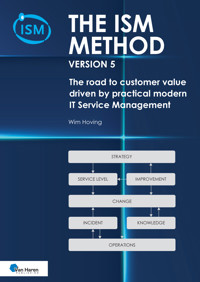
Customers expect increasingly valuable IT services, services that are flexible, reliable, secure, and efficient. Services that optimally support their users in their work. At the same time, IT organizations are struggling with rapidly changing applications and techniques, increasing compliance requirements, suppliers, and a shortage of employees. ITSM methods such as ITIL, DevOps, XLA, IT4IT, and SIAM are valuable and provide many insights and guidelines and are set up in practice, but due to their complexity and size, they are almost never successfully applied. The road to go is a result-oriented applicable method that is compact and complete, and maximally supports the entire IT organization in creating valuable IT services. A method that is both manageable and executable. ISM Version 5 (Integrated Service Management) uses just seven processes to organize the supply chain from customer to suppliers, and from strategy to operations. It supports the professionals with compact, recognizable, and applicable frameworks and supports the managers with result-oriented and clear control. The holistic design guarantees the coherence in the method across the entire service delivery chain. In ISM Version 5, the most important ITSM developments of recent years such as customer value, experience management, agile, and OBM are integrated into one single solution that is exceptionally applicable due to its compactness, and extremely efficient due to its completeness. With ISM Version 5, every IT organization is offered a clear perspective that can be adopted at its own pace. This book is primarily aimed at all managers and professionals in the IT organization who want insight into the possibilities of result-oriented IT Service Management. In addition to the ISM foundation training, it also forms the basis for the ISM foundation exam. ISM, smart co-creation of customer value.
Sie lesen das E-Book in den Legimi-Apps auf:
Seitenzahl: 420
Veröffentlichungsjahr: 2024
Das E-Book (TTS) können Sie hören im Abo „Legimi Premium” in Legimi-Apps auf:
Ähnliche

















The ISM method version 5
Other publications by Van Haren Publishing
Van Haren Publishing (VHP) specializes in titles on Best Practices, methods and standards within four domains:
- IT and IT Management
- Architecture (Enterprise and IT)
- Business Management and
- Project Management
Van Haren Publishing is also publishing on behalf of leading organizations and companies: BRMI, CA, Centre Henri Tudor, CATS CM, Gaming Works, IACCM, IAOP, IFDC, Innovation Value Institute, IPMA-NL, ITSqc, NAF, KNVI, PMI-NL, PON, The Open Group, The SOX Institute.
Topics are (per domain):
IT and IT Management
ABC of ICT
ASL®
CMMI®
COBIT®
e-CF
ISM
ISO/IEC 20000
ISO/IEC 27001/27002 ISPL
IT4IT®
IT-CMFtm
IT Service CMM ITIL®
MOF
MSF
SABSA
SAF
SIAMtm
TRIM VeriSMtm
XLA®
Enterprise Architecture
ArchiMate®
GEA®
Novius Architectuur Methode
TOGAF®
Project Management
A4-Projectmanagement DSDM/Atern
ICB / NCB
ISO 21500
MINCE®
M_o_R®
MSP®
P3O®
PMBOK ® Guide Praxis®
PRINCE2®
Business Management
BABOK ® Guide BIAN®
BiSL® and BiSL® Next BRMBOKTM
BTF
CATS CM® DID®
EFQM
eSCM IACCM
ISA-95
ISO 9000/9001 OPBOK SixSigma
SOX
SqEME®
For the latest information on VHP publications, visit our website: www.vanharen.net.
Colophon
Title:
The ISM method version 5
Subtitle:
The road to customer value - driven by practical modern IT Service Management
Author:
Wim Hoving
Publisher:
Van Haren Publishing, ‘s-Hertogenbosch, www.vanharen.net
ISBN Hard copy:
978 94 018 1125 5
ISBN eBook:
978 94 018 1126 2
ISBN ePub:
978 94 018 1127 9
Edition:
First edition, first impression, January 2024
Lay-out and DTP:
Coco Bookmedia, Amersfoort - NL
Copyright:
© Van Haren Publishing, 2024
For further information on Van Haren Publishing, e-mail to: [email protected].
Copyright:All rights reserved. No part of this publication may be reproduced in any form by print, photo print, microfilm, or any other means without written permission by the publisher.
Although this publication has been composed with much care, neither author, editor, nor publisher can accept any liability for damage caused by possible errors and/or incompleteness in this publication.
The ISM method helps IT organizations to grow towards creating excellent service, by integrating practical IT service management with, among other things, elements from existing frameworks and methods such as ITIL 4, DevOps, Agile, XLA and OBM in one compact, manageable and gradually implementable way of working.
Modern IT organizations are collaborations of IT departments, customers and suppliers; together they support the business with integrated IT services, leading to customer value.
Realizing customer value is a struggle for many IT organizations. A switch from technology-oriented to service-oriented (“behind every call there is a user who is waiting”), from supplier to partner and thinking along about how the latest techniques and ways of working can be used to support the business objectives. There is constant pressure to innovate flexibly and at the same time to guarantee continuity and safety.
The solution to this dilemma lies in the compact and holistic organization of the IT organization’s way of working, which is what the ISM method offers. Rather than the physical information system, it is the IT organization’s way of working that lays the foundation for success. Professionals who apply this way of working to create the services and information systems that fulfil the customer organization’s needs. Leaders who facilitate the professionals by setting up and directing the way of working.
By integrating the latest insights and especially by continuously innovating and implementing solutions in collaboration with many IT organizations, the ISM method (ISM) has grown since 2002 from a process method to a single compact ITSM way of working for the entire IT organization.
An ISM application is result-oriented and only successful when the customers and users assess the service positively, and when the basis for continuous improvement has been laid.
This book is mainly intended for those IT leaders and IT professionals who want to better serve the customer organizations that use their IT services. They understand that insight into the way of working of the entire IT organization is necessary to improve internal collaboration. They recognize the added value of frameworks and methods such as ITIL 4, DevOps, XLA, OBM, and Agile and want to apply this in their own environment.
So, this book is also intended for those customers and users of IT services who understand that collaboration is a precondition and that they themselves contribute significantly to the quality of the IT services they require.
This book is therefore also important for those IT suppliers who want to align with their customers’ ways of working in order to complete the chain towards customer value.
In short, this book focuses primarily on those people who do the work.
In ISM, our own innovations are linked to insights from methods and developments in the world of ITSM, such as ITIL 4, DevOps, Agile, OBM, XLA, IT4IT, SIAM, Obeya, etc. It is emphatically not the intention to discuss these methods and trends in depth, and nor to integrate them as is in ISM. Those who want to study detailed and up-to-date information about these beautiful methods are referred to the available literature and the many specialists. In ISM, we strive for one easy-to-apply integrated holistic way of working for the IT organization.
In addition, this book is intended for those advisors and consultants who help IT organizations by co-creating solutions that work, not by introducing the latest methods, but by helping IT organizations grow from their current situation.
Finally, the book is also intended for experts and enthusiasts who fully master, propagate and promote the latest methods and techniques. ISM helps them recognize how these methods can be integrated into a single solution.
Those who do not have their basics in order, are building on quicksand, have more calamities, and spend their energy reactively. With ISM, IT organizations reinforce the foundations of their way of working, a foundation on which professionals can practice their skills, which offers stability for growth, and is valuable for the customer.
Introduction
0 GOAL OF THIS BOOK AND HOW TO READ IT
0.1 Human beings in the center
0.2 Premises
0.3 ISM background
0.4 Book structure
0.5 Acknowledgments
1 ABOUT SERVICES AND CUSTOMER VALUE
1.1 What is customer value? And what are the consequences?
1.1.1 Customer requirements
1.1.2 The consequences of customer value
1.2 What is an IT service?
1.2.1 Characteristics of an IT service
1.2.2 Services and products
1.3 Service levels and agreements
1.3.1 User and customer satisfaction
1.3.2 The Service (experience) Level Agreement (SxLA®)
1.3.3 Underpinning contracts and OLAs
1.3.4 Dynamic service levels
1.4 Summary
2 IT SERVICE MANAGEMENT AND ISM, A DYNAMIC PROFESSION
2.1 The Beginnings of IT Service Management
2.2 The growing scope of IT service management
2.3 From best practices to processes and practices
2.4 The meaning of practice, process and procedure
2.5 Bottlenecks in IT service management
2.6 New developments outside ITIL
2.7 An integrated holistic solution
2.8 The need for integration and applicability
2.9 ISM design principles
2.10 What is not covered by ITSM and ISM?
2.11 The application of service management beyond IT
2.12 Summary of ITSM and ISM
3 THE CREATION OF SERVICES: ACTIONS, PROCESSES AND VALUE STREAMS
3.1 How are services created?
3.1.1 Actions
3.2 Processes
3.2.1 The natural presence of processes
3.2.2 From process to process description
3.2.3 The choice for process control and management
3.3 Standardization of processes and practices
3.4 The classic ISM process model
3.4.1 The need for the Strategy Management process
3.4.2 Triggers from the customer
3.4.3 The relationships between the processes
3.5 The ISM process model applied to the domains of business, functionalITY management and IT management
3.5.1 The IT organization is larger than the IT department
3.6 Three value streams
3.6.1 Service demand as the basis for the three value streams
3.6.2 The value stream Run
3.6.3 The value stream Build
3.6.4 The value stream Optimize
3.6.5 Mapping of the processes to the value streams
3.7 From value stream to customer value
3.8 Summary: from service expectation to customer value
4 PEOPLE
4.1 People act
4.2 The basic roles
4.3 The customer roles (with regard to IT services)
4.3.1 Customer
4.3.2 User
4.4 The IT Department roles
4.4.1 The professional
4.4.2 The leader
4.4.3 Combination of roles
4.4.4 The supplier
4.5 Team classification
4.5.1 Knowledge teams
4.5.2 Service teams
4.5.3 Project teams
4.5.4 Outsourcing
4.5.5 Internal or external employees
4.5.6 All organizations are hybrid, the service integrator does not exist
4.6 The matrix organization
4.6.1 The collaboration between line management and process management
4.7 The Process Management Matrix (PMM)
4.7.1 The seven PMM variants
4.7.2 Escalations in the matrix organization
4.7.3 PMM and value streams
4.7.4 PMM and Agile
4.7.5 Choose the most suitable variant and deviate where necessary
4.8 Roles versus people
4.9 Behavior
4.9.1 What is behavior?
4.9.2 Two forms of behavior
4.9.3 The influence of attitude and culture
4.10 Summary
5 MANAGEMENT OF OPERATIONS
5.1 Result-oriented management
5.2 Management complexity
5.2.1 Causes of poor management
5.2.2 Hierarchical management, the rake divides, the matrix connects
5.2.3 Managers versus leaders
5.3 Management of IT services
5.3.1 The purpose of management
5.3.2 The elements to be managed
5.3.3 Service creation starts with policy
5.3.4 The relationship between policy, mission, vision, strategy and objective
5.3.5 Objective requirements
5.3.6 Policy management
5.3.7 Policy areas
5.3.8 The distinction between team, process and service performance
5.3.9 The distinction between action-, task- and service-oriented management
5.4 The ISM management model
5.4.1 The structure of the ISM management model
5.4.2 Horizontal meeting structure, the broad MT
5.4.3 Obeya
5.4.4 The management elements
5.4.5 Service-oriented objectives per element
5.4.6 Insight into performance, basis for data-driven management
5.4.7 The core roles and their relationships
5.5 Influencing behavior
5.5.1 Behavioral change and behavioral management
5.5.2 Influencing behavior
5.6 Summary
6 STRATEGY MANAGEMENT (POSITIONING)
6.1 Purpose
6.2 People
6.3 Process
6.4 Products
6.5 Tips & Tricks
6.6 Process description
6.6.1 Determine policy scope
6.6.2 Determine policy
6.6.3 Manage policy
6.6.4 Account for policy
7 SERVICE LEVEL MANAGEMENT (AGREE)
7.1 Purpose
7.2 People
7.3 Process
7.4 Products
7.5 Tips & Tricks
7.6 Process description
7.6.1 Making and maintaining service agreements
Description of activities
7.6.2 Managing IT services
Description of activities
8 IMPROVEMENT MANAGEMENT (IMPROVE)
8.1 Purpose
8.2 People
8.3 Process
8.4 Products
8.5 Tips & Tricks
8.6 Process description
8.6.1 Identify risk
8.6.2 Determine cause
8.6.3 Select measure
8.6.4 Implement measure
8.6.5 Close
9 CHANGE MANAGEMENT (CHANGE)
9.1 Purpose
9.2 People
9.3 Process
9.4 Products
9.5 Tips & Tricks
9.6 Process description
9.6.1 Receive RFC
9.6.2 Classify
9.6.3 Plan & approve
9.6.4 Prepare change
9.6.5 Test & release
9.6.6 Implement
9.6.7 Close
10 INCIDENT MANAGEMENT (RESTORE)
10.1 Purpose
10.2 People
10.3 Process
10.4 Product
10.5 Tips & Tricks
10.6 Process description
10.6.1 Receive incident
10.6.2 Categorize & match
10.6.3 Analyze
10.6.4 Prepare recovery
10.6.5 Recover
10.6.6 Close
11 KNOWLEDGE MANAGEMENT (INFORM)
11.1 Purpose
11.2 People
11.3 Process
11.4 Product
11.5 Tips & Tricks
11.6 Process description
11.6.1 Set up Knowledge Management System (KMS)
11.6.2 Register Knowledge Items (KIs)
11.6.3 Verify KMS
12 OPERATIONS MANAGEMENT (DELIVERY)
12.1 Purpose
12.2 People
12.3 Process
12.4 Products
12.5 Tips & Tricks
12.6 Process description
12.6.1 Receive and register
12.6.2 Assess feasibility
12.6.3 Plan work
12.6.4 Route work
12.6.5 Perform work
12.6.6 Inform initiator
APPENDIX A: GLOSSARY OF CONCEPTS AND DEFINITIONS
INDEX
The quality of IT services is crucial for almost every organization. Good, flexible and stable IT services are not only the backbone, but also a differentiating factor. Nowadays, almost every organization is an IT organization with a specialism.
This places great demands on the qualities of IT services. In order to provide maximum support to the organizational objective, an almost impossible combination of speed, continuity and flexibility is expected. And there is an increasing focus on customer experience and customer value.
Meanwhile, the societal importance of good IT services has become so large that the failure or malfunction of IT services directly leads to harm for the organization, the economy, or large groups in society.
That is why governments are increasingly setting requirements (compliancy) not only for the quality of IT services (output and outcome), but also for the way in which the services are created (the throughput). Here, security, privacy and continuity are key concepts and therefore strongly influence IT organizations’ way of working. This is confirmed by increasingly serious ransomware attacks, hacks and data leaks.
Despite the great importance attached to IT services, not every organization’s IT services have the same quality or value. That difference is not caused by access to new IT products, services and techniques. Access to these is equal for everyone. The difference is in the ability to produce products and services properly and flexibly and to make them available to users. And that is the field of IT service management:
“IT service management organizes the way of working of the IT organization, providing the customer with valuable IT services.”
The IT service management (ITSM) discipline organizes the way of working. In ISM, organizing means setting up and applying the way of working through which the IT services are created and further developed. ITSM ensures that the best management techniques are made available to IT management. ITSM is therefore about the way people collaborate. Together with the customer, they use the way of working to determine the quality of the IT services. Their information systems are only the result of this effort.
In recent years, DevOps, Agile and ITIL 4 have added important ideas and new insights to the existing ITSM methodologies and ideas. However, many IT organizations can no longer see the wood for the trees and are in danger of floundering due to the enormous complexity. ISM offers an effective helping hand for this situation. ISM is, in essence, a practical and compact ITSM implementation that holistically describes and supports the set up and application of the way of working for the entire IT organization.
ISM therefore goes further than both the classic and modern ITIL. ISM focuses on the people who create and use the services. This requires a holistic approach focused on customer value, in which all parts of the service organization, at strategic, tactical and operational levels are aligned. Moreover, it is a way of working that integrates the recent learnings from, among others, ITIL 4, DevOps, VeriSM, Lean, Agile, and Organizational Behavior Management (OBM).
The ISM method offers a practical IT service management (ITSM) approach. An approach that reduces the many complex best practices, Agile methods, and reference models available in the market into one single, integral, compact, holistic and easily applicable way of working to create IT services.
All models are wrong, but some are useful.
George E. P. Box
This book describes the ISM method version 5, resulting in a compact and holistic description of the way of working for an IT organization. However, the ISM method is also a simplification of reality and is, therefore, not perfect. The aim of the ISM method is therefore not to provide a perfect method, but due its compactness, the most applicable and valuable method.
In Lean terms, a True North that every organization can work towards at their own pace.
0.1 HUMAN BEINGS IN THE CENTER
The goal of ISM is the effective, efficient and ensured creation of customer value (outcome) by organizing the IT services – and this is done by people.
It is striking that precisely in the better-functioning IT organizations the focus of the management, the leadership, is on leading the people. Servant leadership is put into practice: facilitating the professionals, enabling them to create the services.
In ISM, the emphasis is therefore on the person, the professional, the craftsman, who performs the actions that lead to the creation of valuable services and on the leader who supports the professionals.
In addition to the professional and the leader, there are also the (end) users who use the services, and the customers who determine which services they want, who have a major impact on the quality of service.
The professional, the leader, the user, and the customer determine together the quality of service; in short:
“Service is people work.”
Improving services is therefore mainly about supporting and improving the behavior of people, professionals, by supporting them with processes and value streams and products that help professionals and leaders to work more effectively in their respective roles. These people then design, create and maintain information systems and services through their way of working.
“People determine the technology, fallible systems and services are man-made, as are successful services.”
If the service fails, there is almost always a human error behind it, and the cause is more often the management system than the technology. Improving the service therefore starts with professionalizing the way people work. This concerns both setting up and managing, and applying the way of working. ISM is therefore mainly about organizational change management, with much emphasis on the behavior of people, managers and professionals, and how to influence this.
0.2 PREMISES
This book’s intent is to contribute to the realization of customer value by optimizing the way of working for creating IT services. It describes the main elements that are integrated in ISM. And it can be used as a basis to relate the different traditional and modern concepts and insights and to apply them in one’s own environment.
The first premise is that service management is about people. People collaborate, set up systems and create services.
The second principle is that a well-functioning solution should be as simple as possible. Complex solutions can be perfectly correct in terms of design but are often difficult to manage and to apply in practice.
A third starting point is the need for a holistic approach. Many good partial solutions, methods and models together fail to provide a single working whole. It is precisely in IT, in which all parts must be linked to each other in order for IT services to function properly, that the many parts of management form a whole. This concerns both the creation of services, as well as the management of the creation.
A holistic approach therefore includes all involved: the IT department, the customer and an increasing number of suppliers.
Another aspect of the holistic approach is the emphasis on managing service. Despite the presence of well-designed teams, processes and tools, many organizations fail due to inadequate management. The leaders often see insufficient opportunity to properly manage the well-designed execution. The result is poor contacts with the customer, an overloaded team, lack of security and compliance, and lack of customer value.
A fourth premise is standardization of the way of working. Although many do not like to hear it, all IT organizations have the same goal, namely to create customer value through good IT services, and can therefore apply the same methods. ISM offers a standardized elaboration of these ways of working. Where the standard way of working needs to be expanded, ISM’s way of working still provides the foundation for additional situational choices.
0.3 ISM BACKGROUND
The ISM method was developed by Servitect and has been made publicly available as a process-application model since 2003. In the beginning, the domain was the field of IT management and the emphasis was on applying a compact ITIL-derived process model with only six processes. The process model has withstood the test of time and is still growing in popularity. This turned out to be just the prelude to the ISM relationship model, developed into an integration with standardized service management tooling, and with the introduction of the process management matrix for a clear division of roles between process and line management.
In 2006, the development of FSM (Functional Service Management) started in collaboration with Univé insurance, the Netherlands. This is the application of ISM in the field of functionality management.
In 2010, the first version of the ISM book was published with a set of clear premises and definitions, and with attention to translating theory into practice through the description of implementation methods. The chapters about the service management lifecycle already introduced co-creation, the concept of the joint creation of services by the business and IT.
In 2014, under the title Enterprise Service Management (ESM), there was an initiative for the universal application of service management principles in fields such as facility services, medical technology and HRM. The publication of ESM showed that the principles of ISM are universally applicable to all forms of services.
Since then, new insights into change management, Agile ways of working, service integration, behavioral change and service creation have been consistently added, which have led to a single compact holistic ISM method, in which the fields of business, functionality and IT management are organized in one way of working. This is in line with how IT service management is regarded in 2024. The compact ISM method enables IT organizations with both a large and smaller staff to achieve a high level of maturity quickly and with relatively little effort.
This book describes version 5 of ISM. Just like the previous versions, this new version can also be used by anyone as a reference model to create their own ITSM solution, but the ISM choices can also be applied as is. This enables a far-reaching standardized, simple and compact elaboration and application.
0.4 BOOK STRUCTURE
This book is about IT service management, the field that organizes the way of working that leads to the delivery of valuable IT services, and has the following structure:
■Chapter 1 describes what an IT service and its creation are. And also, the position of the SLA and the increasing focus on experience management. And finally, it also answers the question of why the IT organization is much larger than the IT department.
■Chapter 2 describes the role of IT service management (ITSM), what ISM is, and the many developments going on in the field.
■Chapter 3 describes how an IT service is determined. And also, the activities and processes that always take place to create IT services, and why good collaboration with all parties in the chain is needed.
■Chapter 4 describes the different roles played by people in creating services, and the importance of the behavior of professionals and leaders.
■Chapter 5 describes how to manage the creation of IT services by setting up and managing the way of working.
■Chapters 6 through 12 describe how the seven ISM processes can be applied in a practical way.
Appendix A is a comprehensive glossary explaining the many terms used in the world of ITSM and ISM.
0.5 ACKNOWLEDGMENTS
This book has been created thanks to the many developments, publications and experiences of recent years and by bringing them together in one all-encompassing compact solution. As part of this many new ideas and insights have been added.
Many have contributed to the creation of this book, with critiques, additions, and discussions:
■ Ron Bovee – ITSM Consultant, Bete-Talent B.V.
■ Robert den Broeder – Trigono BV and OBM Dynamics
■ Dave van Herpen – Transformation Consultant
■ Marcel de Jong – Ventus
■ Robert de Koning
■ Jan van Marum – IT Organisational Consultant, Watson Service Management
■ Richard Sitters – Advisor, M&I/Partners
■ Mark Smalley – The IT Paradigmologist, Smalley.IT
■ Christian Tijsmans – Serviceminded
■ Jeroen van der Ven – Manager Operations, Catharina Hospital Eindhoven
■ Paul Wilkinson – Chief Architect, The Shiny New Thing that Really helps, Egor Productions
■ Richard de Wit – CIO, Alrijne Hospital
The ISM method is maintained by a team of Servitect experts:
■ Arno Becht
■ Willem Buik
■ Gidon van Dongen
■ René van der Horst
■ Robbert-jan van Lippevelde
■ Rolf Smit
■ Martijn Wiedijk
The team is led by Wim Hoving, lead developer of the ISM method.
Everyone who wants to contribute to the further improvement and future development is cordially invited to make their contribution.
ISM is an application model that can be used freely, provided that the source is clearly referenced. This also applies to the ISM process model and the glossary in appendix A. These are available for everyone to apply as is in their own organization, or to adapt them to their own situation if desired.
A book about ISM and IT service management should start with an explanation about IT services and especially the value of these services. This chapter also explains the basic principles related to creating services.
1.1 WHAT IS CUSTOMER VALUE? AND WHAT ARE THE CONSEQUENCES?
Supporting services, such as IT services, but also HRM, financial or facility services, are worthless if they have no value for the receiving party.
The value of IT services is determined solely by the using/receiving party, the customer. Only the customer can and will determine the value assigned to the created IT services.
“ Customer value is the value that the customer assigns to the IT service.”
So, it doesn’t matter how good the service is from the point of view of the IT service provider. Nor how much money and energy has been spent on the creation of the service. The value of a service from the perspective of the customer organization will only be related to the extent to which the IT service supports their activities.
Value is determined by the customer. The customer can only assess whether the service meets the agreed expectations, but more and more attention is also paid to the value of the service for business operations, the business value. This is based on the extent to which IT services have value for business operations.
If the agreement between the customer and the supplier is clear, then the scope of the term ‘value’ is also clear.
If the customer bases the value of the service on the extent to which business operations are proactively and reactively supported, this will have an impact on the scope and the way of working of the IT organization.
The customer organization has two main roles: that of the customer, who pays for making the service available, and that of the user, who uses the service to achieve their goal.
Customer value does not only have to be objective. The extent to which the customer or user is satisfied with the service or its effect is also part of the value perceived by the customer. This also concerns whether the operation of the service is experienced as pleasant (customer experience) or, for example, the extent to which they have confidence in the reliability of the service and the supplier.
The consequence of the above is that the creation of valuable services can only be achieved if it is understood what is valuable to the customer.
“Outside-in thinking and acting is a precondition for customer value.”
An important aspect of customer value is the extent to which the customer can manage the service they receive. Customers often feel dependent on IT; they feel that they are not really able to influence the services they receive. IT often determines which services are made available and the pace at which they are delivered. If the customer has the feeling that they have little or no influence on the quality of the services they receive, this will lead to a high degree of dissatisfaction.
“The customer commissions and manages the IT service.”
This also applies to the acquisition of cloud services, in which case the customer or IT department that hires the supplier remains ultimately responsible for the result. For the customer, the degree of manageability is an important factor in determining the value of the service.
A second aspect is the increasing importance of customer experience. It is about the value that the customer assigns to the way in which they experience the service.
“Experience has a major impact on the value of the service.”
This concerns, for example, the extent to which you feel heard as a customer, have confidence in the supplier and their services, the ease of use of the service, how comfortable the user feels when approaching the service desk, etc. It concerns the form of collaboration and having mutual empathy. These are things that we now know are decisive in the assessment of the value of the service, and which we are increasingly able to talk to the customer about, whilst also making it manageable.
In summary:
Customer value is determined by the recipient of the service based on objective and subjective elements. In order to create services that lead to a high degree of customer satisfaction, the supplier must have a very good understanding of the customer. They must understand what is really valuable to the customer: the latest possibilities, availability, compliance, speed or perhaps greater flexibility, customer-friendliness, partnering, contributing ideas and/or usability.
The trick is not only to understand the customer and their business properly, but also to discuss these aspects, and even to objectify the more subjective value aspects as effectively as possible.
1.1.1 Customer requirements
Given the importance of IT services for almost all organizations, it is not enough for an organization to simply commission and receive the service.
The common classic approach of the customer who expects to receive suitable IT services in return only simply making agreed payments is an important cause of service failure. If the customer wants the supplier to understand them, they will also have to structurally and frequently devote time and attention to collaborating with the supplier. And in order to gain control and actually determine what is to be delivered, and how, the customer will also have to be intensively involved in the management of IT services.
The dissatisfaction that many customers experience with regard to the quality of IT services is therefore often directly linked to the extent to which the customer actively involves themself in the delivery.
“The extent to which the customer is involved in the delivery of theIT services determines the quality of the service.”
Lack of customer involvement, vision and quality-thinking with regard to acquiring IT services is one of the main causes of stalled IT services. The underlying cause of this is that the customer is insufficiently aware of the strategic value of the IT services. They are ‘unconsciously incompetent’. The IT supplier or IT service provider will therefore have to invest a lot of time in bringing that customer on board.
A customer’s management of the IT supplier or IT service provider requires involvement, insight and skills from the customer. In practice, these aspects often appear to be missing or are not organized in a coherent way. A customer who, without the insight of their supplier, asks for all their energy to be put into enhancements, will discover that over time the quality of the service deteriorates enormously due to overdue maintenance, and that enhancements are becoming increasingly difficult to implement.
It is good to realize that from a customer perspective, the IT supplier or IT service provider is often the first point of contact in the service chain that is formed by the IT department, suppliers, cloud services, etc.
A customer who pays insufficient attention to acquiring their IT services makes themself dependent on their supplier. For IT services that are so tightly integrated into the business, that almost amounts to negligence.
1.1.2 The consequences of customer value
The absolute requirement to create customer value therefore has a direct impact on the way IT services are organized:
1. Customer value requires continuous collaboration between customer and supplier.
2. The value of the service and the requirements placed on it are determined by the customer and are both objective and subjective.
3. The customer must be able to determine what they receive and to be able to actively and continuously manage it. Since resources are limited, the customer must have insight into the alternatives and make conscious choices.
4. The IT supplier or IT service provider must recognize what and how the value is determined for the customer.
5. It should not matter to the customer whether the supplier provides the services independently or in collaboration with suppliers.
This has a major impact on the design of the way of working for creating IT services.
1.2 WHAT IS AN IT SERVICE?
The goal of an IT service is to support the user with IT resources in their work. The degree to which the service is supportive determines the value that the customer assigns to it. The IT service enables the user to perform data processing that would not take place, less well or more slowly without these resources.
This can vary from providing a financial application or an Electronic Patient File to, for example, e-mail functionality, word processing via MS Word or spreadsheet functionality via MS Excel. The characteristic of these IT resources is therefore that they have the ability to process or apply data in a certain way. This also includes the safe storage of data.
More and more IT services are also offered directly to consumers, such as booking hotel rooms or air travel, taking out insurance, completing a tax form, offering navigation services such as Google Maps, or services such as Weather.com, etc. Consumers or other organizations become the direct user of IT services created by the IT organization.
1.2.1 Characteristics of an IT service
What are the characteristics of a service? Every IT service has three important characteristics: Functionality, Functioning and Delivery:
1. Functionality – At its core, functionality in IT terms is nothing more than the ability to manipulate data in a certain way. By processing data, for example, invoices are sent and paid and documents are created, etc.
“Functionality is the form of processing through whichinformation becomes more valuable.”
Examples of functionality are: addition, subtraction and multiplication. In addition, recording data, analysis and reporting, or searching with Google are also examples of functionality, as are requesting a patient file or booking a hotel, etc.
By automating the processing of data, not only can work be done faster and more accurately, but more complex processing is also possible. It must be clear which processing options the service offers the user.
Requirements that can be set for the functionality are, for example:
Correctness – the operation leads to the correct result.
Consistency – the operation always leads to the same result.
Transparency – the way the data is processed must be clear.
Integrity – preventing data from being unintentional or modified.
‘Utility’ and ‘fit for purpose’ are also used to characterize functionality.
2. Functioning – A service must work according to certain requirements. For example, a smartphone should not only be able to perform functional operations, but it should also be usable. The keys should not be too small, the screen should be easy to read, perhaps even in the dark, it should be able to work for a long time on one battery charge, it should be easy to operate, etc.
Functioning is meeting operational requirements. Classic performance requirements are:
Availability;
Capacity;
Speed.
Modern requirements are also about meeting:
User experience;
Security requirements;
Compliance (regulatory) requirements such as ISO 27001, GDPR;
Ease of use;
Flexibility or adaptability;
Time to deliver.
Requirements for functioning are also referred to as the non-functional requirements or warranty. The term ‘fit for use’ also applies here.
3. Delivery – Delivery concerns the relationship between the customer and the supplier. In addition to realizing ‘functioning functionality’, this must also be made available to the user in a way that allows them to have access to the functionality. The interaction between the customer and the supplier will also have to be organized in a way that ensures continuous collaboration. The delivery has two aspects:
1. Support – A service must be usable, the user must know how to use the functioning information system, what possibilities the available functionality offers, and how to use it. Therefore, applications should not only be designed as ergonomically and self-explanatory as possible so that they can be used intuitively, users should also be able to receive explanations or training on how to use the information system. The positioning of key users also falls under support, as do instructions for, for example, the service desk regarding the way in which users can be supported.
2. Collaboration – Making supported functioning functionality operationally available is not enough. Particularly for IT services, there must be continuous collaboration between the customer and the supplier, at strategic, tactical and operational levels. The way in which the requesting and providing parties work together must therefore be organized. How the service is experienced and if the expectation (experience) is met. Who is operationally involved and authorized at the customer organization (such as the role of the user, the key user and the product owner or service owner). Reporting to the customer about the quality of the functioning functionality is necessary and this will have to be discussed. A fee may have to be agreed on for making the IT service available. Agreements about who communicates with whom must be made and implemented, and it must also be determined what the customer does and what the supplier does.
The above characteristics determine the definition of the term ‘IT service’:
An IT service is the delivery of functioning functionality.
The key terms in this definition are:
■ Functionality;
■ Functioning;
■ Delivery.
Although IT services are initially often thought of as services used by users and consumers, services can also include automated services, robotics and the Internet of Things. The definition of ‘service’ also applies here.
An IT service must meet all three characteristics in order to be valuable to the customer. And requirements can be set for all these three characteristics.
1.2.2 Services and products
It is very important to recognize that a service is something other than a piece of hardware, software or data. A service is an available functioning element.
The core concepts of functioning and delivery also indicate that there is an action, in other words, in contrast to products, a service only exists as long as the information system is “kept running” and is made available and supported. Once the plug is disconnected, the service no longer exists. And without good support (training, explanation) and communication, the value of the service will quickly decrease.
Providing a laptop is not a service, but a precondition for making functionality possible. A user does not want to have a device or software; that is not a goal. There’s a reason they want that laptop. They want to process text, collect information, store data, assign work orders, etc.
A user does not want a network, but rather, access to information and data transport. They do not want cables, routers and switches.
Networks, computers, storage, apps – they can all be turned off. The products then still exist and are not broken, these assets also have economic value for the owner. However, they no longer function as a service and have no functional value for the user.
“The relationship between functionality, functioning anddelivery determines the value for the customer.”
If one of the three elements does not work properly, or does not work well with the other two, then the quality of the IT service deteriorates, and therefore also the customer value.
The delivery of functioning functionality is a continuous activity within the duration of the agreed service agreements. This also means that IT service management must be continuously active in order for both the set up and management to take place.
1.3 SERVICE LEVELS AND AGREEMENTS
Service levels are performance levels that can be linked to IT services. They can be agreed between customer and supplier to determine what the desired or minimum level of service should be. Service levels can be agreed for all features of a service.
When determining the service levels, it is important to check whether these determine the value required by the customer. By agreeing appropriate service levels, the realization of customer value becomes more concrete and measurable. This also applies to subjective value, by making as many SMART (Specific, Measurable, Acceptable, Realistic and Time-related) agreements about this as possible. Particularly by making agreements on how to determine, measure, report, discuss and improve them, these subjective values become part of integral management.
Service levels must be relevant to customer value. An IT service that meets the service levels must at least deliver the value that the customer expects. Service levels, including customer experience, can be expressed in key performance indicators (KPIs) or experience indicators (XIs).
Setting up service levels that do not deliver customer value should therefore be avoided.
1.3.1 User and customer satisfaction
As stated earlier, services arise through continuous collaboration and co-creation, between the customer and the supplier. Not only should the supplier clearly understand the customer in order to be able to supply them with what they need, the customer must also understand the impact of their actions on the supplier and therefore on the quality of the services they receive. Any lack of mutual understanding will lead to poor collaboration and even worse service.
“The most important outcome of the conversations about theservices are not the (determined) agreements,but the created mutual insight and understanding.”
It is therefore sensible to make clear agreements about the desired outcomes of the collaboration. This concerns all features of a service, the functionality, the functioning and the delivery.
Understanding each other well is the basis of good collaboration. Understanding goes beyond knowing what someone else needs, but also touches on questions such as:
■ Why does the other party need that?
■ What are realistically achievable needs?
■ What are expected developments?
It is not enough to express the quality of the service only in classic KPIs such as speed, availability and capacity. Modern requirements will also have to be expressed in terms of KPIs or experience indicators (XIs).
Call satisfaction, the extent to which a person who submits a call (request or incident) is satisfied with the handling of their questions, such as service requests, incident notifications and change requests, is easy to measure, but gives a limited picture of the extent to which a service meets expectations.
Fig. 1.1 Call satisfaction, user satisfaction and customer satisfaction
More relevant is the satisfaction of the user of the IT service with regard to the objective and subjective value of the IT service with which they work. This also concerns how the user has experienced the service. Having up-to-date and trend-based insight into the user experience is essential for determining the way of working and prioritizing it. User satisfaction surveys (user surveys), on a monthly or quarterly basis, can provide the required insight.
Service is ultimately about customer value, which is largely determined by customer satisfaction. User satisfaction is often an important part of this. However, the customer will assess from an organizational point of view whether the IT services adequately support the business, and that may deviate from user satisfaction.
It is therefore also about how the customer and the users have experienced the service. This can be expressed in experience indicators (XIs).
It is often wise to record the relevant agreements on call, user and customer satisfaction.
1.3.2 The Service (experience) Level Agreement (SxLA®)
Traditionally, collaboration agreements are laid down in a Service Level Agreement (SLA). In the past, the emphasis in SLAs was mainly on the functioning characteristics of the service, such as recovery speed, downtime or transaction speed. Reports on the service were, therefore, often concerned with the number of reports or calls, whether or not they were handled on time, throughput times, and the availability of systems.
In practice, the agreements from the SLA were often realized, but the customer was still dissatisfied with the service. The customer therefore experienced insufficient customer value. The conclusion is then that the content of the traditional SLA does not sufficiently cover the customer’s needs.
The infamous Watermelon effect: the IT department thinks everything is green because on the outside the SLA requirements appear to have been met.
However, the customer experiences that most of it is red because they are not getting what they expect and their business is not sufficiently supported by the service.
This approach to the SLA is no longer in line with the modern view of IT services and the realization of customer value. Aspects such as collaboration or co-creation, partnering, user satisfaction, usability, customer satisfaction have become much more important for realizing customer value.
The modern view is that the way in which the customer experiences the service is decisive for success. To record this experience requirement, the experience, the term ‘eXperience Level Agreement (XLA®)’ is also used, sometimes as a replacement, sometimes as a supplement to the SLA, sometimes as integral documentation of all agreements.
The XLA concept was introduced in 2007 by the Dutchman Marcel Broumels. The term, then called Experience Level Agreement, emerged in his publication Research project on the impact of the Experience economy on usage of SLAs (Experience Level Agreement project). The outcome of this study into the value of SLAs in facility management also turned out to be very relevant for IT services.
The ultimate goal, expressed in the concept of ‘customer value’, is not to create an output but an outcome. In other words, a positive contribution to the customer’s business operations.
To emphasize the importance of experience, and to prevent complexity from increasing, we choose the term ‘SxLA®’ in ISM to document all agreements. Objective and subjective requirements are therefore recorded in the SxLA, including the experience agreements and contribution to the outcome that are relevant to arrive at customer value.
By explicitly naming experience in the SLA and including the “x” in the term ‘SLA’, the great importance of experience and the change compared to the past is emphasized. Including experience in the SLA is just one aspect of experience management, the field specifically concerned with managing customer expectations.
“The SxLA is the agreement between customer and supplier aboutthe service levels of one or more services.”
The experience, as perceived by the customer and user, is therefore also an important service level and its recording must be included in the SxLA. Any legal and collaboration agreements should also be included. An SxLA is therefore a single dynamic whole of agreements to describe the mutual collaboration. The core is that the mutual expectations and agreements regarding the service are clearly laid down in the SxLA. So, this will include user and customer experience such as:
■ accessibility and friendliness of support;
■ the ease of use of the IT service;
■ the smoothness of the on-boarding;
■ the flexibility in the collaboration;
■ the proactive attitude of the IT supplier in providing business support solutions;
■ etc.
Experience management
Within the field of IT service management, experience management (XM) is a rapidly emerging area of interest. Experience management focuses on mapping out the desired user experience and making agreements (the XLA), having the services set up accordingly, measuring and improving them. XM not only affects the processes, but also the employees involved (People) in their behavior and also the design of the IT services (Product).
Experience management therefore does not only concern the Service Level Management process, but is an integral part of ISM. For in-depth knowledge about experience management, reference is made to the many publications and expertise available on this subject.
Under the leadership of the NEN (Dutch Standardization Institute), a national standard was drawn up in June 2023 with the title NEN 8038:2023, Xperience Level Agreement (XLA) with minimum requirements for the use and implementation of the XLA method with many usable aspects.
The use of the terms SLA and XLA is certainly not wrong, but working with two agreements increases the risk of contradiction and uncontrollability and increases the management effort.
The terms SLA, XLA and SxLA refer to the documents in which the expectations and agreements are recorded. Documents don’t make mistakes.
The core of the problem is that there was insufficient active management involved in making, maintaining and complying with agreements. In other words, the Service Level Management process (and the other processes) does not function properly in most organizations.
SLM and therefore also experience management (XM) requires the active management of expectations, management towards the realization of the agreements and measuring results.
Now that user and customer experiences are given increasing emphasis, this also means active contact about the experience of the user and customer and anticipating this.
As a result, the documents change from static objects to dynamic management elements.
Using the terms SxLA, XLA and SLA side-by-side is, therefore, not wrong. However, it is unnecessarily complicated and, as such, is therefore not recommended. The agreements are the outcome of a, hopefully, careful (SLM) process in which customer and supplier(s) determine in continuous consultation what is desired and feasible and how experience of the service can be continuously tested and, where necessary, adjusted.
The value of a service is therefore largely determined by the outcome, such as the extent to which IT services contribute to the competitive position. The value of a service is a combination of classic and modern service levels, which can most easily be managed integrally from one coherent set of agreements.
Fig. 1.2 The SxLA determines the content of the desired service that leads to customer value.
This means that all agreements can be recorded in the SxLA about the delivery of functioning functionality. The service levels linked to these service characteristics must be determined in such a way that they lead to customer value. This means that service levels with regard to the experience can also be recorded in the SLA.
In an SxLA the agreements that are relevant to the customer are recorded for all service characteristics (this can also be done in accompanying documents). In the SxLA reference can be made to other documents such as specifications for functional designs, quality standards or internal regulations.
1.3.3 Underpinning contracts and OLAs
The IT department and IT organization are not the same. The IT organization includes all parties involved in the creation of IT services. In addition to the IT department, these are also the customer organization with both its customer and user roles, and the suppliers.
“The IT organization is bigger than the IT department,the customer and suppliers are also part of the IT organization.”




