


18,49 €
Mehr erfahren.
- Herausgeber: The History Press
- Kategorie: Geisteswissenschaft
- Sprache: Englisch
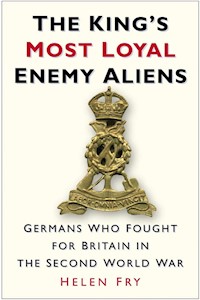
Most of the Germans and Austrians who fought with the British were Jews but a significant number were political opponents of the Nazi regime and so-called 'degenerate artists'. They arrived in Britain between 1933 and 1939, and at the outbreak of war on 3 September 1939 became enemy aliens. They volunteered to serve in the British forces, donned the King's uniform, swore allegiance to George VI and became affectionately known as the King's most loyal enemy aliens. This compelling story includes previously unpublished interviews with veterans and an impressive selection of archive photographs, many of which are reproduced for the first time.
Das E-Book können Sie in Legimi-Apps oder einer beliebigen App lesen, die das folgende Format unterstützen:
Veröffentlichungsjahr: 2007
Ähnliche



















THE KING’S MOST LOYAL ENEMY ALIENS
‘Freedom! Out of the clutches of the Nazis, I might yet live to fight them.’ Peter Masters (originally Peter Arany), 1938
Dedicated to the men and women of German and Austrian origin who sacrificed their new-found freedom to liberate Europe from Nazism
THE KING’S MOST LOYAL ENEMY ALIENS
GERMANS WHO FOUGHT FOR BRITAIN IN THE SECOND WORLD WAR
HELEN FRY
First published in 2007
The History Press
The Mill, Brimscombe Port
Stroud, Gloucestershire, GL5 2QG
www.thehistorypress.co.uk
This ebook edition first published in 2013
All rights reserved
© Helen Fry, 2007, 2013
The right of Helen Fry to be identified as the Author of this work has been asserted in accordance with the Copyrights, Designs and Patents Act 1988.
This ebook is copyright material and must not be copied, reproduced, transferred, distributed, leased, licensed or publicly performed or used in any way except as specifically permitted in writing by the publishers, as allowed under the terms and conditions under which it was purchased or as strictly permitted by applicable copyright law. Any unauthorised distribution or use of this text may be a direct infringement of the author’s and publisher’s rights, and those responsible may be liable in law accordingly.
EPUB ISBN 978 0 7524 9620 7
Original typesetting by The History Press
CONTENTS
Preface and Acknowledgements
Introduction
1
The Pioneer Corps
2
Royal Armoured Corps
3
The Small-Scale Raiding Force
4
Commandos
5
Special Operations Executive
6
The Royal Air Force
7
The Royal Navy
8
Infantry
9
Airborne Forces
10
Women in the Forces
11
War Crimes Investigations, Intelligence and Military Government
Reflections: The Contribution of the King’s Most Loyal Enemy Aliens
Select Bibliography
Notes
PREFACEAND ACKNOWLEDGEMENTS
When I embarked on the research for this book, it soon became clear that the sheer volume of material emerging meant that it would not be possible to cover all aspects of ‘enemy aliens’ in the British Forces in the Second World War. I have therefore limited the material to German and Austrian refugees who enlisted in the British Forces, and with one or two exceptions, only those who fought in the European campaigns. I have not been able to go into any depth on overseas service in Africa, the Middle East or Far East. Neither could I extend this book to include the part played by Czech, Italian and Polish refugees, all of whom made their own special contribution to the British Forces during the war. Other individual profiles, photographs of the period, and appendices of official war diaries for the alien Pioneer Corps companies are contained in my previous book Jews in North Devon during the Second World War, and have not been duplicated in full here. Every endeavour has been made to ensure accuracy of information throughout the text.
I would like to pay special tribute to the veterans and their families who have given so much of their time to be interviewed and supply information. It has been a pleasure and huge privilege working with them. Many have shared experiences about which they have not previously spoken for fear of burdening their families with the past. Now their voices are heard here, some for the first time. They have ensured that their selfless contribution to the defeat of Nazism and that of their colleagues are remembered. My sincere thanks to Eric Sanders for extensive help on 12 Force/SOE; William Howard for the Royal Navy; Colin Anson for material on 3 Troop of No. 10 Inter-Allied Commando; also Fritz Lustig and Michael Streat for the Entertainment Section of the Pioneer Corps and other related material. Each has spent many hours with me and helped enormously in the production of this book.
To the veterans of Harry Rossney’s monthly coffee mornings, a special thank you for sharing your wartime experiences and supporting my research on many levels. Thanks especially to Harry Rossney, Geoffrey Perry and Willy Field.
This book would not have been possible without the enormous help of archivists and historians in specialist libraries, museums and archives. My thanks must go to Martin Sugarman of the Association of Jewish Ex-service Men and Women (AJEX); Howard Spier of the Association of Jewish Refugees; staff at the Imperial War Museum; David Fletcher, historian at the Tank Museum; staff at the Wiener Library and the Jewish Military Museum, and Dr Elisabeth Lebensaft and Christoph Mentschl at the Austrian Academy of Sciences in Vienna for material on Austrians in the British Forces in the Second World War.
I would also like to pay particular tribute to the late Captain Peter Leighton-Langer, who died earlier this year. An ex-Austrian refugee, he served first in the Pioneer Corps from 1941 until 1943 and then the Royal Artillery, seeing active service in India from January 1945. After his wartime service, he spent many decades researching, recording and accumulating a huge archive about fellow Germans and Austrians who enlisted in the British Forces during the Second World War. This extensive and encyclopedic research resulted in the publication of two books, the first of which was entitled X Steht für unbekannt: Deutsche und Österreicher in den Britischen Streitkräften im Zweiten Weltkrieg and was published by Verlag in Berlin in 1999. His translation of that book, The King’s Own Loyal Enemy Aliens: German and Austrian Refugees in Britain’s Armed Forces, 1938–1945, was published by Vallentine Mitchell in 2006. Without his unprecedented work in this field, so much about the refugees who served in the British Forces would now be lost to future generations.
Sincere thanks to Jonathan Falconer, my Commissioning Editor, and staff at Sutton Publishing for publishing the book and making it such an enjoyable experience.
I am fortunate to have a close circle of friends who support me during the writing of my books. To each of them goes my particular thanks: James Hamilton, Richard Bernstein Paul and Daphne Ruhleman, Karen Davy, Edith Palmer, Dorinda and Lorna. To Elkan Levy, former President of the United Synagogue and currently Director of Small Jewish Communities, I owe a huge debt of gratitude. He deserves a special mention for his tireless and enthusiastic support of my work and for spurring me on. Thanks to Mick Catmull, producer at BBC South-West, who has enthusiastically taken up this story and with whom it is a pleasure to work. Over the summer of 2006 he produced a short documentary about some of these veterans for BBC South-West’s programme ‘Inside Out’ which he entitled The King’s Most Loyal Enemy Aliens. It was broadcast on 16 October 2006 and then shown twice on Armistice Day, 11 November, across Britain.
My heartfelt thanks must go to my friend and mentor Mary Curry. For the last few years she has sent appropriate material my way and read the drafts of every chapter. Her comments and meticulous attention to detail are much appreciated and have enhanced the quality of my writing.
My love and thanks to my husband Martin and mother Sandra without whose practical help this book could not have been written. To my young boys Jonathan, David and Edward: thank you for being interested in my work and asking questions. May you continue to appreciate the significance of recording history for posterity.
INTRODUCTION
This is the extraordinary story of the 10,000 Germans and Austrians who fought for Britain during the Second World War. Their particular contribution to the Allied victory over Hitler and Nazism is largely unknown. One in seven of the 75,000 German and Austrian refugees who came to Britain between 1933 and 1939 enlisted in the British Forces, a surprisingly high percentage. Under Nazi law they were stateless, but according to British law they were still Germans. They all took the unprecedented step of swearing allegiance to King George VI even though, with a few exceptions, they did not receive British nationality until after the war. The majority began their army life in the non-combatant Pioneer Corps, the pick and shovel on their cap badge emblematic of hard physical labour. They became affectionately known as ‘the King’s Most Loyal Enemy Aliens’.
They had come to Britain as victims of Nazi oppression, mainly the Jewish intellectuals of central Europe but also Aryan Socialists and ‘degenerate artists’; the political opponents of Nazism. All had one thing in common – their lives and those of their families were at risk after the Nazis gained power in Germany in 1933 and Austria in 1938. Born and raised in those countries, the Jewish refugees saw themselves first and foremost as loyal German and Austrian citizens. Their Jewishness was secondary. A trace of Jewish ancestry or opposition to Nazism put thousands of ordinary German lives at risk. Many had relatives who had fought the British during the First World War or they themselves had done so and received the Iron Cross for bravery. All this counted for nothing. So, just twenty-one years later, they found themselves on the other side in British uniform fighting their fellow Germans. Their story is unique in British history and all the more extraordinary because none of them could be conscripted. All had to volunteer. Each wanted a hand in defeating Nazism and to repay the debt to Britain for saving their lives.
The exodus of Europe’s most prominent intellectuals began when Hitler came to power in 1933. During the 1930s German society was gradually transformed into one of tyrannous fear and exclusion of anyone not considered a ‘true Aryan’. Prominent Jewish scientists, professors, musicians, doctors, surgeons and other public figures left Germany to begin a new life in Britain and the United States. The Nuremberg Laws, passed in the summer of 1935, excluded Jews from public life and forced them on to a path that would eventually lead to the Holocaust and the Final Solution, although they could not have totally foreseen such a fate. By the late 1930s it became clear that Hitler had designs to incorporate neighbouring countries into a ‘Greater Germany, a Third Reich. Austria was the first when German troops crossed the border on 12 March 1938 in what became known as the Anschluss. The face of Austria changed more dramatically than anywhere else. Just two days later, on 14 March, Hitler paraded through the streets of Vienna amid a rapturous welcome from the crowds. The anti-Jewish laws which had gradually defined and restricted the lives of Germany’s Jews over a number of years since 1933, applied immediately to Austrian Jews. The cultural and social fabric of Austrian society crumbled as its Jewish population was denied its public appointments as lawyers, doctors, musicians, architects, teachers, dentists, scientists, bankers and businessmen. All found themselves without employment and many sought ways of leaving Austria, as intellectuals had done in Germany since 1933. Obtaining an exit visa was by no means straightforward. Britain had strict quotas for entry into Britain and Palestine. Even for those with an international reputation, such as Sigmund Freud (the founder of psychoanalysis), leaving Vienna was not easy. His family was fortunate in obtaining the financial and moral support of Princess Marie Bonaparte of Greece, but it still took two months to secure the necessary papers. The Freuds endured raids on their home and business, and a period of house-arrest before they came to Britain.
In the relative safety of Britain enemy aliens, including members of the Freud family, enlisted into the British Army’s Pioneer Corps. However, it would be nearly two years before the government granted permission for them to fight in combatant units or offer their expertise and knowledge of German for intelligence operations. From 1943 they transferred in large numbers from the Pioneer Corps into fighting regiments and were at the forefront of every campaign of the war, especially after D-Day. With the Royal Armoured Corps, the infantry, the Commandos, the Royal Marine Commandos and the Parachute Regiment, they spearheaded the advance through Normandy and finally into Germany, often working behind enemy lines. Others trained for ‘special duties’ and were formed into German-speaking units for covert operations, either with raiding forces, the Commandos or Special Operations Executive (SOE). Their fluency in German was crucial for each regiment, especially once German prisoners were captured. They could interrogate prisoners and gain vital intelligence for the Allies. They also had to cope with the reality of losing their comrades in battle, whether fellow German refugees or British comrades. Their motivation was never in doubt. If it was anyone’s war, it was certainly theirs. Some had already spent time in concentration camps and were lucky to survive the appalling conditions and brutality. For Willy Field (Willy Hirshfeld), born in Bonn and a survivor of Dachau concentration camp, his motivation for joining-up is clear:
I volunteered for the British Forces because I wanted to give something back to Britain for saving my life. Without it I would have perished in the Holocaust alongside my parents and other family members. I could have stayed in Australia or the Pioneer Corps where in either case life would have been easy, but I didn’t. I wanted to fight the Germans. It was my duty.
William Ashley Howard (Horst Adolf Herzberg), half-Jewish in the eyes of the Nazis, served first in the Pioneer Corps and then the Royal Navy and was involved in the height of action at sea:
Having been in Germany and lived through what was happening, every fibre of my body suggested that I had to do something. The regime was so evil. I was aware of the plight of the Jewish people and I considered it unquestionably my duty to fight at the highest level.
Max Dickson (Max Dobriner) of 3 Troop explains that from 1942/3 many German-speaking refugees were aware of what was going on in the concentration camps.
I knew then that I had to fight. I had tried to get my parents out of Germany but they were too far East. My eldest brother went to France where he was shot. Another brother went to Denmark and in 1942 was sent to Theresienstadt and Auschwitz. He was rescued by Count Bernadotte who exchanged German POWs for Jews in concentration camps, and survived.1 My parents were sent to the Warsaw Ghetto and didn’t survive. I had come to England in 1939 and knew that I had to fight in the British Forces.
How did it feel to be fighting fellow Germans? Ken Adam (Klaus Adam), the only known German fighter pilot in the RAF, comments:
Even Germans today often ask me did I feel any qualms when I attacked German soldiers during the war. I say, ‘No, I didn’t’. Apart from anything else, when you’re flying in a single-seater fighter aircraft, you are not in contact with the death you create on the ground. You’re very much in contact with the death of your friends who are shot down or crash in flames, but not with the people on the ground. By that, I mean the military. Obviously, we didn’t attack any civilians. But having said that, even if I had been eye to eye with it, I decided that we had to win the war and we had to get rid of Hitler and the Nazis.
But the story of these remarkable men and women did not end with the silencing of the mortars and guns. When Germany signed the unconditional surrender and the European war was officially over in May 1945, the enemy aliens in the British Forces were drafted in their thousands to begin the vital work of denazification and reconstruction in Germany and Austria. Their fluency in German and intimate knowledge of the towns and cities of their birth meant that they were an inestimable asset, and one that the Allies could ill afford to lose. They were assigned to the hunt for Nazi war criminals, compiling evidence of war crimes, interrogation of POWs, translation of key military and civic documents, and overseeing local government and translation work at the War Crimes Tribunals. How did it feel as victors? Walter Eberstadt, who served in the Oxfordshire and Buckinghamshire Light Infantry and worked for the British military authorities at Radio Hamburg at the end of the war, comments:
I tried not to abuse my power. We had innumerable discussions, often late into the night, about the past and future. I tried not to impose my opinions, let alone bully, because of the authority vested in me by a British officer’s uniform, because Britain had won the war, because my parents had been kicked out of Germany, my grandparents had died at Belsen, because Germany had been responsible for two world wars, for killing six million Jews. By setting myself strict standards, I hoped it would become self-evident to those with whom I was in contact that Jews were not what they had been made out to be by Hitler. I wanted to earn respect by what I did, not because I wore a uniform and we had won and they had lost. Personal example provides the only effective form of leadership.2
Failure to defeat Nazism was never an option in their minds. Many have since discussed how they did not expect to survive the war, especially those involved in frontline fighting and operations behind enemy lines. By the end of the war, they had distinguished themselves out of all proportion to their numbers. Without them, the war would have lasted longer and the task of reconstructing postwar Europe become impossible in such a short space of time. Postwar obligations lasted longer than the war itself. They remained loyal to Britain, were granted British citizenship and went on to distinguish themselves in public life.
Chapter 1
THE PIONEER CORPS
War broke out on 3 September 1939, changing the status of Germans and Austrians living in Britain. They were immediately classified as enemy aliens even though they had been granted refuge as victims of Nazi oppression. Three and a half thousand refugees were living in Kitchener Camp, a transit camp on the Kent coast. The majority volunteered for the British Forces because they wanted a direct hand in defeating Nazism. They had seen too much in the countries of their birth to sit back and allow others to do the fighting. By the end of 1939 the British Government permitted enemy aliens to join the non-combatant Auxiliary Military Pioneer Corps (AMPC), the only unit open to them at that time. Those who enlisted took the momentous step of swearing allegiance to King George VI, donned British Army uniform and received the King’s Shilling. They became affectionately known as ‘The King’s Most Loyal Enemy Aliens’.
The alien Pioneer companies were trained at No 3. Training Centre of the Pioneer Corps, initially based at Kitchener Camp under the command of Lord Reading (Lord Rufus Isaacs). A number of men of alien nationality living elsewhere in Britain, who had also volunteered for army service, were sent directly to the camp for training. Derelict since the First World War, it had been given by the British Government to Jewish relief organisations in 1938 to be rebuilt as a transit camp for men fleeing persecution. Reconstruction began after Kristallnacht, the Night of Broken Glass, when on 9 November 1938 the Nazis burned synagogues and smashed Jewish businesses throughout Germany and Austria. Kitchener Camp was rebuilt using the skills of 200 refugee craftsmen from Germany. The work was carried out under the supervision of British architect Ernest Joseph and aided by two refugee architects, Viennese-born Dr Walter Marmorek, and Berlin-born Dr Rudi Herz. Both enlisted in the Pioneer Corps. Walter Marmorek served with 74 Company and in 1943 transferred to the Royal Engineers, eventually posted to Italy and Austria. He attained the rank of major. Rudi Herz joined 220 Company and then 77 Company of the Pioneer Corps. In 1943 he also transferred to the Royal Engineers and in June 1944 embarked for service in India where he remained for a year as chief engineer in Bangalore. In October 1945 he was posted to Germany to work on designing buildings in army quarters and camps for the British Army of the Rhine (BAOR). He was demoblised in September 1947 with the rank of captain.
Six Pioneer Corps companies were raised at Kitchener Camp, each consisting of about 300 men. These were nos 69, 74, 77, 87, 88 and 93. Five of these companies were sent to France in early 1940 to join the British Expeditionary Force (BEF). Before they left, the men changed their names in case of capture and signed the following declaration:
I certify that I understand the risks . . . to which I and my relatives may be exposed by my employment in the British Army outside the United Kingdom. Notwithstanding this, I certify that I am willing to be employed in any theatre of war.
The declaration is a poignant reminder of their commitment to the freedom of Europe and the personal risk that they were prepared to undertake to secure that freedom.
The first to be raised at Kitchener Camp was 69 Company which arrived in France on 23 January 1940. The men worked around Rennes in Brittany with a railway construction company. On 1 February, 74 Company landed and was stationed in Rennes and then Bruz (15km south of Rennes) working on roads. On 18 March, 87 Company landed and commenced work with the Royal Army Ordnance Corps at the port of Le Havre before moving to Harfleur. In April, 88 Company arrived and worked alongside 87 Company in guarding the docks at Harfleur. Finally, 93 Company arrived on 11 May 1940, the day after Holland had fallen to German forces. They worked initially on road construction at Bruz and then handled stores at a railway dump and road construction at Château Bray. The companies were essentially an unarmed manual labour force, supporting the BEF, and remained in France until their evacuation in mid-June 1940. Only 77 Company remained in England, stationed from February at the Royal Engineers Stores Depot at Donnington.
Back in England, men of German and Austrian nationality continued to enlist at Kitchener Camp and train for the Pioneer Corps. Alfred Perlés, the metaphysical writer and friend of Henry Miller and Lawrence Durrell, who was training for the Pioneer Corps contrasted the mood of the refugees with that of the nation:
The fears that obscured the minds of the Pioneers were well founded in fact. These men were desperate because they knew from their own experience all the atrocities of which the Nazis, unloosed, were capable. Nearly every one of them had been subjected to the cruelty and brutality of the Hitlerites. The English, on the other hand, had never experienced this fear. They were apprehensive, of course, of the war situation in general but they were not really afraid. Their very ignorance of the thoroughness of German native brutality, which none of them had experienced in the flesh, saved them from the panic with which the victims of Nazi oppression seemed to be seized. Had the English actually known, as the refugees did, the terrible tortures and ordeals in store for them should the Germans be able to get a foothold in these islands, they too might have lost their heads and given in before the struggle for life and death was actually to take place. It so happened that their ignorance of the true danger, coupled with their nerve, saved the world from the terror of Nazi domination. England could resist only because the English had no idea what they were resisting, nor how heavily the dice were loaded against them.1
For Harry Rossney (Helmuth Rosettenstein), one of the 200 craftsmen reconstructing Kitchener Camp, all hope lay in Britain: ‘England, at that hour, was the hope of the world, of freedom and tolerance. We clung to its apron, blessing the day we were allowed to set foot on it, albeit originally on a temporary visa.’2
When in the late spring of 1940 Belgium, Holland and France was overrun by Nazi forces, panic struck the British Government. There was the very real possibility and fear that Hitler would parachute German spies in British uniforms, ‘Fifth Columnists’, into Kent and infiltrate the refugees. As a result, the remaining refugees at Kitchener Camp were moved overnight with No. 3 Training Centre to Willsworthy Camp near Lydford on Dartmoor in the heart of Devon. Morale was low and the weather on the moor was terrible. For several weeks, the men camped in tents in dense fog and heavy rain. Nicolai Poliakoff, more famously known as Coco the Clown of Bertram Mills Circus, had also enlisted in their ranks and entertained the men with his comedy sketches in the NAAFI tent. In his autobiography Behind My Greasepaint, he writes:
The weather was very bad, pouring with rain. It was not enough that the weather was wet but I had to pour buckets of water all over myself and get wetter still; but I didn’t mind that as long as I could make the boys laugh.
Alfred Perlés, who served with 137 and 249 Companies, describes the depressing conditions on Dartmoor, interspersing his memories with no small amount of humour:
The camp proper – a tent camp – was reached after half an hour’s cross-country march from the village [of Lydford]. It was a most desolate place. We lived in a meadow like cattle. None of us was used to living under canvas, and we all felt highly uncomfortable. The tents seemed too small, yet eight men had to find accommodation in one tent, together with their full equipment. . . . The weather too changed overnight and the first morning we woke up in the tents it was raining outside. Rain is always depressing at the best; but when your abode is a tent it is tragic. We did have floorboards – not all the tents had them – but they did protect us from the chilly damp. . . . There was a wash-place in the open: cold water and a few washbasins, hopelessly inadequate for the whole company. Only the inveterate cleanliness fiends went out in the rain for a wash. The latrine was an abominable contraption, seemingly conceived and constructed by a paranoiac corporal. It was no longer the lack of privacy that bothered us, but the total absence of any minimum of comfort. At night it was quite a hazardous matter to venture to leave the tent, as all the tents looked alike in the rigorously enforced blackout. Yet blackout or no blackout, a man has to get out of his tent once in a while when the cold and damp begin to have their effect on the bladder. Gorloff [a colleague] had marked our tent ‘Ritz Hotel’ with a piece of white chalk.3
Frankfurt-born Edgar Bender was assigned as army cook on Dartmoor. From there he was sent on detachment to a quarry near Mary Tavy, again as cook but also on general work including loading and unloading goods trains. He writes in Reminiscences of the Pioneer Corps: 1940–1942:
On one occasion I unhooked a goods wagon to push it into a more convenient position for unloading and stacking the contents and on hooking it up again I must have fixed it wrongly. It came away later. As the railway line from the quarry to Plymouth station was downhill all the way, we had a telephone call from the station to say that a lonely goods truck had just rolled into the station!4
With no washing facilities at Willsworthy Camp, the men bathed in the fast-flowing River Tavy. Complaints about the conditions were finally heeded and the men were moved to Hilltop Holiday Camp at Westward Ho! on the North Devon coast. Edgar Bender was responsible once again for cooking duties:
From our detachment in the quarry we were sent to a former holiday camp by the sea near Bideford. I had to cook again, at first in the field. I had to send out a ‘fatigue party’ every day to collect drift wood for my Aldershot oven. This was a mud tunnel built over corrugated iron sheets in a trench. The meals were cooked in large oval pots. It was all very primitive. Breakfast for 200 men had to be ready by 8 a.m. As well as cooking, I helped in our work of building large rectangular pits in the local golf course for storing high octane aircraft fuel.5
Westward Ho! with its miles of sandy beach and pebble ridge was an idyllic setting, seemingly remote from the realities of war. It was a secluded haven where the men could enjoy the delights of a Devonshire cream tea, rationing not yet having taken hold. Training continued in anticipation of forming more alien Pioneer companies. It was a tense time with fears of an imminent German invasion. Harry Rossney writes:
We were training hard, but still without weapons. Only noncommissioned officers and officers were armed, most of these were British. We were also guarding the area against agents being dropped, or invasion forces taking advantage of good landing beaches. Bideford Bay was one. I remember one dark stormy night being alerted to rush to my post overlooking the bay. My weapon a pickaxe handle. With tin-hat, gas mask and gas cape, I flew as fast as my legs would carry me. Running up the dunes at 3 a.m., pitch-dark, I was challenged: ‘Halt, who goes there?’ Breathless and with a strong German accent I tried to explain who I was and what I was doing there. I did not get very far before I heard a rifle being cocked nearby by an English soldier behind bushes. My heart stopped beating. In those fearful days it was ‘shoot first, ask questions later’. Then another command: ‘Hold your fire! Raise your arms! Advance to be recognised!’ A sergeant approached cautiously and asked me a question. I could breathe again. It would appear that they had moved another Regular Army unit in to guard the area. They did not know that a group of friendly aliens were billeted not far away. We were then confined to camp for 7 days to give the local people a chance to get used to the idea of foreigners with German accents running around in British Army uniform.6
Meanwhile the Germans were advancing through Western Europe at alarming speed. By May 1940 Belgium, Holland and Denmark had fallen. German troops finally swept into France and broke through the Allied lines cutting off Dunkirk and trapping the British Expeditionary Force. Paris was declared an open city. The British Government ordered the immediate evacuation of some 300,000 troops from the beaches around Dunkirk in an epic rescue operation. It was to be another month before the alien Pioneer companies were also evacuated. In the intervening period there was great anxiety and uncertainty with rumours abounding that they might be left behind. William Ashley Howard (Horst Adolf Herzberg), who was later in the Royal Navy, was stationed in France with 88 Company:
We had been billeted in a camp on a hilltop overlooking the docks of Le Havre. During the day we were assigned to loading and unloading freight in those docks. During the night we were bombarded by the Luftwaffe. On 19 May our daily routine was abruptly interrupted by Jeeps patrolling up and down the sea front hollering instructions to return to our units. Having clambered up the hill to our base, we reported to our section sergeant. We were told that we were on standby because the Germans had swept through Belgium overnight and had moved into French territory. We stood patiently in our huts, gas masks on because we expected an attack. We were told to have an early night.
At about 1.a.m, our agitated sergeant shouted instructions in his German accent that we must prepare to leave at once and only take essentials – a toothbrush and aftershave. We were marched down the hill on that starlit night to waiting lorries. We clambered aboard in a state of unease and foreboding. Where were we going? We soon had our answer. One of our learned members looked up at the night sky and exclaimed in his thick German accent, ‘Looking at ze stars, I can tell ve are going to ze frontline’. There was great consternation all around. The general consensus was that this was impossible – we were unarmed. We were moving along, mostly in silence, and after about two hours we arrived in a sleepy village. It was about 4 a.m. and most of the houses surrounding the village square still had their shutters closed. We were told not to make a noise or speak German. At around 8 a.m. a staff car swept into the square and out stepped a brigadier. His gloved hands tightly grasped around his swagger stick. He mounted his soap box and called us to attention and then instructed us to stand easy. His plum, lisp voice declared words along these lines: ‘Men of 88 Company, as you are probably aware, the enemy has broken through on several fronts and is heading in this direction. I therefore call on you to fight side by side with your British comrades. You will be given arms and ammunition with appropriate training. May God bless you all.’
We were stunned. Within the next two hours we were issued with Lee Enfield rifles. Most of us had never seen a rifle before. That afternoon we were marched to a field, each carrying a rifle. We assumed that we were about to receive instruction on how to use it. No. Our florid-faced sergeant major of Irish descent decided that first we must be able to handle the rifle like a soldier on parade. We were shown how to slope arms, order arms and present arms. We practiced incessantly whilst the enemy was closing in. The following morning we were each given five rounds of ammunition and shown how to load, aim and fire. Shooting was prohibited unless we saw the whites of the enemy eyes. We were moved closer to the frontline, on guard at all times, even through the night. During the third night I was on guard duty for four hours, marching up and down the highway with my rifle in the slope arm position. I had five rounds of ammunition in my pocket. Halfway through the watch the duty officer carried out his rounds and asked me whether there was anything to report. I replied, ‘Yes, see over there at the foot of the valley. A flashing light is going on and off.’ ‘Well,’ he replied. ‘We’ll investigate in the morning.’ So much for reassurance.
Over the following two days the advancing German Army swung towards Paris and away from us. Once the immediate crisis had been averted we were rapidly disarmed and once again became noncombatant, digging trenches near Rennes.7
The five alien Pioneer companies were finally evacuated from St Malo in June, the sound of German gunfire clearly audible in the background. One of William Howard’s lasting memories of that day was the sight of French citizens lining the streets and jeering at them for abandoning them to the incoming German forces: ‘they called us all the names under the sun for walking out on them, but we walked to fight another day.’
Once back on British soil, the Pioneer companies were taken to Westward Ho! to re-group, with the exception of 88 and 93 Companies which went first to Alexandra Palace in London. After re-grouping they were sent all around the country on vital construction work, guarding strategic depots, fire-watch duties and clearing up after bombing raids on London, Plymouth and Exeter. Others were involved in constructing civil defences around the south coast.
COLLAR THE LOT – MASS INTERNMENT OF ENEMY ALIENS
After the fall of Dunkirk, the government began the full-scale internment of enemy aliens. Those men who had already enlisted in the Pioneer Corps were not interned, but nearly 30,000 other Germans, Austrians and Italians were interned behind barbed wire under Churchill’s policy of ‘collar the lot’. Many were working in academic institutions and businesses, but in the early hours of the morning received a visit from a local policeman and were taken from their homes into custody. They remained in internment for several months, sometimes longer, while parliament debated their situation. The majority were interned on the Isle of Man, living in requisitioned hotels and boarding houses behind barbed wire. The camps became a microcosm of Central European intellect with the formation of a mini-university, an orchestra and the Amadeus Quartet. Artists, sculptors, scientists, musicians, doctors, surgeons and professors organised lectures and cultural activities.
About 1,500 internees were boarded onto the SS Arandora Star bound for Canada. On 2 July the ship was torpedoed by a German U-boat off the coast of Ireland, resulting in huge loss of life. The survivors were pulled from the freezing waters and taken back to internment camps. A few days later they joined 2,000 other internees on the troopship Dunera at Liverpool, bound for Australia. The Dunera sailed on 10 July 1940, also carrying 251 Nazi POWs and 200 Italian Fascists, both Category A prisoners and deemed a threat to national security. The internees suffered a nine-week journey to Sydney amid appalling conditions on board. Many likened the Dunera to a floating concentration camp. Overcrowding was the main problem with internees sleeping on three levels below deck. One group slept on the iron floor, another on long tables or benches, and the third on hammocks strung above the tables. Most suffered terrible sea-sickness. The sanitary arrangements were spartan with only ten toilets for 2,000 men. Walter Freud, grandson of Sigmund Freud, was one of the Dunera internees. His mathematical brain calculated that if all ten toilets were in use all the time, then each internee would have just seven minutes a day for their requirements. Such a situation necessitated major organisational creativity. He writes in his unpublished memoirs Before the Anticlimax:
The organisational talent of some of our co-internees, genuine German-Prussian merchant seamen and similar prisoners, came in very useful. They formed the toilet police, calling up people as vacancies arose. The shout ‘Drei Mann rechts ran zum pinkel’ (three men to the right for peeing) is still clearly audible in my ears.
Not only were conditions severely cramped, but internees were confined below deck for 23 hours a day with a maximum of one hour’s exercise above deck. Most passed the time playing bridge and chess, but for many of the older internees, the conditions were insufferable. In spite of the conditions, Freud comments philosophically:
With hindsight, to transport us away from England was an act of mercy. If Britain had been invaded in the autumn of 1940, as many people anticipated, the Jews, particularly the German and Austrian Jews, could not have expected an easy time. Alternatively, if Britain had been forced to make a dishonourable peace, she might well have been asked to extradite all the immigrant Jews back to Germany. Far away, in Canada or Australia, outside British jurisdiction, we would be safe from such a fate.8
Occasionally they were permitted above deck, a luxury not afforded to other internees for more than an hour a day. Another internee Willy Field (Willy Hirschfeld) comments:
I had survived Dachau concentration camp to be subjected to this horrifying experience. Where was my freedom? We were very badly treated aboard ship and not as refugees from Nazi oppression. England saved my life, but what happened to us on the Dunera was a grave injustice. We were not safe on board. We were torpedoed by a German submarine, the ship was overcrowded and people were sick. We never saw the light of day. The officer-in-charge was later court-marshalled for this.9




